













Plot Explained Spoilers guaranteed!
Plot Explained

Browse by genre

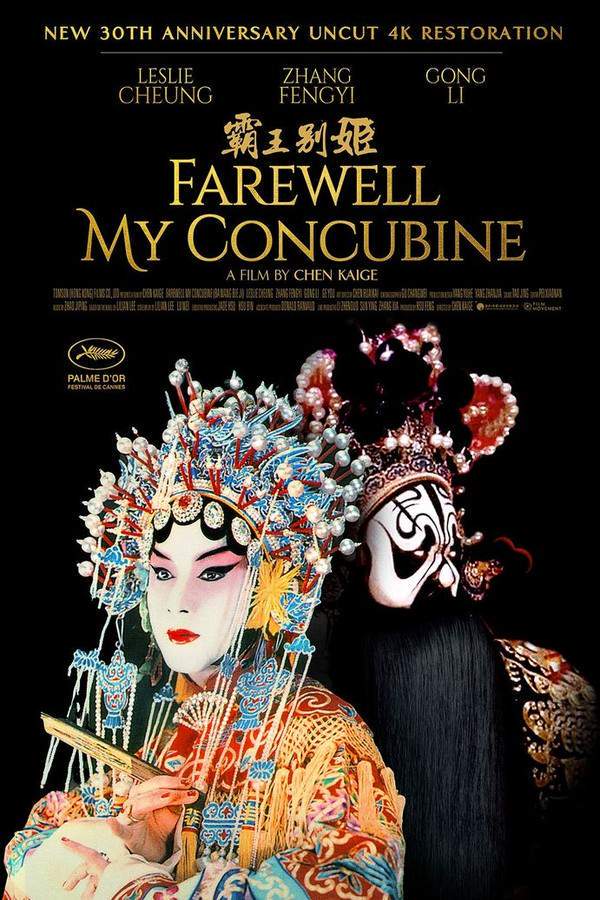
Farewell My Concubine (1993) movie poster

Timeline

Farewell My Concubine (1993) Timeline Explained – Every Event in Order

Release, runtime and language
1993 · 171 min · Chinese
JustWatch #4,258 43
Directed by
Kaige Chen
Starring
Li Gong, Fengyi Zhang, You Ge, Leslie Cheung, Da Ying, Di Tong

Within Beijing's Opera House, two young performers, Dieyun and Xiaolou, forge a passionate and complex relationship as they navigate the world of traditional Chinese theatre. Their lives become entangled with the dramatic events of twentieth-century China, including the Japanese invasion and the subsequent Cultural Revolution. The film explores themes of love, loyalty, and the struggle to preserve artistic integrity amidst political upheaval, portraying a poignant and sweeping portrait of a nation in turmoil.

On this page (7)
  1. 1 Where to watch
  2. 2 Events in order (15)
  3. 3 Timeline questions answered
  4. 4 The book behind the movie
  5. 5 Movie threads
  6. 6 Movies like Farewell My Concubine
  7. 7 Every angle

Where to watch

Where to Watch Farewell My Concubine (1993)

Where can you watch Farewell My Concubine? Stream, rent or buy it in the US, including on Film Movement Plus, Hoopla and MUBI: current JustWatch availability with up-to-date prices.

Streaming availability powered by JustWatch

15 events in order · contains spoilers

Farewell My Concubine Timeline: Events in Chronological Order

Every key event of Farewell My Concubine (1993) in order, scene by scene, with when and where it takes place. Use it to untangle flashbacks, time jumps and parallel storylines, to refresh your memory before the sequel or to find the exact scene you are thinking of.

  1. Douzi's Abandonment

    Douzi, a young boy, is abandoned by his mother who turns to a life of prostitution. This tragic event sets the stage for his search for belonging and comfort in a harsh world.

  2. Joining the Peking Opera Troupe

    Seeking solace, Douzi finds refuge in an all-boys Peking opera troupe led by Master Guan. Here, he begins to form relationships and explore his passion for performance.

    Where
    Peking Opera Troupe
  3. Friendship with Shitou

    Within the troupe, Douzi develops a close friendship with Shitou, who becomes his confidant and supporter. Their bond deepens as they endure the challenges of the demanding world of Peking opera together.

  4. The Rehearsal Incident

    During a rehearsal for _Dreaming of the World Outside the Nunnery_, Douzi mistakenly asserts, 'I am by nature a boy, not a girl.' This blunder leads to severe punishment, highlighting the strict expectations of the troupe.

  5. Attempted Escape

    Traumatized by the punishment, Douzi and Laizi attempt to escape the harsh realities of their environment. However, Douzi is drawn back into the world of performance when he witnesses a captivating act.

  6. Return to the Troupe

    Douzi's renewed passion for acting leads him back to the troupe after his brief attempt at freedom. His return does not go unnoticed, and he faces brutal consequences for his earlier defiance.

  7. Laizi's Tragic Death

    The harsh realities of life in the troupe culminate in the tragic death of Laizi, a devastating event that underscores the dangers faced by those who challenge expectations in their art.

  8. An Agent's Visit

    An agent arrives at the troupe, seeking new talent. Douzi, amidst his earlier mistakes, seizes the opportunity and, with encouragement from Shitou, delivers a passionate performance that captures the agent's attention.

  9. Performance for Eunuch Zhang

    The troupe receives an invitation to perform for the illustrious eunuch Zhang. Following the performance, Zhang gifts them an ornate sword, symbolizing both admiration and the complex ties within their world.

    Where
    Zhang's estate
  10. Zhang's Unsettling Invitation

    Douzi's life takes a dark turn when Zhang invites him for a private meeting, leading to a distressing incident of sexual assault. Although Douzi remains silent, his internal turmoil grows evident to Shitou.

    Where
    Zhang's estate
  11. Douzi's Compassion

    In a moment of vulnerability, Douzi finds solace in caring for an abandoned infant. This act of kindness intertwines their fates as this child later becomes a disciple of Master Guan.

  12. Rise to Stardom

    As years pass, Douzi and Shitou emerge as celebrated stars of the Peking opera, adopting the stage names Cheng Dieyi and Duan Xiaolou. Their performance in _Farewell My Concubine_ defines their careers and cements their legacy.

  13. Complex Love Triangles

    Amidst their fame, an unrequited love develops between Dieyi and Xiaolou, further complicated when Xiaolou marries Juxian. This jealousy and tension begin to fracture their once deep relationships.

  14. Xiao Si's Rising Resentment

    Taking on the role of Dieyi's apprentice, Xiao Si grows embittered by Dieyi's demanding nature. His resentment culminates in his usurpation of Dieyi's role in _Farewell My Concubine_, leading to conflict and heartbreak.

  15. Tragic Resolution

    As the Cultural Revolution escalates, tensions within the troupe culminate in accusations and personal turmoil. In a final act of desperation, Xiaolou's betrayal leads to Juxian's suicide, marking an irrevocable end to their shared dreams.

Last updated: November 18, 2024 at 20:32

Was this helpful?

Timeline questions answered

Farewell My Concubine Timeline Explained: Your Questions Answered

When does it happen, and why in that order? The questions people ask about the chronology of Farewell My Concubine (1993): time jumps, flashbacks, cause and effect between scenes and the correct order of events, each answered with spoilers.

Q1

Why does Dieyi kill himself at the end of the movie?

Dieyi commits suicide by stabbing himself with Xiaolou's sword during their 1977 rehearsal of Farewell My Concubine. This act represents the culmination of his lifelong emotional suffering, his unrequited love for Xiaolou, the trauma of his childhood assault by Zhang, his opium addiction, and the betrayal he experienced during the Cultural Revolution. When Xiaolou reversed their childhood lines and said 'I am by nature a boy' while Dieyi responded 'I am not a girl,' it echoed their original traumatic moment and the reversal of their once-close bond, breaking Dieyi emotionally.

Foreshadowing: Earlier, Dieyi performs the tragic concubine who kills herself with a sword, foreshadowing his own end.

  • dieyi suicide
  • ending explained
  • concubine death
  • farewell my concubine ending
Q2

Why does Xiaolou betray Dieyi during the Cultural Revolution?

During the Cultural Revolution, Xiaolou betrays Dieyi under extreme pressure from the Red Guards. To protect himself and survive the punitive sessions, Xiaolou accuses Dieyi of various crimes. This betrayal is not ideological but rather a desperate act of self-preservation in an era where anyone could be targeted. The political chaos forces old friends to turn against each other to demonstrate loyalty to the new order, ultimately destroying their decades-long friendship.

Foreshadowing: Their earlier tensions over Juxian and Dieyi's opium addiction already strained their relationship, making the betrayal more plausible.

  • cultural revolution
  • betrayal
  • xiaolou accuses dieyi
  • red guards
Q3

What happens to Douzi when Zhang invites him privately?

When the eunuch Zhang invites young Douzi for a private visit after their performance, Zhang sexually assaults Douzi. This traumatic event occurs off-screen, but its impact is felt throughout the rest of Dieyi's life. Douzi never speaks of it, yet Shitou clearly perceives the profound trauma it causes. This assault represents the vulnerability of young performers and adds to Dieyi's deep emotional wounds that shape his character.

Foreshadowing: Zhang's gift of the sword earlier establishes his interest in the boys, hinting at his inappropriate intentions.

  • zhang
  • assault
  • douzi
  • eunuch
  • sexual abuse
Q4

Why does Dieyi love Xiaolou throughout his life?

Dieyi's love for Xiaolou develops from their shared childhood trauma and artistic bond. They grew up together in the Peking opera troupe, enduring harsh training, punishment, and isolation together. The famous line 'I am by nature a boy, not a girl' that Douzi mistakenly declares becomes a defining moment linking their fates. As they perform together as Cheng Dieyi and Duan Xiaolou, the boundary between performance and reality blurs, and Dieyi's emotional dependence on Xiaolou becomes the central tragedy of his life.

Foreshadowing: Their childhood friendship and mutual reliance during the punishing opera training plants the seeds of Dieyi's devotion.

  • dieyi loves xiaolou
  • unrequited love
  • cheng dieyi
  • duan xiaolou
Q5

Why does Juxian kill herself?

Juxian commits suicide after Xiaolou publicly denies loving her during the Cultural Revolution's struggle sessions. To save himself from further persecution, Xiaolou declares he no longer loves Juxian, betraying both her and their marriage. Devastated by this betrayal and the political persecution she faces, Juxian returns the sword to Dieyi and takes her own life. Her death underscores how the Cultural Revolution destroys not only artistic traditions but also personal relationships and human dignity.

Foreshadowing: Earlier tension in their marriage and Juxian's status as a courtesan already established her vulnerable position.

  • juxian suicide
  • cultural revolution
  • xiaolou betrays wife
  • sword returned
Q6

What is the significance of the sword in the movie?

The sword first appears as a gift from eunuch Zhang to the troupe, symbolizing heroic traditions. Shitou promises to give it to Douzi someday, linking it to romantic heroism. Later, patron Yuan Shiqing gives Dieyi the same sword, cementing its importance. The sword ultimately becomes the instrument of Dieyi's suicide, mirroring the tragic death of Consort Yu in Farewell My Concubine. It represents the intertwining of art and life, loyalty and betrayal, and the fatal romantic heroism Dieyi has always idealized.

Foreshadowing: The sword is first mentioned in connection with Zhang, linking it to the traumatic assault scene.

  • sword
  • symbolism
  • heroism
  • cons ort yu
  • dying scene
Q7

Why does Xiao Si turn against Dieyi and steal his role?

Xiao Si, the abandoned infant whom Dieyi takes in and trains, betrays Dieyi by secretly learning the lead role of Farewell My Concubine and performing it without permission. This usurpation happens during a period when Dieyi is struggling with opium addiction. Xiao Si's resentment stems from Dieyi's demanding teaching methods and his own ambition to succeed. By taking the role during the Cultural Revolution's chaos, Xiao Si abandons his master, representing the generational betrayal that mirrors the political betrayals occurring around them.

Foreshadowing: Master Guan's earlier death and Xiao Si's growing resentment over difficult training foreshadow his betrayal.

  • xiao si
  • apprentice betrayal
  • steals role
  • opera succession
Q8

What does the final scene's reversed dialogue mean?

During their 1977 rehearsal, Xiaolou says 'I am by nature a boy' while Dieyi responds 'I am not a girl', reversing the original traumatic line from their childhood. This reversal signifies how their relationship has fundamentally changed. The childhood moment originally showed Douzi's confusion about gender identity under pressure; now, decades later, the reversed lines acknowledge their shared trauma, their damaged bond, and the impossibility of returning to their past selves. It sets up the tragic ending where Dieyi uses the sword.

Foreshadowing: This directly echoes the rehearsal incident from their childhood that caused severe punishment.

  • final scene
  • reversed lines
  • boy not girl
  • rehearsal
  • 1977
Q9

Why does Dieyi become addicted to opium?

Dieyi turns to opium as an escape from his emotional pain, the trauma of his childhood assault, his unrequited love for Xiaolou, and the pressures of fame. His addiction intensifies after he becomes a star and loses his sense of purpose. Xiaolou and Juxian eventually help him recover, showing the complex but ultimately caring relationship they maintain despite love triangles and conflicts. The opium subplot illustrates how the characters use various means to cope with life's hardships.

Foreshadowing: Dieyi's emotional struggles and isolation following the assault and his unrequited love plant the seeds for his addiction.

  • opium
  • addiction
  • dieyi
  • recovery
  • xiaolou helps
Q10

Why is Laizi's death significant to the story?

Laizi dies after attempting to escape the troupe with Douzi. When Douzi returns to the opera after being inspired by a performance, Laizi remains and faces the harsh consequences. His tragic death underscores the brutal realities of the Peking opera troupe's discipline and the fatal consequences of defying its rules. It also marks Douzi's permanent commitment to the troupe and serves as an early example of how the system destroys those who resist it.

Foreshadowing: The severe punishment Douzi receives after the rehearsal incident establishes the troupe's ruthlessness.

  • laizi death
  • escape
  • punishment
  • troupe rules
  • childhood trauma
Q11

How does the Cultural Revolution affect the opera troupe?

The Cultural Revolution devastates the opera troupe through public denunciations, forced confessions, and the suppression of traditional Peking opera as feudal remnants. During struggle sessions led by Red Guards, Dieyi and Xiaolou are forced to accuse each other, destroying their friendship. Traditional works like Farewell My Concubine are banned as feudal poison. The revolution destroys not just performances but the entire social fabric of the troupe, illustrating how political movements can obliterate artistic traditions and personal bonds.

Foreshadowing: The communists' victory in the civil war earlier brings political changes that begin affecting the characters' lives.

  • cultural revolution
  • opera banned
  • red guards
  • political persecution
  • traditional art
Q12

Why is the line 'I am by nature a boy, not a girl' so important?

During rehearsal of Dreaming of the World Outside the Nunnery, young Douzi mistakenly says 'I am by nature a boy, not a girl' instead of the correct 'I am by nature a girl, not a boy.' This blunder leads to brutal punishment from Master Guan, as the troupe demands absolute commitment to their assigned roles. This moment establishes themes of identity, performance versus reality, and the harsh training of Peking opera. It also becomes a defining trauma that echoes throughout the film, culminating in the final scene's reversal.

Foreshadowing: This is the original traumatic moment that the ending reverses.

  • boy not girl line
  • dreaming nunnery
  • rehearsal
  • gender identity
  • dan role
Q13

Who is Juxian and why does she matter?

Juxian is a courtesan who marries Xiaolou, creating a love triangle with Dieyi who secretly loves Xiaolou. She represents both independence and vulnerability in a male-dominated world. Her marriage to Xiaolou directly impacts her relationship with Dieyi, fueling his jealousy and emotional pain. During the Cultural Revolution, her courtesan background makes her a target, and Xiaolou's denial of their love leads to her tragic suicide. She matters because her presence catalyzes the emotional conflict between the three central characters.

Foreshadowing: Dieyi's unrequited love for Xiaolou creates immediate tension when Xiaolou brings Juxian into their lives.

  • juxian
  • courtesan
  • marriage
  • love triangle
  • xiaolou wife
Q14

How do the historical events shape the characters' lives?

The film spans fifty years of Chinese history, from the Qing Dynasty's decline through the Japanese invasion, the Chinese Civil War, and the Cultural Revolution. Each period directly impacts the characters: the Japanese era brings fame through performing for elites; the civil war leads to political changes; the Communist victory brings the Cultural Revolution's destruction. These historical upheavals force characters to make impossible choices, betray friends, abandon art, or sacrifice personal happiness, showing how individual lives are shaped by political forces beyond their control.

Foreshadowing: The troupe's performance for the eunuch during the Qing era establishes the historical context.

  • japanese invasion
  • chinese civil war
  • cultural revolution
  • 50 years
  • historical context

Movie threads

More Movies Like Farewell My Concubine, by Mood & Story

Curated lists built around what makes Farewell My Concubine tick: the same mood, the same kind of story or the same emotional payoff. Each list explains why these movies belong together.

Epic Historical Dramas of Artistic Integrity like Farewell My Concubine

Sweeping tales of individuals striving to preserve their art amidst political and social upheaval. If you were captivated by the scope and sorrow of Farewell My Concubine, explore more movies like it. This collection features similar historical dramas where artists struggle to maintain their craft through decades of political turmoil, offering stories of unrequited love, heavy emotional weight, and tragic beauty.

  • sweeping
  • tragic
  • somber
  • nostalgic
  • oppressive
  • longing
  • Tone: melancholic, tragic
  • Pacing: steady, epic
Why these movies?

The story pattern: These narratives often span decades, using a linear, steady pace to chronicle how major historical events—wars, revolutions, cultural shifts—erode the lives and passions of central characters. The plot revolves around the tension between unwavering artistic devotion and the brutal demands of a changing world, typically leading to a sense of profound loss.

Why they belong together: Movies are grouped here for their shared focus on the artist's struggle, their epic chronological scope, and the heavy emotional impact of watching personal dreams crushed by historical forces. They share a melancholic tone, high intensity, and a tragic ending feel.

Movies about Tragic Bonds Spanning Decades like Farewell My Concubine

Intense, life-long relationships defined by unrequited love and inevitable tragedy. For viewers who loved the poignant, decades-spanning relationship in Farewell My Concubine, this list finds similar movies about intense friendships and loves that are strained by time and tragedy. Discover stories with heavy emotional weight, steady pacing, and a profoundly sad ending feel.

  • tragic
  • longing
  • somber
  • melancholic
  • intense
  • heartbreaking
  • Tone: somber, longing
  • Pacing: steady, character-driven
Why these movies?

The story pattern: The narrative structure follows a central duo or trio from childhood or youth into old age, using their relationship as a lens to examine broader themes of memory, sacrifice, and identity. The story is driven by the tension between deep, abiding connection and the forces—both personal and societal—that prevent its fulfillment, leading to a cathartic but heartbreaking resolution.

Why they belong together: These films are united by their focus on a single, doomed relationship as the emotional core of the story. They share a heavy emotional weight, a melancholic and somber mood, and a narrative that prioritizes character depth over plot twists, resulting in a similarly powerful and tragic viewing experience.

If you liked this

Movies Like Farewell My Concubine

Similar movies to Farewell My Concubine: the same genre, themes or kind of story. Each one comes with its own plot summary, timeline and ending explained.

Browse all movie summaries

Every angle

Farewell My Concubine (1993) Explained: Plot, Timeline & Characters

Everything about Farewell My Concubine in one place: what happens in the plot summary, the timeline in chronological order, the characters and meaning and a spoiler-free summary. What's After the Movie adds the cast, box office and post-credit scenes.

Coming soon on iOS and Android

The Plot Explained Movie Summary App

Plot summaries, endings explained and timelines on your phone. Catch up on any movie in minutes, save your favorites and never miss a twist again.

Be the first to know when we launch. Your email stays private, always.

Learn more about the app