Plot Explained Spoilers guaranteed!
Plot Explained

Browse by genre

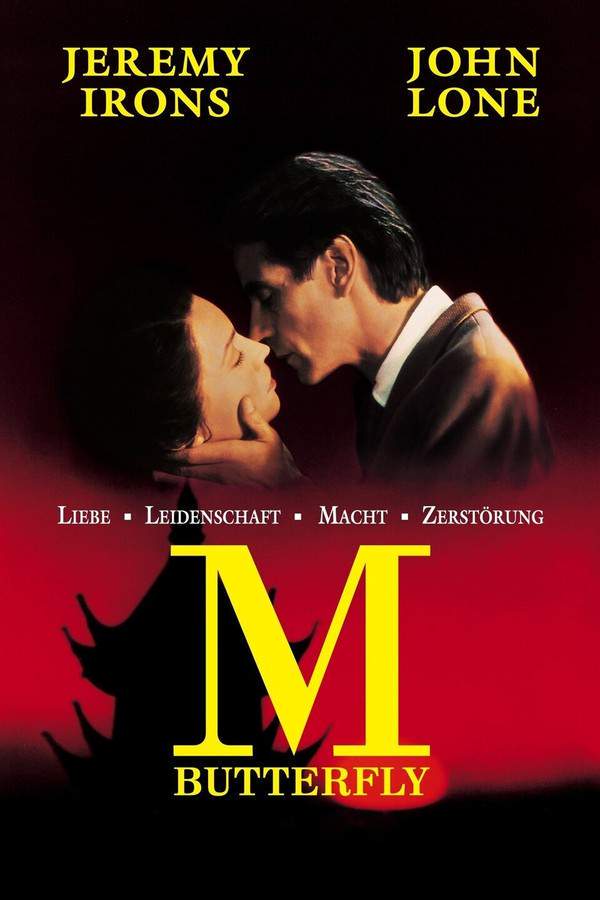
M. Butterfly (1993) movie poster

Plot Summary

M. Butterfly (1993) Plot Summary Explained

Release, runtime and language
1993 · 101 min · English
Directed by
David Cronenberg
Starring
Jeremy Irons, John Lone

In 1980s Beijing, French diplomat René Gallimard becomes captivated by the alluring opera singer Song Liling. Their passionate affair unfolds against a backdrop of political intrigue, challenging Gallimard’s understanding of love, identity, and reality. As their relationship deepens, a startling revelation shatters his perceptions and exposes a complex web of deception and hidden truths.

On this page (7)
  1. 1 Where to watch
  2. 2 What happens: full plot
  3. 3 Plot questions answered
  4. 4 The book behind the movie
  5. 5 Movie threads
  6. 6 Movies like M. Butterfly
  7. 7 Every angle

Where to watch

Where to Watch M. Butterfly (1993)

Where can you watch M. Butterfly? Stream, rent or buy it in the US, including on Amazon Video, Apple TV Store and Fandango At Home: current JustWatch availability with up-to-date prices.

Streaming availability powered by JustWatch

Full plot summary · contains spoilers

What Happens in M. Butterfly: Full Plot Summary

The whole story of M. Butterfly (1993) explained, from the opening scene to the final frame: every key event, every twist and what it all adds up to. Read it as a quick recap before the sequel, to check a scene you missed, or to finally understand what really happened.

In 1964, Beijing, during a time of political transformation, Rene Gallimard, a reserved accountant at the French embassy, is utterly mesmerized by the performance of opera diva Song Liling in a rendition from Madame Butterfly. After the show, he expresses to his wife, Jeanne, his newfound appreciation for the heartbreaking narrative, only to be met with scorn. Jeanne criticizes his romanticized view of the submissive Oriental woman, remarking that "the Chinese can't stand Madame Butterfly because 'the white man gets the girl.'"

Three weeks later, mustering newfound courage, Rene returns to the opera, where he encounters Song backstage. Their initial conversation ignites a spark, yet he feels compelled to conceal the truth from Jeanne, creating an emotional rift. Soon after, he visits Song in her parlor, a gesture deemed risky in a historically conservative society. When Rene attempts to kiss her, she reacts coolly and asks him to leave. Despite the turmoil, communication continues, but Song's letters go unanswered by Rene.

Noticing Rene's shift in demeanor, Ambassador Toulon comments on his transformation, stating, "you've become this new, aggressive, overconfident thing." As a result, Rene is appointed Vice Consul, tasked with establishing an intelligence-gathering operation amidst the Cultural Revolution. Driven by passion, he confronts Song, and she shyly confesses, “I am your butterfly,” albeit maintaining her modesty during their intimate moments.

As their secret relationship flourishes, Rene expresses his views on the Vietnam conflict, asserting, as he tells the ambassador, that "the Oriental will always bow to a superior force." However, Song, unbeknownst to him, is a double agent, feeding misinformation to Comrade Chin, who occurs upon American magazines in her home. Despite this deception, Rene's romantic entanglements deepen during one of Frau Bauden’s soirées, where their affair reaches new heights.

When Song reveals her pregnancy, she plans to return to her village, promising to bring back a son, which fills Rene with joy. Yet, behind this façade, she confides to Chin about needing a blonde-haired baby as part of her cover.

Months later, witnessing the rise of the Red Guards, Rene’s world unravels. The art community he belongs to faces peril as Song brings their "son" to him. However, their dreams shatter when Red Guards apprehend her. Laid off from his diplomatic position for misjudging the Chinese and Vietnamese political landscapes, Rene faces an imminent deportation. In a striking scene, he finds Song’s courtyard filled with peasants while witnessing her forced entry into a re-education camp, a painful reminder of the harsher realities of political discord.

Fast forward to 1968 Paris, Rene watches Madame Butterfly again, tears streaming as he is engulfed by memories. Outside, chaos unfolds with pro-Communist students battling police during the riots. Rene, now living a simpler life as a motorcycle courier, unexpectedly reunites with Song. Yet, their joy is short-lived as Rene soon finds himself arrested for espionage, accused of leaking sensitive documents.

During the dramatic trial proceedings, Rene is confronted by Song, who presents as a man, clad in a suit and tie, a jaw-dropping revelation for everyone present. As she recounts how he facilitated access to diplomatic pouches for the sake of their son, the courtroom gasps. Addressing the prosecutor, Song discusses his "Oriental ways of love," saying, "Out of which I invented myself, just for him."

In a heartrending exchange within a police van, Song strips away the illusions, reminding Rene that he has not changed. Devastated by the truth of Song's identity and the entire relationship being built on deception, Rene rejects him.

Eventually, in prison, Rene takes the stage for an emotional monologue, sharing his tragic tale of love with a man he believed to be a woman, prompting laughter amidst a misjudged political saga. As Song boards a plane back to China, Rene plays an audio tape of Madame Butterfly, paralleling his fate with that of the opera's tragic heroine. Clad in Oriental attire and makeup, he portrays the ultimate tragic figure, and in front of the assembly of inmates and guards, he kneels and takes his own life by slit his throat, becoming a haunting symbol of sacrifice, love, and betrayal.

Last updated: October 27, 2024 at 22:34

Was this helpful?

Plot questions answered

M. Butterfly Plot Explained: Your Questions Answered

The questions people ask most about M. Butterfly (1993): what happens in the confusing scenes, why the characters do what they do, the twists, hidden details and what the ending means. Each answer contains spoilers.

Q1

How was Song Liling able to deceive René for so long?

Song maintained the deception by carefully performing the role of a submissive, traditional Chinese woman. The cultural context of 1960s Beijing allowed minimal physical intimacy, and Song used the conservative social norms as cover, always maintaining modesty during their encounters. Additionally, René was so infatuated with his fantasy of the 'Oriental woman' from Madame Butterfly that he refused to see the truth, choosing to believe in the illusion he had created.

Foreshadowing: Earlier, Jeanne warns René that his romanticized view of the submissive Oriental woman is unrealistic, hinting at his predisposition to self-deception.

  • song ling ling deception
  • how René was fooled
  • butterfly illusion
Q2

Was Song actually pregnant?

No, Song's pregnancy was fabricated as part of her espionage cover. When she announced her pregnancy and promised to return with a son, she secretly told Comrade Chin that she needed a blonde-haired baby to maintain her cover identity. The child René was shown was never his biological child.

  • pregnancy lie
  • song baby
  • fake pregnancy
Q3

What caused René's transformation from a shy accountant to Vice Consul?

Ambassador Toulon observed René's changed demeanor after his obsession with Song began, noting he had become 'this new, aggressive, overconfident thing.' This transformation, driven by René's romantic confidence gained from his affair, led to his appointment as Vice Consul. The position gave him access to diplomatic pouches, which Song exploited for her intelligence operations.

Foreshadowing: Toulon's observation of René's new confidence directly precedes his promotion.

  • rené promotion
  • vice consul appointment
  • ambassador toulon
Q4

Why did Song become a double agent for China?

Song was recruited by Comrade Chin to gather intelligence for China during the political turmoil of the Cultural Revolution. She fed misinformation to Chinese officials while using her relationship with René to access diplomatic secrets. At trial, Song explained she 'invented herself' as a woman specifically to seduce René, using his cultural fantasies as a tool for espionage.

Foreshadowing: Earlier, Song is shown passing American magazines to Comrade Chin, revealing her dual role.

  • song espionage
  • chinese spy
  • comrade chin
Q5

Why did René commit suicide in prison?

René was devastated by the revelation that his entire relationship was based on deception, that Song was a man and the pregnancy was fake. The realization that he had been the victim of an elaborate espionage operation, combined with his shattered understanding of love and identity, led him to recreate the tragic fate of Madame Butterfly. He dressed in Oriental attire, played the opera's music, and slit his throat in front of the prison assembly.

Foreshadowing: The film parallels René's story with Madame Butterfly throughout, with René watching the opera and crying before his reunion with Song.

  • rené death
  • suicide ending
  • butterfly parallel
Q6

How did René become involved in espionage?

René inadvertently facilitated espionage by allowing Song access to French diplomatic pouches. Song used her romantic relationship with René to obtain sensitive documents, which she passed to Chinese authorities through Comrade Chin. When René was arrested, Song testified against him, revealing that he had been unknowingly leaking documents for the sake of their supposed son.

Foreshadowing: Song's double agent role is revealed earlier when Comrade Chin finds American magazines in her home.

  • espionage arrest
  • leaking documents
  • french diplomat spy
Q7

How was Song's true gender revealed?

At René's trial in 1968 Paris, Song appeared in court dressed as a man, wearing a suit and tie, shocking everyone present. This was the first public revelation that Song Liling was actually a male spy named René had been romantically involved with a man throughout their entire affair. The revelation recontextualized their entire relationship.

  • song is a man
  • gender twist
  • revelation trial
Q8

Why didn't René realize Song was a man sooner?

René was blinded by his romantic obsession with the fantasy of the 'submissive Oriental woman' from Madame Butterfly. He projected his idealized vision onto Song and refused to question the inconsistencies. The conservative social constraints of 1960s Beijing also limited physical intimacy, and Song carefully maintained modesty, claiming it was due to traditional Chinese values. René's desire to believe in his fantasy was stronger than his ability to see the truth.

Foreshadowing: Jeanne's early criticism of René's romanticized view foreshadows his willful blindness.

  • rené denial
  • self deception
  • fantasy vs reality
Q9

What happened to Song after being taken to the re-education camp?

Song was apprehended by Red Guards and taken to a re-education camp during the Cultural Revolution. The film shows her being forcibly taken away while René watches from her courtyard filled with peasants. Later, in 1968, Song is seen returning to Paris before ultimately boarding a plane back to China, having survived the camp.

  • red guards
  • re education camp
  • cultural revolution
Q10

What is the significance of Madame Butterfly in the story?

Madame Butterfly serves as the central metaphor for René and Song's relationship. The opera tells the story of Cio-Cio-San, a Japanese woman who commits suicide when abandoned by her American husband. René identifies with the male protagonist who 'gets the girl,' while seeing himself as the tragic heroine. At the end, René literally performs this tragic role, dressing as Cio-Cio-San and killing himself, completing the parallel and making the opera the key to understanding his fate.

Foreshadowing: René's obsession with the opera begins in 1964 when he first sees Song perform it.

  • opera parallel
  • cio-cio-san
  • tragic heroine metaphor
Q11

Why did Song maintain the romantic relationship with René?

Song was using the relationship as cover for her espionage activities. She explained at trial that she 'invented herself' as a woman 'just for him', creating the persona of the submissive Oriental butterfly to seduce René and gain access to diplomatic information. The relationship was a strategic operation, though Song's emotional involvement remains ambiguous and adds complexity to the betrayal.

Foreshadowing: Song's dual role as both lover and spy is established early through her communications with Comrade Chin.

  • song motives
  • using romance
  • spy relationship

Movie threads

More Movies Like M. Butterfly, by Mood & Story

Curated lists built around what makes M. Butterfly tick: the same mood, the same kind of story or the same emotional payoff. Each list explains why these movies belong together.

Movies about identity deception and tragic revelations like M. Butterfly

Stories where a profound relationship is built on a devastating lie. If you were captivated by the shocking twists and emotional turmoil of M. Butterfly, this collection features movies like it that center on tragic deceptions of identity. Discover similar complex dramas where a central relationship is built on an illusion, leading to a shattering truth and a heavy, often bleak, emotional conclusion.

  • deceptive
  • tragic
  • shattering
  • psychological
  • betrayal
  • illusions
  • Tone: melancholic, tense, tragic
  • Pacing: steady, deliberate
Why these movies?

The story pattern: The narrative typically follows a protagonist who becomes deeply involved with an enigmatic figure. As their connection deepens, the audience may sense unease, but the full scale of the deception is withheld. The story culminates in a powerful twist that recontextualizes everything, leaving the protagonist's identity and worldview shattered, often with tragic consequences.

Why they belong together: These films are grouped for their shared focus on the theme of deception as a destructive force. They deliver a heavy emotional experience defined by a slow-burn tension, a melancholic tone, and a complex exploration of how illusions can define and ultimately destroy a person.

Melancholic cross-cultural romance dramas with political tension like M. Butterfly

Passionate affairs doomed by political and cultural divides. For viewers who appreciated the blend of tragic romance and political intrigue in M. Butterfly, this section highlights similar movies. Find other heavy dramas featuring doomed love affairs set against a backdrop of cultural misunderstanding and high-stakes political espionage, all leading to a bittersweet or bleak conclusion.

  • tragic romance
  • political
  • melancholic
  • cross-cultural
  • doomed
  • introspective
  • Tone: melancholic, romantic, bleak
  • Pacing: steady, character-driven
Why these movies?

The story pattern: These stories often begin with a seemingly transcendent connection that bridges cultural gaps. However, the weight of political realities, espionage, or deep-seated societal prejudices creates an insurmountable pressure. The romance becomes a casualty of these larger forces, resulting in a melancholic journey of loss and introspection.

Why they belong together: The grouping is based on a potent mix of a heavy romantic core, a politically charged setting, and a consistently melancholic tone. They share a steady pacing that allows the tragedy to unfold deliberately, creating a complex and emotionally resonant experience centered on the collision of personal desire and impersonal power.

If you liked this

Movies Like M. Butterfly

Similar movies to M. Butterfly: the same genre, themes or kind of story. Each one comes with its own plot summary, timeline and ending explained.

Browse all movie summaries

Every angle

M. Butterfly (1993) Explained: Plot, Timeline & Characters

Everything about M. Butterfly in one place: what happens in the plot summary, the timeline in chronological order, the characters and meaning and a spoiler-free summary. What's After the Movie adds the cast, box office and post-credit scenes.

Coming soon on iOS and Android

The Plot Explained Movie Summary App

Plot summaries, endings explained and timelines on your phone. Catch up on any movie in minutes, save your favorites and never miss a twist again.

Be the first to know when we launch. Your email stays private, always.

Learn more about the app