Plot Explained Spoilers guaranteed!
Plot Explained

Browse by genre

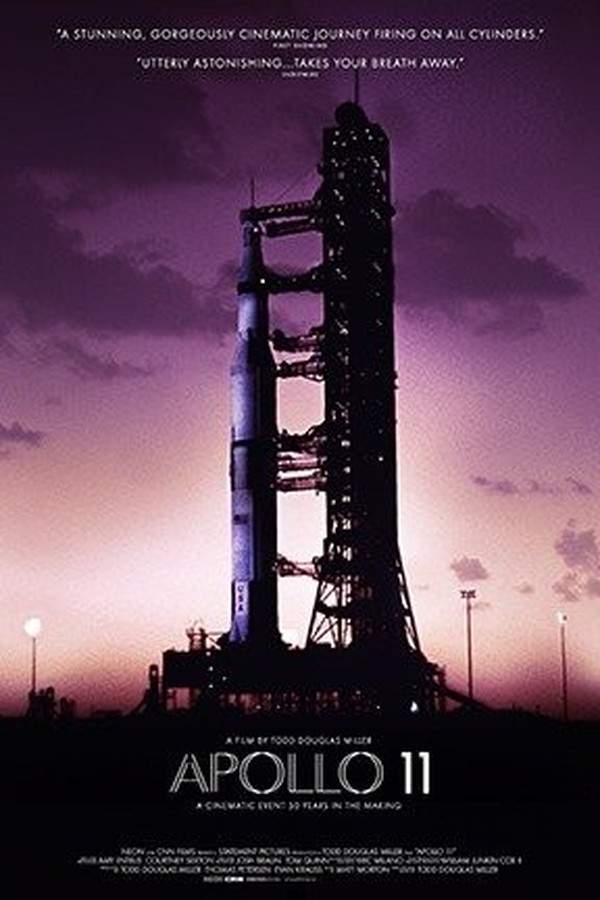
Apollo 11 (2019) movie poster

Timeline

Apollo 11 (2019) Timeline Explained – Every Event in Order

Release, runtime and language
2019 · 93 min · English
Echo score 89
Loading streaming availability…
Directed by
Todd Douglas Miller
Starring
Walter Cronkite, Johnny Carson, Buzz Aldrin, Charles Duke, Clifford E. Charlesworth, Jack Benny

Experience NASA's historic Apollo 11 mission, which landed humans on the moon. Through recently discovered 65mm footage and over 11,000 hours of audio recordings, witness the pivotal moments of 1969. The film offers a unique perspective, showcasing the journey through the eyes of astronauts Neil Armstrong and Buzz Aldrin, the dedicated team at Mission Control, and the millions of people who watched in amazement.

On this page (6)
  1. 1 Where to watch
  2. 2 Events in order (15)
  3. 3 Timeline questions answered
  4. 4 Movie threads
  5. 5 Movies like Apollo 11
  6. 6 Every angle
Loading streaming availability…

15 events in order · contains spoilers

Apollo 11 Timeline: Events in Chronological Order

Every key event of Apollo 11 (2019) in order, scene by scene, with when and where it takes place. Use it to untangle flashbacks, time jumps and parallel storylines, to refresh your memory before the sequel or to find the exact scene you are thinking of.

  1. Preparation for Launch

    The meticulous preparations for the Apollo 11 mission begin as the astronauts undergo the crucial process of getting suited up. Every detail of their mission is examined as teams work in the control center to ensure everything is in place for a successful launch.

    When
    July 1969
    Where
    NASA Kennedy Space Center
  2. Last-Minute Checks

    As the Apollo 11 and the Saturn V rocket make their way to the launchpad, last-minute checks are conducted to confirm the integrity of all systems. Technicians address a hydrogen pump leak, ensuring the safety and efficiency of the upcoming launch.

    When
    July 16, 1969, 3 hours before launch
    Where
    Control Center, Houston, Texas
  3. Rocket Launch

    On July 16, 1969, the Apollo 11 mission achieves liftoff as the Saturn V rocket successfully launches from the pad. The spacecraft generates an astounding 7.6 million pounds of thrust, signaling the beginning of this historic journey to the moon.

    When
    July 16, 1969
    Where
    NASA Kennedy Space Center
  4. Trans Lunar Injection

    Following the successful launch, Apollo 11 engages in its trans lunar injection maneuver, achieving a speed of 23000 MPH. Michael Collins executes a flawless extraction of the lunar module, setting the course for their moon landing.

    When
    July 16, 1969
    Where
    Space
  5. Unexpected Incident

    On the third day into the mission, while performing a routine shave, Michael Collins experiences an unexpected disconnection of his bio-receptors. Despite this minor setback, the crew continues onward, preparing for their critical moon landing.

    When
    July 19, 1969
    Where
    Apollo 11 Lunar Module
  6. Lunar Module Descent

    As the lunar module descends towards the moon's surface, it enters the powered descent phase with only three minutes of fuel remaining. Two alarming signals alert mission control, causing heightened tension as the team monitors the descent.

    When
    July 20, 1969
    Where
    Lunar Surface
  7. Landing on the Moon

    With just 16 seconds of fuel left, Neil Armstrong successfully lands the lunar module on the moon. He transmits the iconic message: 'The Eagle has landed,' marking a monumental moment in space exploration history.

    When
    July 20, 1969
    Where
    Moon
  8. First Steps on the Moon

    Neil Armstrong takes his historic first step onto the moon, famously declaring, 'That's one small step for man, one giant leap for mankind.' He collects crucial samples from the lunar surface as Buzz Aldrin joins him shortly after.

    When
    July 20, 1969
    Where
    Moon
  9. Scientific Experiments

    The astronauts engage in vital scientific experiments on the moon's surface. Buzz Aldrin collects a core tube sample and gathers approximately 20 pounds of lunar rocks, significantly contributing to our understanding of the moon.

    When
    July 20, 1969
    Where
    Moon
  10. Presidential Message

    In a historic moment, President Richard Nixon reaches out to Armstrong from the White House, stating, 'For one priceless moment, all the people on this Earth are truly one.' This highlights the unifying impact of the Apollo 11 mission.

    When
    July 20, 1969
    Where
    White House
  11. Lunar Module Ascent

    After successfully completing their lunar activities, the lunar module's ascent engine ignites, utilizing 5000 pounds of fuel to return to the command module. This critical phase marks the crew's return journey from the moon.

    When
    July 20, 1969
    Where
    Moon
  12. Reunion with Command Module

    The lunar module reunites with the command module, reinstating their identity as Apollo 11. The crew transitions back into the command module as they prepare for the trip back to Earth.

    When
    July 20, 1969
    Where
    Space
  13. Trans Earth Injection

    The command module initiates a burn for the Trans Earth injection trajectory, accelerating to an impressive speed of 5700 MPH. The crew begins their preparations for re-entry as they leave lunar orbit.

    When
    July 20, 1969
    Where
    Space
  14. Re-entry Process

    With 37 hours remaining until re-entry, the spacecraft begins its descent back to Earth. The crew encounters high speeds of 24000 MPH as they approach re-entry at an altitude of 75 miles.

    When
    July 24, 1969
    Where
    Earth's Atmosphere
  15. Successful Recovery

    The Apollo 11 capsule deploys its parachutes at an altitude of 10,500 feet, ensuring a safe landing in the ocean. The astronauts are recovered successfully and taken to a mobile quarantine facility to ensure their safety after the historic mission.

    When
    July 24, 1969
    Where
    Pacific Ocean, USS Hornet

Last updated: November 08, 2024 at 00:16

Was this helpful?

Timeline questions answered

Apollo 11 Timeline Explained: Your Questions Answered

When does it happen, and why in that order? The questions people ask about the chronology of Apollo 11 (2019): time jumps, flashbacks, cause and effect between scenes and the correct order of events, each answered with spoilers.

Q1

Why did Neil Armstrong land the lunar module with only 16 seconds of fuel remaining?

Armstrong took manual control of the lunar module when the computer was receiving too much data and showing error signals. He needed to find a safe landing spot away from boulders and craters, which took extra time and fuel. His decision to continue the descent rather than abort allowed him to land successfully, but it depleted the fuel to just 16 seconds worth. This moment represented the critical window where the mission could have been aborted if he had waited any longer.

Foreshadowing: The two alarming computer signals during descent had already indicated that the automated landing system was struggling, foreshadowing the need for manual intervention.

  • neil armstrong
  • 16 seconds fuel
  • moon landing
  • lunar module
  • manual control
Q2

What caused the two alarming signals during the lunar module's descent?

The computer onboard the lunar module was receiving more data than it could process, causing it to overload and trigger warning signals. The guidance computer was attempting to handle multiple tasks simultaneously, including navigation, altitude tracking, and throttle control. Despite these alarms, the computer continued functioning because it was designed to prioritize the most critical tasks, allowing Armstrong to complete the landing.

Foreshadowing: Earlier mission preparations showed the complexity of the computer systems in the control rooms, highlighting how technical challenges were expected throughout the mission.

  • computer overload
  • descent alarms
  • lunar module computer
  • warning signals
Q3

Why was the hydrogen pump leak addressed just three hours before launch?

The hydrogen pump was part of the fuel cell system that provided power to the spacecraft. A leak could have caused catastrophic failure during launch or in space, so it had to be repaired before the mission could proceed. The three technicians worked frantically to fix the leak, demonstrating how last-minute mechanical issues were a constant threat to the launch schedule. This repair was one of several final checks ensuring the rocket was safe to fly.

Foreshadowing: The montage of previous missions earlier in the film highlighted that technical problems were common in space exploration, setting up the tension around this last-minute fix.

  • hydrogen pump leak
  • launch prep
  • technical issue
  • saturn v
Q4

Why was Apollo 11 considered one of the most perilous missions at the time?

Apollo 11 was perilous because the astronauts would be stepping outside the secured environment of their capsule for the first time in history. They had to rely on their spacesuits and the lunar module's limited life support systems while exposed to the harsh vacuum of space. The mission also involved multiple critical burns and maneuvers where a single failure could have stranded them in space or caused them to crash. The low-fuel landing demonstrated how every decision carried life-or-death consequences.

Foreshadowing: The control rooms filled with massive computers represented the enormous technical complexity that could fail at any moment, building awareness of the risks involved.

  • apollo 11 risks
  • danger
  • space mission
  • life or death
Q5

Why did Michael Collins' bio-receptors disconnect during a routine shave?

During the third day of the mission, while performing a routine shave in zero gravity, Michael Collins accidentally knocked loose his bio-receptor pads that monitored his vital signs. These sensors were attached to his body to track heart rate, breathing, and other health metrics during the mission. The disconnection was a minor incident that did not affect his health or the mission's success, but it required the medical team on Earth to adjust their monitoring temporarily.

Foreshadowing: This incident occurred after the trans lunar injection had successfully set the course for the moon, highlighting that even routine activities posed challenges in space.

  • michael collins
  • bio-receptors
  • medical monitoring
  • space shave
Q6

How did the lunar module reunite with the command module after the moon landing?

After completing their lunar surface activities, Armstrong and Aldrin activated the ascent engine of the lunar module, which used 5,000 pounds of fuel to launch them off the moon's surface. They rendezvoused with the command module, where Michael Collins had been waiting in lunar orbit. The two spacecraft docked, allowing the crew to transfer back into the command module. They then ejected the lunar module over the moon's surface and initiated the trans earth injection burn to begin their return journey to Earth.

Foreshadowing: On day three, the crew had entered the lunar module to prepare for this separation, showing the careful planning that went into the reunion procedure.

  • lunar module
  • command module
  • docking
  • moon orbit
  • rendezvous
Q7

Why were the Apollo 11 astronauts placed in quarantine after returning to Earth?

NASA placed the astronauts in a mobile quarantine facility because scientists were uncertain whether lunar material could contain unknown pathogens or contaminants that might pose a threat to life on Earth. The quarantine lasted for several weeks and involved extensive testing to ensure the astronauts had not been exposed to any extraterrestrial microorganisms. This precaution was standard protocol until scientists could confirm the moon was sterile.

Foreshadowing: Radiation levels were meticulously monitored throughout the mission, showing that protecting Earth from space-based threats was a constant concern.

  • quarantine
  • moon germs
  • astronaut safety
  • pathogens
  • recovery
Q8

What was the trans lunar injection maneuver?

Trans lunar injection was the critical engine burn that pushed the Apollo spacecraft out of Earth orbit and onto a trajectory toward the moon. After launching from Earth, the spacecraft achieved a speed of 23,000 miles per hour during this maneuver. It involved separating from the Saturn V third stage while Michael Collins executed a flawless extraction of the lunar module from behind the rocket. This maneuver marked the point of no return, committing the crew to their lunar journey.

Foreshadowing: The Saturn V rocket generated 7.6 million pounds of thrust at launch, providing the initial velocity needed to eventually reach the speeds required for trans lunar injection.

  • trans lunar injection
  • moon trajectory
  • spacecraft speed
  • orbital maneuver
Q9

Why was the message 'The Eagle has landed' significant?

The phrase 'The Eagle has landed' was Neil Armstrong's announcement that the lunar module, named Eagle, had successfully touched down on the moon's surface. This message marked the culmination of President Kennedy's goal to land a man on the moon and return him safely before the end of the decade. The transmission was heard worldwide and signaled one of humanity's greatest technological achievements. The tension of the low-fuel descent made this moment particularly dramatic for everyone listening.

Foreshadowing: The powered descent had been proceeding with only three minutes of fuel remaining, creating intense anxiety at mission control about whether they would land at all.

  • the eagle has landed
  • armstrong quote
  • moon landing announcement
Q10

How did the spacecraft survive re-entry at 24,000 miles per hour?

The command module entered Earth's atmosphere at an altitude of 75 miles traveling at 24,000 miles per hour, creating intense heat from air compression around the spacecraft. The capsule's heat shield was designed to burn away and absorb this extreme heat, protecting the astronauts inside. Communication was lost at 62 miles altitude due to the ionized gas surrounding the spacecraft, a phenomenon called re-entry blackout. Parachutes deployed at 10,500 feet, slowing the capsule for a safe ocean landing where the USS Hornet was waiting for recovery.

Foreshadowing: The trans earth injection had accelerated the spacecraft to 5,700 MPH for the return journey, building up the velocity that made re-entry so intense.

  • re-entry
  • heat shield
  • parachutes
  • 24000 mph
  • atmosphere
Q11

Why was Apollo 11 the first mission to land humans on the moon?

Apollo 11 was the first successful moon landing because previous Apollo missions had been building toward this goal through orbital tests and practice approaches. NASA had conducted 21 manned spaceflights before Apollo 11 to develop the technology and procedures needed for lunar landing. The mission required precise coordination between the astronauts, the lunar module's guidance systems, and mission control. Only after years of development, testing, and earlier Apollo missions could NASA attempt this historic landing.

Foreshadowing: The film showed a montage of previous missions, including 21 manned spaceflights that led up to this landmark event, illustrating the incremental progress toward the moon landing.

  • first moon landing
  • apollo program
  • 1969
  • nasa history
Q12

Why did the astronauts collect lunar rocks and soil samples?

The astronauts collected approximately 20 pounds of lunar rocks and soil to bring back to Earth for scientific analysis. These samples allowed scientists to study the moon's composition, age, and geological history. Buzz Aldrin also collected a core tube sample from beneath the lunar surface to retrieve deeper geological material. Additionally, they erected a solar wind experiment to analyze particles from the sun that had accumulated on the moon's surface. These experiments provided data that could not be obtained from Earth without physically visiting the moon.

Foreshadowing: The mission description emphasized that this was a scientific endeavor, not just an achievement in exploration, showing that sample collection was always part of the plan.

  • lunar samples
  • moon rocks
  • scientific experiments
  • buzz aldrin

Movie threads

More Movies Like Apollo 11, by Mood & Story

Curated lists built around what makes Apollo 11 tick: the same mood, the same kind of story or the same emotional payoff. Each list explains why these movies belong together.

High-stakes historical missions like Apollo 11

Gripping, real-life stories of teams working under immense pressure to achieve the impossible. Discover movies like Apollo 11 that recount real-world, high-stakes missions. These films share a focus on meticulous procedure, teamwork under pressure, and the palpable tension of events where the stakes are immense. If you liked the methodical build-up and triumphant payoff of Apollo 11, you'll find similar documentaries and historical dramas here.

  • tense
  • methodical
  • historic
  • awe-inspiring
  • dramatic
  • triumphant
  • Tone: tense, hopeful, awe-inspiring
  • Pacing: steady, methodical build-up
Why these movies?

The story pattern: Narratives in this thread follow a linear, procedural structure, often culminating in a singular, high-risk objective. The tension is built through a steady pacing that emphasizes preparation, problem-solving, and the quiet, monumental moments where failure is not an option. The emotional journey moves from intense focus and anxiety to a profound sense of relief and triumph.

Why they belong together: Movies are grouped here because they share a unique combination: they are based on true events, they maintain a steady, methodical pace that builds tension, and they focus on the collective effort and technical precision required to overcome near-impossible odds. The shared mood is one of tense awe.

Awe-inspiring stories of scientific achievement like Apollo 11

Celebratory stories of monumental human endeavors that expand our understanding. Find more movies like Apollo 11 that celebrate monumental human achievements in science and exploration. These films share a grandiose, hopeful tone and aim to inspire awe in the viewer. If you enjoyed the triumphant feeling of watching a landmark event unfold in Apollo 11, explore these similar documentaries and dramas.

  • awe-inspiring
  • triumphant
  • grandiose
  • hopeful
  • historic
  • dramatic
  • Tone: hopeful, triumphant, grandiose
  • Pacing: steady, awe-building
Why these movies?

The story pattern: The narrative pattern revolves around a central, ambitious goal that seems almost unimaginable. The story unfolds by showcasing the scale of the challenge, the ingenuity required to solve problems, and the ultimate success that represents a leap forward for humanity. The emotional arc is consistently upward, moving from determined effort to magnificent triumph.

Why they belong together: These movies are grouped together because their primary emotional driver is awe. They share a hopeful, triumphant tone and focus on stories of discovery and innovation that have a positive, world-changing impact. The pacing is often steady to allow the magnitude of the achievement to sink in.

If you liked this

Movies Like Apollo 11

Similar movies to Apollo 11: the same genre, themes or kind of story. Each one comes with its own plot summary, timeline and ending explained.

Browse all movie summaries

Every angle

Apollo 11 (2019) Explained: Plot, Timeline & Characters

Everything about Apollo 11 in one place: what happens in the plot summary, the timeline in chronological order, the characters and meaning and a spoiler-free summary. What's After the Movie adds the cast, box office and post-credit scenes.

Coming soon on iOS and Android

The Plot Explained Movie Summary App

Plot summaries, endings explained and timelines on your phone. Catch up on any movie in minutes, save your favorites and never miss a twist again.

Be the first to know when we launch. Your email stays private, always.

Learn more about the app