Plot Explained Spoilers guaranteed!
Plot Explained

Browse by genre

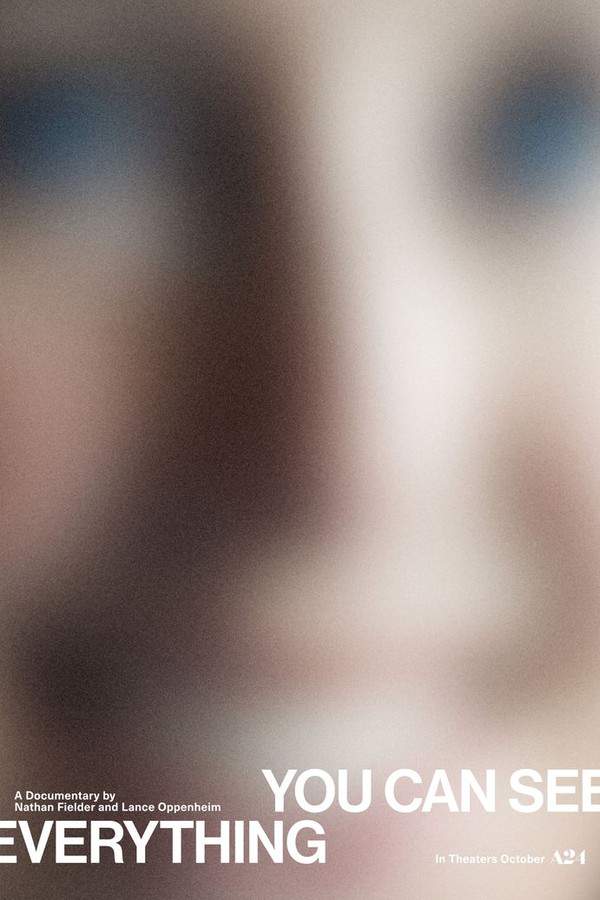
You Can See Everything (2026) movie poster

Plot Summary

You Can See Everything (2026) Plot Summary Explained

Release, runtime and language
2026 · 2 h 54 m · English
Echo score 95
Loading streaming availability…
Directed by
Lance Oppenheim
Starring
Elizabeth Holmes, Nathan Fielder, Billy Evans

Thirty-four days before a sentencing that will send her to prison, infamous Silicon Valley entrepreneur Elizabeth Holmes agrees to let a skeptical documentary crew follow her every move. What begins as an intimate portrait of the enigmatic founder expands into a mind‑bending three‑year journey into the abyss, documenting the unfolding events.

On this page (5)
  1. 1 Where to watch
  2. 2 What happens: full plot
  3. 3 Plot questions answered
  4. 4 Movie threads
  5. 5 Every angle
Loading streaming availability…

Full plot summary · contains spoilers

What Happens in You Can See Everything: Full Plot Summary

The whole story of You Can See Everything (2026) explained, from the opening scene to the final frame: every key event, every twist and what it all adds up to. Read it as a quick recap before the sequel, to check a scene you missed, or to finally understand what really happened.

The film starts in 2023 as Billy Evans, partner to Elizabeth Holmes, expresses to the documentary crew how the two of them want to tell an “accurate” version of her story. The opening text explains that there are 34 days leading up to Elizabeth’s eleven-year sentence for defrauding investors with her company Theranos. A crew led by Nathan Fielder have been given the chance over other reporters and journalists because the couple trusts he will help tell the story Elizabeth wants.

Nathan does his research on Elizabeth’s history, from her start at Stanford, to her infamous rise and fall alongside her former president/lover Sunny Balwani. Elizabeth and Billy have also expressed negative feelings towards the Hulu miniseries “The Dropout”, where she is portrayed by Amanda Seyfried. They are also fixated on a quote in the New York Times regarding Amanda’s portrayal, as well as a scrapped film that would have starred Jennifer Lawrence: “They’re not playing me. They’re playing a character I created.” Elizabeth claims she never said SHE created the character.

Nathan joins Elizabeth and Billy at their beach house in San Diego, which they share with their kids. Elizabeth claims she is being as open and honest as possible, though Nathan has his doubts, especially since she’s claimed to have never lied a day in her life. Nathan asks Billy about how he met her, which was around the time she was found guilty of fraud. Billy insists that he loves her despite all that he heard about her.

Elizabeth’s parents Christian and Noel visit the house and meet Nathan. He speaks to Christian privately and learns that things started to go downhill for Elizabeth when she was raped as a student. Billy interrupts the meeting and seems to get defensive about Elizabeth’s parents not being with the family.

Nathan shows Elizabeth and Billy most of “The Dropout”. When it gets to scenes depicting Elizabeth and Sunny, she gets emotional and wants to stop watching. When she talks privately with Nathan, Elizabeth expresses sadness about her upcoming sentence and being separated from Billy and their kids.

Elizabeth shows Nathan a deconstructed version of her “scam device” that she claimed could run hundreds of tests at once with a single drop of blood. She insists that it works as she said it does, but somewhere along the development process, something went wrong. She and Billy are also in the process of trying to get “Theranos 2.0” going.

In the days leading up to her incarceration, Elizabeth gets 3D scans of her body done, though she is not comfortable at the thought of her image being used. She bids Nathan farewell before heading to prison in Bryan, Texas. Billy and the kids move closer to be near her.

Two years later, Nathan shows the footage up to that point to none other than Amanda Seyfried herself. She becomes stunned at what she has seen, especially Elizabeth’s reaction to her performance. For all the remaining scenes prior to filming or wherever the crew could not film, Amanda reprises her role as Elizabeth in re-enactments, while Billy is portrayed by Christopher Abbott. A “flashback” is shown when Elizabeth and Billy first met with Nathan, co-director Lance Oppenheim, and two executives from A24. After Elizabeth had left the room, Billy asked about possibly being paid for their part in the film, but Nathan and the others argue that it would be unethical since it would look biased on their part. Regardless, they negotiate a deal.

Nathan and Amanda review a clip where he spoke to Elizabeth about how she implicitly knew nothing about Billy making any money deals behind her back. Furthermore, Nathan and Amanda find out that Billy is using Elizabeth’s social media account and saying things that she would not say (mainly swearing and insulting people).

Billy meets with Nathan and Amanda in his house. He reveals he has power of attorney over Elizabeth, something that shocks the two. When Amanda accuses Billy of exploiting Elizabeth, he gets defensive and mentions her getting backlash for criticizing Charlie Kirk after his assassination, especially since Billy was a fan of his (make of that what you will). Amanda later tells Nathan that Billy is “batshit crazy” and that, despite her distrust of Elizabeth, she feels no woman should be with a guy like that. Billy also later shows Nathan that he has billboards with Elizabeth’s image in Times Square, with the famous image of her holding a blood sample that she dislikes, as well as AI videos of her.

Nathan has trouble contacting Elizabeth over the phone due to limited minutes. The one time Amanda gets to speak directly to Elizabeth, she is visibly unnerved. Eventually, they arrange for him to speak to her in prison before Billy and the kids arrive. With Amanda playing Elizabeth one last time, we see “Elizabeth” expressing her disapproval of Amanda’s portrayal in “The Dropout” because she thinks that’s the only image of herself that people will believe. On the subject of Billy making the money deal, she says that she would gain nothing anyway because she owes hundreds of millions in restitution, so all of it would be taken from her anyway. Elizabeth becomes emotional once again, proclaiming that her and Billy’s love for one another is real. Nathan leaves after Billy and the kids arrive.

Nathan and Amanda sit one last time to discuss Nathan’s final thoughts. Even though they know Elizabeth can hardly be trusted, Amanda believes Nathan grew to care for Elizabeth in some way.

The final shot is the real Elizabeth and Billy with their kids from outside the prison as they visit her.

The ending text states that Billy eventually dropped his deal to gain money from the film. Nathan eventually got in touch with the New York Times reporter, who, despite being unable to provide evidence, stands by her quote of Elizabeth saying that actresses portraying her are playing a character SHE created.
Last updated: October 18, 2026 at 17:00

Was this helpful?

Plot questions answered

You Can See Everything Plot Explained: Your Questions Answered

The questions people ask most about You Can See Everything (2026): what happens in the confusing scenes, why the characters do what they do, the twists, hidden details and what the ending means. Each answer contains spoilers.

Q1

Why did Elizabeth Holmes choose Nathan Fielder to document her story?

Elizabeth Holmes and Billy Evans selected Nathan Fielder over other reporters and journalists because they believed he would help tell the version of the story Elizabeth wanted told. Rather than approaching established news outlets, the couple offered him intimate access in exchange for what they hoped would be a sympathetic portrayal leading up to her eleven-year prison sentence for defrauding investors.

  • nathan fielder
  • elizabeth holmes
  • documentary crew
  • accurate story
  • theranos
Q2

Why did Elizabeth Holmes get so emotional watching The Dropout?

Elizabeth became visibly upset specifically during scenes depicting her relationship with Sunny Balwani, her former president and romantic partner at Theranos. Watching Amanda Seyfried portray that period of her life, just days before she was about to begin an eleven-year prison sentence, forced Elizabeth to confront the collapse of both her company and the relationship that was central to it.

Foreshadowing: Her fixation on The Dropout before Nathan arrives signals how deeply she still resents how that era has been portrayed.

  • elizabeth holmes
  • the dropout
  • sunny balwani
  • amanda seyfried
  • emotional reaction
Q3

What did Christian Holmes reveal about Elizabeth's past?

Speaking privately with Nathan, Christian Holmes disclosed that things began to go downhill for Elizabeth after she was sexually assaulted while a student at Stanford. The revelation reframes the origins of her obsessive drive and compulsive lying as responses to deep trauma, though Billy quickly interrupted the conversation and grew defensive about Elizabeth's parents not living with the family.

Foreshadowing: Elizabeth's insistence that she 'never lied a day in her life' is set up earlier as a clue that the truth about her compulsions runs deeper than business decisions.

  • christian holmes
  • elizabeth holmes
  • stanford
  • assault
  • parents
Q4

Does Elizabeth Holmes still believe her blood-testing device actually works?

Yes. Elizabeth showed Nathan a deconstructed version of the Theranos device and insisted it performs the way she originally claimed, running hundreds of tests from a single drop of blood. She acknowledged that something went wrong somewhere along the development process, but she continued working with Billy on 'Theranos 2.0,' suggesting she has never fully accepted that the technology was fundamentally impossible.

  • elizabeth holmes
  • theranos device
  • blood test
  • scam device
  • theranos 2.0
Q5

Why does Billy Evans have power of attorney over Elizabeth Holmes?

Billy Evans revealed during a meeting with Nathan and Amanda Seyfried that he holds legal power of attorney over Elizabeth, giving him authority to make financial and personal decisions on her behalf. This stunned both of them because it meant Billy could negotiate deals, control her assets, and manage her public image without needing her direct consent, raising serious questions about whether she was being manipulated.

Foreshadowing: Elizabeth earlier said she was unaware of Billy making money deals behind her back, foreshadowing the revelation that he legally controlled her affairs.

  • billy evans
  • elizabeth holmes
  • power of attorney
  • control
  • exploitation
Q6

Why is Amanda Seyfried re-enacting scenes in the documentary?

Two years after Elizabeth entered prison, Nathan showed the footage to Amanda Seyfried, who was so affected by Elizabeth's reaction to her performance in The Dropout that she agreed to reprise the role. For any scenes that occurred before filming began or where the crew could not be present, she re-enacted Elizabeth while Christopher Abbott portrayed Billy, creating a layered blend of documentary footage and staged recreation.

  • amanda seyfried
  • re-enactment
  • elizabeth holmes
  • nathan fielder
  • christopher abbott
Q7

What is Billy doing with Elizabeth Holmes' social media accounts?

Nathan and Amanda discovered that Billy was actively using Elizabeth's social media accounts to post messages Elizabeth herself would never write, including swearing and insulting people. This violated the very image Elizabeth was trying to project and suggested Billy was either speaking through her or making public statements on her behalf without her knowledge or approval.

Foreshadowing: Elizabeth had told Nathan she was unaware of Billy making any deals behind her back, hinting at a broader pattern of him acting without her consent.

  • billy evans
  • elizabeth holmes
  • social media
  • posting
  • control
Q8

Why did Billy Evans put up billboards with Elizabeth's image in Times Square?

Billy showed Nathan several Times Square billboards featuring Elizabeth's image, including the iconic photo of her holding a blood sample, an image she personally dislikes. He also had AI-generated videos of her circulating publicly. The displays projected a larger-than-life public persona that Elizabeth herself did not control or approve of, reinforcing how Billy was shaping her image for his own purposes.

  • billy evans
  • elizabeth holmes
  • times square
  • billboards
  • ai videos
  • blood sample
Q9

Why would Elizabeth gain nothing from Billy's deal with the filmmakers?

Elizabeth explained that any money Billy negotiated from the documentary would be taken from her regardless because she owes hundreds of millions of dollars in restitution to defrauded Theranos investors. Even if a payment reached her, it would immediately be seized to repay victims of the fraud, which is why she saw no personal benefit in the arrangement Billy was pushing.

  • elizabeth holmes
  • restitution
  • defrauded investors
  • theranos
  • deal
Q10

Why did Billy Evans eventually drop his deal to get paid from the film?

Although the ending text does not spell out Billy's full reasoning, the film implies that the pressure of being exposed for exploiting Elizabeth, combined with the documentary's unflattering portrayal of his behavior, led him to walk away. His decision to abandon the deal marks the only consistent gesture in the film that puts Elizabeth's dignity above his own financial interest.

Foreshadowing: Amanda's earlier accusation that Billy was 'batshit crazy' and exploiting Elizabeth foreshadows the documentary's gradual erosion of his leverage.

  • billy evans
  • money deal
  • documentary
  • exploitation
  • elizabeth holmes
Q11

What is the 'character I created' quote controversy about?

Elizabeth and Billy fixated on a New York Times quote attributed to Elizabeth that said actresses portraying her are 'playing a character I created.' However, Elizabeth insisted she never claimed she herself created the character, implying the quote was taken out of context or misattributed. Despite Elizabeth's denial, the original reporter stood by the quote at the end of the film, even though she could not produce direct evidence to verify it.

  • character i created
  • new york times
  • elizabeth holmes
  • amanda seyfried
  • quote
Q12

Why did Elizabeth get 3D scans of her body before going to prison?

In her final days of freedom, Elizabeth underwent full 3D body scans, though she was visibly uncomfortable with the idea of her image being used afterward. The scans appear to have been commissioned by Billy or the production to create realistic recreations of Elizabeth for Amanda Seyfried's re-enactments, and Elizabeth's discomfort foreshadows how her likeness would later be used in billboards, AI videos, and staged scenes without her full approval.

  • elizabeth holmes
  • 3d scans
  • body scan
  • prison
  • image rights
Q13

Why was Amanda Seyfried visibly unnerved after speaking to Elizabeth on the phone?

After weeks of trying to reach Elizabeth through limited prison phone minutes, Amanda finally spoke to her directly and was visibly shaken. The encounter underscored how Elizabeth, despite being incarcerated and convicted of fraud, still projected an unsettling presence and persuasive power that even the actress who had spent years studying her could not fully shake off.

  • amanda seyfried
  • elizabeth holmes
  • phone call
  • prison
  • presence
Q14

Why does Elizabeth Holmes stay with Billy despite his controlling behavior?

Elizabeth repeatedly proclaimed that her love for Billy is real, and during her prison conversation she grew emotional defending their bond. Given her trauma history, her approaching eleven-year sentence, and the complete collapse of her public identity, Billy represented the only person still fully committed to her, which may explain why she tolerated his control over her finances, social media, and public image.

Foreshadowing: Billy's insistence that he loves Elizabeth 'despite everything he has heard' sets up the question of what he knows and chooses to ignore.

  • elizabeth holmes
  • billy evans
  • relationship
  • love
  • control
  • prison

Movie threads

More Movies Like You Can See Everything, by Mood & Story

Curated lists built around what makes You Can See Everything tick: the same mood, the same kind of story or the same emotional payoff. Each list explains why these movies belong together.

Meta-documentaries that fracture reality like in You Can See Everything

Films that blur footage, performance, and truth until you question what you watched. Movies like You Can See Everything that blur the line between real footage, re-enactment, and performance. These cerebral, layered documentaries turn the camera back on themselves, forcing viewers to wrestle with truth, media portrayal, and the ethics of watching. If you liked the unsettling meta quality of this film, these documentaries will keep you guessing.

  • meta
  • cerebral
  • layered
  • voyeuristic
  • unsettling
  • confrontational
  • Tone: dark, cerebral, unsettling
  • Pacing: variable, shifting between slow intimacy and bursts of re-enactment
Why these movies?

The story pattern: These films often begin with a premise of access or intimacy and then quietly destabilize what documentary means. Real subjects are reconstructed by performers, filmmakers appear on screen, and time itself is collapsed or extended to serve a deeper truth. The narrative journey is less about answers and more about the slow, uncomfortable realization that every frame was a negotiation between subject, filmmaker, and audience.

Why they belong together: Movies in this thread share a cerebral, meta-aware quality and often mix high emotional weight with intellectual provocation. They tend toward complex structure, variable pacing that shifts between quiet intimacy and confrontational set pieces, and endings that refuse easy resolution. The viewer's role as witness becomes part of the story itself.

Rise and fall of a charismatic fraud like in You Can See Everything

Stories where a beloved public figure's empire of lies begins to crack and crumble. Movies like You Can See Everything that follow the downfall of larger-than-life figures whose charisma masked exploitation, fraud, and manipulation. These dark, layered documentaries and dramas trace the architecture of deception, the complicity of media and audience, and the unresolved human fallout. If you were drawn to the cynical, confrontational portrait of Silicon Valley fraud here, these stories will haunt you too.

  • dark
  • cynical
  • confrontational
  • manipulative
  • unsettling
  • intimate
  • Tone: dark, cynical, confrontational
  • Pacing: variable, mixing slow intimate scenes with bursts of revelation
Why these movies?

The story pattern: Stories in this thread often begin with access or intimacy to a charismatic figure on the brink of consequence. The narrative unfolds through a mix of public spectacle, private confession, and journalistic excavation, exposing how the lie was constructed, who profited, and who was harmed. The emotional arc moves from fascination to complicity to reckoning, and the ending is rarely clean or fully satisfying.

Why they belong together: Movies in this thread share a dark, cynical tone and an obsession with how powerful people manipulate truth, media, and relationships. They tend toward heavy emotional weight, variable pacing that mixes slow intimate moments with sharp revelations, and complex layering of public image versus private reality. Viewers can expect a confrontational, intellectually engaging experience.

Every angle

You Can See Everything (2026) Explained: Plot, Timeline & Characters

Everything about You Can See Everything in one place: what happens in the plot summary, the timeline in chronological order, the characters and meaning and a spoiler-free summary. What's After the Movie adds the cast, box office and post-credit scenes.

Coming soon on iOS and Android

The Plot Explained Movie Summary App

Plot summaries, endings explained and timelines on your phone. Catch up on any movie in minutes, save your favorites and never miss a twist again.

Be the first to know when we launch. Your email stays private, always.

Learn more about the app