Plot Explained Spoilers guaranteed!
Plot Explained

Browse by genre

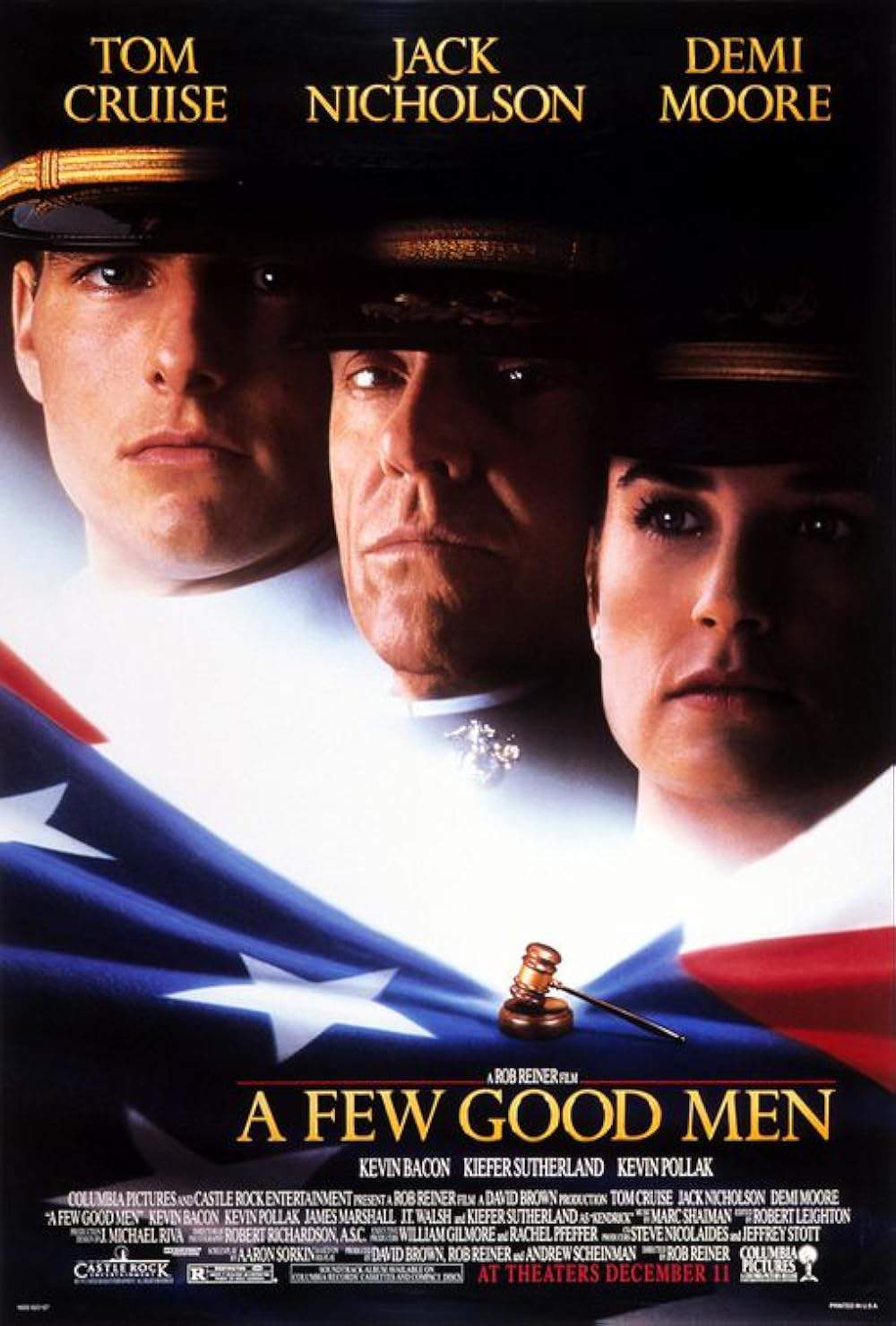
A Few Good Men (1992) movie poster

Plot Summary

A Few Good Men (1992) Plot Summary Explained

Release, runtime and language
1992 · 138 min
JustWatch #85 5
Starring
Jack Nicholson, Tom Cruise, Demi Moore
Budget
$41M

A driven financier experiences a sudden romantic crisis when his girlfriend unexpectedly ends their relationship just before a proposal. Devastated and questioning his approach to love, he begins to examine his past relationships and wonder if his compassionate nature has unintentionally pushed potential partners away. The film explores themes of heartbreak, self-reflection, and the complexities of finding lasting connection.

On this page (6)
  1. 1 Where to watch
  2. 2 What happens: full plot
  3. 3 Plot questions answered
  4. 4 Movie threads
  5. 5 Movies like A Few Good Men
  6. 6 Every angle

Where to watch

Where to Watch A Few Good Men (1992)

Where can you watch A Few Good Men? Stream, rent or buy it in the US, including on HBO Max, YouTube TV and Amazon Video: current JustWatch availability with up-to-date prices.

Streaming availability powered by JustWatch

Full plot summary · contains spoilers

What Happens in A Few Good Men: Full Plot Summary

The whole story of A Few Good Men (1992) explained, from the opening scene to the final frame: every key event, every twist and what it all adds up to. Read it as a quick recap before the sequel, to check a scene you missed, or to finally understand what really happened.

In the oppressive heat of the Guantanamo Bay Naval Base in Cuba, the lifeless body of Private William Santiago is discovered, and this shocking event ignites a serious crisis within the military ranks. Accused of Santiago's brutal murder, Lance Corporal Harold Dawson and Private First Class Louden Downey are put on trial, with their defense assigned to Lieutenant Daniel Kaffee, a young lawyer known for making swift plea deals.

Yet, Lieutenant Commander Joanne Galloway suspects that the case is not as straightforward as it appears. Her instincts tell her that Santiago's tragic death, following his plea for a transfer, is linked to deeper, troubling issues within the chain of command. As she uncovers more details, she learns that Lieutenant Jonathan James Kendrick, the platoon commander, had received orders from Colonel Nathan Jessep to "train" Santiago, hinting at systemic failures rather than individual shortcomings.

As Kaffee and Galloway delve into the investigation, they discover that Dawson and Downey may have acted on a "code red" order, a violent form of punishment. Their inquiries lead them straight to the core of the base, where they face hostility, particularly from Colonel Jessep. In an unexpected twist, while attempting to negotiate a plea bargain with Captain Jack Ross, Dawson and Downey refuse to take the easy way out, believing that doing so would betray their honor.

Things take a pivotal turn when Kaffee chooses to enter a not guilty plea on behalf of his clients, driven by the desire not just to maintain his reputation but also to expose the underlying truths of the case. What he does not realize is that this decision will lead to significant consequences, causing ripples throughout the military establishment.

In a confidential meeting, Lieutenant Colonel Matthew Markinson, Santiago’s commander, reveals a startling fact: there was never a direct order from Jessep granting Santiago a transfer. Faced with this new information, the defense team must reevaluate their strategy, addressing the harsh realities of life on the base. Testimonies expose the life's brutality in the military; Dawson reveals that he had been demoted for helping a fellow Marine, while Downey confirms the existence of prior "code red" orders but admits he was absent when the order against Santiago was delivered.

As the weight of the trial bears down on Kaffee, he grapples with considerable doubt and regret over his handling of the case. His friend, Sam Galloway, encourages him to confront Colonel Jessep, despite the considerable risks associated with challenging such a high-ranking official without substantial evidence.

The courtroom drama escalates as Kaffee faces off against Jessep. Initially self-assured, Jessep's confidence falters as Kaffee expertly scrutinizes his testimony, leading to a flurry of revelations concerning Santiago's fate. Jessep's facade ultimately collapses, prompting an outburst against the court and his own conduct, culminating in a dramatic exit that has consequences reverberating through the courtroom.

In the aftermath, the verdict against Dawson and Downey is delivered: guilty of "conduct unbecoming," leading to their dishonorable discharge. Confused by the ruling, Downey seeks clarity, while Dawson imparts wisdom, illuminating the poignant truth that honor is in protecting the vulnerable. As the dust settles, Kaffee shares an intimate moment with Dawson, promoting the idea that true honor transcends mere titles. With the tension dissipating, Kaffee and Captain Ross engage in a brief exchange, before Ross takes action to apprehend Kendrick, paving the way for new developments in this intricate tale of duty and moral complexity.
Last updated: November 19, 2024 at 18:40

Was this helpful?

Plot questions answered

A Few Good Men Plot Explained: Your Questions Answered

The questions people ask most about A Few Good Men (1992): what happens in the confusing scenes, why the characters do what they do, the twists, hidden details and what the ending means. Each answer contains spoilers.

Q1

What is a "code red" order in the military?

A "code red" is an unofficial, violent form of punishment used in military units to discipline Marines who have violated unwritten rules or shown weakness. It involves physical violence, typically administered by fellow Marines, and is conducted outside official channels. The practice represents a breakdown in proper military discipline, as orders come from ranking members rather than formal judicial processes.

Foreshadowing: Earlier in the film, Downey confirms that "code red" orders have been used previously on the base, establishing it as an accepted practice among certain Marines.

  • code red
  • military discipline
  • unauthorized punishment
  • marine code
Q2

Why do Dawson and Downey refuse the plea bargain offered by Captain Ross?

Dawson and Downey refuse the plea bargain because accepting it would mean admitting to murder they did not commit. More importantly, accepting the deal would betray their sense of military honor, they believe taking the easy way out would be a disgrace to the Marine Corps and themselves. Dawson explicitly states they did not kill Santiago, and taking a guilty plea would be a lie.

Foreshadowing: Earlier, Dawson reveals he was demoted for defending a fellow Marine, showing his commitment to loyalty and doing what he believes is right over personal gain.

  • plea bargain
  • honor
  • Dawson
  • Downey
  • court-martial
Q3

Why did Colonel Jessep order Santiago to be "trained"?

Colonel Jessep ordered Lieutenant Kendrick to "train" Santiago because Santiago had requested a transfer and was considered weak by Jessep. In Jessep's view, Santiago's plea for transfer represented a failure of character. Rather than granting the transfer, Jessep ordered Kendrick to harshen Santiago up through "training," essentially punishing Santiago for showing what Jessep perceived as cowardice.

Foreshadowing: The film establishes early on that Jessep runs his base with an iron fist and has a strong disdain for what he views as weakness in Marines.

  • Jessep
  • Santiago
  • Kendrick
  • training order
  • transfer
Q4

Why is Lieutenant Colonel Markinson's revelation about the transfer order significant?

Markinson reveals that there was never a direct order from Jessep granting Santiago's transfer. This matters because it proves Jessep lied under oath and that Santiago's death resulted directly from Jessep's unauthorized "training" order rather than from any legitimate military process. This revelation becomes the key evidence that allows Kaffee to confront Jessep directly.

Foreshadowing: Galloway had suspected from the beginning that Santiago's death was linked to chain-of-command issues, and Markinson's testimony confirms her theory.

  • Markinson
  • transfer order
  • Jessep
  • testimony
  • evidence
Q5

What causes Colonel Jessep's explosive outburst in court?

Jessep's outburst occurs when Kaffee pushes him to admit that he ordered the "training" that led to Santiago's death and that he did so knowing Santiago would be transferred out. Under intense cross-examination, Jessep breaks down and admits to the court that he ordered the code red, justifying it as necessary to maintain unit cohesion and discipline. His facade of confident authority crumbles as he realizes he's been trapped.

Foreshadowing: Throughout the trial, Jessep displays arrogance and dismissiveness toward the defense, confident he can control the narrative, his sudden collapse shows how this facade was merely a performance.

  • Jessep
  • outburst
  • courtroom
  • confession
  • cross-examination
Q6

Why are Dawson and Downey still convicted even after Jessep admits his orders?

Dawson and Downey are convicted of "conduct unbecoming" because they did carry out the code red that led to Santiago's death, regardless of who gave the order. The military court rules that following an illegal order does not absolve the individuals who executed it. While Jessep's orders were the root cause, Dawson and Downey physically carried out the violence that killed Santiago, making them culpable under military law.

Foreshadowing: The film establishes early that Dawson and Downey were the ones who actually performed the code red, even if motivated by orders from above.

  • conviction
  • conduct unbecoming
  • Jessep
  • military law
  • orders
Q7

What was Lieutenant Kendrick's role in Santiago's death?

Lieutenant Kendrick was the platoon commander who received Colonel Jessep's order to "train" Santiago. He was responsible for carrying out the code red that resulted in Santiago's death. While Jessep gave the order, Kendrick was the one who delegated it to Dawson and Downey, making him directly complicit in the murder.

Foreshadowing: Galloway specifically identifies Kendrick as the link between Jessep's orders and the actual execution of the code red, noting he received direct orders from Jessep.

  • Kendrick
  • code red
  • Jessep
  • platoon commander
  • orders
Q8

Why does Kaffee change his strategy and enter a not guilty plea?

Kaffee enters a not guilty plea because he realizes Dawson and Downey are willing to accept consequences for their actions but want the truth exposed. After learning from Markinson that Jessep lied about the transfer order, Kaffee understands the case is bigger than his usual plea deal strategy, he needs to expose the chain of command's culpability rather than let the Marines take the blame alone.

Foreshadowing: Kaffee's earlier reputation is for quick plea deals, but his growing involvement with Galloway and the evidence changes his approach to seeking actual justice.

  • Kaffee
  • not guilty plea
  • strategy
  • court-martial
  • defense
Q9

What does Dawson mean when he says honor is protecting the vulnerable?

Dawson explains that true honor in the Marine Corps means protecting those who cannot protect themselves, not blindly following orders or maintaining a tough facade. He contrasts this with Jessep's twisted interpretation of honor, which used discipline as an excuse to harm Santiago. Dawson's view emphasizes compassion and standing up for others as the core of military integrity.

Foreshadowing: Dawson was demoted for defending another Marine, which demonstrates he has always lived by this principle of protecting the vulnerable.

  • Dawson
  • honor
  • vulnerable
  • protection
  • marine values
Q10

What happens to Lieutenant Kendrick after the trial ends?

After the trial, Captain Ross takes action to apprehend Kendrick, indicating that he will face military charges for his role in Santiago's death. The film suggests Kendrick will be held accountable for following Jessep's illegal orders and carrying out the code red that killed Santiago.

Foreshadowing: The film establishes that Kendrick received direct orders from Jessep and was the one who assigned Dawson and Downey to carry out the code red.

  • Kendrick
  • arrest
  • Captain Ross
  • accountability
  • military justice

Movie threads

More Movies Like A Few Good Men, by Mood & Story

Curated lists built around what makes A Few Good Men tick: the same mood, the same kind of story or the same emotional payoff. Each list explains why these movies belong together.

Movies about challenging institutions like A Few Good Men

Tense dramas where individuals confront the crushing weight of a powerful institution. If you enjoyed the high-stakes confrontation with a rigid military system in A Few Good Men, you'll find similar tension in these movies about individuals fighting powerful institutions. This thread features films where characters risk everything to expose corruption or injustice within a claustrophobic, rule-bound world.

  • tense
  • claustrophobic
  • high-stakes
  • serious
  • gripping
  • institutional pressure
  • Tone: tense, serious, high-stakes
  • Pacing: steady, procedural
Why these movies?

The story pattern: Stories in this thread typically follow a protagonist who uncovers a hidden truth or injustice within a powerful, self-contained system. The central conflict is the individual versus the institution, escalating through investigation and confrontation, often culminating in a high-pressure verbal or legal showdown.

Why they belong together: Movies are grouped here for their shared atmosphere of oppressive institutional pressure, the intellectual tension of challenging a rigid hierarchy, and the thematic focus on duty, honor, and the cost of speaking truth to power.

Courtroom dramas with complex endings like A Few Good Men

Legal procedurals where uncovering the truth leads to a morally complex, bittersweet resolution. For viewers who appreciated the morally nuanced conclusion of A Few Good Men, this thread collects legal dramas where the ending is bittersweet. These films deliver a captivating trial but leave you with a heavy, thought-provoking feeling about the cost of justice and the complexity of truth.

  • courtroom
  • tense
  • investigation
  • moral ambiguity
  • bittersweet
  • procedural
  • Tone: tense, intellectually challenging, morally gray
  • Pacing: steady, building to a climax
Why these movies?

The story pattern: The narrative pattern involves a legal investigation and trial that serves as the central engine of the plot. The journey is about peeling back layers of deception to reach a core truth, but the resolution acknowledges that the system is imperfect, and justice rarely provides a clean, happy ending.

Why they belong together: These movies share a focus on the procedural elements of a legal battle, a steady pacing that builds to a courtroom climax, and a tonally consistent experience that is tense, intellectually engaging, and concludes with a emotionally heavy, bittersweet feeling.

If you liked this

Movies Like A Few Good Men

Similar movies to A Few Good Men: the same genre, themes or kind of story. Each one comes with its own plot summary, timeline and ending explained.

Browse all movie summaries

Every angle

A Few Good Men (1992) Explained: Plot, Timeline & Characters

Everything about A Few Good Men in one place: what happens in the plot summary, the timeline in chronological order, the characters and meaning and a spoiler-free summary. What's After the Movie adds the cast, box office and post-credit scenes.

Coming soon on iOS and Android

The Plot Explained Movie Summary App

Plot summaries, endings explained and timelines on your phone. Catch up on any movie in minutes, save your favorites and never miss a twist again.

Be the first to know when we launch. Your email stays private, always.

Learn more about the app