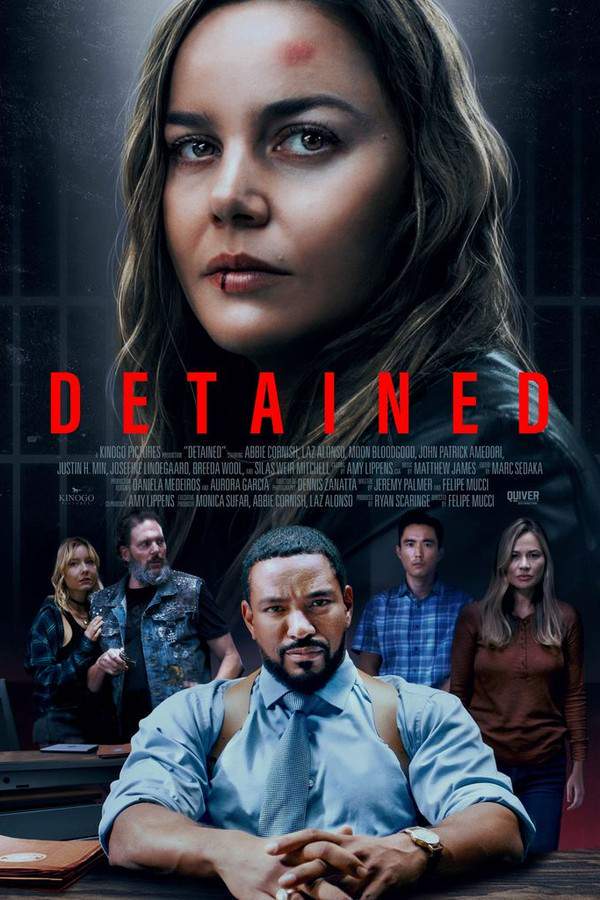
Rebecca Kamen, Abbie Cornish, wakes up under a wake of flashing lights, her memory foggy as police tape surrounds a scene where several bodies lie burned beyond recognition. A dying victim has scratched the name “Jovan” in blood, a clue that threads through the entire ordeal. The film then pivots to a tense interrogation at a police station, where Rebecca’s nervous denial clashes with the mounting evidence: a toxicology report that shows she was far from fit to drive, and the discovery of blood on the front bumper of her car, suggesting a hit-and-run. Robert, John Patrick Amedori, Rebecca’s date from the previous night, has already been taken in by authorities, leaving her to face the consequences largely on her own. The truth feels slippery, and the system seems primed to squeeze her for answers she isn’t ready to give.
As the investigation deepens, Rebecca insists she has no memory of the events that led to the carnage, yet the mounting evidence suggests a night she can’t exonerate herself from. The room is crowded with insinuations, and the police grow wary of her story’s gaps. Into this precarious moment steps Issac Barsi, Justin H. Min, who appears not as a steadfast defender but as a questionable stand-in with a veneer of competence that doesn’t quite hold up. Rebecca’s friend Sarah, Breeda Wool, shows up during a fragile moment, a reminder of the ordinary life she stands to lose, and her warning—“you need to run”—lands with unsettling weight. The police’s suspicions widen as the investigators uncover blood traces on the bumper and the body of a cyclist killed in the same incident, painting a picture of a driver who may have harmed more than one person.
In a turn that tugs at the borders of legality, Avery appears—not as a detective, but as a con artist who has built a convincing façade of a police precinct to fleece Rebecca. Avery, played by Laz Alonso, arrives with a counterfeit sense of authority, flaunting a loaned laptop and a staged backdrop, insisting that Rebecca could buy her way out of a murder charge if she pays the right price. The moment is jarring: the props on the desk look authentic enough to fool a frightened suspect, and Avery’s smooth talk edges toward coercion. Rebecca’s panic turns into calculation as she realizes the game has a bigger objective than a mere DUI. The supposed “case” forks into a web of manipulation where Lisa becomes a pivotal figure in the scheme, and the line between victim and participant blurs.
The truth behind the operation gradually unfolds: Avery’s supposed investigation is a scam, and the lifelike environment is a trap designed to extract money. The realization comes with a staggering cascade of betrayals—Issac, Robert, and the detainee Sully are all part of the ruse, each playing a role to tighten Rebecca’s grip on fear and money. The con’s architecture is reinforced by a stark revelation: Louis Denton, a wealthy man who once trusted Rebecca, had already kept a sliver of a larger payoff in a storage locker. Avery knows this money exists and believes Rebecca’s fear will coax the sum into his account. What follows is a brutal education in manipulation, as Rebecca toys with the others’ suspicions to turn them against each other, all while keeping her true motive hidden.
The plan escalates quickly. Rebecca’s intricate scheme feeds off the chaos she helped create, with Robert falling to a fatal arterial bleed after an attempt to escape, and Sully succumbing to a manipulated overdose that Rebecca orchestrates by lacing his coffee. Jess, caught in the crossfire of control and desperation, pays with her life as she tries to align with Rebecca’s shifting loyalties. As the tension peaks, Rebecca forces Avery to bring in Sarah, the adoptive mother of Brandon—the child Rebecca once shared with Louis. The stakes climb higher as Avery threatens to endanger the baby unless the money lands in his account within minutes. In a tense standoff, Rebecca offers a counterplay to buy time, and Avery’s grip tightens around the real prize: the child’s safety and the money’s flow.
Issac’s attempt to mediate collapses when Avery shoots him, and Lisa, pressured by a choice Rebecca sets in motion, turns on Avery only to fall to his gun too. Throughout this gambit, a shifting identity sits at the center of the plot: Jovan, the name scrawled in blood at the murder scene, is ultimately revealed to be Rebecca herself. The plan was never about bringing someone to justice; it was about Rebecca seeking vengeance, money, and control—an orchestration that used everyone around her as instruments. Rebecca’s orchestration is so thorough that she even succeeds in manipulating Issac as the weak link, pulling him into a web of deceit from which there is no easy exit.
In the final act, Rebecca seizes the upper hand with chilling precision. She reclaims the means of power, obtains the real gun, and confronts Avery directly. After a brutal confrontation, she shoots Avery and burns the building to the ground, a cinematic bookend to the violence she has already engineered. Sarah’s murder seals the tragedy, a grim reminder of the far-reaching consequences of Rebecca’s covert war. The closing sequence echoes the film’s opening: a smoky, ruined scene where seven bodies lie burned, Jovan’s name again scrawled across the wall, a silent epitaph to the con that consumed them all. Rebecca steps out into the smoke with her baby, a figure shaped by calculation, risk, and an unflinching will to survive, leaving behind a question about the line between victim and architect of her own fate.
The cast threads through this unraveling with precision. Rebecca’s arc centers the narrative, but the ensemble—Josefine Lindegaard as Jess, John Patrick Amedori as Robert, Breeda Wool as Sarah, Justin H. Min as Issac, Laz Alonso as Avery, and Moon Bloodgood as Detective Moon—provides the emotional and procedural texture that grounds the twists. Minor players such as Silas Weir Mitchell as Sullivan, Bernardo De Paula as Detective Lerner, and Jeremiah OC Jahi as the Crime Scene Analyst contribute to the atmosphere of a city-wide sting gone wrong, while background performers like Alma K. Garcia, Emmalee Brooks, Liv Mend, Esther Brown, Larry Stenseth, and Debbie Mayfield populate the space with a realistic, lived-in feel.
This is a story that aggressively interrogates trust, deception, and the moral cost of survival in a high-pressure crush of lies. It invites the viewer to question every motive and every ally, to watch as a calculated mind uses fear as currency, and to witness a woman who chooses a dangerous, transformative path to reclaim control—even if that path requires sacrificing others, including those she once called friends. The result is a tightly wound thriller where the line between hero and villain is deliberately blurred, and where the true con is not the lie told by the impostor, but the truth Rebecca ultimately reveals about herself.