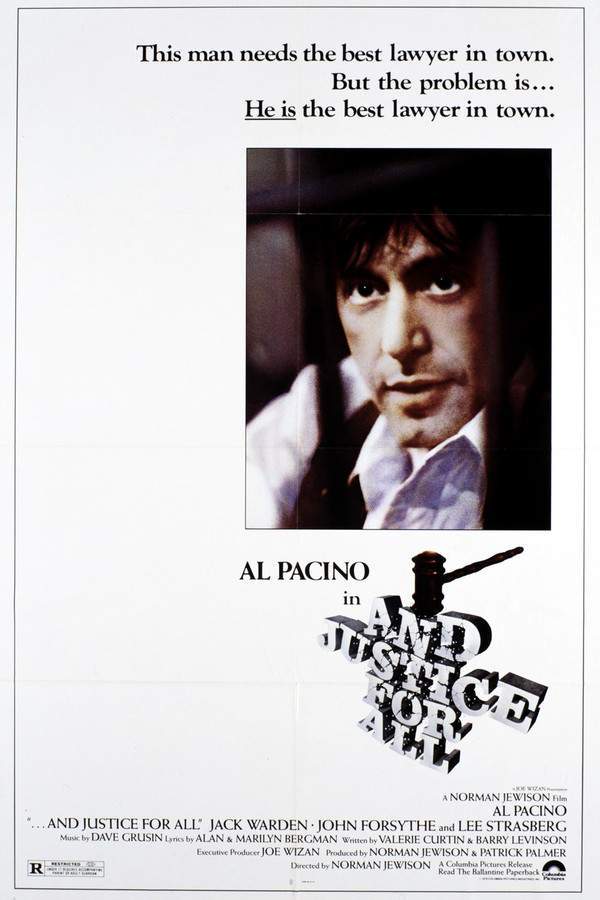
...and justice for all.

...and justice for all.

JustWatch#18,001NaN

Year: 1979

Runtime: 119 min

Language: English

Director: Norman Jewison

DramaThrillerCrime

A young, idealistic lawyer finds himself embroiled in a controversial case when he defends a judge accused of rape. The lawyer must grapple with a flawed legal system and his own beliefs as he navigates the courtroom, where personal biases and the pursuit of justice clash. He faces mounting pressure and ethical dilemmas while trying to uncover the truth and ensure a fair trial for his client.

Where to Watch ...and justice for all.?

Find where to stream, rent, or buy ...and justice for all. (1979) in the US with current JustWatch availability, up-to-date pricing, and platform listings for subscription, rental, and digital purchase options.

Warning: spoilers below!

Haven’t seen ...and justice for all. yet? This summary contains major spoilers. Bookmark the page, watch the movie, and come back for the full breakdown. If you're ready, scroll on and relive the story!

...and justice for all. (1979) – Full Plot Summary & Ending Explained

Read the complete plot breakdown of ...and justice for all. (1979), including all key story events, major twists, and the ending explained in detail. Discover what really happened, and what it all means.

Arthur Kirkland, Al Pacino, a Baltimore defense attorney, is in jail on a contempt-of-court charge after punching Judge Henry T. Fleming, Jack Warden, while arguing the case of Jeff McCullaugh. McCullaugh was stopped for a minor traffic offense, then mistaken for a killer of the same name, and has already spent a year and a half in jail without being convicted of a crime. Fleming refuses to consider his appeal due to its late submission, so he remains in prison. Kirkland begins a new case defending Ralph Agee, a young black cross-dresser arrested for a robbery who has a fetish for being misgendered and is terrified of being sent to a male prison.

Kirkland regularly visits his grandfather Sam Kirkland, Sam Levene in a nursing home. Sam is progressively becoming senile. It is revealed that Kirkland was abandoned by his parents at a young age, and it was Sam who raised him and put him through law school. Kirkland also begins a romance with Gail Packer, Christine Lahti.

Kirkland has a friendly relationship with Judge Francis Rayford, John Forsythe, who takes him on a hair-raising ride in his personal helicopter. Rayford laughs in amusement as he tests how far he can fly before running out of fuel. Kirkland is terrified and begs him to land. Rayford eventually crashes his helicopter in knee-deep water. Rayford, a Korean War veteran, is borderline suicidal; at all times, he keeps a rifle in his chambers at the courthouse and an M1911 pistol in his shoulder holster. He even eats his lunch on a ledge outside his office window, four stories up.

One day, Kirkland is unexpectedly requested to defend Judge Fleming, who has been accused of brutally assaulting and raping a young woman. Although the two loathe each other, Fleming feels that having the person who publicly hates him argue his innocence will be to his advantage. Fleming blackmails Kirkland with an old violation of attorney-client confidentiality, for which Kirkland will likely be disbarred if it were to come to light.

Kirkland's friend and partner Jay Porter, Jeffrey Tambor, is also unstable. He feels guilt for gaining acquittals for defendants who were truly guilty of violent crimes. Porter arrives drunk at Kirkland's apartment, after one of his guilty clients kills two kids following his acquittal. Porter soon shaves his head, claiming that it will make his hair grow back thicker, but he keeps shaving it. After a violent breakdown inside the courthouse—wherein he ends up throwing dinner plates at everybody in the hallway—Porter is taken to a hospital.

Before leaving in the ambulance, Kirkland asks another partner, Warren Fresnell, to handle Agee's court hearing in his absence. Kirkland gives Fresnell a corrected version of Agee's probation report and stresses that it must be shown to the judge, so that Agee will receive probation rather than serve jail time. Fresnell arrives at the courthouse late and forgets to give the judge the corrected version, causing Agee to be sentenced to jail time. Kirkland is livid and attacks Fresnell's car, revealing that thirty minutes after he was sentenced, Agee died by suicide. Meanwhile, McCullaugh, who has been sexually and physically assaulted by other inmates, finally snaps and takes two hostages. Kirkland pleads with him to surrender, promising to get him out, but a police sniper shoots and kills McCullaugh when he moves in front of a window.

A clearly disturbed Kirkland takes on Judge Fleming's case. Prosecuting attorney Frank Bowers hopes to make his reputation by convicting a judge. Kirkland's client Carl Travers hopes to receive free legal services by offering photos of Judge Fleming engaged in bisexual BDSM with a prostitute. Gail reminds Kirkland of his professional obligations to defend the judge. Kirkland shows the pictures to Fleming, who admits that he is a rapist.

At the trial, Fleming jokes that he would like to see his victim again sometime. In his opening statement, Kirkland sarcastically muses about the legal system and Bowers's ambition. He surprises everyone by tearfully saying that Bowers will not convict Fleming because he will, and he proceeds to accuse his client of being guilty, referring to him as a "son of a bitch" and stating that he should "go right to fucking jail".

> "son of a bitch" and "go right to fucking jail."

Kirkland is dragged out of the courtroom, venting his rage the whole way, saying that the Judge hurts people. The spectators cheer for Kirkland, Fleming sits down in defeat, and a fed-up Rayford storms out.

As an exhausted Kirkland, knowing his actions will result in his disbarment, sits on the courthouse steps, Jay Porter passes on his way back to work, tipping his wig to Kirkland.
Last updated: October 09, 2025 at 15:38

Was this helpful?

...and justice for all. (1979) Plot Questions Answered – Summary FAQ

Explore frequently asked questions about ...and justice for all. (1979) with spoiler-rich answers covering the full plot summary, major story beats, character motivations, hidden details, and ending meaning. This movie summary FAQ helps explain confusing scenes, plot twists, and narrative decisions in clear, searchable detail.

Q1

Why does Arthur Kirkland punch Judge Fleming in court?

A.

Kirkland punches Judge Fleming during a hearing over Jeff McCullaugh's case. McCullaugh was stopped for a minor traffic offense but mistaken for a killer of the same name, and had already spent a year and a half in jail without being convicted. When Fleming refuses to consider McCullaugh's late appeal, Kirkland attacks him in frustration, resulting in his arrest for contempt of court.

The confrontation establishes the hostile relationship between Kirkland and Fleming that later becomes central to the story.

arthur kirklandjudge flemingpunchcontempt of courtjeff mccullaugh
Q2

Why does Kirkland agree to defend Judge Fleming despite hating him?

A.

Judge Fleming blackmails Kirkland with an old violation of attorney-client confidentiality. If exposed, Kirkland would likely be disbarred. Fleming calculates that having the person who publicly hates him argue his innocence will actually help his defense, as it will appear more genuine to the jury.

Fleming's manipulation of Kirkland sets up the ethical dilemma that defines the film's climax.

judge flemingblackmailattorney-client confidentialitydisbarmentdefense attorney
Q3

Why does Ralph Agee kill himself after being sentenced?

A.

Agee is a young black cross-dresser arrested for robbery who has a deep fear of being misgendered and of being sent to a male prison. Kirkland entrusts a partner to present a corrected probation report that would have secured him probation instead of jail time. The partner forgets to submit the report, Agee receives jail time, and he commits suicide within thirty minutes of the sentencing.

Agee's fear of male prison was established early in his case, making his suicide a tragic consequence of system failure.

ralph ageesuicidecross-dresserprobation reportwrongful sentencing
Q4

What happens to Jeff McCullaugh at the end?

A.

McCullaugh, who has spent a year and a half in jail for a crime he may not have committed, is sexually and physically assaulted by other inmates during his prolonged detention. He eventually snaps and takes two hostages. Kirkland pleads with him to surrender, promising to help, but a police sniper shoots and kills McCullaugh when he moves in front of a window.

McCullaugh's wrongful imprisonment and mistreatment build throughout the film, foreshadowing his violent breakdown.

jeff mccullaughhostagesniperwrongful imprisonment
Q5

Why does Judge Rayford take such dangerous risks like the helicopter ride?

A.

Rayford is a Korean War veteran who displays borderline suicidal behavior throughout the film. He keeps a rifle in his chambers and an M1911 pistol in his shoulder holster. He eats lunch on a ledge outside his office window four stories up and takes Kirkland on a helicopter ride specifically to test how far he can fly before running out of fuel. His reckless behavior stems from psychological trauma and possible suicidal ideation.

Rayford's volatile temperament and near-suicidal tendencies are established early, foreshadowing his emotional breakdown during the trial.

judge rayfordhelicopterkorean war veteransuicidal behavior
Q6

Why does Kirkland accuse his own client Fleming of being guilty during the trial?

A.

During his opening statement, Kirkland unexpectedly tears into Fleming, calling him a "son of a bitch" and stating he should "go right to fucking jail." This appears to be Kirkland's way of exposing the truth while maintaining his professional obligation to defend Fleming. He tells the court that prosecutor Bowers will not convict Fleming because he, Kirkland, will. Kirkland knows Fleming is guilty and uses the trial as a platform to publicly condemn him, knowing this will likely result in his own disbarment.

Kirkland's earlier discovery of photographs proving Fleming's guilt sets up this dramatic courtroom confrontation.

kirklandflemingcourtroomguiltydisbarmentopening statement
Q7

Why does Jay Porter shave his head and have a violent breakdown?

A.

Jay Porter, Kirkland's partner, experiences a moral crisis after one of his guilty clients kills two children following an acquittal. Guilt-ridden and drunk, he arrives at Kirkland's apartment and shaves his head believing it will make his hair grow back thicker. He then has a violent breakdown in the courthouse, throwing dinner plates at people in the hallway before being taken to a hospital. The breakdown represents the psychological toll of defending guilty criminals.

Porter's guilt over previous acquittals was established earlier in the film, building toward his emotional collapse.

jay porterbreakdownguilty clientshaved headpsychological toll
Q8

What is Ralph Agee's fear of being misgendered about?

A.

Agee is a cross-dresser with a fetish for being correctly gendered. He lives in terror of being sent to a male prison where he would be misgendered and potentially face violence. This vulnerability makes the court's failure to consider his corrected probation report even more tragic, as probation would have avoided placing him in that situation.

Agee's fear is established early, making his suicide an emotionally logical consequence of receiving a jail sentence.

ralph ageecross-dressermisgenderedprison fear
Q9

What does Judge Fleming hold over Kirkland to force him to take the case?

A.

Fleming threatens to expose an old violation of attorney-client confidentiality that Kirkland committed. If this violation became public, Kirkland would almost certainly be disbarred and lose his law license. Fleming uses this leverage to force Kirkland to defend him against rape charges, calculating that Kirkland's obvious disdain for him would make the defense more convincing to a jury.

The blackmail explains why Kirkland takes on a case he clearly objects to morally.

judge flemingblackmailattorney-client confidentialitydisbarment
Q10

What happens to Arthur Kirkland after the trial?

A.

After publicly accusing Fleming in court and being dragged out, Kirkland sits on the courthouse steps exhausted, knowing his actions will result in disbarment. His friend Jay Porter passes by on his way back to work, tipping his wig to Kirkland in a gesture of solidarity. Kirkland achieves a form of personal and moral victory by exposing the guilty judge, but at the cost of his legal career.

The ending reflects the film's theme of personal integrity versus systemic corruption.

arthur kirklanddisbarmentcourthouse stepsendingporter
Q11

Why does Fleming admit to Kirkland that he is a rapist?

A.

Kirkland confronts Fleming with photographs showing him engaged in bisexual BDSM with a prostitute. After seeing the evidence, Fleming admits to Kirkland that he is a rapist. This admission confirms what Kirkland already suspected and drives his decision to publicly betray Fleming during the trial.

The photographs provide the concrete evidence Kirkland needs to confirm his client's guilt.

judge flemingphotographsadmissionrapeprostitute
Mobile App Preview

Coming soon on iOS and Android

The Plot Explained Mobile App

From blockbusters to hidden gems - dive into movie stories anytime, anywhere. Save your favorites, discover plots faster, and never miss a twist again.

Sign up to be the first to know when we launch. Your email stays private, always.

Explore Movie Threads

Discover curated groups of movies connected by mood, themes, and story style. Browse collections built around emotion, atmosphere, and narrative focus to easily find films that match what you feel like watching right now.

Movies about fighting systemic corruption like ...and justice for all.

Idealistic figures battle a rigged and cynical institution from the inside.If you liked ...and justice for all., explore more movies about crusaders battling rigged institutions. These films feature heroes confronting systemic corruption, facing ethical dilemmas, and risking everything for a flawed notion of justice, often with intense, dark, and heavy emotional journeys.

angryfrustratedtensecynicaloppressiveanxiousmoral outrage

Narrative Summary

The narrative typically follows a protagonist who begins with faith in the system. As they uncover layers of deceit and institutional rot, they are forced into increasingly desperate and risky actions, culminating in a confrontation that often costs them their career or peace of mind but achieves a form of pyrrhic victory.

Why These Movies?

They are grouped by their shared theme of institutional decay and the intense, personal toll of fighting it. They evoke a similar mood of righteous anger, frustration, and cynical insight into power structures, often featuring fast-paced revelations and a heavy emotional weight.

Intense legal thriller breakdowns like in ...and justice for all.

Intense legal dramas where the lawyer's sanity is as much on trial as the case.Fans of ...and justice for all. will find similar tension in these high-stakes legal dramas. These movies focus on lawyers under extreme pressure, grappling with ethical dilemmas and a flawed justice system, leading to intense courtroom confrontations and personal psychological unraveling.

tenseanxiousfrustratedoppressivecynicallegal dramaethical dilemma

Narrative Summary

The plot revolves around a morally complex case that challenges the protagonist's ethics. A series of setbacks, shocking revelations, and personal sacrifices escalate the tension, driving the lawyer toward a public breakdown or a desperate, career-ending act of defiance in the courtroom to achieve a form of justice.

Why These Movies?

They share a specific setting (the legal world) and a narrative pattern of a protagonist's psychological descent under the weight of a case. The experience is defined by a fast pace, high intensity, dark tone, and the central theme of a moral and emotional collapse within the justice system.

Unlock the Full Story of ...and justice for all.

Don't stop at just watching - explore ...and justice for all. in full detail. From the complete plot summary and scene-by-scene timeline to character breakdowns, thematic analysis, and a deep dive into the ending - every page helps you truly understand what ...and justice for all. is all about. Plus, discover what's next after the movie.

...and justice for all. Timeline

Track the full timeline of ...and justice for all. with every major event arranged chronologically. Perfect for decoding non-linear storytelling, flashbacks, or parallel narratives with a clear scene-by-scene breakdown.

...and justice for all. Timeline

Characters, Settings & Themes in ...and justice for all.

Discover the characters, locations, and core themes that shape ...and justice for all.. Get insights into symbolic elements, setting significance, and deeper narrative meaning - ideal for thematic analysis and movie breakdowns.

Characters, Settings & Themes in ...and justice for all.

...and justice for all. Spoiler-Free Summary

Get a quick, spoiler-free overview of ...and justice for all. that covers the main plot points and key details without revealing any major twists or spoilers. Perfect for those who want to know what to expect before diving in.

...and justice for all. Spoiler-Free Summary

More About ...and justice for all.

Visit What's After the Movie to explore more about ...and justice for all.: box office results, cast and crew info, production details, post-credit scenes, and external links - all in one place for movie fans and researchers.

More About ...and justice for all.

Similar Movies to ...and justice for all.

Discover movies like ...and justice for all. that share similar genres, themes, and storytelling elements. Whether you’re drawn to the atmosphere, character arcs, or plot structure, these curated recommendations will help you explore more films you’ll love.