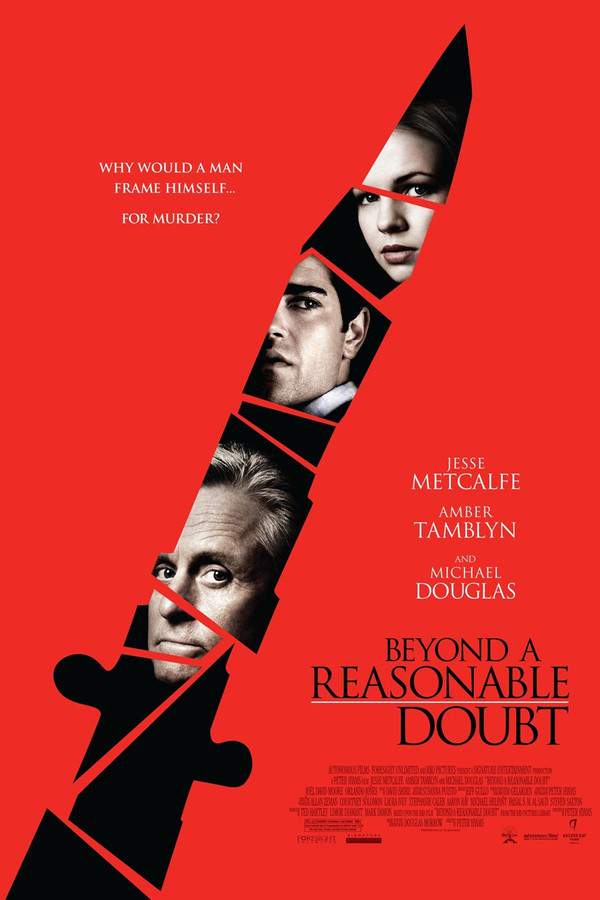
Ambitious lawyer Mark Hunter’s bid for governor is threatened when rookie journalist C.J. Nicholas suspects evidence has been manipulated. To expose what he believes to be corruption and achieve justice, C.J. undertakes a risky plan, becoming a suspect himself and seemingly framing himself. This sets off a tense game of deception and pursuit as Hunter attempts to maintain his reputation and C.J. tries to reveal the truth.
Find where to stream, rent, or buy Beyond a Reasonable Doubt (2009) in the US with current JustWatch availability, up-to-date pricing, and platform listings for subscription, rental, and digital purchase options.
Warning: spoilers below!
Haven’t seen Beyond a Reasonable Doubt yet? This summary contains major spoilers. Bookmark the page, watch the movie, and come back for the full breakdown. If you're ready, scroll on and relive the story!
Read the complete plot breakdown of Beyond a Reasonable Doubt (2009), including all key story events, major twists, and the ending explained in detail. Discover what really happened, and what it all means.
As C.J. Nicholas navigates the intriguing backdrop of Louisiana as a TV journalist in Shreveport, he is driven by a desire to rejuvenate his career. In collaboration with colleague Corey Finley, he aims to launch an investigative unit. Nicholas first gained recognition through an award-winning documentary that chronicled the heartbreaking tale of a pregnant teenager, a prostitute, who tragically lost her life in Buffalo, New York, after suffering a stillbirth.
With an unwavering commitment to uncovering the truth, Nicholas suspects that District Attorney Mark Hunter is embroiled in corruption. Hunter, an ambitious former police detective, has gained his notoriety from a series of convictions that rely heavily on circumstantial evidence obtained at the last minute. As Nicholas digs deeper, he finds himself romantically entangled with Assistant D.A. Ella Crystal, despite harboring reservations about her connections to Hunter.
In this quest for truth, Nicholas comes upon a critical videotape indicating that Hunter may have been manipulating evidence through his former partner, Lt. Merchant, who has played a key role in securing successful cases for Hunter. Even though Nicholas struggles to substantiate how the evidence was falsified, his findings are dismissed by his superior, leading to the dismantling of his investigative unit due to funding issues.
Refusing to back down, Nicholas hatches a bold plan to frame himself for the murder of a prostitute, utilizing circumstantial evidence. Alongside Finley, he starts to gather incriminating materials that will theoretically link him to the crime, recording evidence that vividly includes him holding a newspaper dated after the murder. This pivotal footage is carefully stored away, both in Finley's desk and a secure safe deposit box.
Next, Nicholas strategically orchestrates his own arrest for DUI by contacting Lt. Nickerson while wearing his circumstantial evidence as a mask of disgrace. He finds himself charged with murder, but Merchant intervenes, asking for the case to be reassigned to him to undermine Hunter, to Nickerson's dissatisfaction.
As Nicholas' dramatic ploy unfolds, he patiently anticipates the prosecution's case to rest, preparing to introduce the documentary evidence that could expose the truth. However, Hunter orders Merchant to destroy the crucial videotape evidence, and chaos ensues when Finley discovers his workspace ransacked. In a desperate attempt to retrieve the backup copy, Finley meets a tragic fate during a high-speed chase with Merchant, destroying their last chance at clarity.
The situation escalates as Nicholas’ entire scheme hangs in a precarious balance, with the truth on the verge of being obliterated. In the courtroom, as the web of lies begins to unravel, dated receipts become the only remnants of Nicholas' fabricated narrative. Yet, Hunter deftly undermines Nicholas's credibility, leaving the jury with doubts and culminating in a guilty verdict that results in a death sentence for Nicholas.
Not willing to accept this injustice, Crystal launches her own investigation, her faith in Nicholas's innocence driving her forward. Meanwhile, unbeknownst to her, Hunter keeps a close watch on her every move due to her involvement with Nicholas. Moreover, Merchant proves to be a menacing presence, tailing Crystal as she digs deeper into the case.
During a fateful visit to Nicholas in prison, Hunter reveals that Nicholas’s phone calls guiding Crystal have been recorded, further tainting his claims of innocence. As Crystal investigates with relentless fervor, she uncovers crime scene photos from Hunter's past convictions that bear disturbing evidence: each item containing suspect DNA appears to have been digitally inserted into the photographs post-factum.
In a brazen effort to resolve the injustice, Crystal approaches authorities only to find herself directly threatened by Merchant, who attempts to silence her permanently but is thwarted by Nickerson, who has been tracking Merchant’s movements as part of his investigation.
The ensuing scandal surrounding Hunter’s tainted photo evidence ignites public outrage, leading to Hunter's arrest and a re-evaluation of his previous convictions. Nicholas is ultimately freed from prison with his case declared a mistrial, rising as an unexpected media icon while Hunter faces the consequences of his illicit actions.
As Crystal revisits the documentary that initially sparked outrage, she uncovers a shocking revelation: the hands of the prostitute depicted in the film match those found at the crime scene linked to Nicholas’s original conviction. She deduces that Nicholas had hired the woman to reenact her role, and when she attempted to blackmail him, he eliminated the threat.
Confronting Nicholas about his motives, Crystal is met with a frigid justification for his heinous actions, as he seeks to defend the murder as a necessary evil in exposing Hunter’s corruption. This emotional confrontation leaves Crystal devastated, revealing the depths of Nicholas's moral decay. As she steels herself to depart, she delivers a powerful rebuke, questioning, "How can I love a lie?" With these piercing words, she leaves, as authorities close in on Nicholas, drawing the curtain on a twisted saga of deception and turmoil.
Last updated: November 19, 2024 at 16:05
Explore frequently asked questions about Beyond a Reasonable Doubt (2009) with spoiler-rich answers covering the full plot summary, major story beats, character motivations, hidden details, and ending meaning. This movie summary FAQ helps explain confusing scenes, plot twists, and narrative decisions in clear, searchable detail.
Nicholas frames himself for a prostitute's murder to expose District Attorney Mark Hunter's pattern of manipulating evidence. By becoming a suspect and creating a case that relies on circumstantial evidence similar to Hunter's previous convictions, Nicholas aims to prove that Hunter fabricates evidence to secure guilty verdicts. His plan involves planting false evidence against himself that would theoretically be dismissed once his defense reveals the manufacturing of the case.
Earlier in the film, Nicholas suspects Hunter has been manipulating evidence through Lt. Merchant to secure convictions based on circumstantial evidence.
Corey Finley, Nicholas's colleague who helps orchestrate the self-framing plan, dies during a high-speed chase with Lt. Merchant. After Hunter orders Merchant to destroy the crucial videotape evidence, Finley discovers his workspace has been ransacked and attempts to retrieve the backup copy stored in a safe deposit box. During the chase, Finley's vehicle crashes, killing him and destroying their last chance at proving the evidence was manufactured.
Finley is shown handling the critical evidence and storing copies in both his desk and a safe deposit box, making him a target.
Crystal discovers that crime scene photos from Hunter's past convictions contain digitally inserted DNA evidence. While investigating after Nicholas's conviction, she finds that suspect DNA appears to have been added to photographs after they were originally taken. This proof of photo manipulation leads to Hunter's arrest and the re-evaluation of his previous convictions.
Nicholas initially found a videotape suggesting Hunter manipulated evidence with Lt. Merchant, but the evidence was destroyed.
Nicholas's plan unravels because the prosecution presents evidence that undermines his credibility. Dated receipts and other documentation contradict his fabricated timeline. Additionally, Hunter strategically undermines Nicholas's credibility in court, portraying him as someone who would go to extreme lengths for a story. The jury ultimately convicts Nicholas and sentences him to death.
The plan relies on Nicholas being able to reveal the manufactured evidence at trial, but Hunter destroys the videotape before Nicholas can use it.
In the film's final twist, Crystal discovers that Nicholas actually did commit the murder he was framed for. While reviewing the original documentary that made Nicholas famous, she realizes the prostitute's hands in the film match the crime scene photos from his case. Nicholas had hired the woman to reenact her role, and when she attempted to blackmail him, he killed her. His entire righteous crusade was built on the murder of an innocent woman.
Nicholas's documentary about a pregnant prostitute who died after a stillbirth initially gained him recognition and credibility.
Crystal leaves Nicholas after learning he actually murdered the prostitute. When she confronts him about the murder, he coldly justifies it as a necessary evil to expose Hunter's corruption. Devastated by his moral decay, she delivers the parting line "How can I love a lie?" and walks out as authorities close in on Nicholas. Their relationship, which began with romantic entanglement despite her working for Hunter, ends once she discovers the depth of his deception and crimes.
Throughout the film, Nicholas harbors reservations about Crystal's connections to Hunter, hinting at his capacity for deception.
Hunter manipulates evidence through his former partner Lt. Merchant, who has been digitally inserting suspect DNA into crime scene photographs after the photos were originally taken. This method allowed Hunter to secure convictions based on seemingly concrete forensic evidence that was entirely fabricated. His successful cases all relied on circumstantial evidence obtained at the last minute, suggesting a pattern of manufactured proof.
Nicholas discovers a videotape showing Hunter and Merchant discussing evidence manipulation, though he struggles to prove it.
Hunter is arrested after the scandal surrounding his tainted photo evidence erupts. His pattern of digitally manipulating crime scene photos is exposed, leading to public outrage and the re-evaluation of his previous convictions. His attempt to maintain his reputation and political ambitions ultimately fails, and he faces criminal consequences for his corruption.
Throughout the film, Hunter orders Merchant to destroy evidence and monitor Crystal, revealing his desperation to protect his position.
Nicholas plans his arrest by wearing the circumstantial evidence he manufactured as a disguise. He contacts Lt. Nickerson while carrying incriminating materials, including a newspaper dated after the murder, to make himself appear guilty. This strategic DUI arrest places him at the center of the investigation, allowing him to expose Hunter's methods when his case goes to trial.
Nicholas and Finley carefully gather incriminating materials and record Nicholas holding the evidence on video, storing copies in multiple locations.
Nicholas targets Hunter because he suspects the District Attorney is corrupt and has been manufacturing evidence to secure convictions. Hunter, a former police detective, gained prominence through a series of convictions that relied heavily on circumstantial evidence obtained at the last minute. Nicholas believes exposing this corruption will not only achieve justice but also rejuvenate his career as an investigative journalist.
Nicholas's reputation began with an award-winning documentary about injustice, showing his history of pursuing truth.
Nicholas's award-winning documentary about a pregnant teenager who died after a stillbirth in Buffalo established his reputation as a serious journalist. The documentary chronicled a tragic case of injustice that fueled his commitment to exposing corruption. However, the film reveals the prostitute in that documentary was the same woman Nicholas later murdered when she tried to blackmail him, making his crusading reputation built on a victim he killed.
The documentary initially appears to represent Nicholas's journalistic integrity and noble pursuit of truth.
Discover curated groups of movies connected by mood, themes, and story style. Browse collections built around emotion, atmosphere, and narrative focus to easily find films that match what you feel like watching right now.
Stories where a risky gambit to expose corruption leads to personal ruin.If you liked the high-stakes gamble and moral complexity of Beyond a Reasonable Doubt, explore more movies like it. This collection features tense thrillers where protagonists risk everything to expose corruption, often getting entangled in a web of lies that leads to a cynical or morally gray conclusion. Discover similar stories of risky investigations, frame-ups, and justice sought through dangerous means.
Narratives in this thread typically follow a protagonist—often a journalist or an outsider—who designs an elaborate, high-risk scheme to trap a powerful, corrupt antagonist. The plot revolves around the execution of this plan, the constant threat of exposure, and the psychological strain on the protagonist. The climax often involves a twist that recontextualizes the events, revealing deeper layers of corruption or the protagonist's own flawed morality, leading to a victory that feels hollow or tragic.
Movies are grouped here because they share a core narrative of a dangerous investigation, a dominant tone of paranoia and tension, and a thematic focus on moral decay within systems of power. They deliver a similar viewing experience of high-intensity suspense coupled with a heavy, often disillusioning, emotional payoff.
Character-driven stories where the pursuit of justice leads to moral compromise.For viewers who appreciated the heavy emotional weight and moral quandaries in Beyond a Reasonable Doubt, this section highlights movies with similar themes. Discover films about journalists, investigators, or ordinary people whose quest for truth forces them into ethically gray areas, leading to a profound exploration of justice, sacrifice, and personal corruption. Find more complex dramas and thrillers about the cost of uncovering the truth.
These stories follow a character arc that begins with a righteous motivation but descends into moral ambiguity. The protagonist often becomes as manipulative or ruthless as the antagonist they seek to defeat, sacrificing their relationships and principles. The narrative structure builds towards a revelation of this internal corruption, forcing both the character and the audience to question the price of their goal and the nature of justice itself.
These movies are united by their shared focus on a heavy emotional weight stemming from ethical dilemmas and character degradation. They feature protagonists on a complex path where the means used to achieve an end ultimately redefine them, creating a cohesive vibe of psychological depth and unsettling conclusions.
Don't stop at just watching - explore Beyond a Reasonable Doubt in full detail. From the complete plot summary and scene-by-scene timeline to character breakdowns, thematic analysis, and a deep dive into the ending - every page helps you truly understand what Beyond a Reasonable Doubt is all about. Plus, discover what's next after the movie.
Track the full timeline of Beyond a Reasonable Doubt with every major event arranged chronologically. Perfect for decoding non-linear storytelling, flashbacks, or parallel narratives with a clear scene-by-scene breakdown.
Discover the characters, locations, and core themes that shape Beyond a Reasonable Doubt. Get insights into symbolic elements, setting significance, and deeper narrative meaning - ideal for thematic analysis and movie breakdowns.