Plot Explained Spoilers guaranteed!
Plot Explained

Browse by genre

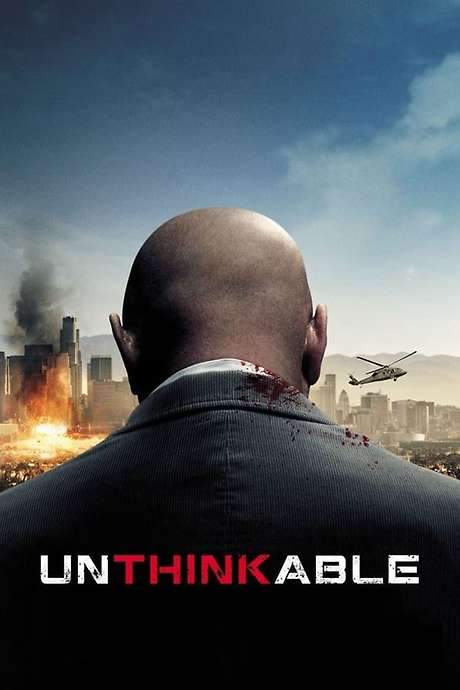
Unthinkable (2010) movie poster

Plot Summary

Unthinkable (2010) Plot Summary Explained

Release, runtime and language
2010 · 97 mins · English
Loading streaming availability…
Directed by
Gregor Jordan
Starring
Samuel L. Jackson, Michael Sheen, Yara Shahidi, Sasha Roiz, Stephen Root, Gil Bellows

When the government learns of a covert scheme to devastate the United States using three missing nuclear weapons, the clear line between right and wrong blurs. A seasoned interrogator and an FBI agent are tasked with locating the devices, racing against time to stop the catastrophe.

On this page (5)
  1. 1 Where to watch
  2. 2 What happens: full plot
  3. 3 Plot questions answered
  4. 4 Movie threads
  5. 5 Every angle
Loading streaming availability…

Full plot summary · contains spoilers

What Happens in Unthinkable: Full Plot Summary

The whole story of Unthinkable (2010) explained, from the opening scene to the final frame: every key event, every twist and what it all adds up to. Read it as a quick recap before the sequel, to check a scene you missed, or to finally understand what really happened.

An American former Delta Force operator, Steven Younger, Michael Sheen makes a videotape that sets the entire drama in motion. In Los Angeles, FBI Special Agent Helen Brody Carrie-Anne Moss and her team are summoned to a high school that has been repurposed by the military as a black site holding Younger, who is using the alias Yusuf Mohamed. The team watches Yusuf’s tape, which shows three nuclear bombs planted in separate U.S. cities, all set to explode at once if his demands aren’t met.

A renowned interrogator, “H” Samuel L. Jackson, is brought in to extract the bombs’ locations. He wastes no time displaying his power, severing one of Yusuf’s fingers to demonstrate the stakes. Brody, appalled by the brutal tactics, tries to intervene, while Saunders Martin Donovan, the senior official overseeing the operation, argues that the threat of ten million deaths justifies torture. The confrontation between ends and means escalates, with Brody trying to play the role of the “good cop” as H pushes further.

Yusuf’s demands arrive: the President must announce a halt to American support for puppet governments and dictatorships in Muslim countries and withdraw troops from there. The group quickly dismisses any chance of satisfying such terms, citing the government’s long-standing stance of not negotiating with terrorists.

Brody pushes back when she suspects Yusuf is exploiting the tension to reveal a moral critique of the United States. Yusuf breaks down and admits the threat was a ruse to provoke a reaction, providing an address to prove it. The team follows the clue to a room that matches the scene in the video, but finds no nuclear device. A soldier unexpectedly pulls Yusuf’s photo down, triggering a nearby C-4 explosion at a shopping mall that leaves 53 people dead.

Filled with anger over the senseless loss of life, Brody returns to Yusuf and cuts his chest with a scalpel. Yusuf remains unfazed and rationalizes the carnage: he had been willing to die to expose U.S. oppression, insisting that the Americans kill that many people every day. The line is chillingly clear: > "Americans kill that many people every day."

Yusuf’s wife and children are detained, and H threatens to mutilate her right there. Brody and the others move to remove her, but H slashes her throat, and she bleeds out before Yusuf’s eyes. Yusuf does not flinch, so H orders the children brought in. Outside Yusuf’s hearing, he tells everyone that he will not harm the children, yet the order to torture them hangs in the air. Yusuf finally relents and provides three addresses—New York, Los Angeles, and Dallas—but the pressure to coerce him persists.

The group weighs the possibility of an unseen fourth bomb, pointing to the amount of missing nuclear material and the meticulous planning that would allow for an unanticipated device. H argues that the torture was a message about what would happen to Yusuf’s children if he did not cooperate. The government official in charge, who had previously chastised H, attempts to coerce him into continuing the interrogation.

In a final, devastating turn, Yusuf seizes the pistol from the official, requests that Brody look after his children, and then kills himself. Brody walks out of the building with Yusuf’s children, leaving the room in a cautious silence that underscores the moral tension at the heart of the ordeal.

Last updated: October 27, 2025 at 16:47

Was this helpful?

Plot questions answered

Unthinkable Plot Explained: Your Questions Answered

The questions people ask most about Unthinkable (2010): what happens in the confusing scenes, why the characters do what they do, the twists, hidden details and what the ending means. Each answer contains spoilers.

Q1

Why did Yusuf create the nuclear bomb threat?

Yusuf (Steven Younger, a former Delta Force operator) created the elaborate nuclear threat as a deliberate provocation to force the U.S. government to publicly address its foreign policy in Muslim countries. His demands, ending support for puppet governments and withdrawing troops, were never intended to be met. The threat was a ruse designed to expose and protest American military involvement abroad, not an actual terrorism plot.

Foreshadowing: Yusuf's video explicitly outlines political demands before any bomb details are revealed, signaling the ideological nature of his mission.

  • yusuf mohamed
  • steven younger
  • nuclear threat
  • motivation
  • protest
  • political demands
Q2

Was the nuclear threat real or a bluff?

The nuclear threat was a bluff. When Brody accused Yusuf of faking the bomb threat, he broke down and admitted it was a ruse to provoke a reaction from the U.S. government. He provided an address to prove his claim, which led authorities to a matching room that contained no nuclear device. However, the consequences became very real when a mall bombing killed 53 people.

Foreshadowing: The team quickly dismisses any chance of satisfying his political demands, implying the government believed the threat was negotiable rather than purely ideological.

  • nuclear bombs
  • bluff
  • ruse
  • new york
  • los angeles
  • dallas
  • fake threat
Q3

How did the mall bombing happen?

The mall bombing occurred when a soldier at the facility pulled down Yusuf's photograph from a wall. The photo was connected to a remote detonator, triggering a C-4 explosion at a nearby shopping mall that killed 53 innocent people. Yusuf had set up the trap as a contingency, using his own image as the trigger mechanism.

Foreshadowing: Yusuf's meticulous planning and technical expertise as a former Delta Force operator made such elaborate traps feasible.

  • mall bombing
  • c-4
  • 53 dead
  • explosion
  • soldier
  • photo trigger
Q4

Why did H kill Yusuf's wife?

H killed Yusuf's wife to break his psychological resistance. After detaining Yusuf's family, H threatened to mutilate her and then slashed her throat in front of Yusuf, allowing her to bleed out. The tactic was designed to create maximum emotional trauma to force Yusuf to reveal the bomb locations. Despite Brody and others trying to remove the wife, H carried out the killing.

Foreshadowing: H immediately demonstrates his methods by severing Yusuf's finger at the start, establishing his willingness to use extreme violence.

  • h
  • interrogator
  • wife killed
  • torture
  • brutality
  • samuel l jackson
Q5

Why did Yusuf reveal the bomb locations after his children were brought in?

Yusuf finally revealed the bomb locations (New York, Los Angeles, and Dallas) when H brought his two children into the interrogation room. Though H claimed outside Yusuf's hearing that he would not harm the children, the threat of imminent torture was clear. Yusuf relented not to save himself, but to protect his children from the brutality he had just witnessed inflicted on his wife.

Foreshadowing: The threat to torture the children was a direct escalation after Yusuf remained unmoved by his wife's murder.

  • children
  • bomb locations
  • coerced
  • torture threat
  • protect family
Q6

Why did Yusuf kill himself at the end?

Yusuf killed himself by grabbing the government official's pistol after providing the bomb addresses. He asked Brody to look after his children as his final request. Rather than face continued interrogation or potential execution, Yusuf chose to die on his own terms, denying the authorities any further leverage or information. His suicide was the final act of control in a situation where he had lost everything.

Foreshadowing: Throughout the film, Yusuf demonstrates unwavering conviction in his ideological cause, willing to sacrifice himself and his family for his message.

  • suicide
  • final act
  • pistol
  • dies
  • ends himself
  • official gun
Q7

What was the concern about a fourth bomb?

Officials worried about a fourth bomb because approximately 18 pounds of nuclear material was unaccounted for, and each device required about 4.5 pounds. Given Yusuf's meticulous planning and the sophistication of his scheme, authorities believed he could have concealed an additional, unforeseen weapon. H specifically warned that Yusuf could be holding back critical information.

Foreshadowing: Yusuf's methodical approach throughout the film, from the videotape to the trap-laden photo, demonstrated he was capable of multilayered planning.

  • fourth bomb
  • missing nuclear material
  • 18 pounds
  • hidden weapon
  • concern
Q8

What was Yusuf's political message about America?

Yusuf's core message was a stark moral critique of U.S. foreign policy. After the mall bombing killed 53 people, he justification was chilling: 'Americans kill that many people every day' through military actions abroad. He viewed his own actions as exposing the hypocrisy of American violence, believing his casualties were minimal compared to the ongoing toll of U.S. policies in Muslim countries.

Foreshadowing: His initial demands explicitly reference ending U.S. support for puppet governments and troop withdrawals, directly tying his actions to foreign policy criticism.

  • political message
  • americans kill
  • u.s. foreign policy
  • oppression
  • justification
  • ideology
Q9

Why was Brody opposed to the torture methods?

Brody opposed the torture because she believed the methods were ethically wrong and counterproductive. She attempted to act as the 'good cop' throughout, trying to maintain some humanity in the process. Her moral objections intensified as H escalated, from cutting off fingers to murdering Yusuf's wife, leading her to physically intervene and ultimately walk out with Yusuf's children at the end, rejecting the entire operation's moral framework.

Foreshadowing: Brody immediately objects when H severs Yusuf's finger, establishing her role as the ethical counterbalance from the start.

  • brody
  • helen brody
  • fbi agent
  • carrie-anne moss
  • against torture
  • ethics
  • moral
Q10

What happened to Yusuf's children at the end?

At the end of the film, Yusuf's two children were present in the black site facility. After Yusuf committed suicide, Brody walked out of the building carrying his children, choosing to protect the innocent rather than seek vengeance or return them to custody. The final shot shows her exiting with the children, leaving behind the moral ambiguity of the interrogation.

Foreshadowing: The children's presence was the turning point that broke Yusuf, making their fate central to the emotional resolution.

  • children
  • exit
  • brody
  • protection
  • innocent
  • ending
  • escape

Movie threads

More Movies Like Unthinkable, by Mood & Story

Curated lists built around what makes Unthinkable tick: the same mood, the same kind of story or the same emotional payoff. Each list explains why these movies belong together.

Moral Dilemma Thrillers like Unthinkable

Stories where the line between right and wrong dissolves under extreme pressure. If you were captivated by the ethical conflict in Unthinkable, this list features movies with similar high-stakes scenarios that force difficult choices. These thrillers explore the tension between pragmatism and principle, leaving you to question what you would do in the same situation.

  • morally conflicted
  • tense
  • anxious
  • grim
  • thought-provoking
  • claustrophobic
  • Tone: tense, bleak, morally conflicted
  • Pacing: fast, driven by urgency
Why these movies?

The story pattern: Stories in this thread typically feature a ticking clock scenario that forces characters to employ morally ambiguous or outright brutal tactics. The plot often revolves around a clash of ideologies between characters who represent different sides of the ethical debate, leading to a climax that questions whether the ends justified the means.

Why they belong together: These films are grouped together because they share a core focus on moral ambiguity under duress. They generate tension not only from external threats but from internal conflict, creating a heavy, thought-provoking experience that challenges simplistic notions of good and evil.

Ticking Clock Thrillers with a claustrophobic feel like Unthinkable

Confined settings and a relentless deadline create unbearable suspense. For viewers who enjoyed the relentless tension and confined setting of Unthinkable, this collection highlights movies that master the race against time trope. These stories often take place in isolated locations or single rooms, where the pressure builds exponentially as the deadline looms.

  • suspenseful
  • anxious
  • claustrophobic
  • oppressive
  • race against time
  • desperate
  • Tone: tense, anxious, oppressive
  • Pacing: fast, relentless
Why these movies?

The story pattern: The narrative pattern is linear and propulsive, driven entirely by the need to solve a problem before time runs out. Character development happens in real-time under extreme stress, and the setting itself becomes a character that heightens the anxiety. The endings are often bleak or ambiguous, reflecting the immense cost of the struggle.

Why they belong together: These movies are united by their shared structure of a high-pressure countdown and a spatially confined narrative. This combination creates a specific, immersive type of suspense that is both intellectually engaging and viscerally anxiety-inducing for the audience.

Every angle

Unthinkable (2010) Explained: Plot, Timeline & Characters

Everything about Unthinkable in one place: what happens in the plot summary, the timeline in chronological order, the characters and meaning and a spoiler-free summary. What's After the Movie adds the cast, box office and post-credit scenes.

Coming soon on iOS and Android

The Plot Explained Movie Summary App

Plot summaries, endings explained and timelines on your phone. Catch up on any movie in minutes, save your favorites and never miss a twist again.

Be the first to know when we launch. Your email stays private, always.

Learn more about the app