Plot Explained Spoilers guaranteed!
Plot Explained

Browse by genre

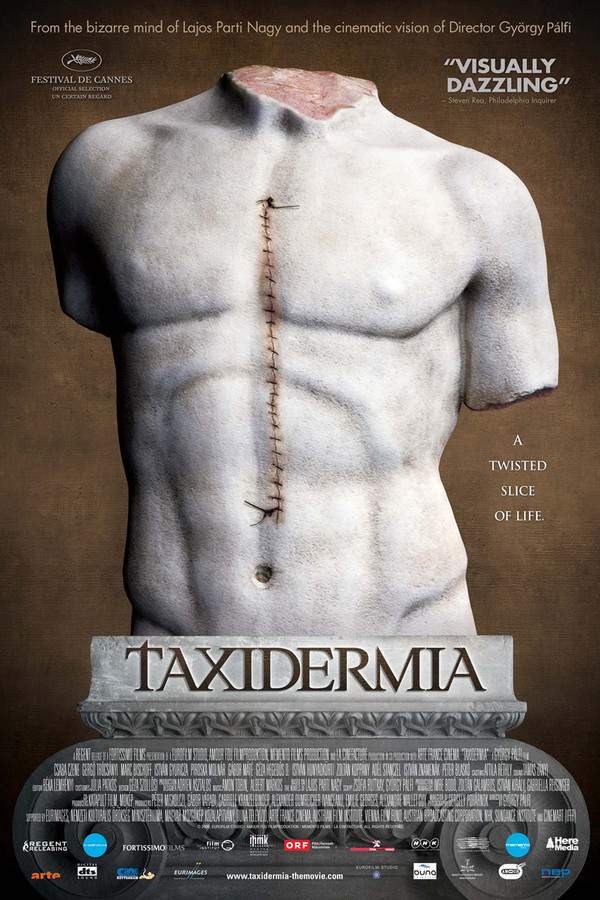
Taxidermia (2009) movie poster

Plot Summary

Taxidermia (2009) Plot Summary Explained

Release, runtime and language
2009 · 91 min · Hungarian
Directed by
György Pálfi

Three generations of men are portrayed with unusual obsessions and desires. The grandfather is consumed by recollections of war, while the father compulsively overeats in a desperate pursuit of accomplishment. His son, however, seeks an unattainable ideal of lasting perfection through the art of taxidermy, attempting to preserve life in a static, eternal form.

On this page (5)
  1. 1 Where to watch
  2. 2 What happens: full plot
  3. 3 Plot questions answered
  4. 4 Movie threads
  5. 5 Every angle

Where to watch

Where to Watch Taxidermia (2009)

Where can you watch Taxidermia? Stream, rent or buy it in the US, including on Here TV: current JustWatch availability with up-to-date prices.

Streaming availability powered by JustWatch

Full plot summary · contains spoilers

What Happens in Taxidermia: Full Plot Summary

The whole story of Taxidermia (2009) explained, from the opening scene to the final frame: every key event, every twist and what it all adds up to. Read it as a quick recap before the sequel, to check a scene you missed, or to finally understand what really happened.

At a desolate military outpost in Hungary, Morosgoványi Vendel finds himself trapped in a life of misery, serving under the tyrannical Öreg Balatony Kálmán. Forced into performing menial tasks for the officer and his family, Morosgoványi's living conditions are dismal, as he sleeps in an unheated shack next to the latrines. To escape this oppressive reality, he often immerses himself in vivid fantasies. In one particularly bizarre episode, he dreams of a sexual encounter with the lieutenant's wife, only to wake up to an even more shocking scene: engaging in an act of sodomy with a slaughtered pig. This gruesome revelation leads to his execution at the hands of Balatony Kálmán, who then raises his son, Balatony Kálmán, as his own.

Years later, Balatony Kálmán emerges as a formidable Hungarian speed-eating champion. Under the strict tutelage of Jenő, his life focuses solely on preparing for a time when the International Olympic Committee might recognize speed-eating as an official sport. After suffering from lockjaw during a Soviet competition and eloping with fellow speed-eating star Aczél Gizi, Kálmán's life is a whirlwind of rigorous training, especially as Gizi welcomes their son, Balatony Lajoska, into the world.

As time passes, Lajoska grows into a professional taxidermist. Unlike his parents, who are characterized by their significant weight, Lajoska possesses a frail, thin appearance that contrasts sharply with their imposing frames. While juggling his work at the taxidermy shop and struggling to live a normal life, he takes on the responsibility of grocery shopping for his father, who has become grotesquely obese and immobile, confined to a chair in their cramped apartment. Kálmán, who indulges in feeding butter to his caged cats, constantly berates Lajoska, pushing him to his breaking point. Feeling utterly defeated, Lajoska ultimately walks out on his father. Upon returning later, he is horrified to find the cats have broken free from their cages and have gruesomely eviscerated Kálmán out of sheer hunger.

In a macabre twist, Lajoska decides to stuff both his father and the felines. With little motivation left to live, he constructs a makeshift surgical harness and, using sedatives and painkillers alongside a heart-lung machine, embarks on the shocking act of removing his own internal organs. Finally, after preserving his body and sewing himself back up, he activates the machine that eventually beheads him, leaving behind a grotesque preserved figure. His remains are then displayed in a chilling exhibit alongside his father and the taxidermied cats, a testament to a life steeped in surreal tragedy and dark absurdity.

Last updated: November 16, 2024 at 12:32

Was this helpful?

Plot questions answered

Taxidermia Plot Explained: Your Questions Answered

The questions people ask most about Taxidermia (2009): what happens in the confusing scenes, why the characters do what they do, the twists, hidden details and what the ending means. Each answer contains spoilers.

Q1

Why was Morosgoványi Vendel executed?

Vendel was executed after being discovered in a grotesque act with a slaughtered pig. While escaping into fantasies about the lieutenant's wife, he awoke to find he had engaged in bestiality, which was witnessed by others. This horrific incident led Öreg Balatony Kálmán to order his execution.

Foreshadowing: Earlier scenes establish Vendel's desperate mental state as he copes with his miserable conditions through vivid daydreams.

  • execution
  • bestiality
  • morosgoványi vendel
  • balatony
  • kálmán
Q2

Why did Balatony Kálmán become a speed-eating champion?

After being raised by Öreg Balatony Kálmán following Vendel's execution, Kálmán dedicated his life to becoming a competitive eater with the hope that speed-eating would one day be recognized as an official Olympic sport. This pursuit gave his life meaning and purpose, representing his attempt to achieve greatness where his biological father failed.

Foreshadowing: The film establishes early that Kálmán was raised without a true father figure, leaving him driven to prove himself through achievement.

  • speed-eating
  • champion
  • olympic
  • dream
  • competition
Q3

Why did the cats kill Balatony Kálmán?

Kálmán became so grotesquely obese that he was confined to a chair and unable to care for himself. He kept cats in cages and fed them butter, but when Lajoska left the apartment after a confrontation, the cats escaped from their cages and, presumably out of hunger, brutally attacked and killed Kálmán.

Foreshadowing: Kálmán's obsessive feeding of butter to his caged cats establishes his detachment from reality and sets up the tragic outcome.

  • cats
  • attack
  • death
  • butter
  • evisceration
Q4

Why did Lajoska taxidermy his father's body?

When Lajoska returned to find his father dead and eviscerated by the cats, he decided to preserve both his father and the cats through taxidermy. This macabre act reflects his lifelong obsession with preservation and his final, twisted embrace of his family's dark legacy, creating a grotesque monument to their lineage.

Foreshadowing: Lajoska's career as a professional taxidermist and his fascination with preserving life in static form foreshadow this moment.

  • taxidermy
  • father
  • cats
  • preserve
  • body
Q5

Why did Lajoska perform self-taxidermy?

After stuffing his father and the cats, Lajoska felt he had nothing left to live for. In a final act of desperate artistic expression, he built a surgical harness, removed his own internal organs using sedatives and a heart-lung machine, preserved his body, and ultimately beheaded himself, creating the ultimate taxidermy piece and joining his father in the exhibit.

Foreshadowing: His frail, isolated existence and his breakdown after his father's constant berating hint at his fragile mental state.

  • self-taxidermy
  • suicide
  • preservation
  • surgery
  • beheading
Q6

What connects the three generations of men in the film?

Each generation is defined by a consuming obsession: Vendel by fantasizing to escape reality, Kálmán by speed-eating in pursuit of achievement, and Lajoska by taxidermy to preserve life eternally. All three live in isolation, lack meaningful human connection, and meet tragic ends, suggesting a循环 of futility and desperation passed down through the male line.

Foreshadowing: The film opens with Vendel's misery and tracks how each man's obsession becomes his downfall.

  • generations
  • obsession
  • family
  • legacy
  • cycle
Q7

Why did Kálmán elope with Aczél Gizi?

Gizi was also a speed-eating champion and Kálmán's fellow competitor. After suffering lockjaw during a Soviet competition, Kálmán eloped with Gizi, forming a partnership between two people who shared his obsessive dedication to competitive eating. Their union represented a blend of personal and professional connection.

Foreshadowing: The film establishes speed-eating as Kálmán's entire identity, making a partnership with another competitor natural.

  • marriage
  • elopement
  • acél gizi
  • speed-eater
  • competition
Q8

Why did Lajoska leave his father then return?

Lajoska was pushed to his breaking point after constantly being berated by his obese, immobile father despite caring for him. Feeling defeated and suffocated, he walked out seeking autonomy. However, he returned later, only to discover the horrifying scene of his father killed by the cats, drawing him back into the family's dark fate.

Foreshadowing: Tension between father and son builds throughout their scenes, with Kálmán's constant criticism creating inevitable conflict.

  • leaving
  • return
  • father
  • conflict
  • breakdown
Q9

What is the significance of the final exhibit?

The exhibit displays Lajoska's preserved body alongside his father and the taxidermied cats, a grotesque family portrait frozen in time. This final image encapsulates the film's themes of obsession, futility, and the desperate human desire to preserve memory and existence, even through extreme and disturbing means.

Foreshadowing: The entire narrative builds toward this culmination, with each man's obsession leading to their preservation.

  • exhibit
  • display
  • preserved
  • bodies
  • final scene

Movie threads

More Movies Like Taxidermia, by Mood & Story

Curated lists built around what makes Taxidermia tick: the same mood, the same kind of story or the same emotional payoff. Each list explains why these movies belong together.

Movies with grotesque body horror and surreal themes like Taxidermia

Surreal films where the human body becomes a canvas for obsession and decay. Discover movies like Taxidermia that explore the grotesque and surreal relationship between the physical body and psychological turmoil. These films often use shocking imagery and body horror to depict obsession, decay, and the darkly absurd corners of human experience.

  • grotesque
  • surreal
  • unsettling
  • macabre
  • absurd
  • body horror
  • Tone: dark, surreal, macabre
  • Pacing: steady, methodical
Why these movies?

The story pattern: Stories in this thread often feature characters whose physical transformations or obsessions reflect their internal struggles. The narrative progresses through surreal and symbolic events, leading to conclusions that are as bleak as they are inevitable, emphasizing the futility or tragedy of the characters' pursuits.

Why they belong together: Movies are grouped here for their shared commitment to using the grotesque and the bodily as a primary narrative device. They create a cohesive experience through a dark, surreal tone, high intensity, and a thematic focus on the physical manifestations of psychological despair.

Multi-generational stories of trauma and obsession like Taxidermia

Multi-generational stories where family legacies of obsession lead to bleak ends. If you liked the multi-generational structure of Taxidermia, explore these films that delve into family legacies of trauma, obsession, and futility. These complex narratives show how the sins and struggles of the past manifest in the lives of descendants, often leading to bleak outcomes.

  • grim
  • oppressive
  • desperate
  • tragic
  • family legacy
  • generational
  • Tone: grim, bleak, desperate
  • Pacing: steady, epic
Why these movies?

The story pattern: The narrative pattern follows a family across decades, with each generation inheriting and reinterpreting the same core flaws or traumas. The structure is often deliberate and steady, allowing the full weight of the legacy to accumulate, culminating in an ending that feels both shocking and fated.

Why they belong together: These films are united by their structural ambition and thematic depth, using the multi-generational framework to explore cycles of despair. They share a complex narrative, a bleak tone, and a heavy emotional weight, creating a powerful sense of inevitability and tragic legacy.

Every angle

Taxidermia (2009) Explained: Plot, Timeline & Characters

Everything about Taxidermia in one place: what happens in the plot summary, the timeline in chronological order, the characters and meaning and a spoiler-free summary. What's After the Movie adds the cast, box office and post-credit scenes.

Coming soon on iOS and Android

The Plot Explained Movie Summary App

Plot summaries, endings explained and timelines on your phone. Catch up on any movie in minutes, save your favorites and never miss a twist again.

Be the first to know when we launch. Your email stays private, always.

Learn more about the app