Year: 2026
Runtime: 1 h 29 m
Language: english
Director: Alex Ullom
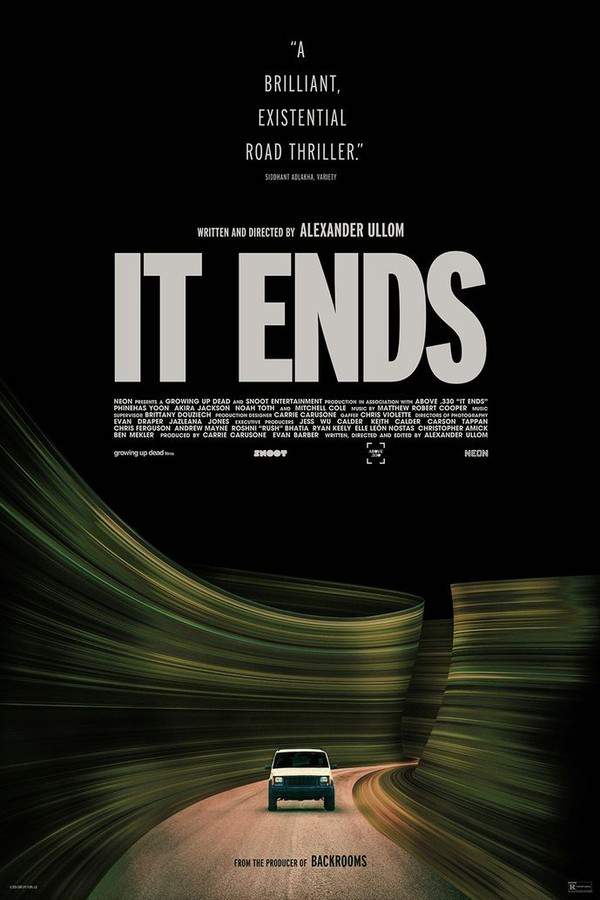
Recent graduates embark on a late‑night drive for a quick bite, hoping for one last hangout before their lives diverge. They accidentally turn onto a desolate two‑lane road that stretches endlessly, surrounded by incomprehensible horrors and cosmic forces. Cramped in a Jeep Cherokee, they must face the unknown as the miles keep expanding.
Warning: spoilers below!
Haven’t seen It Ends yet? This summary contains major spoilers. Bookmark the page, watch the movie, and come back for the full breakdown. If you're ready, scroll on and relive the story!
Read the complete plot breakdown of It Ends (2026), including all key story events, major twists, and the ending explained in detail. Discover what really happened, and what it all means.
Three recent graduates, James, Day, and Fisher, are picked up by their friend Tyler, whom they haven’t seen for a year. Tyler drives them down a forested road, and the group trades ideas about which animals would win in a fight as they chat and joke along the way. The turnoff Tyler hopes to reach remains elusive, and when he turns the car around, a thick wall of trees suddenly blocks the road. After Tyler steps out to investigate, a swarm of frantic people bursts from the forest, pleading to be let in. The four manage to push the car forward, but Fisher’s arm is clawed during the chaos. They pause briefly to tend to the wound, only for the vehicle to be swarmed again. As they struggle to understand their bizarre predicament, they realize the road seems to stretch endlessly, with no clear end in sight.
They push through the night, and James notices the fuel gauge hasn’t budged. Tyler surmises that the engine isn’t supposed to function properly and that they should not switch off the ignition. The trio drives for a full day, taking turns at the wheel, and they begin to notice an odd lack of fatigue or hunger; even Fisher’s arm seems to heal before their eyes. They start to theorize about why they are trapped on this interminable roadway. Using timers on their phones, they conclude there’s a 90-second window after stopping before the car is attacked again. Tyler wanders into the woods and finds it continues without end, and the people around him appear docile within.
Inside the car, they inventory supplies, noting a Clif Bar among the items, and James cautions against eating it. Frustration grows, and Tyler and James restrain and question a man they pull from the forest, but the man does not respond. They eventually discover an abandoned car parked on the opposite side of the road, its keys missing and the odometer reading maxed out at 999,999 miles.
After more than 50,000 miles of driving, Tyler concedes defeat and stays behind in the forest as the others continue ahead. Time passes, and the remaining three adapt to the monotony, scavenging from abandoned vehicles to amuse themselves while maintaining a rhythm of similar conversations and rest stops. Day and Fisher begin daily screaming sessions to vent their frustration, something James does not participate in. Day and Fisher settle into the routine more readily than James, who remains fixated on finding a way out. One day, while inspecting another abandoned car, they notice that no one is emerging from the woods anymore. James feels a spark of hope, but Fisher and Day are less enthused.
At 835,000 miles, Day removes the keys from the ignition, and the two tell James that there is no escape and that he is torturing himself with hope by continuing to drive. In a tense struggle over the ignition, James wrests the keys from Fisher; he tries to restart the engine, and, after a moment of seeming failure, a prayerful plea is followed by the engine finally turning over. James drives off, leaving Day and Fisher behind. Left alone on the road, the two share a quiet, uneasy embrace.
When the odometer passes 1,100,000 miles, it begins to rain, adding to James’s unease. He continues driving and eventually comes across dozens of abandoned cars lining the road. He ventures on foot past the vehicles and reaches the end: a circular strip of asphalt surrounded by cars from different eras, with a single sign that reads, “ROAD ENDS.” James sits at the edge of the circle for a long time before returning to the car, consuming the Clif Bar, and crying. He then unleashes another loud screaming session outside the vehicle before climbing back in and resuming the journey down the endless road. Later, James encounters another empty vehicle and drags a lethargic man off the roadside into the car. As he drives, the now-responsive man joins in a discussion about which animals would win in a fight.
Last updated: September 03, 2026 at 09:21
Explore frequently asked questions about It Ends (2026) with spoiler-rich answers covering the full plot summary, major story beats, character motivations, hidden details, and ending meaning. This movie summary FAQ helps explain confusing scenes, plot twists, and narrative decisions in clear, searchable detail.
After Tyler turns the Jeep around to find the elusive turnoff, the forest rearranges itself and a thick wall of trees seals the road behind them, trapping the group. This is the moment the ordinary drive becomes a supernatural trap, with the road itself reshaping into an inescapable prison. The blocking trees are never explained, but they function as the boundary of the cosmic space the friends have unknowingly entered in It Ends.
Earlier, Tyler mentions struggling to find the correct turnoff, hinting that the road is not behaving like a normal stretch of forest.
The swarms are groups of panicked people who burst from the forest, clawing at the Jeep and begging to be let inside. They appear every time the car stops, always within the narrow window the group later identifies. Their origins are never explained, but they appear to be other victims trapped on the endless road, driven to desperation by the same incomprehensible forces.
The first swarm appears immediately after Tyler steps out to investigate, suggesting the people are drawn to any opening or stillness on the road.
Tyler reasons that the engine should not even function properly in this place, and the group quickly notices they never tire, never grow hungry, and that Fisher's clawed arm heals almost instantly. This implies the normal laws of biology and physics no longer apply, they are caught in a supernatural or afterlife-like state where their bodies are preserved indefinitely. The unchanging fuel gauge is the clearest evidence that the road exists outside normal reality.
Tyler warns early on not to switch off the ignition, hinting that something about the car's operation is already unnatural.
Using phone timers, the group measures the interval between stopping the car and being attacked by the frantic people emerging from the forest. They find they consistently have about 90 seconds before the swarms reach them. This narrow window allows them to tend to wounds, inspect the woods, and even pull strangers from the treeline without being immediately overrun.
The first attack happens almost the instant the car stops, giving the group a baseline to measure every future stop against.
When they inventory the car, James spots a Clif Bar and cautions against eating it, though his reasoning is never fully explained. The bar becomes a symbolic object that James protects for the entire journey, and he finally eats it only after sitting beside the "ROAD ENDS" sign. His early warning suggests he sensed the bar should be saved for a moment of final acceptance rather than consumed out of habit.
James's caution during the inventory is the first sign that the Clif Bar holds unusual symbolic weight for him.
They find an empty car parked on the opposite side of the road with no keys and an odometer maxed out at its highest possible reading of 999,999 miles. It implies someone else drove to the literal limit of the odometer, well over a million miles, before vanishing. The car serves as a grim confirmation that the road is truly endless and that others have been trapped in it long before James and his friends.
The discovery comes shortly after Tyler gives up, reinforcing that the road defeats everyone in the end.
After more than 50,000 miles of driving without progress, Tyler concedes that there is no way out and chooses to leave the Jeep behind. He opts to settle in the docile forest rather than continue an endless drive with no destination. His departure marks the first fracture in the group and establishes the pattern of resignation that Day and Fisher later embrace.
Tyler's early frustration over the missing turnoff foreshadows his decision to stop fighting the road altogether.
By that point, Day and Fisher have accepted that escape is impossible and believe James is tormenting himself by clinging to hope. They remove the keys from the ignition to force the car to a permanent halt. The conflict between James's stubborn hope and their resignation becomes the emotional core of the film's second half, culminating in a physical struggle over the keys.
Day and Fisher's daily screaming sessions contrast with James's refusal to participate, foreshadowing their opposing responses to the road.
After wrestling the keys back from Fisher, James tries to restart the Jeep, but it initially does not turn over. He makes a prayerful plea, and only then does the engine catch. The moment suggests the road may respond to willpower, faith, or emotional intensity, or that the road itself is choosing whether to let him continue, reinforcing that the supernatural rules governing the space are tied to the driver's state of mind.
Tyler's early warning not to switch off the ignition hints that the car's operation is bound to something more than mechanics.
After passing 1,100,000 miles, James encounters dozens of abandoned cars lining both sides and proceeds on foot to the road's conclusion. He finds a circular strip of asphalt surrounded by vehicles from different eras, with a single sign that reads "ROAD ENDS." The end offers no exit, no portal, and no revelation, only a physical boundary that confirms the road was never meant to lead anywhere meaningful.
The discovery of the first maxed-out odometer hinted that other drivers had reached similar dead ends long before James.
Earlier, James had warned the group not to eat the Clif Bar, treating it as something to be preserved. After sitting at the edge of the circular end for a long time, he returns to the car, eats the bar, and breaks down crying. The act signals final acceptance, he has nothing left to save it for, and his hope of escape has fully collapsed. Eating it marks the moment he stops rationing both the food and his own will to fight.
James's inventory-time warning against eating the bar set up its later consumption as a payoff.
Near the end, James drags a lethargic man from the roadside into the Jeep; once inside, the man becomes responsive and joins James in debating which animals would win in a fight, the same playful topic from the very beginning of the film. This circular conversation strongly implies James has become the next Tyler, picking up new passengers to begin the loop again on the endless road. The film closes on the suggestion that the cycle of false hope and slow despair will repeat indefinitely.
The very first scene establishes the animal-fight debate as the group's signature ritual, making its return at the end a deliberate structural echo.
Still wondering what the ending of It Ends (2026) really means? Here’s a spoiler-heavy breakdown of the final scene, major twists, and the deeper themes that shape the film’s conclusion.
The endless road separates the friends according to what each can accept. Tyler gives up first, while Fisher and Day eventually stop driving because companionship has become more meaningful than an answer that may never arrive. James cannot stay with them; he continues alone until he reaches a literal end of asphalt surrounded by abandoned cars. There is no revelation about punishment, cosmic rules, or a mistake that placed them there. The road simply ends, shattering James’s belief that enough persistence will produce a structural explanation for the ordeal and for the uncertain adulthood it represents.
Director Alex Ullom describes James’s realization as acceptance that he cannot know. Deprived of an external answer, James understands that the only meaning available lies in the moments he shared with the others. Fisher and Day reached that truth earlier by choosing one another over forward motion, whereas James had to exhaust the road before he could value the same thing. The final turn is therefore more hopeful than the setting suggests: uncertainty does not disappear, but it no longer has to prevent connection. The horror and hangout movie resolve their conflict when James stops treating life as a puzzle whose solution matters more than the people traveling beside him.
Last updated: August 25, 2026 at 14:20
Don't stop at just watching - explore It Ends in full detail. From the complete plot summary and scene-by-scene timeline to character breakdowns, thematic analysis, and a deep dive into the ending - every page helps you truly understand what It Ends is all about. Plus, discover what's next after the movie.
Track the full timeline of It Ends with every major event arranged chronologically. Perfect for decoding non-linear storytelling, flashbacks, or parallel narratives with a clear scene-by-scene breakdown.
Discover the characters, locations, and core themes that shape It Ends. Get insights into symbolic elements, setting significance, and deeper narrative meaning - ideal for thematic analysis and movie breakdowns.
What really happened at the end of It Ends? This detailed ending explained page breaks down final scenes, hidden clues, and alternate interpretations with expert analysis and viewer theories.