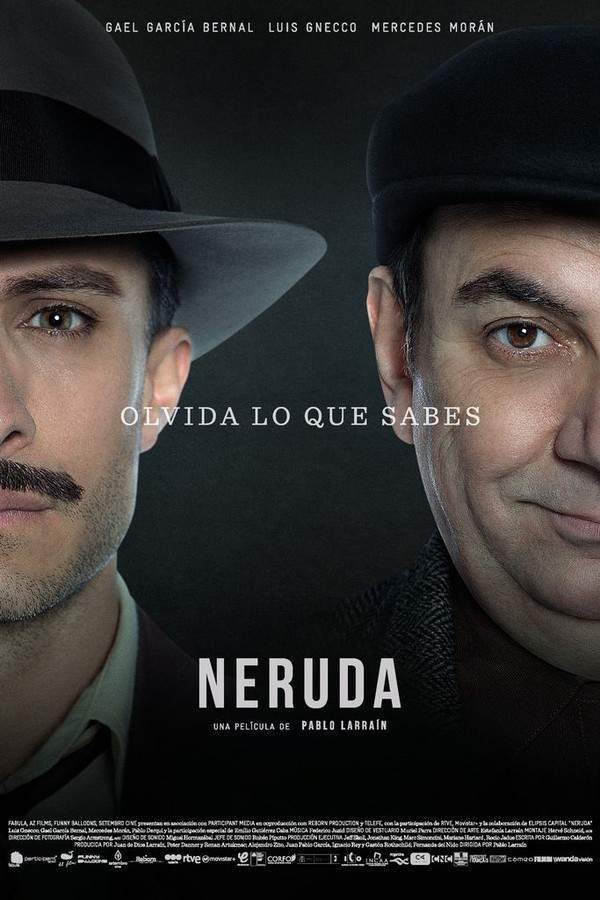
In 1946, Chile finds itself at a crossroads of politics and courage. Chile’s president Gabriel González Videla wins the election with Communist support, but soon betrays that backing by banning the party and ordering mass arrests. Senator Pablo Neruda, portrayed by Gael García Bernal, a former ambassador and renowned poet, openly condemns the repression, placing himself in danger as the regime tightens its grip. Neruda and his wife Delia attempt to flee to Argentina through the mountains, yet their path is harshly blocked at the border, forcing them into a perilous hiding.
Entered into this tense landscape is Oscar Peluchonneau, a young policeman played by Luis Gnecco. Tasked with capturing Neruda, Peluchonneau throws himself into the investigation, but rather than a straightforward hunt, he becomes absorbed in understanding his elusive target. He studies Neruda’s life and poetry, trying to map the mind behind the public figure, while Neruda makes unexpected appearances that undermine the hunter’s certainty. The poet leaves volumes of poetry as a quiet, persistent act of resistance, turning the pursuit into a cat-and-mouse game where Neruda is always one step ahead.
As the pursuit intensifies, Neruda’s circle secures smugglers to ferry him across the border by horseback, turning the journey into a fragile, improvised escape. Delia is captured and interrogated by Peluchonneau; in a fierce, piercing remark, she suggests that the policeman is secondary to the story’s larger truth, a line that unsettles Peluchonneau and gnaws at his confidence, hinting that Neruda’s legacy will endure even if Peluchonneau fades into fiction.
The group presses through the snowy forests toward the border, while Peluchonneau presses forward in a relentless pursuit that cannot close the gap. The chase culminates with Peluchonneau dying on a wintry mountaintop, abandoned by his indigenous guides. Neruda later discovers his body, a stark moment that underscores the thin line between reality and myth. Peluchonneau’s grip on reality fractures as he becomes part of the fiction he once chased, a meta turn that echoes Neruda’s enduring impact.
Neruda finally reaches Paris, where he is warmly received by Pablo Picasso and becomes a media sensation. In a public sphere that amplifies his voice, Neruda references Peluchonneau at a press conference, granting the hunter a kind of immortality within the story he once hunted. The film explores themes of memory, power, and the way a poet’s persistence can outlast the men who pursue him, leaving behind a legacy that outlives the chase.