Plot Explained Spoilers guaranteed!
Plot Explained

Browse by genre

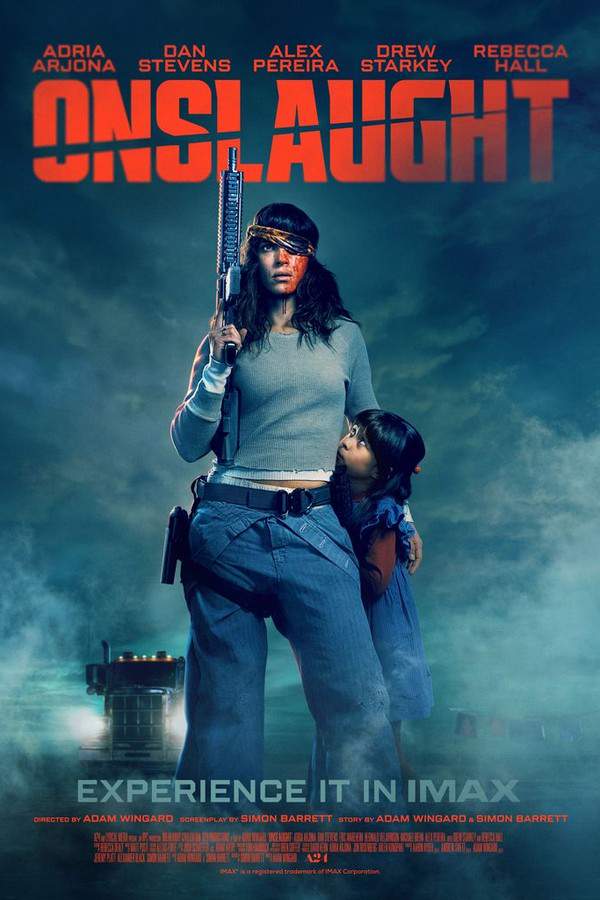
Onslaught (2026) movie poster

Plot Summary

Onslaught (2026) Plot Summary & Ending Explained

Release, runtime and language
2026 · 1 h 32 m · English
Echo score 65
Directed by
Adam Wingard
Starring
Adria Arjona, Sarah Minnich, Rebecca Hall, Michael Biehn, Dan Stevens, Jasper Keen
Budget
$15M

When a rogue squad of genetically engineered super soldiers break loose in the desert, a badass Army sniper must unleash hell to protect her young daughter.

On this page (5)
  1. 1 What happens: full plot
  2. 2 Plot questions answered
  3. 3 How it ends
  4. 4 Movie threads
  5. 5 Every angle

Full plot summary · contains spoilers

What Happens in Onslaught: Full Plot Summary

The whole story of Onslaught (2026) explained, from the opening scene to the final frame: every key event, every twist and what it all adds up to. Read it as a quick recap before the sequel, to check a scene you missed, or to finally understand what really happened.

The film begins with Celeste, portrayed by Adria Arjona, an ex-army sniper, honing her shooting skills on some pumpkins outside her trailer. The tension in her arms is evident as she even uses her ring to inflict a small bruise on herself, which surprisingly assists her focus and steadies her aim. Meanwhile, Dr. Hans Kammler (played by Dan Stevens) and his wife Hanna (depicted by Rebecca Hall) seem to be starting their day with an unusual intimacy. Hans departs on a helicopter for his laboratory while Hanna watches from below, concerned.

In a poignant scene, Celeste’s ex, Griffin (portrayed by Jacob Scipio), brings their daughter Daisy (played by Blake Kennedy) to the trailer park. As Daisy enters the trailer, Griffin breaks the news to Celeste that he plans to relocate with Daisy to another state. Celeste reacts with distress, fiercely confronting him about his wish to separate her from their child. Among the residents at the trailer park are Josiah (played by Reginald VelJohnson) and Kovacks (portrayed by Eric Wareheim), who add to the mix of Celeste’s complicated life.

In a darker turn, Hans and his team conduct experimental tests on three male subjects who are ex-soldiers. They are being closely observed by Baylor (portrayed by Michael Biehn), who represents an unidentified organization. The first subject, known as Crybaby (played by Tyler Hall), earned his nickname for breaking down after a horrific event involving civilian casualties. The second, dubbed Cockroach (portrayed by Dave Campbell), has survived numerous gunshot wounds, while the last, The Butcher (played by Alex Pereira), was once a combat instructor notorious for his brutal methods. In a shocking display of their capabilities, Hans exposes the men to a lethal gas, leading to a horrific outcome where they ultimately rise against their handlers in a violent rebellion.

As chaos unfolds, Celeste takes Daisy to a gas station for refreshments. The tension escalates when Daisy glimpses the trio of brutalized soldiers, who vanish before Celeste can see them. Shortly after, the three men arrive, wreaking havoc at the gas station, leaving no survivors. This incident draws the attention of Cyrus (portrayed by Drew Starkey), an agent who is notified and begins tracing the path of destruction left behind by the super soldiers. At the tragic scene of Hans's lab, he learns the horrifying truth from Larkin (played by Leon M. Brown) that Hans has been manipulating these men to function as ideal combatants, stripped of their humanity.

Cyrus's mission intensifies when he is directed by Hanna to monitor the chaos rather than intervene directly. As the evening progresses, the super soldiers descend upon the trailer park, where they begin their slaughter. In a gut-wrenching moment, The Butcher murders a resident doing laundry, while Cockroach kills another neighbor during a casual barbecue. Amidst the chaos, Celeste realizes the danger and rushes to protect Daisy, but not before losing her eye during a brutal encounter when Crybaby attempts to invade her home.

As they flee for safety, Celeste musters her courage and arms herself for a fight. When Crybaby aggressively pursues her in a chainsaw duel, Celeste fights back heroically, ultimately leading to a violent conclusion where she avenges her injuries by slaying him. The turmoil continues as Cockroach meets his end in a deadly car crash, while Daisy narrowly escapes from The Butcher’s clutches.

In an emotional climax, Celeste confronts The Butcher, discovering his identity—he was part of her infantry once lost in battle. In a fierce encounter, she defeats him, impaling him with a chainsaw. After the horrific night comes to an end, government agents, including Cyrus, arrive to clean up the aftermath, while Josiah gradually regains consciousness from his wounds. Cyrus informs Celeste that for her and Daisy’s safety, they need to relocate and remain silent about the events that transpired. In the end, Hanna views the grotesque experiment as a twisted success, while Celeste reassures Daisy, hinting that change might be on the horizon for them both.

Last updated: September 18, 2026 at 09:00

Was this helpful?

Plot questions answered

Onslaught Plot Explained: Your Questions Answered

The questions people ask most about Onslaught (2026): what happens in the confusing scenes, why the characters do what they do, the twists, hidden details and what the ending means. Each answer contains spoilers.

Q1

Why does Celeste cut herself with her ring before shooting?

In the opening scene of Onslaught, Celeste, a former Army sniper, deliberately makes a small cut with her ring to create pain that steadies her trembling arms and sharpens her focus. The technique functions as a self-inflicted grounding mechanism, using controlled physical discomfort to override the anxiety and tremor that still affect her after leaving military service.

Foreshadowing: This opening detail establishes that Celeste's combat instincts are still active even in civilian life, foreshadowing how quickly she will snap back into sniper mode when the trailer park comes under attack.

  • celeste ring cut
  • sniper steadying aim
  • opening scene
Q2

Why does Griffin want to move Daisy to another state without Celeste?

Griffin informs Celeste that he is relocating with their daughter Daisy to a different state, which sparks a violent confrontation. The summary does not give a stated reason, but the decision isolates Daisy from Celeste's unstable, post-service lifestyle in the trailer park and signals that Griffin believes the environment is not a healthy place to raise her.

Foreshadowing: This custody conflict becomes irrelevant once the super soldiers attack the trailer park, but it sets up Celeste's fierce protectiveness over Daisy that drives the rest of the film.

  • griffin custody
  • daisy move
  • celeste daughter
Q3

How do the three super soldiers break loose from Hans's lab?

Hans Kammler exposes Crybaby, Cockroach, and The Butcher to a lethal gas as part of his experiment to engineer unstoppable combatants. Instead of dying, the men revive instantly and immediately turn on their handlers, massacring the lab staff including Hans himself, with The Butcher delivering the killing blow.

Foreshadowing: Baylor's visible disgust during the demonstration hints that the experiment has already crossed a threshold the observers cannot control.

  • lab break
  • super soldiers escape
  • hans kammler death
Q4

Why are the three soldiers called Crybaby, Cockroach, and The Butcher?

Each nickname comes from a defining trauma in the soldier's military past. Crybaby broke down emotionally after a civilian-casualty incident, Cockroach survived countless gunshot wounds that should have killed him, and The Butcher was a combat instructor famous for brutally savage training methods. The names effectively catalog the psychological and physical scars that made them candidates for Hans's genetic enhancement program.

Foreshadowing: Their origins as ex-soldiers with extreme battlefield histories explain why Dr. Kammler chose them specifically for the experimental program.

  • crybaby cockroach butcher
  • super soldier names
Q5

Why does Cyrus only monitor the attack instead of intervening?

Cyrus is dispatched by Hanna, who is connected to the program funding the experiments. Rather than engaging the super soldiers, he is ordered to trace their path and observe the destruction, ensuring the incident is studied rather than stopped. This hands-off approach protects the program's existence and allows those involved to control the narrative of what happened.

Foreshadowing: Hanna's concern as Hans departs in the helicopter early in the film hints that she is far more entangled in the project than a worried spouse.

  • cyrus mission
  • hanna orders
  • government cover
Q6

How does Celeste lose her eye during the trailer park attack?

As Celeste rushes to secure Daisy inside their trailer, Crybaby attempts to break in with a chainsaw. During the violent struggle at the door, Celeste takes a shot to the eye, leaving her severely wounded but still able to shield Daisy and eventually turn the fight around using her sniper training.

Foreshadowing: Celeste's earlier habit of using pain to steady herself resurfaces here, as she channels her injury into hyper-focus during the chainsaw confrontation.

  • celeste eye injury
  • crybaby chainsaw
  • trailer attack
Q7

Why does The Butcher reveal he was part of Celeste's old infantry?

During their climactic fight at the trailer park, The Butcher discloses that he served in the same infantry unit as Celeste and was one of the soldiers lost during a previous battle. The connection reframes the entire showdown as a personal reckoning with a comrade who was presumed dead but has now been twisted into a weapon by Hans's experiments.

Foreshadowing: Celeste's lingering combat trauma, established through her trembling hands and self-inflicted pain in the opening, takes on new weight once her military past literally returns to hunt her.

  • the butcher celeste
  • former infantry
  • lost soldier
Q8

Why does Hanna see the experiment as a success at the end?

Even after Hans is killed and the three test subjects are taken down, Hanna evaluates the program as successful because the soldiers demonstrated the ability to recover from lethal conditions, sustain extreme damage, and eliminate targets with overwhelming efficiency. For her, the proof of concept outweighs the human cost, confirming that enhanced combatants can be deployed as designed.

Foreshadowing: Her detached reaction contrasts with the concern she shows watching Hans leave for the lab, signaling that her unease was never about the ethics of the work itself.

  • hanna success
  • experiment outcome
  • program results
Q9

Why does the government force Celeste and Daisy into silence and relocation?

After the super soldiers are neutralized, Cyrus and other agents arrive to seal off the trailer park and inform Celeste that she and Daisy will be moved somewhere safe but must never speak about what happened. The cover-up protects the existence of the enhancement program, shields the unnamed organization Baylor represents, and prevents public exposure of the fact that government-backed experiments produced killers who attacked American civilians.

Foreshadowing: Cyrus being ordered to 'monitor, not intervene' earlier in the film establishes the chain of command that ultimately enforces the silence.

  • government cover up
  • relocation
  • witness silence
Q10

Who is Baylor, and what organization does he represent?

Baylor is an observer at Hans's laboratory who watches the experiments on the three super soldiers and expresses disgust at the brutality. He represents an unidentified outside organization that has a stake in the program, but the summary never clarifies whether he is military, intelligence, or a private contractor, leaving his exact role deliberately ambiguous.

Foreshadowing: His silent observation implies that the project has sponsorship beyond Hans himself, which connects to the broader cover-up at the end of the film.

  • baylor organization
  • observer role
  • unknown agency
Q11

Why do the super soldiers specifically attack the trailer park?

After escaping the lab and massacring the gas station, the soldiers continue along a path of destruction rather than choosing targets strategically, and the trailer park simply lies in their trajectory. Celeste and Daisy are not singled out in advance; the park is overwhelmed because it is unguarded, populated, and on the soldiers' rampaging route.

Foreshadowing: Daisy's earlier sighting of the three men at the gas station, before Celeste notices them, signals that the soldiers were already heading toward the park.

  • trailer park attack
  • soldier rampage
  • target choice
Q12

How does Celeste finally defeat The Butcher?

In the final showdown at the trailer park, Celeste turns the chainsaw that Crybaby had used against her into a weapon and impales The Butcher with it. The moment completes her arc from wounded victim to the one who delivers the killing blow, using the very tool that symbolized the soldiers' brutality against its wielder.

Foreshadowing: Her sniper precision from the opening scene pays off here, as she exploits the same controlled focus to land the fatal strike on a former comrade.

  • celeste kills butcher
  • chainsaw weapon
  • final fight
Q13

What happens to Josiah and Kovacks after the trailer park massacre?

Josiah survives the attack and gradually regains consciousness from his wounds as government agents secure the area the following morning. Kovacks is not shown after the violence, leaving his fate unclear in the provided summary, though the implication is that he is among the casualties or traumatized survivors of the assault.

  • josiah survivor
  • kovacks fate
  • trailer park aftermath

Ending explained

What Happens at the End of Onslaught?

How Onslaught (2026) ends, in short: the final scene, the last twist and what it means for the characters. The full ending explained, with every spoiler, lives on its own page.

Read the full ending explained

Celeste defeats Butcher, the soldier whose earlier death has haunted her memories of combat, after he has been brought back as an experimental weapon. Surviving the attack leads to Cyrus offering her relocation in exchange for silence, and she agrees that she is ready to move. The apparent chance to begin again becomes less reassuring during the credits: documents identify both Celeste and Daisy as missing, while a map suggests they have been placed in Alaska. The film never confirms that this new life gives them ordinary freedom.

Celeste's confrontation with Butcher makes the physical threat inseparable from the trauma she brought home from military service. Her victory offers a measure of relief, but the machinery that turned a casualty into a weapon still controls what happens to the survivors. The missing-person material can therefore be read as evidence of containment rather than a straightforward fresh start. Remaining together matters, yet it does not establish that Celeste and Daisy can leave, maintain other relationships or avoid further exploitation. The immediate attackers are defeated; the institutional threat remains.

Onslaught ending explained in full

Movie threads

More Movies Like Onslaught, by Mood & Story

Curated lists built around what makes Onslaught tick: the same mood, the same kind of story or the same emotional payoff. Each list explains why these movies belong together.

Parental siege survival movies like Onslaught

One fierce protector, one child to save, and an enemy that won't stop coming. If you loved how Onslaught turns a mother-daughter bond into a brutal war of survival, these action-horror and thriller stories deliver the same emotional gut-punch. They feature fierce parents—often single mothers or estranged heroes—who unleash their deadliest skills to protect their children against impossible odds. Expect graphic violence, heavy emotional weight, and bittersweet victories where family survival comes at a devastating cost. Perfect for fans searching for movies like Onslaught with the same protective rage and child-endangerment tension.

  • protective rage
  • child in danger
  • lone protector
  • siege
  • fierce mother
  • exhausting
  • Tone: gritty, tense, bittersweet
  • Pacing: variable, escalating violence
Why these movies?

The story pattern: The parent begins in a domestic space, usually isolated or running from something. Combat competence is hinted at but rarely used—until a monstrous external force closes in. The child becomes the moral anchor, transforming lethal skill into desperate protection. Expect a long night of escalating violence, an exhausted protagonist, and a dawn that feels earned but never fully happy. The win is always partial: the family survives, but the world has changed them.

Why they belong together: These movies share the recipe of a deeply personal stakes anchor (the child) fused with relentless, graphic violence, isolation under siege, and an ending where survival is real but the cost is permanent. The protective parent archetype meets a near-impossible threat, and the emotional power comes from the collision between love and violence. Tonal cousins include both the visceral action of military thrillers and the slow dread of post-apocalyptic survival.

Shadow government conspiracy movies like Onslaught

The real enemy wears a suit, and the program that made them is still running. Onslaught's darkest layer is the secret program behind its super soldiers—and the disturbing fact that it survives the heroes' victory. These action, thriller, and sci-fi movies dive into the same shadow-state territory: secret military experiments, engineered weapons deployed against citizens, and conspiracies that bury every witness. If that paranoid, bleak nerve hooked you, these similar thrillers and sci-fi action movies will hit the same institutional bite.

  • conspiracy
  • genetic experiments
  • state violence
  • cover-up
  • engineered soldiers
  • domestic threat
  • Tone: dark, paranoid, bleak
  • Pacing: variable, layered reveals
Why these movies?

The story pattern: A surface-level monster or crisis unfolds—often as visceral action—but pulls the protagonist into a deeper rabbit hole of classified programs, betrayed allegiances, and silent institutions. The immediate threat may be neutralized, but the architecture that produced it remains intact. Endings trend ambiguous to bittersweet: the bullet is dodged, the program is not. Justice arrives in fragments, never as a clean victory.

Why they belong together: These films share a paranoid, institutional-distrust worldview where the visceral hero fantasy coexists with a cynical reading of state power. They combine graphic violence with thematic bite, rewarding viewers who notice small details—classified files, hidden labs, sideline operatives—that signal the conspiracy's real scope. The monster is rarely the true enemy; the apparatus that built it is.

Every angle

Onslaught (2026) Explained: Plot, Ending, Timeline & Characters

Everything about Onslaught in one place: what happens in the plot summary, the timeline in chronological order, the characters and meaning, the ending explained and a spoiler-free summary. What's After the Movie adds the cast, box office and post-credit scenes.

Coming soon on iOS and Android

The Plot Explained Movie Summary App

Plot summaries, endings explained and timelines on your phone. Catch up on any movie in minutes, save your favorites and never miss a twist again.

Be the first to know when we launch. Your email stays private, always.

Learn more about the app