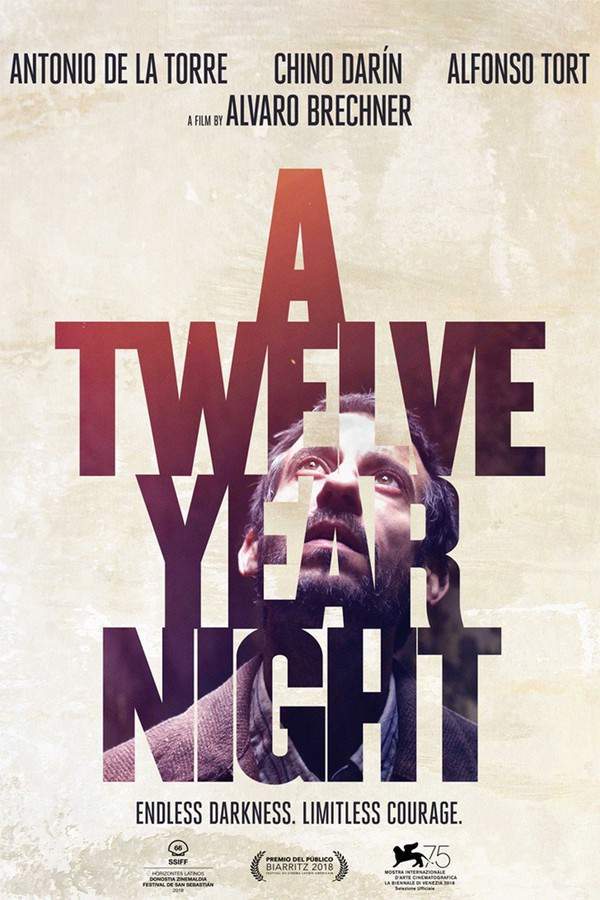
On 23 November 1977, during Argentina's last civil-military dictatorship, Claudio Tamburrini Rodrigo De la Serna, a goalie for a minor league soccer team in Buenos Aires, is abducted by members of the Argentine secret military police. He is taken to a detention center known as Mansión Seré—an old, dilapidated house in the suburban neighborhood of Morón—on the suspicion that he is a guerrilla opponent of the regime. Blindfolded, Tamburrini endures daily torture as his jailers press for information he does not have, because he is not a political activist. He discovers that an acquaintance nicknamed El Tano has lied under torture and falsely implicated him, claiming Tamburrini possesses a mimeograph. On New Year’s Eve, Huguito [Pablo Echarri] as the lead captor mocks Tamburrini with a supposed chance of release, only to move him to another room crowded with more captives. When Huguito orders Tamburrini to remove his blindfold and look at him, Tamburrini realizes he will never be released alive.
A new captive, Guillermo [Nazareno Casero], arrives and admits that he was the one with the mimeograph, which he used to produce fake papers for Tano. Tamburrini hopes this clears his name, but Guillermo explains that to save himself he will have to implicate someone else, and Tamburrini refuses. Tano and a dozen other prisoners are told they are being transferred to prison, but in reality they are drugged and handed over to the Argentine Air Force, presumably for a death flight. From that moment, Tamburrini braces for an uncertain fate, clinging to the hope that survival will require extraordinary endurance.
After four long months of imprisonment and repeated torture, Tamburrini and three fellow captives—Guillermo [Nazareno Casero], El Vasco [Matías Marmorato], and Gallego [Lautaro Delgado Tymruk]—make a desperate bid for freedom. They dive out a window during a thunderstorm, naked and stripped of almost everything but their senses. The escape takes them through a night of peril as they hide in the suburbs. Once they gain cover, the quartet manages to acquire money and clothes, and a plan begins to form. They split up, with three of them heading to leave the country, including Tamburrini, while the fourth stays behind for a time. In the aftermath, Tamburrini eventually leaves the country, and many years later writes the book on which this film is based, providing a hard-won account of his ordeal, the moral ambiguities of survival, and the lasting scars left by a regime that vanished thousands while leaving family and communities to pick up the pieces.
The story is a stark, restrained recounting of fear, resilience, and the human cost of political repression. It quietly emphasizes the bonds formed under pressure, the uneasy alliances that emerge in crisis, and the long arc from captivity to memory—culminating in a survivor’s chronicling of events that sought to erase him but ultimately could not erase his account. The film remains faithful to a real, brutal history, presenting the dim, claustrophobic world of a detention center and the perilous path to freedom with a steady, unflinching gaze. Through Tamburrini’s eyes, viewers witness a harrowing snapshot of a nation’s past—and a reminder that courage often comes in the form of choosing to tell the truth, even when the odds are overwhelming.