Plot Explained Spoilers guaranteed!
Plot Explained

Browse by genre

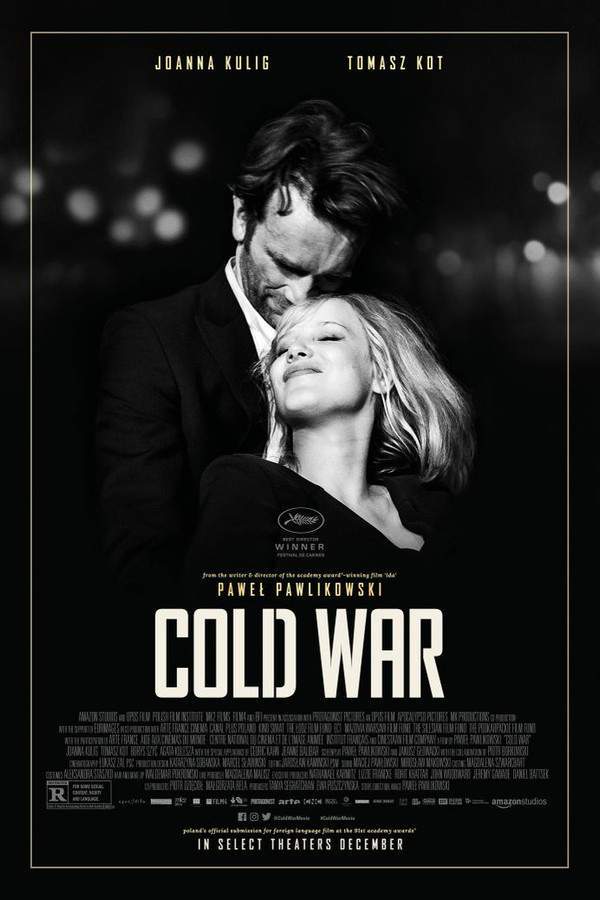
Cold War (2018) movie poster

Plot Summary

Cold War (2018) Plot Summary Explained

Release, runtime and language
2018 · 89 min · Polish
Echo score 79
Directed by
Pawel Pawlikowski
Starring
Agata Kulesza, Jeanne Balibar, Adam Ferency, Adam Szyszkowski, Adam Woronowicz, Borys Szyc
Budget
$4.3M

Set against the political turmoil of post-World War II Europe, a passionate and complex relationship develops between a Polish classical pianist and a young dancer. Their connection is tested by ideological differences and the ever-present shadow of the Cold War, forcing them to confront difficult choices and make sacrifices. As their personal lives intertwine with the broader political landscape, they must grapple with the consequences of their love and the uncertain future that lies ahead.

On this page (6)
  1. 1 Where to watch
  2. 2 What happens: full plot
  3. 3 Plot questions answered
  4. 4 Movie threads
  5. 5 Movies like Cold War
  6. 6 Every angle

Where to watch

Where to Watch Cold War (2018)

Where can you watch Cold War? Stream, rent or buy it in the US, including on Amazon Prime Video, History Vault and Fawesome: current JustWatch availability with up-to-date prices.

Streaming availability powered by JustWatch

Full plot summary · contains spoilers

What Happens in Cold War: Full Plot Summary

The whole story of Cold War (2018) explained, from the opening scene to the final frame: every key event, every twist and what it all adds up to. Read it as a quick recap before the sequel, to check a scene you missed, or to finally understand what really happened.

In post-WWII Poland, specifically the year 1949, a passionate trio of creative minds embark on a journey across the war-torn countryside. This group consists of the talented music composer and pianist Wiktor, the skilled dance choreographer Irena, and their pragmatic manager Kaczmarek. Their mission is to collect traditional folk songs and dances from rural communities. Despite Kaczmarek's skepticism regarding the commercial viability of these regional dialect songs, they persevere in their quest.

They record an array of captivating folk melodies and subsequently hold auditions in an abandoned palatial venue to form a vibrant folk dance group. It is during these auditions that Wiktor encounters Zula, who captivates him with her remarkable singing ability. As they progress, Wiktor learns of Zula's troubled past, including her time in prison due to a traumatic incident involving her father.

Fast forward to 1951, after a successful two-year rehearsal timeline, the dance ensemble presents a performance in Warsaw that receives an enthusiastic response. Following this triumph, Wiktor and Zula share an intimate moment in a restroom. However, the triumph is overshadowed when a government official demands a show lauding the communist regime, a request met with resistance from Irena, yet ultimately conceded by Kaczmarek. Both Wiktor and Irena express their distress over the situation.

Deciding to escape Poland for France, Wiktor arranges to meet Zula near a border crossing in East Berlin. Unfortunately, Zula has a change of heart and does not join him, leaving Wiktor to cross the border alone into West Berlin.

By 1954, Wiktor has established himself at a jazz bar named L'Eclipse in Paris when he receives a letter from Zula expressing her desire to meet. Their reunion is tinged with an emotional undercurrent as they share their feelings, and Zula reveals her insecurities about her art and ability to thrive in France.

In 1955, Wiktor travels to Yugoslavia to see Zula, where she is performing with her dance troupe. A chance encounter with Kaczmarek sets off a fateful turn when he informs the authorities about Wiktor, leading to his deportation back to France.

By 1957, Wiktor has shifted his focus to composing for films when Zula visits him at his studio. She confesses to having married an Italian to leave Poland, though her heart still lies with Wiktor. Their passionate affair resumes, despite Zula's jealousy toward Juliette, Wiktor’s former lover who complicates things further by writing songs for Zula to perform.

Amidst this tumultuous relationship, Zula struggles with her identity, leading to a disastrous night fueled by alcohol after confrontation with Juliette. Their relationship deteriorates as Wiktor finds out about Zula’s infidelity with Michel. Heartbroken, Zula returns to Poland, while Wiktor faces obstacles at the embassy when seeking to reunite with her, ultimately leading him to consider illegal means to cross the border.

In 1959, however, Wiktor is detained while attempting to re-enter Poland and faces a harsh 15-year sentence marked by brutal treatment that shatters his hands, making it impossible for him to play piano again. During a visit, Zula promises to secure his release by any means necessary.

The story takes an intriguing turn in 1964 when Wiktor is finally freed from prison, thanks to Zula's connections and a powerful minister's influence. Their love story culminates in a poignant wedding in a decrepit church. As their journey together seems to lead to despair, the film concludes ambiguously, leaving viewers to ponder whether Wiktor and Zula choose to take their lives by consuming tablets, a decision shrouded in uncertainty.

Last updated: November 16, 2024 at 14:34

Was this helpful?

Plot questions answered

Cold War Plot Explained: Your Questions Answered

The questions people ask most about Cold War (2018): what happens in the confusing scenes, why the characters do what they do, the twists, hidden details and what the ending means. Each answer contains spoilers.

Q1

Why did Zula not meet Wiktor at the border in Cold War?

Zula fails to meet Wiktor at the East Berlin border crossing because she experiences a last-minute change of heart. While Wiktor waits for her, Zula cannot bring herself to leave Poland, she fears leaving her homeland, doubts whether she can survive in France, and feels overwhelmed by the uncertainty of starting over. This decision marks the first major separation between them and sets the tragic tone for their relationship.

Foreshadowing: Earlier in the auditions, Zula's troubled past and instability are hinted at when Wiktor learns she served time in prison for a crime related to her father.

  • Zula
  • Wiktor
  • border
  • East Berlin
  • escape
  • Poland
  • France
Q2

What happened to Wiktor after he was detained in 1959?

Wiktor was arrested while attempting to re-enter Poland to reunite with Zula. He received a harsh 15-year prison sentence and suffered brutal torture that permanently shattered his hands, making it impossible for him to ever play piano again. This devastating event occurs after Zula has already returned to Poland following her failed attempt to build a life in France.

Foreshadowing: Earlier attempts to cross borders illegally are hinted at when Wiktor considers 'illegal means' after Zula returns to Poland.

  • Wiktor
  • prison
  • 1959
  • torture
  • hands
  • piano
  • Poland
  • detained
Q3

Why does Kaczmarek report Wiktor to the authorities in Yugoslavia?

Kaczmarek betrays Wiktor when they encounter each other in Yugoslavia in 1955. Although the exact motivation isn't fully explored in the summary, Kaczmarek's earlier skepticism about the folk music project and his pragmatic nature suggest he may have wanted to gain favor with authorities or simply wanted to protect himself from any association with someone attempting to leave the Eastern Bloc. His betrayal results in Wiktor being deported back to France.

Foreshadowing: Kaczmarek's earlier resistance to the folk music project and his pragmatic, business-focused attitude foreshadows his willingness to prioritize self-preservation over loyalty.

  • Kaczmarek
  • Yugoslavia
  • authorities
  • deportation
  • betrayal
  • Wiktor
Q4

What is Zula's criminal past in Cold War?

Zula reveals to Wiktor that she spent time in prison due to a traumatic incident involving her father. While the specific details of the crime aren't fully elaborated in the summary, this troubled past contributes to Zula's emotional instability and complex relationship with her identity. It adds depth to her character and helps explain her hesitation when making life-changing decisions.

Foreshadowing: During the auditions, Wiktor encounters Zula and learns about her background, establishing early that she carries significant emotional baggage.

  • Zula
  • father
  • prison
  • past
  • crime
  • background
Q5

Why does Zula return to Poland in Cold War?

Zula returns to Poland after her relationship with Wiktor in Paris falls apart. The situation deteriorates following a chaotic night involving alcohol and confrontation with Juliette, Wiktor's former lover. Zula's insecurities about her art and ability to thrive in France, combined with her jealousy and the discovery of Wiktor's infidelity with Michel, lead her to retreat back to the safety of her home country.

Foreshadowing: Zula's earlier confession about her insecurities regarding her art and ability to succeed in France foreshadows her eventual return.

  • Zula
  • Poland
  • Paris
  • return
  • jealousy
  • Juliette
  • Wiktor
Q6

What causes Wiktor's hands to be broken in Cold War?

Wiktor's hands are shattered during his 1959 imprisonment in Poland. After being detained for attempting to re-enter the country illegally, he is brutally tortured while in custody, resulting in permanent damage that destroys his ability to play the piano. This devastating physical consequence symbolizes the destruction of his artistic identity and marks a turning point in his life.

Foreshadowing: Earlier mentions of the harsh political climate and imprisonment consequences establish the danger Wiktor faces.

  • Wiktor
  • hands
  • piano
  • broken
  • torture
  • prison
  • 1959
Q7

Why did Zula marry an Italian in Cold War?

Zula marries an Italian man as a strategic way to escape Poland and leave the communist regime. She explains to Wiktor that marrying the Italian allowed her to legally depart Poland, though she confesses her heart still belongs to Wiktor. This marriage represents the lengths Zula is willing to go to gain freedom, even if it means entering into a relationship without genuine emotional attachment.

Foreshadowing: Zula's earlier decision not to meet Wiktor at the border demonstrates her complicated relationship with leaving Poland.

  • Zula
  • Italian
  • marriage
  • Poland
  • escape
  • French
  • visa
Q8

Does Wiktor and Zula commit suicide at the end of Cold War?

The ending of Cold War remains deliberately ambiguous. After Wiktor is released from prison in 1964 thanks to Zula's connections, they marry in a decrepit church. The film concludes with them sitting together, and viewers are left to interpret whether they consume poison tablets and choose to end their lives together. The ambiguity reinforces the film's themes of tragic, inescapable fate and the destructive power of their tumultuous relationship.

Foreshadowing: The film's consistent pattern of passionate reunions undercut by separation, betrayal, and despair foreshadows this bleak, ambiguous conclusion.

  • ending
  • suicide
  • poison
  • church
  • 1964
  • Wiktor
  • Zula
  • ambiguous
Q9

Why does the government want a communist show in Cold War?

After their successful 1951 Warsaw performance, a government official pressures the ensemble to create a show that glorifies the communist regime. This reflects the period's political climate where artistic expression was expected to serve propaganda purposes. Irena strongly opposes this demand, viewing it as a betrayal of their artistic integrity, while Kaczmarek ultimately concedes to the pressure. This incident contributes to Wiktor and Irena's distress and later decision to escape Poland.

Foreshadowing: The political pressure introduced in 1951 establishes the constant external forces that will drive characters apart throughout the film.

  • government
  • communist
  • show
  • propaganda
  • Warsaw
  • 1951
  • Irena
  • Kaczmarek
Q10

What happens between Zula and Juliette in Cold War?

Juliette is Wiktor's former lover who continues to complicate his relationship with Zula. She writes songs for Zula to perform, creating tension between the two women. The situation escalates when Zula, consumed by jealousy and insecurity about her own artistic abilities, confronts Juliette. This confrontation leads to a disastrous night of alcohol and conflict, which accelerates the deterioration of Zula and Wiktor's relationship.

Foreshadowing: Zula's earlier admission of insecurity about her art and ability to thrive in France sets up this explosive confrontation.

  • Juliette
  • Zula
  • Wiktor
  • jealousy
  • confrontation
  • Paris
  • songs
Q11

How does Wiktor and Zula's relationship evolve across the years in Cold War?

Wiktor and Zula's relationship spans from 1949 to 1964, defined by passionate encounters and painful separations. They first meet during auditions in 1949, share an intimate moment after their 1951 Warsaw success, but Zula abandons their escape plan in East Berlin. They reunite in Paris in 1954, briefly reunite in Yugoslavia in 1955, and have a tumultuous affair in 1957. After Zula returns to Poland and Wiktor's imprisonment, they finally marry in 1964 after Wiktor's release. Throughout it all, their relationship is constantly tested by political circumstances, personal insecurities, and betrayal.

Foreshadowing: The film's structure, moving through distinct years with significant events, creates a sense of relentless, fateful progression in their relationship.

  • Wiktor
  • Zula
  • relationship
  • timeline
  • years
  • love
  • passion

Movie threads

More Movies Like Cold War, by Mood & Story

Curated lists built around what makes Cold War tick: the same mood, the same kind of story or the same emotional payoff. Each list explains why these movies belong together.

Doomed Epic Romances like Cold War

Passionate relationships that are tested and defined by forces beyond their control. If you liked the sweeping, tragic love story in Cold War, you'll find similar movies here. This collection features passionate romances defined by external pressures, significant time jumps, and a melancholic tone, perfect for fans of emotionally heavy, historically-set relationship dramas.

  • tragic
  • yearning
  • passionate
  • epic
  • somber
  • desperate
  • Tone: melancholic, tragic, passionate
  • Pacing: steady, episodic
Why these movies?

The story pattern: These stories follow a linear but expansive timeline, charting the key moments in a relationship over years or decades. The central conflict is often the lovers versus the world, with political upheaval, societal norms, or simple bad timing serving as the primary antagonist. The narrative structure emphasizes the cyclical nature of separation and reunion, building towards a final, emotionally resonant conclusion.

Why they belong together: These films are grouped by their shared focus on a 'great love' narrative set against a vast historical canvas. They blend heavy emotional weight with a steady, episodic pacing, creating a powerful sense of yearning and the high personal cost of love in turbulent times.

Movies about Art Under Oppression like Cold War

Characters who use art as an escape and expression under a repressive regime. Discover films similar to Cold War that explore the clash between artistic freedom and political control. These dramas feature musicians, dancers, and painters whose lives and loves are deeply affected by the oppressive governments they live under, resulting in stories of sacrifice and yearning.

  • oppressive
  • somber
  • passionate
  • defiant
  • tragic
  • yearning
  • Tone: oppressive, melancholic, passionate
  • Pacing: steady, character-driven
Why these movies?

The story pattern: The narrative follows artists navigating a hostile political landscape. Their art is a source of both solace and danger, representing a freedom the state seeks to control. The plot often involves compromises, betrayals, and the difficult choice between artistic purity and survival, with the central relationship serving as a metaphor for the struggle for personal and creative liberty.

Why they belong together: This thread connects films that share a specific mood: the oppressive weight of a political system contrasted with the transcendent beauty of art. The combination of a heavy, melancholic tone, high stakes for the characters, and the theme of impossible choices creates a uniquely resonant and somber viewing experience.

If you liked this

Movies Like Cold War

Similar movies to Cold War: the same genre, themes or kind of story. Each one comes with its own plot summary, timeline and ending explained.

Browse all movie summaries

Every angle

Cold War (2018) Explained: Plot, Timeline & Characters

Everything about Cold War in one place: what happens in the plot summary, the timeline in chronological order, the characters and meaning and a spoiler-free summary. What's After the Movie adds the cast, box office and post-credit scenes.

Coming soon on iOS and Android

The Plot Explained Movie Summary App

Plot summaries, endings explained and timelines on your phone. Catch up on any movie in minutes, save your favorites and never miss a twist again.

Be the first to know when we launch. Your email stays private, always.

Learn more about the app