Plot Explained Spoilers guaranteed!
Plot Explained

Browse by genre

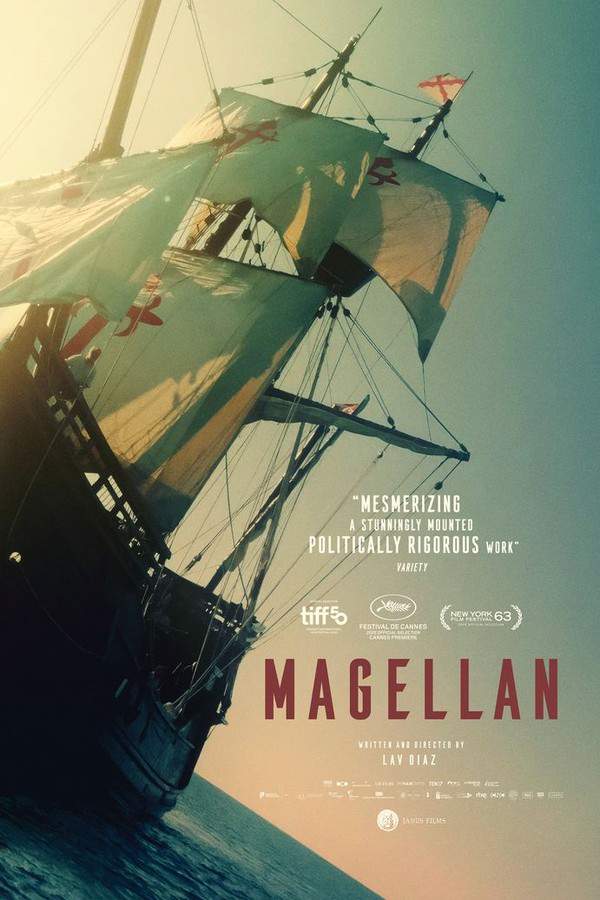
Magellan (2026) movie poster

Plot Summary

Magellan (2026) Plot Summary & Ending Explained

Release, runtime and language
2026 · 2 h 40 m · Portuguese
Echo score 51
JustWatch #2,173 35
Directed by
Lav Diaz
Starring
Gael García Bernal, Brontis Jodorowsky, Ronnie Lazaro, Dario Yazbek Bernal, Baptiste Pinteaux, Bong Cabrera

At the dawn of the modern era, Portuguese explorer Ferdinand Magellan (Gael García Bernal) leads a fleet of ships on a daring expedition to Southeast Asia, seeking the first crossing of the massive Pacific Ocean. Upon reaching the Malay Archipelago, the sailors confront relentless storms, scorching heat and the awe‑inspiring yet unforgiving beauty of the islands, driving them to the brink of madness as they struggle to survive the high seas and fulfill Magellan’s ambitious quest.

On this page (6)
  1. 1 Where to watch
  2. 2 What happens: full plot
  3. 3 Plot questions answered
  4. 4 How it ends
  5. 5 Movie threads
  6. 6 Every angle

Where to watch

Where to Watch Magellan (2026)

Where can you watch Magellan? Stream, rent or buy it in the US, including on Amazon Prime Video, Plex and Tubi TV: current JustWatch availability with up-to-date prices.

Streaming availability powered by JustWatch

Full plot summary · contains spoilers

What Happens in Magellan: Full Plot Summary

The whole story of Magellan (2026) explained, from the opening scene to the final frame: every key event, every twist and what it all adds up to. Read it as a quick recap before the sequel, to check a scene you missed, or to finally understand what really happened.

In 1511, Gael García Bernal portrays Fernão de Magalhães as he takes part in the Capture of Malacca under Roger Alan Koza as D. Afonso de Albuquerque, enduring a wound in battle. During this campaign, he acquires a Cebuano slave named Enrique, Amado Arjay Babon, and brings him along on his return to Portugal. Magellan is cared for by Beatriz Barbosa, Ângela Azevedo, whom he eventually marries, while Enrique quietly clings to the worship of his native gods. Years pass, and the Portuguese crown, under King Manuel I, rejects Magellan’s bold proposal to circumnavigate the globe in search of a new trade route free from Spanish competition, a setback that propels him to seek support in Spain, where his plan is ultimately approved. In 1519, he sets sail, leaving Beatriz pregnant behind, and begins a voyage that tests every limit of endurance for the crew.

The journey is fraught with hardship and harsh discipline. A crewmember is executed for engaging in homosexual acts, and another is marooned with a priest on Patagonia amid mutiny. Mutinies proliferate, costing ships and forcing punishments that range from executions to tying sailors to lashings. As the fleet pushes onward across the vast Pacific, the voyage grows grimmer by the day, and Magellan himself often dreams of Beatriz confessing the deaths of their child and of herself.

Upon reaching Cebu, Enrique serves as translator to the local chieftain, Raja Humabon, and his people. Magellan presents a statue of the Santo Niño and a stash of quinces, visiting Humabon’s sick son with the hope of curing him. The boy’s recovery is welcomed by the community, and Humabon’s wife, baptized as Reyna Juana, embraces the new faith, sparking celebrations that echo through the village. The tone shifts as Humabon orders the spread of rumors about a dangerous rival, Datu Lapu-Lapu, a wak-wak said to prey on humans, and Magellan lids his doubts about the rival’s existence, only to be drawn into a confrontation he cannot predict.

The confrontation begins in earnest as Magellan and his forces march to meet Lapu-Lapu, but the clash ends in tragedy. Magellan staggers across the battlefield and collapses, his death marking a brutal turning point. Enrique watches as Humabon and his subjects haul the corpse of one of Magellan’s men, along with his severed head, in celebration. In a stark depicture of betrayal and survival, Enrique reveals—through a later reckoning—that it was Humabon and his followers who attacked Magellan, and that there was no real danger from Lapu-Lapu. The revelation intensifies as Enrique confesses his own role in the massacre of most of Magellan’s remaining crew in his bid for freedom, a confession that casts a long shadow over the voyage and its remnants, leaving a legacy of force, faith, and subterfuge in its wake.
Last updated: January 06, 2026 at 10:49

Was this helpful?

Plot questions answered

Magellan Plot Explained: Your Questions Answered

The questions people ask most about Magellan (2026): what happens in the confusing scenes, why the characters do what they do, the twists, hidden details and what the ending means. Each answer contains spoilers.

Q1

Why did Magellan seek support in Spain instead of staying with Portugal?

King Manuel I of Portugal rejected Magellan's proposal to circumnavigate the globe and find a trade route that would bypass Spanish competition. Frustrated by this rejection, Magellan traveled to Spain where King Charles I (later Emperor Charles V) approved his expedition. This decision was driven by Portugal's focus on maintaining its existing African trade routes and unwillingness to fund an risky westward voyage.

Foreshadowing: Earlier, Portugal's rejection of his proposal directly motivates Magellan's shift to Spain, setting the entire expedition in motion.

  • portugal
  • spain
  • king manuel i
  • circumnavigation
  • rejection
Q2

Why was Enrique the slave significant to Magellan?

Enrique was a Cebuano slave Magellan acquired during the Capture of Malacca in 1511. Magellan brought him back to Portugal and later took him on the voyage as his personal servant. Enrique's importance became clear when he served as translator upon reaching Cebu, facilitating contact with Rajah Humabon. Most crucially, Enrique later revealed he had orchestrated the massacre of Magellan's remaining crew in his bid for freedom, making him a central figure in the expedition's tragic end.

Foreshadowing: The timeline notes that Enrique 'quietly clings to the worship of his native gods' while in Portugal, hinting at his secret loyalties.

  • enrique
  • slave
  • translator
  • cebu
  • magellan
Q3

Why did Humabon trick Magellan into fighting Lapu-Lapu?

Humabon spread rumors about Datu Lapu-Lapu being a dangerous rival who preyed on humans, using this as a lure to draw Magellan into battle. The truth, revealed by Enrique, was that there was no real threat from Lapu-Lapu, it was a fabrication. Humabon and his followers ultimately attacked Magellan themselves, celebrating after his death with his severed head. The betrayal appears motivated by Humabon's desire to rid his island of the Spanish presence after Magellan burned the local ancestral images (anitos).

Foreshadowing: The burning of anitos and Juana's warning that 'their gods will seek retribution' directly precedes Humabon's decision to turn against Magellan.

  • humabon
  • lapu-lapu
  • trap
  • betrayal
  • battle of mactan
Q4

Was Lapu-Lapu actually a real threat to Magellan?

No, Lapu-Lapu was not a real threat. Enrique reveals in a voice-over that there was no actual Datu Lapu-Lapu, a wak-wak said to prey on humans was merely a rumor spread by Humabon. The supposed rival was a fabrication designed to lure Magellan into a confrontation. When Magellan marched to meet this 'threat' at Mactan Island, he was actually walking into an ambush set by Humabon and his people.

Foreshadowing: The timeline notes Magellan 'lids his doubts about the rival's existence' before engaging, suggesting the warning signs were present.

  • lapu-lapu
  • mactan
  • rumor
  • ambush
Q5

How did Magellan die at the Battle of Mactan?

Magellan was killed during the Battle of Mactan Island in 1521 when he and his forces were overwhelmed by the islanders' fierce resistance. Magellan staggered across the battlefield and collapsed, his death marking a brutal turning point for the expedition. After his fall, Humabon and his subjects celebrated by hauling the corpse of one of Magellan's men and his severed head in triumph. The battle was not a heroic last stand but rather a disastrous trap orchestrated by Humabon.

Foreshadowing: Magellan's decision to engage despite his doubts, spurred by the natives' defiance, leads directly to this fatal confrontation.

  • magellan death
  • battle of mactan
  • killed
  • defeat
Q6

What happened to Magellan's remaining crew after his death?

After Magellan's death at the Battle of Mactan, most of his remaining crew were massacred in Cebu. Enrique later confesses that he participated in this massacre as part of his bid for freedom. Only a handful of sailors managed to escape on the remaining ships, eventually completing the first circumnavigation of the globe under Juan Sebastián Elcano. The expedition that began with five ships and around 270 men ended in near-total failure.

Foreshadowing: Enrique's role as translator and his intimate knowledge of the local situation made him positioned to orchestrate or facilitate this betrayal.

  • crew massacre
  • survivors
  • elcano
  • circumnavigation
Q7

Why did Enrique betray Magellan and help orchestrate the massacre?

Enrique betrayed Magellan as a bid for freedom. After years as a slave serving Magellan in Portugal and accompanying him on the dangerous voyage, Enrique saw the aftermath of Magellan's death as an opportunity to reclaim his freedom. He confesses to participating in the massacre of most of Magellan’s remaining men. His betrayal was driven by resentment over his enslavement and his desire to return to his homeland, revealing the complex power dynamics between the European explorers and the native peoples they encountered.

Foreshadowing: Enrique's secret devotion to his native gods while in Portugal foreshadows his ultimate allegiance.

  • enrique betrays
  • massacre
  • freedom
  • revenge
Q8

Why did Humabon and his people convert to Christianity?

Magellan presented a statue of the Santo Niño and successfully cured Humabon's sick son, which led the community to view the Spanish favorably. Humabon and his wife Juana were baptized, and a blood compact was formed to seal the alliance. However, this conversion was short-lived, after Magellan burned the islanders' ancestral images (anitos), tensions escalated, and Humabon orchestrated the betrayal that led to Magellan's death. The conversion appears largely strategic rather than deeply spiritual.

Foreshadowing: Juana's warning that 'their gods will seek retribution' after the burning of anitos hints at the fragile nature of this alliance.

  • humabon
  • conversion
  • christianity
  • santo niño
  • baptism
Q9

Why were there so many mutinies during Magellan's voyage?

The mutinies were driven by extreme hardships including dwindling supplies, brutal discipline, and the grueling Pacific crossing. Harsh punishments included executions for offenses like homosexual acts and marooning dissidents in Patagonia. The crew's morale plummeted as ships were lost and conditions worsened. These mutinies represented the physical and psychological breaking point of men pushed to their limits over months at sea, reflecting the brutal reality of early exploration.

Foreshadowing: The execution for homosexual acts and marooning of a mutinous crew member and priest foreshadow the escalating tensions that plague the expedition.

  • mutiny
  • discipline
  • punishment
  • execution
  • pacific crossing
Q10

Why did Magellan burn the anitos and what happened after?

Magellan's forces burned the islanders' ancestral images (anitos) days after the baptisms, viewing them as pagan idols. This act directly sparked the conflict with Humabon's people. Juana warned that their gods would seek retribution for the desecration, and this proved prophetic, the burning became the catalyst for Humabon's decision to betray and destroy Magellan and his men. The incident illustrates the cultural and religious clashes that characterized early European colonization.

Foreshadowing: Juana's warning about divine retribution directly precedes the betrayal and massacre that follow.

  • anitos
  • burning
  • retribution
  • cultural clash
  • religion
Q11

Why did Magellan leave his pregnant wife Beatriz to go on the voyage?

Magellan left Beatriz pregnant in 1519 when he departed Seville because he was determined to secure a westward route to the Indies that would give Portugal, and now Spain, a competitive edge in the spice trade. His ambitious quest for circumnavigation proved stronger than his personal ties. The separation was permanent; Magellan dreamed of Beatriz confessing the deaths of their child and herself during the voyage, suggesting both perished while he was at sea.

Foreshadowing: Magellan's departure sets in motion the personal tragedy that haunts him throughout the expedition.

  • beatriz
  • wife
  • pregnant
  • departure
  • ambition

Ending explained

What Happens at the End of Magellan?

How Magellan (2026) ends, in short: the final scene, the last twist and what it means for the characters. The full ending explained, with every spoiler, lives on its own page.

Read the full ending explained

Lav Diaz's Magellan concludes with a haunting subversion of historical record, reframing the explorer's death not as a glorious battle but as a calculated assassination born of betrayal. After months of starvation and desperation crossing the Pacific, Ferdinand Magellan finally arrives at the island of Cebu in 1521, where Rajah Humabon welcomes him with provisions and a blood compact of alliance. But the relationship sours quickly. Magellan's aggressive push to convert the natives to Christianity—destroying their anito statues and forcing baptism upon them—enrages Humabon, who begins plotting his guest's demise. The film then introduces a striking revision: Humabon spreads fear about a chieftain named Lapu Lapu, claiming he is a wakwak, a mythical vampire-like creature. Magellan, fueled by religious arrogance and a desire to prove his God's power, marches to confront this supposed demon.

The ending reveals that Lapu Lapu was never real—at least not in the way Magellan was led to believe. Enrique, Magellan's enslaved companion, exposes the truth: Humabon fabricated the entire story, manipulating Magellan's fanaticism to lure him into a trap where he was killed. Humabon then hosts a feast, poisoning and slaughtering the remaining Portuguese crew. Enrique, complicit in the scheme, earns his freedom through the betrayal. The film closes on this bitter note—Magellan's grand ambitions undone not by a warrior's spear but by the very people he sought to "save," his legacy reduced to a cautionary tale about imperialism's blind arrogance. Diaz strips away the mythologized heroism often granted to historical explorers, leaving us with a sobering portrait of a man destroyed by his own convictions.

Magellan ending explained in full

Movie threads

More Movies Like Magellan, by Mood & Story

Curated lists built around what makes Magellan tick: the same mood, the same kind of story or the same emotional payoff. Each list explains why these movies belong together.

Brutal Historical Expeditions like Magellan

Epic journeys where ambition clashes with the brutal realities of survival. Explore more movies like Magellan that depict grim historical expeditions. If you were captivated by the harsh survival and tragic outcomes of ambitious journeys, this thread features similar epic stories of exploration, cultural clash, and brutal reality.

  • epic
  • grim
  • harsh survival
  • historical
  • brutal
  • desperate
  • Tone: dark, brutal, tragic
  • Pacing: steady, relentless
Why these movies?

The story pattern: Stories in this thread follow a linear, goal-oriented expedition that is constantly undermined by external hardships and internal discord. The focus is on the arduous process and the psychological toll of the journey, often leading to a Pyrrhic victory or a tragic conclusion for the protagonists.

Why they belong together: These films share a high-intensity, dark tone, focusing on the heavy emotional weight of survival against overwhelming odds. They are grouped by their epic scale, steady pacing through relentless challenges, and a bleak outlook on the human cost of historical ambition.

Movies about Ambition's Tragic Cost like Magellan

Character-driven tales where a grand vision leads to a devastating fall. Discover films similar to Magellan that explore the theme of tragic ambition. If you were fascinated by the story of a visionary leader whose quest ends in personal downfall and betrayal, this thread collects powerful character studies with bleak conclusions.

  • tragic
  • ambitious
  • betrayal
  • psychological
  • downfall
  • heavy
  • Tone: dark, tragic, bleak
  • Pacing: steady, character-driven
Why these movies?

The story pattern: The narrative pattern follows a protagonist with a powerful, often noble, goal. As they pursue it with unwavering determination, they face escalating moral compromises, betrayal from within their ranks, and ultimately, a catastrophic failure that underscores the futility or danger of their ambition.

Why they belong together: These movies are united by a heavy emotional weight and a dark, bleak tone. They feature complex protagonists on a steady, inevitable march towards a tragic ending, making the journey a poignant study of the price of greatness.

Every angle

Magellan (2026) Explained: Plot, Ending, Timeline & Characters

Everything about Magellan in one place: what happens in the plot summary, the timeline in chronological order, the characters and meaning, the ending explained and a spoiler-free summary. What's After the Movie adds the cast, box office and post-credit scenes.

Coming soon on iOS and Android

The Plot Explained Movie Summary App

Plot summaries, endings explained and timelines on your phone. Catch up on any movie in minutes, save your favorites and never miss a twist again.

Be the first to know when we launch. Your email stays private, always.

Learn more about the app