Plot Explained Spoilers guaranteed!
Plot Explained

Browse by genre

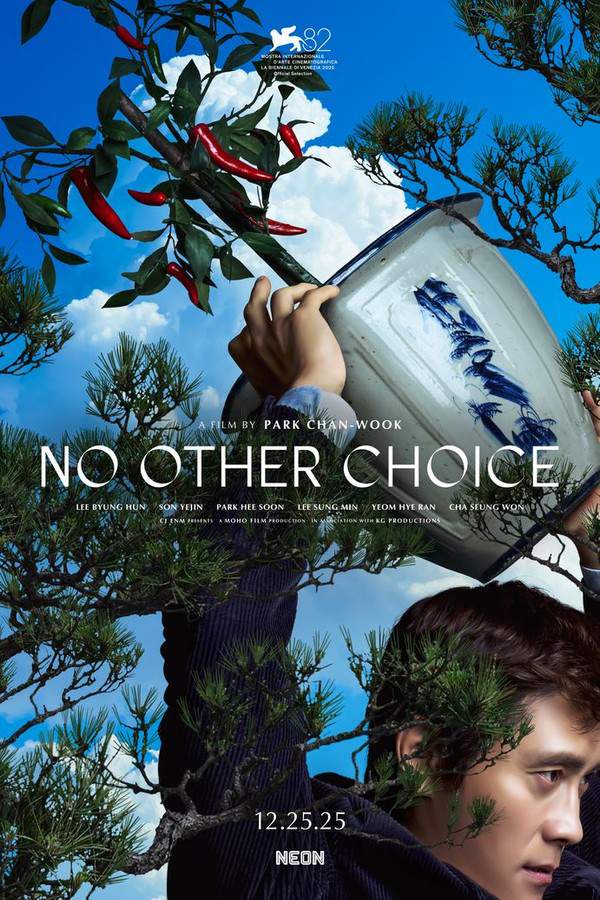
No Other Choice (2025) movie poster

Plot Summary

No Other Choice (2025) Plot Summary & Ending Explained

Release, runtime and language
2025 · 2 h 19 m · Korean
Echo score 87
Directed by
Park Chan-wook
Starring
Derek Chouinard, Lee Byung-hun, Lee Sung-min, Yoo Yeon-seok, Kim Hae-sook, Yeom Hye-ran
Budget
$12.2M

After 25 years as a paper mill supervisor, Man‑su loses his job when the plant is bought by foreign owners. Unable to find new work, he and his family must slash their lifestyle drastically. Desperate to impress at his next interview, Man‑su resorts to eliminating his rivals, wondering how far he will go when there is no other choice.

On this page (5)
  1. 1 What happens: full plot
  2. 2 Plot questions answered
  3. 3 How it ends
  4. 4 Movie threads
  5. 5 Every angle

Full plot summary · contains spoilers

What Happens in No Other Choice: Full Plot Summary

The whole story of No Other Choice (2025) explained, from the opening scene to the final frame: every key event, every twist and what it all adds up to. Read it as a quick recap before the sequel, to check a scene you missed, or to finally understand what really happened.

Man-su Lee Byung-hun is a proud, award-winning veteran at Solar Paper, a papermaking company where his skills and loyalty have earned him a comfortable, well-paid life. He buys his childhood home and enjoys a luxurious routine with his homemaker wife Mi-ri Son Ye-jin, their teenage stepson Si-one Woo Seung Kim, and their young daughter Ri-one So Yul Choi. The family also lives with an antisocial, neurodivergent cello prodigy and two dogs who bring their own quiet challenges and moments of warmth. For a long time, life looks stable and predictable, and Man-su savors the security he has built after years of hard work.

All of that begins to unravel when Solar Paper is bought by American interests, and a wave of layoffs follows. The company fires many workers, and Man-su is among those left stunned and devastated by the sudden turn of events. After breaking the news to his family, he makes a bold, if dangerous, promise: he will return to papermaking and secure his position again within three months. The dream of reclaiming his old life fuels him, even as the reality of unemployment and the strain it places on his household begins to bite.

Thirteen months slip by, and Man-su finds himself working low-paying retail jobs rather than returning to the factory floors he knows so well. The family tightens its belt to make ends meet, cutting back on nearly everything. They even have to give up their dogs and put them with Mi-ri’s parents, a decision that weighs heavily on Ri-one. The burden grows heavier when Ri-one’s teacher pushes hard for expensive, advanced cello lessons, a dream that seems increasingly out of reach given the mortgage payments that loom over the home. Mi-ri picks up work as a dental assistant to help stretch the family budget, while Man-su faces a nagging toothache that he refuses to treat, stubbornly insisting on his own stubborn pride and self-reliance.

Determined to rejoin Moon Paper, Man-su faces humiliation at the hands of Seon-chul, a manager who stands between him and a hopeful return. The humiliation ignites something darker in Man-su: a growing fixation on reclaiming his lost status and securing his family’s future, even if it requires drastic action. He nearly sabotages Seon-chul with a pot of plant soil, a precursor to the lengths he is willing to go, but the moment passes when the company’s owner intervenes. Still, Man-su’s resolve hardens. He purchases the plant and uses it to stage a fake advertisement that allows him to sift through job applications and identify two candidates—Beom-mo and Si-jo—whose credentials exceed his own. The realization that these rivals could outshine him becomes a consuming obsession.

With a fragile plan in place, Man-su sets his sights on Beom-mo and Si-jo, and he begins spying on them. A twist of fate occurs when a snakebite temporarily interrupts his pursuit, and he is saved by A-ra, Beom-mo’s dissatisfied wife, who is entangled in her own web of infidelity. The two adults uncover each other’s secrets, deepening Man-su’s paranoia and pushing him further toward a breaking point. A-ra’s infidelity is exposed, and the triangle of suspicion intensifies as Beom-mo and A-ra become embroiled in a dangerous struggle over who truly controls the situation. In a frenzied confrontation at Beom-mo’s residence, A-ra shoots Beom-mo dead, and Man-su narrowly escapes the dangerous consequences of the chaos they have unleashed.

Driven by a need to restore balance in his own life, Man-su heads to a dance party where Mi-ri unexpectedly dances with Jin-ho, a suave dentist whom Mi-ri has begun to see romantically. The sight of this rival happiness rekindles Man-su’s rage and reinforces his sense of urgency. He returns to Beom-mo’s house, where A-ra and her lover have disposed of the body and buried Beom-mo and the gun. Man-su retrieves the weapon, and the cracks in his marriage widen as he and Mi-ri accuse one another of infidelity, their relationship strained to the breaking point. Yet in the same breath, they appear to cling to each other, choosing to reconcile rather than completely fracture.

On another front, Si-one, who works selling shoes, shares his own quiet hopes and fears, including a desire to protect his young daughter. Man-su reluctantly confronts Si-jo on a highway, and in a cold, fatal moment, he shoots Si-jo dead, hiding the body in his car. While this murder cascades through the family’s lives, Si-one and Geon-ho—Si-one’s friend—are busy stealing iPhones to resell from Geon-ho’s father’s store, drawing police attention that leads to an arrest. In a tense twist, Man-su and Mi-ri leverage Geon-ho’s father to take responsibility for the crimes, allowing Si-one to walk free, at least for now. Detectives inform Man-su of the disappearances of Beom-mo and Si-jo, and the investigation assets begin to point toward a chain of lurid coincidences that stem from the same man’s desperate choices. Si-one witnesses Man-su attempting to dismember Si-jo’s corpse, and the family’s secrets threaten to explode into the open. When the attempt fails, Man-su buries the corpse in the garden alongside the stolen iPhones, a grim image of the deceit fueling their lives.

Seeking some sense of control, Man-su visits Seon-chul’s home, where he drugs him with alcohol and then forcibly removes the cavities from his teeth, a brutal display of his desperation to dominate a rival who stands in his way. Si-one tells Mi-ri what he has seen, prompting Mi-ri to dig up Si-jo’s corpse but to lie to Si-one about it in an effort to safeguard him. Despite the growing truth around them, Mi-ri reaches out to Man-su to share her worries, but he remains resolute, refusing to change course. The mounting pressure culminates in a chilling act: Man-su suffocates Seon-chul, framing the death as a drunken incident that resulted in fatal choking on vomit.

Moon Paper ultimately decides to hire Man-su to replace Seon-chul, and this new employment marks a turning point: the family’s future—particularly their home and the dogs—appears stabilised once more. The detectives visit Man-su again, revealing that A-ra has implicated Beom-mo as a gunowner and possibly the killer of Si-jo, which shifts suspicion away from Man-su, who can finally see a path to normalcy. Yet even as he climbs back into a modern, machine-driven paper mill where workers are few, Man-su is left to contemplate the costs of his choices and the hollow victory of reclaiming a life built on fear, deceit, and violence. In the end, the family appears reunited, the dogs are back, and Man-su stands alone in a world that has grown colder, more mechanical, and forever changed by his desperation to recover what he once had.
Last updated: December 27, 2025 at 11:31

Was this helpful?

Plot questions answered

No Other Choice Plot Explained: Your Questions Answered

The questions people ask most about No Other Choice (2025): what happens in the confusing scenes, why the characters do what they do, the twists, hidden details and what the ending means. Each answer contains spoilers.

Q1

Why did Man-su decide to kill his job competitors?

Man-su's descent into murder began after being fired from Solar Paper following its buyout. Despite vowing to return to papermaking within three months, thirteen months passed as he struggled in low-paying retail jobs. The humiliation he suffered at Moon Paper from manager Seon-chul, combined with mounting financial pressure, mortgage payments, his daughter's cello lessons, and the loss of their dogs, pushed him toward desperate measures. When he discovered that Beom-mo and Si-jo had better credentials than him, his obsession with reclaiming his former life turned violent.

Foreshadowing: Earlier, Man-su nearly attacked Seon-chul with a potted plant, showing his growing willingness to use violence against rivals.

  • man-su murder
  • job competition
  • unemployment
  • desperation
  • beom-mo si-jo
Q2

How did Man-su identify Beom-mo and Si-jo as his competitors?

After his humiliation at Moon Paper, Man-su bought the potted plant he had used in his near-attack on Seon-chul. He used it to place a fake job advertisement, then sifted through the responses to identify applicants whose papermaking credentials exceeded his own. This revealed Beom-mo and Si-jo as the two strongest candidates who could outshine him for the position he desperately wanted.

  • fake advertisement
  • job applicants
  • competition
  • moon paper
Q3

Who actually killed Beom-mo?

Beom-mo was killed by his own wife A-ra, not Man-su. During a confrontation at their home, A-ra shot Beom-mo dead. Man-su was present during the incident but did not pull the trigger. A-ra had been unfaithful, and the confrontation erupted when her infidelity was exposed, leading her to kill her husband in a moment of chaos.

Foreshadowing: A-ra saved Man-su from a snakebite earlier, creating an uneasy connection between them.

  • a-ra
  • beom-mo death
  • wife killed husband
  • infidelity
Q4

Why did A-ra kill her husband Beom-mo?

A-ra killed Beom-mo because her infidelity was exposed during the escalating conflict. When Beom-mo discovered that A-ra had been unfaithful, a confrontation turned violent, and A-ra shot him in self-defense or in a moment of desperation. The murder was unplanned and stemmed from the chaotic revelation of her affair rather than a premeditated act.

  • a-ra affair
  • beom-mo killed
  • domestic violence
  • infidelity exposed
Q5

What happened between Mi-ri and Jin-ho at the dance party?

At a costume dance party, Mi-ri danced romantically with Jin-ho, a dentist she had been seeing. Man-su arrived late and witnessed this, interpreting it as his wife's betrayal. The encounter intensified Man-su's rage and sense of betrayal, reinforcing his determination to reclaim his status and family security by any means necessary. Whether Mi-ri and Jin-ho had a full affair remains somewhat ambiguous, but the emotional betrayal was clear to Man-su.

  • mi-ri jin-ho
  • dance party
  • affair
  • wife betrayal
  • dentist
Q6

How did Si-jo die in the highway scene?

Man-su deliberately killed Si-jo on a highway after tracking him down. He lured Si-jo out of his shoe-selling job, confronted him, and shot him dead in a cold, calculated manner. Man-su then hid the corpse in his car, adding to his growing body count. This murder was premeditated as part of Man-su's plan to eliminate anyone who could compete with him for the Moon Paper position.

Foreshadowing: Man-su had earlier retrieved his father's Vietnam War gun, indicating his serious intent to kill.

  • si-jo death
  • highway murder
  • man-su killed
  • shooting
Q7

Why did Man-su kill Seon-chul at his home?

Man-su killed Seon-chul because the manager had humiliated him and stood as the primary obstacle preventing his return to Moon Paper. After the failed plant attack, Man-su drugged Seon-chul with alcohol and then forcibly drilled into his teeth, a twisted act of dominance. Later, Man-su suffocated Seon-chul and staged the death as a drunk accident where he choked on his own vomit, eliminating the rival who had blocked his path to reemployment.

  • seon-chul death
  • manager killed
  • moon paper
  • revenge
  • framing
Q8

How did Man-su frame Seon-chul's death as an accident?

After suffocating Seon-chul with a pillow or similar method, Man-su staged the scene to appear as if Seon-chul had died from choking on vomit while heavily intoxicated. The staged accident was convincing enough that detectives initially ruled it as an accidental death, allowing Man-su to avoid suspicion while simultaneously benefiting from Seon-chul's elimination, he was later hired to replace him at Moon Paper.

  • frame accident
  • suffocation
  • drunk death
  • cover up
Q9

What did Si-one see Man-su doing in the basement?

Si-one witnessed Man-su attempting to dismember Si-jo's corpse in the basement or garage area, a gruesome act of trying to dispose of the body. This horrified Si-one, who then told Mi-ri what he had seen. Mi-ri subsequently dug up Si-jo's body to protect Si-one from being implicated, though she lied to her stepson about the extent of what she knew.

  • si-one witnessed
  • dismemberment
  • corpse
  • basement
  • mi-ri buried
Q10

What was the iPhone theft subplot with Si-one?

Si-one and his friend Geon-ho stole iPhones from Geon-ho's father's store to resell them. Both were arrested by police. Later, Man-su and Mi-ri blackmailed Geon-ho's father, forcing him to take sole responsibility for the crime so that Si-one would be released. This allowed Si-one to walk free while the stolen iPhones were later buried with Si-jo's body in the garden, linking the subplot to Man-su's broader criminal activities.

  • iphone theft
  • si-one arrested
  • geon-ho father
  • blackmail
Q11

How did Man-su avoid getting caught for the murders?

Man-su escaped suspicion primarily because A-ra falsely implicated her dead husband Beom-mo as the gun owner and potential killer of Si-jo. This shifted police attention away from Man-su. Additionally, Man-su carefully staged Seon-chul's death as an accident and disposed of evidence. His calculated framing, combined with A-ra's false testimony, allowed him to walk free while the investigation focused on the wrong suspect.

  • got away
  • police investigation
  • a-ra testimony
  • suspicion cleared
Q12

Why did Mi-ri dig up Si-jo's grave?

Mi-ri dug up Si-jo's corpse after learning that Si-one had witnessed Man-su attempting to dismember the body. To protect her stepson from being contaminated by evidence or becoming an accessory, Mi-ri took action to remove the remains. She lied to Si-one about what she found, claiming she only buried the body again, but the act further entangled her in Man-su's criminal web.

  • mi-ri grave
  • si-jo body
  • protect si-one
  • family secret
Q13

What does the ending say about Man-su's victory?

While Man-su successfully secures the Moon Paper job, saves his home, and reunites the family with their dogs, the victory is hollow. He has murdered three people (Si-jo directly, and indirectly through the chaos that led to Beom-mo's death and Seon-chul's framing). He now works in a modern, machine-driven paper mill where workers are few, ironically replacing the craft he loved with automation. The ending suggests his desperate choices have permanently damaged his moral integrity and transformed him into someone his family must now fear.

  • ending meaning
  • hollow victory
  • machine mill
  • moral cost
  • family return

Ending explained

What Happens at the End of No Other Choice?

How No Other Choice (2025) ends, in short: the final scene, the last twist and what it means for the characters. The full ending explained, with every spoiler, lives on its own page.

Read the full ending explained

Man‑Su finally succeeds in eliminating the last two rivals who threaten his precarious position at the paper mill. After a tense showdown in the greenhouse, he disposes of Seon‑Chul, buries the body in the front yard and covers it with an apple tree he and Mi‑Ri plant together. The camera lingers on the newly sprouted tree while a light, almost celebratory melody plays, giving the impression of a fresh start.

At the dinner table the family pretends everything is back to normal. Mi‑Ri smiles, the children chatter, and Man‑Su suggests a pork‑barbecue—yet the younger child, Ri‑One, nervously remarks that “the bugs are eating it alive,” hinting that the hidden corpse is still gnawing at their peace. The police, misled by Ah‑Ra’s testimony that the murder weapon belonged to her dead husband, focus their investigation on Bum‑Mo rather than Man‑Su, allowing him to walk away unscathed.

Continue reading the ending (2 more paragraphs)

Meanwhile, the professional world that drove Man‑Su’s desperation has already moved on. The paper mill is now run by automated AI‑systems, leaving no workers for him to supervise. In the final interview at the rival company Moon Paper, he no longer clutches the red notes he once wrote on his palm; the camera shows his clean hands and a freshly grown moustache, signalling that he has shed his obsessive need to script every move. Yet the victory feels hollow—he has killed the competition, secured a superficial façade of stability, but the very job he coveted no longer exists, and the memory of the three murders will forever haunt him.

Thus the ending is both triumphant and tragic. Man‑Su achieves the “no other choice” he convinced himself he had, but the price is a family that lives with a secret, a career that has vanished, and a moral void that no celebratory music can erase. The smiles and cello music mask an underlying absurdity: he is free, yet bound by the invisible threads of guilt, loss, and an ever‑changing world that rendered his sacrifice meaningless.

No Other Choice ending explained in full

Movie threads

More Movies Like No Other Choice, by Mood & Story

Curated lists built around what makes No Other Choice tick: the same mood, the same kind of story or the same emotional payoff. Each list explains why these movies belong together.

Movies about crime for survival like No Other Choice

Ordinary people commit dark acts to escape financial ruin. If you liked the dark premise of No Other Choice, explore these films about ordinary people driven to crime by desperation. Discover similar stories of moral compromise, high-stakes criminal plans, and the heavy emotional weight of doing the unthinkable to save yourself or your family.

  • desperate
  • tense
  • anxious
  • grim
  • unsettling
  • high-stakes
  • Tone: dark, tense, cynical
  • Pacing: steady, methodical
Why these movies?

The story pattern: Narratives in this thread typically follow a protagonist facing an insurmountable financial or social crisis. They devise a risky, often violent plan as their only perceived way out, leading to a steady escalation of tension as they execute their scheme while navigating the threat of exposure and their own crumbling conscience.

Why they belong together: These movies are grouped by their shared core premise: a desperate individual's turn to crime as a last resort. They share a dark tone, high emotional stakes, and a focus on the psychological unraveling that comes with crossing moral boundaries for survival.

Movies with bittersweet victories like the ending of No Other Choice

Stories where success is achieved, but at a profound personal price. Fans of the complex ending in No Other Choice will appreciate these films about pyrrhic victories. Find similar stories where characters achieve their goals but are left scarred by the journey, exploring themes of sacrifice, moral cost, and the true price of ambition.

  • bittersweet
  • contemplative
  • somber
  • costly win
  • moral ambiguity
  • emotional weight
  • Tone: bittersweet, grim, contemplative
  • Pacing: steady
Why these movies?

The story pattern: The narrative arc follows a character striving for a clear objective, often through morally questionable means. The climax sees them succeed in their aim, but the resolution emphasizes the destruction left in their wake—lost relationships, shattered morals, or a compromised future—leaving the audience with a poignant mix of relief and sorrow.

Why they belong together: These films are united by their emotionally complex, bittersweet endings. They resonate with viewers who appreciate stories that reject simple happy conclusions, instead focusing on the heavy, often tragic costs associated with ambition and survival.

Every angle

No Other Choice (2025) Explained: Plot, Ending, Timeline & Characters

Everything about No Other Choice in one place: what happens in the plot summary, the timeline in chronological order, the characters and meaning, the ending explained and a spoiler-free summary. What's After the Movie adds the cast, box office and post-credit scenes.

Coming soon on iOS and Android

The Plot Explained Movie Summary App

Plot summaries, endings explained and timelines on your phone. Catch up on any movie in minutes, save your favorites and never miss a twist again.

Be the first to know when we launch. Your email stays private, always.

Learn more about the app