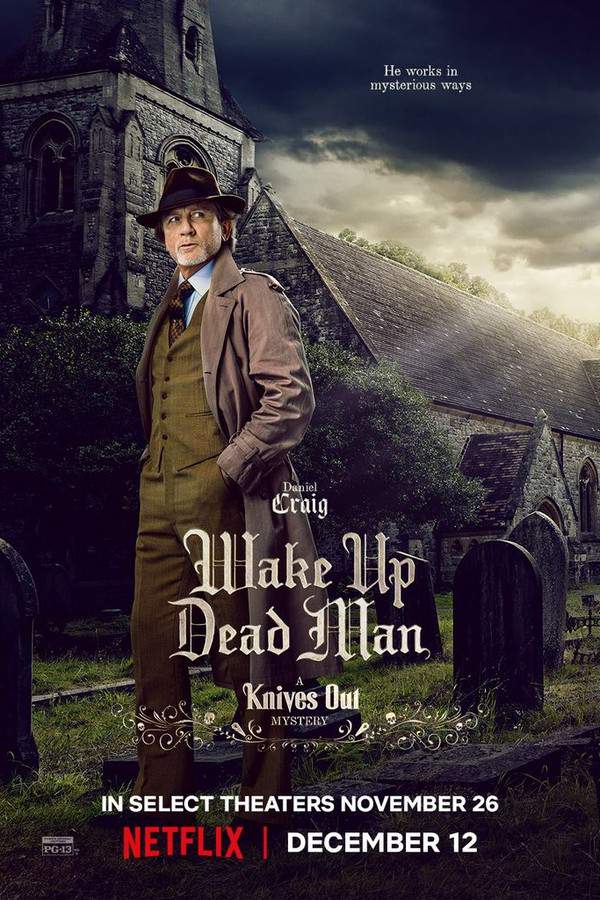
The film opens with Benoit Blanc quieting the room as he reads a letter from Fr. Jud Duplenticy, a former boxer turned preacher who now stands at the center of a tangled religious saga. Jud takes us back to the moment that started it all: a clash with a rude deacon at his old church, an incident that draws the ire of the church hierarchy but earns the support of Bp. Langstrom for the moment. Rather than face a scandal, Jud is shipped off to Our Lady of Perpetual Fortitude in Chimney Rock, a small-town church that has made a sanctuary of hardship and devotion. There, he enters a fragile arrangement with the beloved pastor of the parish, Mons. Jefferson Wicks, whose soaring sermons have drawn a loyal crowd and who carries himself with the charisma of a man who has built an entire moral universe around forgiveness and fire. The confessional act of their early days becomes a show of power and vulnerability: Wicks makes Jud listen as he confesses his recent sins, a grim ritual that double-dips as a test of Jud’s resolve and as a demonstration of how far Wicks is willing to push moral boundaries.
Jud soon becomes entangled in Wicks’s inner circle, where Martha Delacroix, Martha Delacroix, serves as the preacher’s right-hand and strategist, a guardian who knows the church’s secrets and the family histories that shape them. Martha’s connection to Wicks runs through generations, tracing back to her husband Samson Holt, Samson Holt the kindly groundskeeper who keeps the grounds and the graces of the place spotless even as the church’s debts mount. Through Martha, Jud learns about Wicks’s mother Grace, Grace Wicks, a woman whose reputation in the town is the stuff of whispered legends, described by some as “The Harlot Whore” for a lifestyle that doesn’t fit the church’s rigid benevolence. Grace’s legacy is a fractured one: when her father Prentice, Rev. Prentice Wicks, dies, she inherits the estate and is left with little more than a mysterious box etched with “Eve’s Apple” that contains a Christ figurine. This box becomes a symbol of a power struggle and a family secret that will echo long after Grace’s violent outburst at the church and her sudden death at her father’s tomb, a death that hints at forces bigger and darker than anyone suspects.
The letter Jud wrote speaks to a flock that is smaller than it appears, but fiercely devoted to its own myths. Vera Draven, Vera Draven, a sharp and determined lawyer, carries the burden of her father’s past as Wicks’s attorney and the duty of raising her half-brother Cyrus, known as Cy, Cy Draven. Cy is a savvy, party-poster-childYouTuber with a growing appetite for controversy, and his recordings begin to reveal a larger plot inside the church’s walls. Also part of the group is Dr. Nat Sharp, Dr. Nat Sharp, whose descent into alcoholism after his wife leaves him has stoked both sympathy and suspicion among those who wonder how much the man has genuinely become a threat to the flock. Lee Ross, Lee Ross, a best-selling sci‑fi author who longs to break out of his dedicated conspiracy crowd and reach a broader audience, and Simone Vivane, Simone Vivane, a young cellist who joined the church seeking relief from chronic pain and a possible cure, round out the core cast Jud believes could be manipulated or coerced by Wicks’s hunger for control. Jud’s plan to gather the flock privately, away from Wicks’s pulpit, unsettles everyone and inflames the already delicate balance of power within the church, laying the groundwork for a murder that could erase them all.
On Good Friday, Benoit Blanc and the team watch as Wicks delivers his sermon before retreating to a room in the pulpit to re-energize. Jud steps in, and the room erupts in a stealthy, unsettling shift when a clatter and thud signal Wicks’s collapse. Nat investigates and pronounces Wicks dead, a knife protruding from his back. Martha immediately accuses Jud of murder, and Chief Geraldine Scott, Chief Geraldine Scott, is brought in to unravel the knot. The case lands Blanc, summoned after a call from a familiar lieutenant, and the two men—Blanc and Jud—team up to search for motive, opportunity, and the truth behind a weapon that looks almost ceremonial: a knife with a devil’s head that appears to have come from a lamp at a bar. At the bar, the owner Nikolai, Nikolai, identifies the head as part of a door‑less, untraceable design, and Jud minds the subtle clues that suggest something larger at play beyond a straightforward murder.
The investigation winds its way through the pulpit’s hidden rooms and the private retreat where a game is played during the sermon—an ominous clue that someone manipulated the moment of Wicks’s death. The team discovers a remote-control trigger that could have caused a fatal accident, but Jud’s own behavior raises questions about his truthfulness: he concealed a flask from the flock when they found Wicks’s body, and later, the flask itself goes missing. The mystery widens as Cy reveals that he captured the flock’s private meeting with Wicks on Palm Sunday, threatening that video with release, while the rest of the flock scrambles to seal their involvement. The film then pivots on a deeper truth about Eve’s Apple, a family diamond that Grace’s death seems to have buried with the church’s secrets—the box, it turns out, is empty of value, and the real treasure is a different, hidden prize.
Jud’s resolve hardens as the evidence points toward the real killer, but Blanc moves them toward a revelation that none of them anticipated. The team tracks the evidence to Nat’s home and descends to a basement where a foul stench lingers and a tub filled with acid reveals Wicks’s lifeless form, his arms burned and his body dissolved. The scene shifts again as Blanc and Geraldine gather the flock for a final reckoning: Nat, who had spiked Wicks’s drink with pentobarbital, was the actual killer, planting the sword-like device in the preacher’s back and then detonating a squib to simulate a supernatural return. Yet even this explanation feels incomplete until a broader truth about the box named Eve’s Apple is unearthed: the diamond resides in the chest of a statue, a revelation that Martha later confirms, and she collapses under the weight of her own guilt as the truth overtakes her.
As the final pieces fall into place, Blanc’s careful deductions crumble into a moral reckoning. Martha confesses that Eve’s Apple—the diamond—was the prize Grace had chased and that Eve’s Apple had drawn her to violence and ruin. The confession exposes a chain of manipulation: Nat and Samson orchestrated a supposed resurrection to discredit the flock and push Wicks into a cultural battle for power, while Martha herself had long nurtured a grudge against Grace, believing she could seize control through deceit. When the truth emerges, Martha’s remaining strength fails, and the diamond slips from her grasp, falling from her hands as she admits her crimes. Blanc lets her speak her piece and then gently accepts her confession, offering forgiveness as she collapses, the Eve’s Apple finally slipping from her clutched fingers.
In the aftermath, the survivors begin to pick up the pieces. Vera closes her father’s law firm and resolves to forge a new path, Simone returns to the cello and writes through the pain, and Lee Ross continues to write, his controversial book drawing the same fans he once distrusted. Cy, left with nothing after his inheritance siphoned away, speaks of legal action against Blanc and Jud, but the two men play it cool, choosing to protect the fragile truth they now share. A year later, Jud reopens the church and renames it Our Lady of Perpetual Grace, a new beginning built on hard-won mercy. As he exchanges greetings with new members, he reveals a quiet, stubborn secret: Eve’s Apple remains hidden inside the chest of a Christ statue, a reminder that the church’s darkest chapter has become its most enduring riddle.