

















Plot Explained Spoilers guaranteed!
Plot Explained

Browse by genre

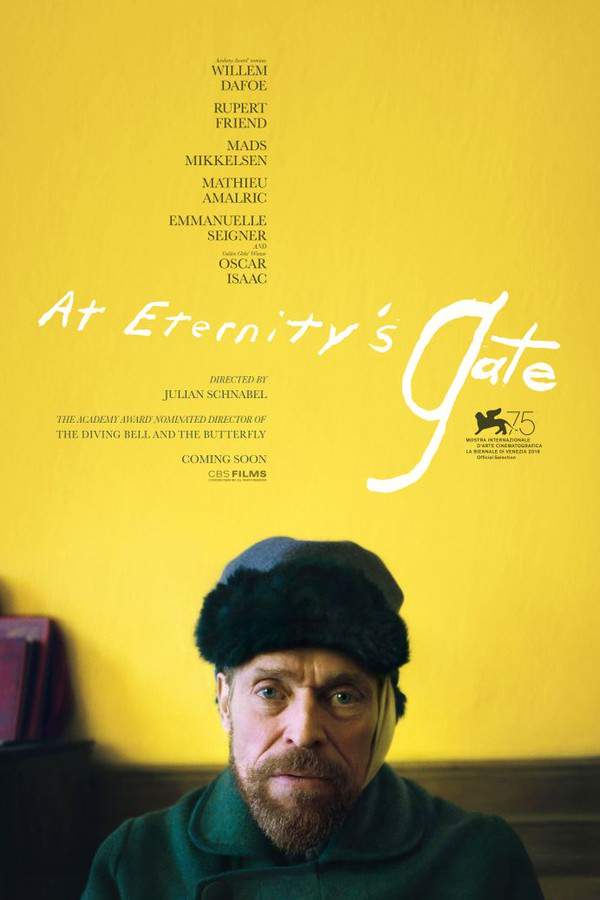
At Eternity's Gate (2018) movie poster

Timeline

At Eternity's Gate (2018) Timeline Explained – Every Event in Order

Release, runtime and language
2018 · 111 min · English
Echo score 73
JustWatch #5,220 32
Directed by
Julian Schnabel
Starring
Mads Mikkelsen, Willem Dafoe, Oscar Isaac, Amira Casar, Mathieu Amalric, Emmanuelle Seigner

This film offers a glimpse into the life of Vincent van Gogh, portrayed by Willem Dafoe, during a pivotal period in his life. It explores his struggles with mental health, his feelings of isolation, and the intense passion that drove his artistic creations. Through a cinematic portrayal, the film reveals the turbulent emotions and experiences that shaped some of his most recognizable works, offering a profound look at the mind of a brilliant and troubled artist.

On this page (6)
  1. 1 Where to watch
  2. 2 Events in order (15)
  3. 3 Timeline questions answered
  4. 4 Movie threads
  5. 5 Movies like At Eternity's Gate
  6. 6 Every angle

Where to watch

Where to Watch At Eternity's Gate (2018)

Where can you watch At Eternity's Gate? Stream, rent or buy it in the US, including on Amazon Prime Video, Hoopla and Kanopy: current JustWatch availability with up-to-date prices.

Streaming availability powered by JustWatch

15 events in order · contains spoilers

At Eternity's Gate Timeline: Events in Chronological Order

Every key event of At Eternity's Gate (2018) in order, scene by scene, with when and where it takes place. Use it to untangle flashbacks, time jumps and parallel storylines, to refresh your memory before the sequel or to find the exact scene you are thinking of.

  1. Opening Reflection

    The film begins with a black screen where a man reflects on how he wishes to be perceived by others. This sets the tone for the exploration of identity and recognition in the world of art.

  2. Encounter with the Woman

    A man approaches a beautiful woman tending to sheep along a rustic country road. They engage in a tentative conversation in French, with him requesting to sketch her, only for her to hesitate at first.

    Where
    Country Road
  3. Artists' Discussion

    A group of men deliberates on the treatment of artists, discussing policies that favor successful artists while burdening the less recognized ones. Paul Gauguin passionately objects to these attitudes, reflecting the struggles of artists.

  4. Gauguin's Choice

    Outside the gathering, Gauguin tells Van Gogh of his plans to travel to Madagascar for artistic freedom. He advises Van Gogh to consider the same path, marking a significant philosophical exchange between the two.

  5. Struggle in Arles

    In the town of Arles, Van Gogh struggles to find his artistic voice within the confines of a dreary room. He resorts to painting his shoes, illustrating his frustration and search for inspiration.

    Where
    Arles
  6. Literary Conversation

    Van Gogh meets Madame Ginoux in a local eatery where they discuss literature, particularly Shakespeare. She gifts him a book of blank pages, encouraging his artistic aspirations as they bond over their conversation.

    Where
    Local Eatery
  7. Renewed Inspiration

    Venturing into nature, Van Gogh finds renewed creativity. He captures the beauty of sunflowers and vibrant greens, emphasizing his belief that a painting can immortalize fleeting moments.

    Where
    Nature
  8. Conflict with Schoolchildren

    While painting among schoolchildren, Van Gogh faces their mischief, leading to a reprimand. This incident highlights the tensions often present between artists and the public's perception.

  9. Visit from Theo

    In a hospital scene, Van Gogh's brother Theo visits him, vowing to support him regardless of his struggles. This moment underlines the importance of familial bonds in the face of adversity.

    Where
    Hospital
  10. Gauguin's Arrival

    When Gauguin arrives, the two artists reignite their camaraderie as they paint together outdoors. They exchange artistic philosophies, delving into the deeper meanings of their works.

  11. Black and White Sketches

    Throughout his experiences, Van Gogh produces poignant black and white sketches, showcasing how he perceives the world. However, the artistry also reflects his growing emotional turmoil.

  12. Emotional Departure

    Gauguin's swift departure devastates Van Gogh, who seeks solace in increasingly blue landscapes. This change symbolizes Van Gogh's deepening emotional instability and artistic isolation.

  13. Commitment to Asylum

    Facing severe mental health struggles, Van Gogh visits a doctor who suggests a voluntary commitment to an asylum. This pivotal moment highlights the intersection of his artistry and mental anguish.

    Where
    Asylum
  14. Conversations in the Asylum

    In the asylum, Van Gogh engages in deep conversations with fellow patients and a priest, emphasizing his belief that his art is divinely inspired. This interaction reveals his inner conflict regarding acceptance.

    Where
    Asylum
  15. Tragic Conclusion

    Tragedy strikes as boys vandalize Van Gogh's paintings, culminating in a devastating gunshot wound that leads to his death. In a somber closing, his body is laid to rest amidst his beloved artwork, finally gaining the recognition he sought.

Last updated: November 04, 2024 at 01:51

Was this helpful?

Timeline questions answered

At Eternity's Gate Timeline Explained: Your Questions Answered

When does it happen, and why in that order? The questions people ask about the chronology of At Eternity's Gate (2018): time jumps, flashbacks, cause and effect between scenes and the correct order of events, each answered with spoilers.

Q1

Why does Van Gogh move to Arles?

Van Gogh moves to Arles seeking a new environment that could reignite his creativity. After struggling in a dreary room in the town, he ventures into nature where he finds renewed inspiration. The change of location represents his constant search for artistic freedom and the right conditions to create his vision.

  • arles
  • artistic inspiration
  • creative struggle
  • france
Q2

What happens between Van Gogh and Gauguin?

Paul Gauguin visits Van Gogh in Arles, and the two artists develop a close bond while painting together outdoors and exchanging artistic philosophies. However, Gauguin's sudden departure devastates Van Gogh, who then turns to increasingly blue landscapes, symbolizing his deepening emotional instability and isolation.

Foreshadowing: Earlier, Gauguin advises Van Gogh to consider pursuing artistic freedom in Madagascar, hinting at his own need for independence.

  • paul gauguin
  • artistic friendship
  • arles
  • departure
  • emotional breakdown
Q3

Why does Van Gogh commit to an asylum?

Van Gogh voluntarily commits to an asylum after consulting with a doctor about his severe mental health struggles. The doctor assures him he can continue painting while receiving treatment. This represents a pivotal moment where Van Gogh attempts to balance his artistry with his deteriorating mental condition.

Foreshadowing: Earlier scenes show his growing emotional turmoil through black and white sketches that reflect his perception of the world.

  • asylum
  • mental health
  • voluntary commitment
  • doctor
  • treatment
Q4

How does Van Gogh die in the film?

Tragedy strikes when boys vandalize Van Gogh's paintings, leading to a devastating gunshot wound that leaves him mortally wounded. His brother Theo arrives too late, and Van Gogh dies surrounded by his beloved paintings, finally receiving the recognition he always sought.

Foreshadowing: Earlier scenes show growing tension with the local community, including a moment where a local boy antagonizes him.

  • death
  • gunshot
  • vandalism
  • boys
  • tragic end
Q5

What is Van Gogh's relationship with his brother Theo like?

Theo van Gogh serves as Van Gogh's unwavering support system throughout the film. Despite Van Gogh's art lacking buyers and his dire circumstances, Theo promises to support him financially and emotionally. Theo also plays a crucial role in supporting other artists, including purchasing Gauguin's work to help Vincent.

Foreshadowing: Theo's letter to Gauguin reveals his continued efforts to help Vincent by facilitating connections with other artists.

  • theo van gogh
  • brother
  • financial support
  • familial bonds
Q6

Why does Van Gogh paint nature and sunflowers?

Van Gogh finds his greatest inspiration in nature, painting sunflowers wilting in sunlight and discovering vibrant greens that kindle his creativity. He believes that while flowers wither, a painting remains eternal, capturing fleeting moments and immortalizing beauty on canvas.

  • sunflowers
  • nature painting
  • eternal art
  • artistic vision
  • inspiration
Q7

Why does Madame Ginoux give Van Gogh a blank book?

During a conversation about Shakespeare in a local eatery, Madame Ginoux gifts Van Gogh a book of blank pages to encourage his artistic endeavors. This gesture represents a moment of genuine connection and support for his work, though she later becomes fearful of his erratic behavior.

  • madame ginoux
  • blank book
  • shakespeare
  • artistic support
Q8

Why does Van Gogh paint his shoes?

While struggling to find creativity in a dreary room in Arles, Van Gogh resorts to painting his shoes. This moment illustrates his frustration and search for inspiration, demonstrating how he finds art even in the most mundane subjects when larger inspiration eludes him.

  • shoes
  • artistic struggle
  • arles
  • creativity
Q9

Why does Gauguin want to go to Madagascar?

Gauguin expresses his intention to travel to Madagascar for artistic freedom, viewing it as an escape from the artistic politics and policies that favor successful artists while burdening less recognized ones. He advises Van Gogh to consider pursuing the same path, reflecting his belief that true artistic expression requires independence from institutional constraints.

  • madagascar
  • artistic freedom
  • paul gauguin
  • escape
Q10

What does Van Gogh tell the priest in the asylum?

In the asylum, Van Gogh engages in conversations with fellow patients and a priest, emphasizing his understanding of scripture and his belief that his artistic contributions may be divinely inspired. Despite the priest's disapproval, Van Gogh maintains faith in the importance and meaning of his work.

  • asylum
  • priest
  • scripture
  • divine inspiration
  • faith
Q11

What do the blue landscapes represent after Gauguin leaves?

After Gauguin's departure, Van Gogh turns to increasingly blue landscapes, which symbolizes his deepening emotional instability, grief, and isolation. The shift from vibrant colors to blues reflects his mental state and the profound impact of losing his artistic companion.

Foreshadowing: The change directly follows Gauguin's swift departure, which devastates Van Gogh.

  • blue landscapes
  • emotional state
  • grief
  • color symbolism
Q12

What happens to Van Gogh's art after his death?

The film concludes with the staggering reality that Van Gogh's innovative sketches remained undiscovered for over a century after his death. His work eventually gained immense recognition, with admirers flocking to see his paintings, providing a tragic counterpoint to the rejection and isolation he experienced during his lifetime.

  • posthumous recognition
  • undiscovered art
  • admirers
  • tragic legacy

Movie threads

More Movies Like At Eternity's Gate, by Mood & Story

Curated lists built around what makes At Eternity's Gate tick: the same mood, the same kind of story or the same emotional payoff. Each list explains why these movies belong together.

Movies about Artistic Obsession like At Eternity's Gate

Films that delve into the passionate and painful lives of brilliant creators. This section features films similar to At Eternity's Gate, showcasing stories about tormented artists and their creative struggle. If you enjoyed watching a portrait of Vincent van Gogh's passionate yet painful life, you'll find other movies that explore the connection between genius, mental anguish, and the relentless pursuit of art.

  • passionate
  • turbulent
  • haunting
  • despairing
  • contemplative
  • fragile
  • Tone: melancholic, intense
  • Pacing: slow, contemplative
Why these movies?

The story pattern: Stories in this thread typically follow a brilliant but troubled artist as they grapple with their craft, societal rejection, and inner demons. The narrative often centers on the creative process as both a salvation and a source of torment, culminating in a legacy born from personal strife.

Why they belong together: These films are grouped together because they share a deep focus on the psychology of creation, blending themes of mental illness, obsession, and the bittersweet nature of leaving a lasting artistic mark on the world.
Slow Burn Psychological Dramas like At Eternity's Gate

Patient, immersive films that explore deep sadness and psychological fragility. Discover movies with a similar slow pace and melancholic tone to At Eternity's Gate. If you liked the film's immersive and haunting portrayal of Vincent van Gogh's mind, you'll appreciate these other character studies that use a slow burn approach to explore heavy emotions and psychological depth.

  • melancholic
  • contemplative
  • isolated
  • haunting
  • despairing
  • psychological
  • Tone: melancholic, haunting
  • Pacing: slow, immersive
Why these movies?

The story pattern: The narrative pattern is less about plot and more about emotional and psychological immersion. These films often unfold through long, contemplative scenes, allowing the audience to intimately experience a character's isolation, despair, or fragile mental state in a deeply felt way.

Why they belong together: Movies are grouped here based on their shared slow pacing, melancholic tone, and high emotional intensity. They prioritize mood and psychological depth over fast-paced action, resulting in a heavy, introspective vibe.

If you liked this

Movies Like At Eternity's Gate

Similar movies to At Eternity's Gate: the same genre, themes or kind of story. Each one comes with its own plot summary, timeline and ending explained.

Browse all movie summaries

Every angle

At Eternity's Gate (2018) Explained: Plot, Ending, Timeline & Characters

Everything about At Eternity's Gate in one place: what happens in the plot summary, the timeline in chronological order, the characters and meaning, the ending explained and a spoiler-free summary. What's After the Movie adds the cast, box office and post-credit scenes.

Coming soon on iOS and Android

The Plot Explained Movie Summary App

Plot summaries, endings explained and timelines on your phone. Catch up on any movie in minutes, save your favorites and never miss a twist again.

Be the first to know when we launch. Your email stays private, always.

Learn more about the app