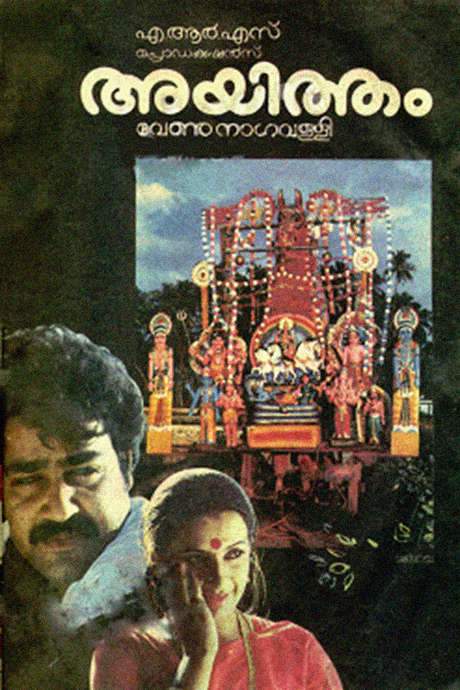
Year: 1992
Runtime: 119 mins
Language: Malayalam
Director: Rajeevnath
Ramya visits a mental asylum where her aunt, a nun, works and meets Sidharthan, a patient living a spiritual life. Fascinated by his enigmatic demeanor, she studies him. As they interact, Sidharthan recalls his ex‑wife and falls for Ramya, only to learn she is observing him as a subject, complicating their bond.
Warning: spoilers below!
Haven’t seen Aham yet? This summary contains major spoilers. Bookmark the page, watch the movie, and come back for the full breakdown. If you're ready, scroll on and relive the story!
Trace every key event in Aham (1992) with our detailed, chronological timeline. Perfect for unpacking nonlinear stories, spotting hidden connections, and understanding how each scene builds toward the film’s climax. Whether you're revisiting or decoding for the first time, this timeline gives you the full picture.
Last updated: February 18, 2026 at 23:43
Find frequently asked questions about the Aham (1992) timeline, including chronological order, nonlinear jumps, cause-and-effect links, and scene sequence clarifications. This timeline FAQ helps explain when key events happen, how moments connect, and why the story unfolds in that specific order.
Siddharthan resents his father because as a judge, his father was responsible for a tragedy that killed their longtime servant and the servant's family. This event created a deep rift between father and son and shaped Siddharthan's rigid, judgmental worldview from childhood.
The film establishes early that his childhood was defined by scarce love and rigid rules, planting the seeds of his later perfectionism.
Siddharthan's suspicious nature stems from his deep-seated mistrust of others, developed through his traumatic childhood. He becomes convinced Renjini is having an affair with her friend Captain Mahendran and warns Mahendran to stay away, despite having no concrete evidence.
His habit of doubting others and expecting conformity was established early in his adulthood, making his accusations predictable.
On his birthday, Renjini buys Siddharthan a tie with money she earned from a part-time job, money he didn't know she had. He interprets this as evidence of infidelity and confronts her angrily. During the heated argument, Renjini falls down the stairs, slips into a coma, and dies shortly after.
The tension between them had been building throughout their marriage as Renjini sought independence while Siddharthan demanded control.
Renjini dies after falling down the stairs during a physical confrontation with Siddharthan. He accused her of infidelity based on his suspicion about the tie gift, and their argument escalated into a struggle. She slipped, fell, went into a coma, and died days later.
The birthday scene marks the breaking point of accumulated marital tension and Siddharthan's uncontrollable jealousy.
After Renjini's death, Siddharthan experiences a complete mental breakdown. The guilt and trauma of causing his wife's death, combined with his lifelong psychological wounds, shatter his grip on reality, leading to his institutionalization.
The film shows his mental fragmentation accelerating immediately after the tragic birthday incident.
Miriyana Varghese is an American researcher who befriends Siddharthan at the mental asylum. She makes him the subject of her study, forming a friendship that gives him rare companionship. Siddharthan develops genuine romantic feelings for her, unaware that her interest is primarily professional.
This relationship represents the first genuine connection Siddharthan has had since his breakdown, making his eventual discovery more devastating.
When Siddharthan discovers that Miriyana is only studying him for research purposes and not genuinely caring for him, he feels betrayed. This shatters the fragile hope that love and healing might come from their bond, deepening his isolation further.
The film builds his hopes carefully, making the betrayal feel like the final emotional destruction.
Siddharthan commits suicide because he believes he cannot repair the rift with his dead wife or earn genuine love from anyone. The combination of guilt over Renjini's death, the betrayal by Miriyana, and his lifelong inability to form authentic connections leads him to see death as the only path to peace and reconciliation.
The diary he writes throughout his asylum stay documents his remorse and longing for atonement, building toward this final choice.
The diary serves as Siddharthan's way of documenting his past deeds and expressing remorse for his actions. It becomes his mechanism for reckoning with his life, recording the consequences of his rigid worldview and the damage it caused to those around him.
The diary frames the entire narrative, serving as both confession and catharsis for the protagonist.
Renjini seeks independence because she feels constrained by Siddharthan's controlling nature. She takes a part-time job to earn her own money and build self-reliance, but her ambition clashes with Siddharthan's demand that she conform to his vision of their life together.
Her striving for autonomy directly conflicts with Siddharthan's need for control, escalating their marital conflict.
Captain Mahendran is Renjini's friend, whom Siddharthan becomes suspicious of without evidence. He warns Mahendran to stay away from their home and from Renjini, driven by his paranoid conviction that there is trouble in Renjini's circle and fear of betrayal.
This unfounded suspicion exemplifies Siddharthan's pattern of quick judgment and mistrust of others.
Discover curated groups of movies connected by mood, themes, and story style. Browse collections built around emotion, atmosphere, and narrative focus to easily find films that match what you feel like watching right now.
Stories exploring fragile minds within the stark confines of institutions.If you were fascinated by the mental asylum setting and psychological observation in Aham, explore more movies that delve into fragile minds within institutional walls. These films share a somber, introspective tone and heavy emotional weight.
The narrative pattern often involves a character—be it a patient, a doctor, or an observer—whose journey forces a confrontation with mental fragility, either their own or others'. Stories unfold through a lens of clinical observation, uncovering past traumas and leading to tragic or bleak realizations about the human psyche.
These films are grouped together because they share a specific setting—the mental institution—which creates a unique atmosphere of confinement and clinical observation. They possess a melancholic tone, high psychological intensity, and focus on the tragic consequences of mental illness, making the viewing experience both somber and intellectually demanding.
Intense portraits of characters consumed by their own flaws towards a bleak end.If you appreciated the intense focus on Siddharthan's psychological breakdown in Aham, you'll find more movies here about tragic characters consumed by guilt and obsession. These films feature heavy emotional weight, steady pacing, and ultimately bleak conclusions.
These narratives follow a protagonist grappling with a deep-seated personal flaw or a traumatic past. The plot is a steady, often linear, progression as their actions, driven by obsession or guilt, increasingly isolate them and lead to irreversible consequences, culminating in a definitive, tragic ending such as death or complete psychological collapse.
Movies in this thread share a core focus on a single character's psychological deterioration. They are united by a high emotional weight, a melancholic or bleak tone, and a steady pacing that builds tension towards an inevitable tragic conclusion. The experience is defined by its heavy, introspective, and emotionally draining nature.
Don't stop at just watching - explore Aham in full detail. From the complete plot summary and scene-by-scene timeline to character breakdowns, thematic analysis, and a deep dive into the ending - every page helps you truly understand what Aham is all about. Plus, discover what's next after the movie.
Read a complete plot summary of Aham, including all key story points, character arcs, and turning points. This in-depth recap is ideal for understanding the narrative structure or reviewing what happened in the movie.
Discover the characters, locations, and core themes that shape Aham. Get insights into symbolic elements, setting significance, and deeper narrative meaning - ideal for thematic analysis and movie breakdowns.
Discover movies like Aham that share similar genres, themes, and storytelling elements. Whether you’re drawn to the atmosphere, character arcs, or plot structure, these curated recommendations will help you explore more films you’ll love.
Aham (1992) Plot Summary & Movie Recap
Aham (1992) Scene-by-Scene Movie Timeline
Aham (1992) Spoiler-Free Summary & Key Flow
Movies Like Aham – Similar Titles You’ll Enjoy
Anandham (2001) Detailed Story Recap
Saaya (2003) Full Movie Breakdown
Madhumasam (2007) Complete Plot Breakdown
Amaram (1991) Plot Summary & Ending Explained
Ulladakkam (1991) Detailed Story Recap
Ram-Avtar (1988) Ending Explained & Film Insights
Ayitham (1988) Ending Explained & Film Insights
Anantaram (1987) Spoiler-Packed Plot Recap
Thalavattam (1986) Film Overview & Timeline
Samooham (1993) Spoiler-Packed Plot Recap
Aah (1953) Complete Plot Breakdown
Ayalathe Adheham (1992) Movie Recap & Themes
Aapadbandhavudu (1992) Ending Explained & Film Insights
Aasai (1995) Full Movie Breakdown
First Bell (1992) Complete Plot Breakdown