Plot Explained Spoilers guaranteed!
Plot Explained

Browse by genre

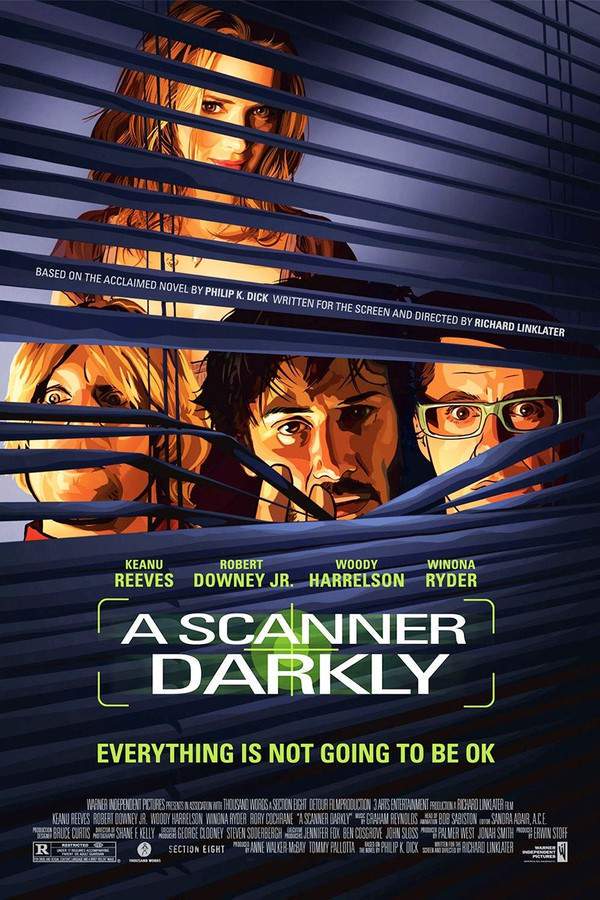
A Scanner Darkly (2006) movie poster

Plot Summary

A Scanner Darkly (2006) Plot Summary Explained

Release, runtime and language
2006 · 100 min · English
Directed by
Richard Linklater
Starring
Keanu Reeves, Robert Downey Jr., Winona Ryder

In a dystopian future, an undercover narcotics agent struggles with drug addiction while attempting to infiltrate a drug ring. The blurring lines between his real identity and his assumed persona lead to a descent into paranoia and a questioning of reality. Combining live-action and animation, this darkly comedic adaptation of Philip K. Dick's semi-autobiographical novel explores themes of surveillance, deception, and the fragility of the human mind in a haunting vision of America.

On this page (6)
  1. 1 Where to watch
  2. 2 What happens: full plot
  3. 3 Plot questions answered
  4. 4 Movie threads
  5. 5 Movies like A Scanner Darkly
  6. 6 Every angle

Where to watch

Where to Watch A Scanner Darkly (2006)

Where can you watch A Scanner Darkly? Stream, rent or buy it in the US, including on Kanopy, YouTube Free and Amazon Video: current JustWatch availability with up-to-date prices.

Streaming availability powered by JustWatch

Full plot summary · contains spoilers

What Happens in A Scanner Darkly: Full Plot Summary

The whole story of A Scanner Darkly (2006) explained, from the opening scene to the final frame: every key event, every twist and what it all adds up to. Read it as a quick recap before the sequel, to check a scene you missed, or to finally understand what really happened.

The United States has succumbed to the war on drugs, with Substance D, a potent drug inducing surreal hallucinations, now rampant throughout the nation. Alarmingly, an estimated 20% of the population is ensnared by addiction. In a desperate bid to regain control, the government has rolled out an invasive and sophisticated surveillance network, deploying undercover agents and informants to combat the escalating crisis.

Manufactured from a rare blue flower that flourishes in select environments, Substance D has become a tool of devastation, with only New-path providing support to those grappling with addiction. Among those dedicated to infiltrating the drug underworld is Bob Arctor, played by Keanu Reeves. Assigned to blend into the underbelly of drug culture, Arctor envisions a traditional family life in Anaheim, California, filled with hopes of a wife and two children. Yet reality tells a different story, as he cohabitates with Luckman (Woody Harrelson) and Barris, two substance-abusing layabouts.

The trio spends their days trapped in the haze of Substance D, engaging in intricate discussions that veer into the realm of paranoia. To preserve his anonymity while navigating this dangerous world, Arctor dons a "scramble suit," a high-tech disguise that alters his appearance and voice, rendering him invisible to facial and voice recognition technologies. Within this convoluted setup, he is known only by his alias, "Fred." His superior officer, Hank, along with other operatives, similarly utilizes scramble suits, creating a web of hidden identities amongst the ranks.

As the operation unfolds, Arctor’s own addiction to Substance D deepens, leading him to purchase increasing amounts from Donna, whom he longs to persuade into revealing her supplier. Their relationship oscillates between tension and tenderness, though she remains resolute against physical intimacy. Charles Freck (Rory Cochrane), a close friend of Barris, complicates matters further by voicing his reluctance to enter New-Path rehabilitation, having heard unsettling rumors.

Beneath the surface, however, surveillance on Arctor intensifies, as Hank instructs "Fred" to scrutinize his actions closely. In a cruel twist, Arctor’s home becomes the focal point of an investigation, with hidden cameras monitoring every movement. The weight of his dual life begins to take a toll, revealing cognitive impairments due to prolonged drug use, assessed through rigorous medical evaluations. Meanwhile, Barris, unbeknownst to Arctor, feeds information to Hank, claiming that Arctor poses a threat.

A devastating turn occurs when Arctor witnesses Luckman’s incapacitation from drugs, an event that Barris coldly ignores. Tragedy strikes when Freck succumbs to his hallucinations, taking his own life in despair.

As Arctor’s condition deteriorates, it becomes starkly apparent that Substance D has irreparably damaged his brain. Bewildered by the police’s interest in his movements, he speculates about larger, covert activities at play. In a moment of revelation, Hank confesses to "Fred" that she has always known his true identity as Arctor. Confronted with the harsh truth, he repeats his name in disorientation. Hank discloses that the surveillance operation's primary target is Barris, aiming to destabilize him into confessing.

Facing serious ramifications for his spiraling addiction, Hank informs Arctor that he will face disciplinary action. This is a prelude to revealing Donna’s true identity as Audrey, who is secretly working alongside the police. At New-Path, Arctor grapples with the sobering reality that the rehabilitation facility is intertwined with the distribution of Substance D.

Audrey and Mike (Dameon Clarke) engage in a philosophical debate about their role in Arctor’s downfall; they had effectively orchestrated his addiction to later expose the insidious workings of New-Path.

Eventually, Arctor finds himself assigned to a labor camp, a bleak existence where he performs menial tasks, mechanically echoing the words of those around him. In the fields, while tending to corn crops, he stumbles upon concealed rows of the very blue flowers responsible for his plight. Determined to retain a fragment of hope, he tucks one flower into his boot, vowing to share it with his friends during his next fleeting moment of freedom.

Last updated: November 08, 2024 at 00:07

Was this helpful?

Plot questions answered

A Scanner Darkly Plot Explained: Your Questions Answered

The questions people ask most about A Scanner Darkly (2006): what happens in the confusing scenes, why the characters do what they do, the twists, hidden details and what the ending means. Each answer contains spoilers.

Q1

Why does Hank reveal she always knew Bob Arctor's true identity?

Hank reveals her knowledge of Arctor's identity because the surveillance operation's primary target was actually Barris, not Arctor. The investigation aimed to destabilize Barris into confessing, and Hank needed Arctor to understand the larger picture. The revelation also underscores the theme of manipulative surveillance - Arctor was being watched and used as a pawn throughout, with his superiors knowing exactly who he was despite his belief in his own anonymity.

Foreshadowing: Earlier, Hank had instructed 'Fred' to closely monitor his own actions, which was a test of his loyalty rather than a genuine investigation into him.

  • hank
  • identity reveal
  • surveillance
  • barris target
  • fred alias
Q2

Why is Donna actually Audrey?

Donna, the drug dealer Arctor was trying to get information from, is revealed to be Audrey, a police informant working alongside Hank and Mike. Her true identity was part of a larger police operation to expose the drug distribution network. She maintained her cover as a dealer to gather intelligence while also building a relationship with Arctor, though she kept professional boundaries, refusing physical intimacy.

Foreshadowing: Donna's reluctance to share her supplier and her guarded behavior throughout the relationship hints at her true allegiances.

  • donna
  • audrey
  • informant
  • police operation
  • undercover
Q3

Why is Barris the real target of the surveillance operation?

Barris, Arctor's roommate, was the primary target of the entire surveillance operation. While Arctor believed he was infiltrating the drug underworld to find suppliers, his real assignment was to gather evidence against Barris, who was suspected of being a major player in the drug network. Unbeknownst to Arctor, Barris had been feeding information to Hank and was under investigation the whole time.

Foreshadowing: Barris's callous dismissal of Luckman's collapse and his suspicious behavior throughout suggested he was not the harmless roommate he appeared to be.

  • barris
  • real target
  • drug ring
  • investigation
  • betrayal
Q4

Why is New-Path connected to Substance D distribution?

New-Path, the rehabilitation facility presented as the solution to Substance D addiction, is actually intertwined with the drug's distribution. The facility was a front - it both treated addicts and facilitated the spread of the very substance destroying them. This revelation exposes the systemic corruption where the supposed remedy is complicit in the epidemic.

Foreshadowing: Charles Freck's reluctance to enter New-Path, having heard unsettling rumors, hints early at the facility's true nature.

  • new-path
  • rehabilitation
  • conspiracy
  • drug distribution
  • corruption
Q5

Why does Charles Freck commit suicide?

Charles Freck succumbs to his hallucinations from Substance D addiction, taking his own life in despair. The drug's surreal hallucinations had consumed his mind, making reality indistinguishable from fantasy. His tragic end illustrates the devastating mental toll of Substance D and serves as a warning of the drug's corrosive effect on the human psyche.

Foreshadowing: Freck's earlier expressions of fear about entering New-Path and his escalating paranoia set the stage for his mental breakdown.

  • charles freck
  • suicide
  • hallucinations
  • substance d
  • despair
Q6

What causes Arctor's cognitive decline?

Arctor's cognitive decline is directly caused by his prolonged and deepening addiction to Substance D. As he purchased and consumed increasing amounts of the drug to maintain his cover and navigate his double life, the substance irreparably damaged his brain. Medical assessments monitor his deteriorating mental state, affecting his ability to distinguish between his real identity and his undercover persona.

Foreshadowing: His escalating discussions about paranoia and the hazy conversations with roommates illustrate the drug's early effects on his mind.

  • cognitive decline
  • brain damage
  • substance d addiction
  • memory loss
  • mental deterioration
Q7

Why does Arctor hide the blue flower in his boot at the end?

Arctor hides a blue flower - the source of Substance D - in his boot as a small act of defiance and hope. Despite being brain-damaged and relegated to a labor camp, he retains enough awareness to recognize the flower and wants to share it with his friends during his next moment of freedom. This gesture represents a fragile clinging to humanity and connection in an otherwise bleak existence.

Foreshadowing: The blue flowers were established earlier as the rare source of Substance D, making their discovery in the labor camp fields thematically significant.

  • blue flower
  • hope
  • defiance
  • labor camp
  • freedom
Q8

How does the scramble suit contribute to Arctor's identity confusion?

The scramble suit is a high-tech disguise that alters Arctor's appearance and voice, rendering him invisible to facial and voice recognition. While designed to protect his anonymity, it symbolizes and exacerbates his fractured identity. As his addiction worsens, he can no longer distinguish between his real self (Bob Arctor) and his alias (Fred), mirroring the suit's ability to constantly shuffle identities.

Foreshadowing: Early scenes show Arctor discussing how the suit makes him 'invisible,' setting up the theme of identity dissolution.

  • scramble suit
  • identity
  • disguise
  • fred alias
  • anonymity
Q9

Why is Arctor sent to a labor camp?

Arctor is sent to a labor camp as disciplinary action for his spiraling addiction and cognitive impairments. Despite being an undercover agent, his addiction to Substance D had progressed so severely that he could no longer effectively perform his duties. The system that used him now discards him, assigning him to menial labor where he mechanically echoes others, symbolizing his complete loss of self.

Foreshadowing: Hank's earlier warning about 'serious ramifications' for his addiction foreshadows this outcome.

  • labor camp
  • disciplinary action
  • addiction consequences
  • institutionalized
  • brain damage
Q10

Why do Audrey and Mike orchestrate Arctor's addiction?

Audrey (Donna) and Mike deliberately allowed and even encouraged Arctor's addiction as part of their plan to expose New-Path's connection to Substance D distribution. They needed him to become sufficiently entangled in the drug network to gather evidence against the rehabilitation facility. Their philosophical debate reveals their awareness of their complicity in his destruction, justifying it as necessary for the larger goal of bringing down the system.

Foreshadowing: Donna's persistent refusal to reveal her supplier and her calculated distance from Arctor hint at a larger scheme.

  • audrey
  • mike
  • orchestrated addiction
  • new-path expose
  • conspiracy
Q11

What happens to Luckman and why does he collapse?

Luckman, Arctor's roommate, collapses due to the effects of Substance D addiction. Arctor witnesses this incapacitation, a disturbing moment that highlights the drug's devastating physical and mental impact. Barris coldly ignores Luckman's collapse, demonstrating the moral decay among the group as addiction erodes their humanity and capacity for compassion.

Foreshadowing: The trio's daily haze and paranoia-filled discussions establish their deepening addiction throughout the story.

  • luckman
  • collapse
  • substance d effects
  • witness
  • neglect
Q12

Why is Arctor's ending so bleak?

Arctor's ending is bleak because he ends up brain-damaged, institutionalized in a labor camp that perpetuates the very system that destroyed him. He mechanically repeats words from his environment, stripped of his former identity and ambitions. His small act of hiding the blue flower offers only ambiguous, minimal hope - a gesture unlikely to change his circumstances but representing a stubborn human will to retain meaning.

Foreshadowing: The gradual decline throughout the film, from his initial dreams of family life to his cognitive deterioration, builds inexorably toward this destination.

  • bleak ending
  • labor camp
  • brain damage
  • institutionalized
  • dystopian
Q13

What causes Arctor's escalating paranoia?

Arctor's paranoia stems from multiple sources: the psychological effects of Substance D, constant surveillance through hidden cameras in his home, his dual identity as both Arctor and Fred, and his growing suspicion that larger covert activities are at play. As his addiction deepens, reality becomes increasingly distorted, making it difficult for him to trust his own perceptions.

Foreshadowing: The early scenes of the trio engaging in paranoia-laden discussions establish this theme from the beginning.

  • paranoia
  • surveillance
  • substance d
  • delusions
  • identity confusion

Movie threads

More Movies Like A Scanner Darkly, by Mood & Story

Curated lists built around what makes A Scanner Darkly tick: the same mood, the same kind of story or the same emotional payoff. Each list explains why these movies belong together.

Movies about identity collapse like A Scanner Darkly

Stories where the line between reality and delusion completely dissolves. Explore movies like A Scanner Darkly, where characters face a complete breakdown of their identity. These psychological thrillers and dramas feature stories of mental deterioration, identity crises, and the blurring of reality, perfect for viewers who appreciate complex, character-driven descents into paranoia.

  • paranoid
  • unsettling
  • disorienting
  • claustrophobic
  • anxious
  • melancholic
  • Tone: dark, unsettling
  • Pacing: slow, deliberate
Why these movies?

The story pattern: Narratives in this thread follow a character's gradual or sudden loss of self. Often triggered by trauma, surveillance, or addiction, the story structure mirrors the protagonist's confusion, employing unreliable perspectives and a disorienting atmosphere to chart their journey from stability into a fragmented, uncertain state.

Why they belong together: Movies are grouped here based on their shared focus on the internal catastrophe of losing one's identity. They converge on a dark tone, complex narrative structures that reflect a broken psyche, and a heavy emotional weight stemming from the tragedy of cognitive decay.

Bleak dystopian movies like A Scanner Darkly

Hopeless futures where the system grinds down the individual. Find movies similar to A Scanner Darkly that present a deeply pessimistic vision of the future. If you liked its themes of inescapable surveillance, societal decay, and the crushing of the individual by the system, this collection of bleak sci-fi and psychological thrillers is for you.

  • bleak
  • dystopian
  • oppressive
  • claustrophobic
  • melancholic
  • heavy
  • Tone: dark, bleak
  • Pacing: slow to steady
Why these movies?

The story pattern: The narrative pattern is one of inevitable defeat. A character may struggle against a corrupt or omnipresent system, but their efforts are futile. The story arc leads to a bleak ending where the system absorbs, destroys, or neuters any resistance, emphasizing the hopelessness of the setting.

Why they belong together: These films are united by their unanimously dark tone, high intensity derived from systemic oppression, and profoundly bleak endings. They share a core thematic focus on the loss of individual autonomy and the psychological toll of living in a controlled, decaying society.

If you liked this

Movies Like A Scanner Darkly

Similar movies to A Scanner Darkly: the same genre, themes or kind of story. Each one comes with its own plot summary, timeline and ending explained.

Browse all movie summaries

Every angle

A Scanner Darkly (2006) Explained: Plot, Timeline & Characters

Everything about A Scanner Darkly in one place: what happens in the plot summary, the timeline in chronological order, the characters and meaning and a spoiler-free summary. What's After the Movie adds the cast, box office and post-credit scenes.

Coming soon on iOS and Android

The Plot Explained Movie Summary App

Plot summaries, endings explained and timelines on your phone. Catch up on any movie in minutes, save your favorites and never miss a twist again.

Be the first to know when we launch. Your email stays private, always.

Learn more about the app