Plot Explained Spoilers guaranteed!
Plot Explained

Browse by genre

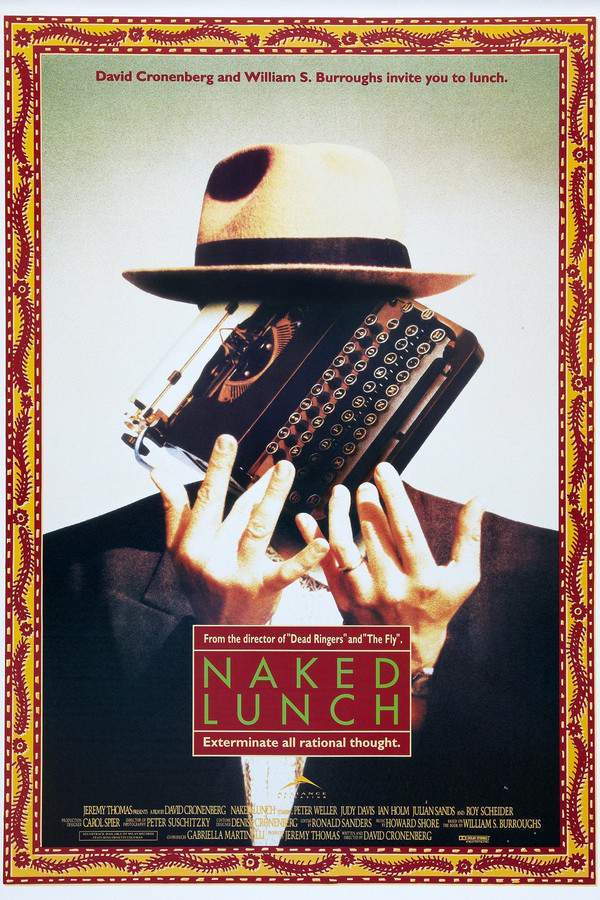
Naked Lunch (1991) movie poster

Plot Summary

Naked Lunch (1991) Plot Summary Explained

Release, runtime and language
1991 · 115 min · English
Directed by
David Cronenberg
Starring
Judy Davis, Peter Weller

A disillusioned exterminator's life spirals out of control when he becomes entangled with a strange substance. As his perception of reality shifts and his sanity wavers, Bill Lee finds himself immersed in a bizarre and nightmarish world. His art, addiction, and the looming threat of mortality intertwine in a darkly comedic and surreal exploration of identity and the complex relationship between an artist and their work.

On this page (6)
  1. 1 What happens: full plot
  2. 2 Plot questions answered
  3. 3 The book behind the movie
  4. 4 Movie threads
  5. 5 Movies like Naked Lunch
  6. 6 Every angle

Full plot summary · contains spoilers

What Happens in Naked Lunch: Full Plot Summary

The whole story of Naked Lunch (1991) explained, from the opening scene to the final frame: every key event, every twist and what it all adds up to. Read it as a quick recap before the sequel, to check a scene you missed, or to finally understand what really happened.

New York City, 1953. While performing pest control in an apartment, Bill Lee finds himself out of bug powder, which frustrates his boss, A.J. Cohen, who uses it sparingly. Later, at a nearby bar, Bill connects with two fellow writers who engage in a spirited debate on writing techniques. Martin endlessly rewrites, while Hank firmly opposes self-censorship. Bill expresses his view: "Exterminate all rational thought," claiming he has stopped writing because it has become "too dangerous." Upon returning home, he discovers his wife, Joan, using the powder herself. She urges him to do the same, saying: > "It's a Kafka high... you feel like a bug."

Things take a turn for the worse when Bill is arrested for possessing illegal drugs. At the police station, he finds himself alone in an interrogation room with an enormous beetle that consumes bug powder and claims to be his "case officer." The insect informs Bill that his latest mission is to eliminate his wife, whom it reveals to be an inhuman agent working for Interzone Incorporated. In a fit of rage, Bill squashes the beetle beneath his shoe and makes a daring escape.

He confronts Joan and shares the bizarre events of his arrest and subsequent hallucinations. A colleague introduces him to Dr. Benway, a dubious figure who can supposedly help him overcome his addiction. At Dr. Benway's, he is given mysterious black centipede powder and warned that it represents an agent who has lost touch with reality, lying dormant until the right moment to awaken. Overwhelmed, Bill feels sick when he encounters a stall selling giant centipedes. Upon arriving home, he witnesses his friend Hank engaged in an intimate encounter with Joan, while Martin recites nonsensical prose. In a tragic twist, Bill injects both himself and Joan with drugs before attempting a William Tell routine, resulting in her tragic demise.

Bill later meets an unusual Asian man in a bar who introduces him to a mugwump—an eerie, bizarre alien creature. This creature recommends a Clark-Nova typewriter to help him document his wife's death for Interzone, giving him a ticket to the strange locale. After pawning his gun for the typewriter, Bill finds himself in Interzone, a surreal North African enclave where he and others are ordered to type obscure reports. He encounters a flamboyant German named Hans, who is engaged in synthesizing a drug known as black centipede "meat."

Bill's drug-induced haze manifests as his Clark-Nova begins to morph into a beetle, which claims that homosexual relationships are the best cover for agents. At a party, he meets Tom and Joan Frost, a woman who bears a startling resemblance to his deceased wife. Tom reveals to Bill that he is killing his wife slowly through manipulative telepathy. Disturbed, Bill collapses on the beach, only to be rescued by the enigmatic Cloquet, who has an interest in Bill’s writing. After a series of absurd encounters and further chaos involving his typewriters and relationships, Bill learns that he was manipulated into becoming an unwitting assassin.

Eventually, when discovering Hans’ drug factory, Bill uncovers the appalling process of how addicts are exploited for their addiction. He must navigate a web of deception, runaway desires, and surreal hazards, including a confrontation with the disguised Fadela who is revealed to be Dr. Benway in disguise. Bill strikes a deal to work for Benway, with the condition that Joan can accompany him. However, as they approach the border into Annexia, it culminates in another horrifying scene where Bill, repeating the William Tell routine, is left devastated after again shooting Joan, only to be welcomed by the border guards with indifference rather than the judgment he expected.
Last updated: November 08, 2024 at 00:26

Was this helpful?

Plot questions answered

Naked Lunch Plot Explained: Your Questions Answered

The questions people ask most about Naked Lunch (1991): what happens in the confusing scenes, why the characters do what they do, the twists, hidden details and what the ending means. Each answer contains spoilers.

Q1

Why does Bill kill Joan with the William Tell routine?

Bill discovers his friend Hank and Joan in an intimate encounter, which sends him into a distressed state. Under the influence of drugs and psychological breakdown, he performs the William Tell routine, a trick shot where he aims a pistol at an apple placed on Joan's head, deliberately missing the apple and shooting her instead. This act represents his simultaneous love and desire to destroy the object of his obsession, combining sexual jealousy with self-destructive impulse.

Foreshadowing: Earlier in the bar, Bill declares he has stopped writing because it has become 'too dangerous,' foreshadowing his descent into dangerous self-destructive behavior.

  • william tell routine
  • joan death
  • bill lee
  • kill wife
  • psychological breakdown
  • drugs
Q2

Is the giant beetle at the police station real or a hallucination?

The beetle appears during Bill's interrogation after his arrest for drug possession. It claims to be his 'case officer' and instructs him to eliminate his wife, revealing she is an 'inhuman agent' working for Interzone Incorporated. Given the film's overall blurring of reality and hallucination due to drug use, the beetle is most likely a manifestation of Bill's paranoid, drug-induced state, though the film deliberately leaves this ambiguous, reflecting the surreal tone of Burroughs' work.

Foreshadowing: Bill's wife Joan earlier describes her bug powder experience as a 'Kafka high,' introducing the insect/beetle motif that will dominate Bill's paranoid visions.

  • beetle
  • hallucination
  • police station
  • interrogation
  • drugs
  • paranoid
Q3

How does Bill get to Interzone?

After meeting the mugwump in a bar, Bill is encouraged to acquire a Clark-Nova typewriter to document his wife's death for Interzone. He pawns his gun to obtain the typewriter, and upon purchasing it, he finds himself transported to Interzone, a surreal North African enclave. The transition is sudden and dreamlike, reflecting the film's non-linear, hallucinatory narrative structure.

Foreshadowing: The mugwump tells Bill the typewriter will help him 'document' his wife's death, hinting at the predetermined tragedy that unfolds.

  • interzone
  • typewriter
  • mugwump
  • travel
  • clark-nova
  • pawn shop
Q4

What is the black centipede powder and what does it do?

Dr. Benway gives Bill the black centipede powder, warning him it represents an agent who has lost touch with reality, lying dormant until the right moment to awaken. The powder causes reality-altering effects, Bill experiences intense hallucinations, including seeing his typewriter morph into a beetle. It's essentially a drug that intensifies paranoid delusions and blurs the line between actual events and fantasies, serving as the mechanism for much of the film's surreal content.

Foreshadowing: Earlier, Joan describes her bug powder experience as feeling 'like a bug,' establishing that mind-altering substances are central to the narrative's reality distortion.

  • black centipede powder
  • dr benway
  • drugs
  • hallucination
  • reality alteration
Q5

Why is Bill ordered to eliminate his wife?

The giant beetle at the police station reveals that Bill's 'mission', given his background as an exterminator, is to kill his wife Joan, who the insect claims is an 'inhuman agent' working for Interzone Incorporated. This establishes the film's central conspiracy: Bill is being manipulated into becoming an assassin, with his wife framed as an enemy agent. This paranoid delusion sets up the film's exploration of manipulation, betrayal, and the protagonist's role as a unwitting tool of larger forces.

Foreshadowing: Bill works as an exterminator, and his boss Cohen is sparing with bug powder, both establishing Bill's connection to killing insects that will translate into killing humans.

  • mission
  • eliminate wife
  • inhuman agent
  • interzone incorporated
  • beetle
  • conspiracy
Q6

Who is Joan Frost and what is her connection to Joan?

Joan Frost is a woman Bill encounters at a party in Interzone who bears a striking resemblance to his deceased wife. The resemblance is deliberately uncanny, and Tom reveals to Bill that he is killing his wife 'slowly through manipulative telepathy.' This suggests Joan Frost may be another manifestation, clone, or replacement for the original Joan, part of the film's exploration of identity duplication and the inescapable nature of Joan's presence in Bill's psyche.

Foreshadowing: The earlier revelation that Joan was an 'inhuman agent' hints at the possibility of multiple Joan entities or replacements.

  • joan frost
  • resemblance
  • interzone
  • party
  • tom
  • telepathy
Q7

What is the mugwump creature?

The mugwump is a bizarre alien creature introduced to Bill by an unusual Asian man in a bar. It appears as an eerie, otherworldly being and recommends Bill acquire a Clark-Nova typewriter to document his wife's death for Interzone. The mugwump serves as a guide or messenger, steering Bill toward his destiny in Interzone. The creature represents another element of the film's surreal bureaucracy, otherworldly entities directing humans toward predetermined fates.

Foreshadowing: The mugwump's instructions to document Joan's death foreshadow both her killing and the elaborate documentation that follows.

  • mugwump
  • alien creature
  • typewriter
  • interzone
  • guide
  • bar
Q8

Why does Bill perform the William Tell routine again at the border?

At the border into Annexia, Bill again attempts the William Tell routine, shooting Joan a second time in a devastating repetition. This recurrence demonstrates that Bill is trapped in a cycle, he cannot escape his own destructive patterns. The act is both a literal repetition of his trauma and a symbolic representation of his inability to break free from the manipulation and programming he has experienced. The William Tell routine appears to be a predetermined script he is compelled to follow.

Foreshadowing: Earlier, Bill was told he must 'type obscure reports' in Interzone, a reference to being controlled to follow prescribed narratives.

  • william tell routine
  • border
  • annexia
  • repetition
  • cycle
  • bill lee
Q9

What is Interzone and Interzone Incorporated?

Interzone is a surreal North African enclave where Bill finds himself after acquiring the Clark-Nova typewriter. It operates as a bizarre bureaucratic setting where residents are ordered to type obscure reports for Interzone Incorporated. The organization appears to be a shadow government or intelligence operation that recruits and manipulates individuals like Bill, assigning them missions and maintaining control through drug addiction and psychological manipulation.

Foreshadowing: The beetle's claim that Joan works for Interzone Incorporated establishes the organization before Bill physically arrives.

  • interzone
  • interzone incorporated
  • north africa
  • bureaucracy
  • reports
  • organization
Q10

Why does Dr. Benway disguise himself as Fadela?

Dr. Benway, the dubious doctor who introduced Bill to the black centipede powder, is later revealed to be disguised as Fadela, an exotic woman Bill encounters. This deception is part of Benway's manipulation of Bill, he operates behind various guises to maintain control over the protagonist and other addicts. The disguise reflects the film's themes of identity manipulation, false fronts, and the difficulty of knowing anyone's true nature or allegiance.

Foreshadowing: Dr. Benway was established as a dubious, untrustworthy figure from the moment he gave Bill the reality-altering powder.

  • dr benway
  • fadela
  • disguise
  • deception
  • manipulation
  • identity
Q11

What does the ending mean when border guards show indifference?

After Bill kills Joan at the border using the William Tell routine, the border guards respond with indifference rather than judgment or horror. This bleak ending suggests that Bill's horrific act, far from being a unique tragedy, is simply part of the system's machinery. His induction into the exploitative world of Interzone/Benway is finalized not through celebration but through cold acceptance. The indifference reflects the film's dark view of dehumanization: acts of violence are routine, and the protagonist's trauma means nothing to the machine he now serves.

Foreshadowing: Throughout the film, Bill is manipulated into becoming an 'assassin' for Interzone, the ending confirms his induction is complete.

  • border guards
  • indifference
  • ending
  • annexia
  • acceptance
  • dehumanization
Q12

How is Bill manipulated into becoming an assassin?

Bill is gradually manipulated into becoming an unwitting assassin through a combination of drug addiction, paranoid hallucinations, and psychological manipulation. The beetle at the police station assigns him the 'mission' to kill his wife, framing her as an enemy agent. Dr. Benway provides the reality-altering drugs that blur his perception. Various characters, including the mugwump and Tom, steer him toward specific actions. By the time he reaches the border, he has been programmed to repeat the William Tell killing, completing his transformation from ordinary exterminator to programmed assassin for Interzone.

Foreshadowing: Bill's early declaration that writing has become 'too dangerous' foreshadows his becoming dangerous to others rather than himself.

  • manipulation
  • assassin
  • programmed
  • interzone
  • dr benway
  • psychological control

Movie threads

More Movies Like Naked Lunch, by Mood & Story

Curated lists built around what makes Naked Lunch tick: the same mood, the same kind of story or the same emotional payoff. Each list explains why these movies belong together.

Surreal Descent into Madness Movies like Naked Lunch

Films where reality unravels and the protagonist's psyche fragments. If you enjoyed the mind-bending psychological breakdown in Naked Lunch, explore more movies like it. This collection features films where reality dissolves, featuring surrealism, hallucinatory sequences, and a profound exploration of a character's sanity. Find similar stories of psychological disintegration and nightmarish realities.

  • surreal
  • disorienting
  • hallucinatory
  • paranoid
  • nightmarish
  • psychological
  • Tone: dark, unsettling, absurd
  • Pacing: variable, deliberate shifts
Why these movies?

The story pattern: Stories in this thread typically focus on a central character losing their grip on reality. The plot structure is often non-linear, filled with symbolic events and encounters that may or may not be real. The conflict is internal, a battle for the protagonist's mind, which is externalized through bizarre and dreamlike imagery. The journey is one of increasing disorientation and ultimate psychological fragmentation.

Why they belong together: These films are grouped together because they share a core focus on blurring perception and depicting mental collapse through a surrealist lens. They create a specific, unsettling mood that blends paranoia, dread, and absurdity, offering a challenging and immersive experience centered on the fragility of the human mind.

Movies about Artistic Torment similar to Naked Lunch

Stories exploring the dark, obsessive relationship between art and agony. For viewers who liked Naked Lunch's portrayal of a writer's chaotic creative process, this section highlights similar movies about artistic torment. Discover films that explore the dark side of creation, where artistry is intertwined with addiction, psychological crisis, and a bleak outlook on the artist's life.

  • obsessive
  • tormented
  • dark
  • psychological
  • bleak
  • introspective
  • Tone: dark, melancholic, bleak
  • Pacing: variable, character-driven
Why these movies?

The story pattern: The narrative pattern follows an artist whose creative output is fueled by personal demons. Their journey is one of obsession, where their art becomes inseparable from their addiction, mental illness, or traumatic experiences. The plot often involves a downward spiral, with the artist's work and life becoming increasingly entangled in a destructive feedback loop, leading to a bleak or ambiguous conclusion about the cost of their creations.

Why they belong together: These movies are united by their thematic focus on the destructive nature of the creative process. They share a heavy emotional weight, a dark tone, and a fascination with how pain fuels artistry. The similarity lies in the portrayal of the artist as a tragic figure grappling with their muse under dire circumstances.

If you liked this

Movies Like Naked Lunch

Similar movies to Naked Lunch: the same genre, themes or kind of story. Each one comes with its own plot summary, timeline and ending explained.

Browse all movie summaries

Every angle

Naked Lunch (1991) Explained: Plot, Timeline & Characters

Everything about Naked Lunch in one place: what happens in the plot summary, the timeline in chronological order, the characters and meaning and a spoiler-free summary. What's After the Movie adds the cast, box office and post-credit scenes.

Coming soon on iOS and Android

The Plot Explained Movie Summary App

Plot summaries, endings explained and timelines on your phone. Catch up on any movie in minutes, save your favorites and never miss a twist again.

Be the first to know when we launch. Your email stays private, always.

Learn more about the app