Plot Explained Spoilers guaranteed!
Plot Explained

Browse by genre

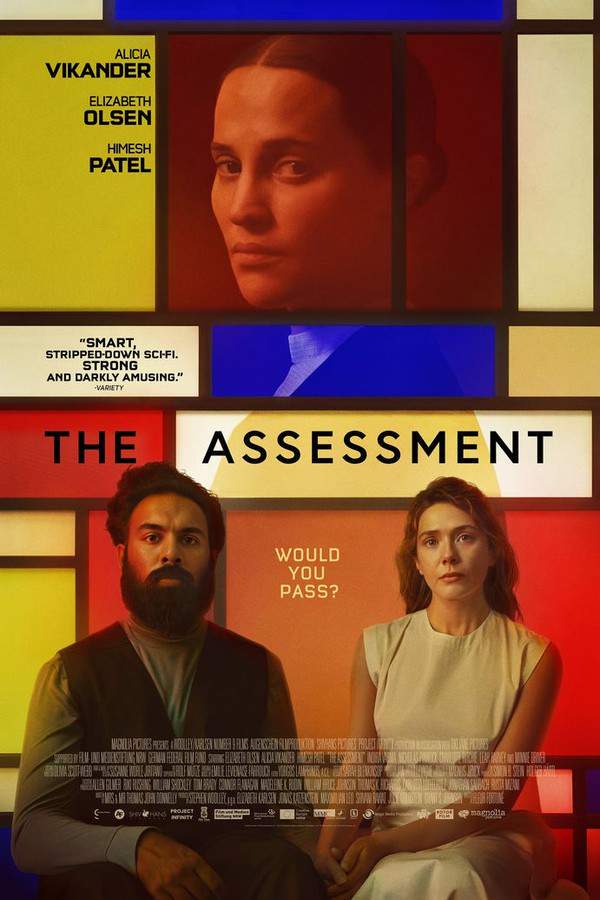
The Assessment (2025) movie poster

Plot Summary

The Assessment (2025) Plot Summary & Ending Explained

Release, runtime and language
2025 · 1 h 54 m · English
Echo score 77
Directed by
Fleur Fortune
Starring
Elizabeth Olsen, Himesh Patel, Alicia Vikander, Leah Harvey, Indira Varma, Minnie Driver
Budget
$8M

In a future where resources are scarce and the government strictly regulates reproduction, Mia and Aaryan, a successful couple, plan to start a family. Their hopes are complicated when an assessor named Virginia is assigned to their home for a week to evaluate their suitability as parents. Virginia's presence disrupts their lives as she observes and assesses their relationship and lifestyle, leading to unexpected revelations and challenges for all involved.

On this page (6)
  1. 1 What happens: full plot
  2. 2 Plot questions answered
  3. 3 How it ends
  4. 4 Movie threads
  5. 5 Movies like The Assessment
  6. 6 Every angle

Full plot summary · contains spoilers

What Happens in The Assessment: Full Plot Summary

The whole story of The Assessment (2025) explained, from the opening scene to the final frame: every key event, every twist and what it all adds up to. Read it as a quick recap before the sequel, to check a scene you missed, or to finally understand what really happened.

In a dystopian future, societal norms mandate rigorous regulations on parenthood, driven by the dire consequences of environmental collapse and resource scarcity. This has led to the implementation of a demanding seven-day assessment for those wishing to become parents, designed to evaluate their fitness for raising children. At the heart of this gripping narrative are Mia, played by Elizabeth Olsen, and Aaryan, portrayed by Himesh Patel, a married couple isolated within a high-tech dome as they yearn for the joys of parenthood.

Mia is a passionate botanist engaged in the challenging task of nurturing plant life in a world where nature has been ravaged. Meanwhile, Aaryan's inventive spirit shines through his designs of virtual reality pets, which serve as a substitute for the genuine animals that no longer exist. Their aspirations are soon challenged when Virginia, a government-appointed assessor played by Alicia Vikander, arrives at their doorstep. Virginia's stoic demeanor masks her true intentions as she announces her plan to live with the couple for the next seven days in order to scrutinize their potential as caregivers.

The assessment takes a drastic turn when Virginia employs unconventional and at times disturbing techniques, which push the couple to their limits. By assuming the role of a child, she forces Mia and Aaryan to face their hidden fears and personal struggles, leading to intense confrontations and unforeseen emotional revelations.

One particularly telling moment emerges during a dinner party orchestrated by Virginia, where the couple’s ability to navigate social pressure becomes evident, revealing their differences in coping strategies and heightened tensions. As doubts about their readiness surface, Virginia's invasive methods further fracture their relationship.

When Mia leaves to tend to her sister, who is supposedly in the hospital, Virginia seizes the opportunity to commit a grave betrayal, resulting in a devastating twist when Mia learns upon her return that the hospital call was merely a mix-up. The drama escalates when Virginia, in a reckless turn of events, destroys Mia’s cherished greenhouse. Mia’s decision to rescue Virginia from the aftermath of the fire reveals both her compassion and the complex dynamics of their relationship.

Virginia ultimately decides to fail Mia and Aaryan without providing any justification, and in a moment of vulnerability, Aaryan confesses his transgressions. His attempt to bridge the emotional chasm is symbolized by the creation of a simulated baby, yet this effort is met with rejection from Mia, deepening their rift.

As the story unfolds, Mia embarks on a quest to find Virginia, uncovering the unsettling truth about the assessment process and its systemic failures. With no couples achieving success in the past six years, Virginia’s own motivations become clear—her opportunity to have a child hinges on the destruction of others’ hopes. She explains that the assessment was never about real potential but a cruel illusion of possibility.

In a tragic turn, Virginia faces her own demons as she prepares to evaluate another couple, ultimately choosing to end her life amid the pervasive despair of their world. It is against this backdrop of grief and loss that Mia resolves to escape the oppressive new society, seeking solace in the Old World where her mother, a defiant critic of the current regime, had been exiled. Meanwhile, Aaryan continues to grapple with his reality, creating simulated versions of their lost dreams and a child growing up in an artificial world.
Last updated: May 12, 2025 at 07:04

Was this helpful?

Plot questions answered

The Assessment Plot Explained: Your Questions Answered

The questions people ask most about The Assessment (2025): what happens in the confusing scenes, why the characters do what they do, the twists, hidden details and what the ending means. Each answer contains spoilers.

Q1

Why does Virginia sexually assault Aaryan while Mia is away?

Virginia assaults Aaryan as a calculated psychological tactic to destabilize the couple and test their relationship's resilience. She frames it as part of the assessment, telling Aaryan it must remain a secret. This betrayal serves multiple purposes: it exposes hidden tensions between Mia and Aaryan, creates moral conflict for Aaryan, and allows Virginia to observe how each partner responds to betrayal and loss of trust.

Foreshadowing: Virginia's stoic demeanor and cryptic announcements about testing their relationship foreshadow her willingness to use manipulative and harmful methods.

  • virginia assault aaryan
  • assessment manipulation
  • betrayal
Q2

Why does Virginia set fire to Mia's greenhouse?

Virginia destroys the greenhouse as a final act of psychological warfare designed to break Mia completely. The greenhouse represents Mia's life's work and her deepest connection to nature and hope for the future. By burning it, Virginia tests whether Mia can maintain composure under devastating loss, while also eliminating something precious to her. Mia's instinct to rescue Virginia from the fire demonstrates her compassion even toward her tormentor, which Virginia likely uses as further data about Mia's parental fitness.

Foreshadowing: Virginia's earlier invasive techniques and her willingness to create emotional turmoil foreshadow this destructive act.

  • greenhouse fire
  • virginia destruction
  • mia botanist
Q3

What is the purpose of the seven-day parenting assessment?

The assessment appears to evaluate couples' suitability to become parents in a world suffering from environmental collapse and resource scarcity. However, the system is fundamentally corrupt, Virginia reveals that no couple has passed in six years. The assessment is revealed to be a cruel illusion of possibility, designed to give hopeful parents false hope while the government maintains strict population control. Virginia herself must fail all couples to earn the opportunity to have a child to replace her deceased daughter.

Foreshadowing: Virginia's vague explanations about what she's looking for and her manipulative testing methods hint that the assessment lacks genuine criteria.

  • parenting assessment
  • government regulations
  • population control
  • seven-day test
Q4

Why has no couple passed the parenting assessment in six years?

No couple has passed because the system is deliberately designed to fail everyone. Virginia explains that the assessment was never about real potential, it exists as a cruel mechanism to maintain strict population control while giving people false hope. The government offers no genuine path to parenthood, using the assessment as psychological control. Virginia was promised a child to replace her deceased daughter only if she failed every couple she assessed, revealing the systemic corruption at the heart of the program.

Foreshadowing: Virginia's evasive answers about what constitutes passing and her admission that she's 'looking for something specific' early on hint at the system's rigged nature.

  • failed assessment
  • six years
  • systemic failure
  • population control
Q5

What happened to Virginia's daughter and why does she need to fail couples?

Virginia lost her daughter, which is why she was willing to participate in the corrupt assessment system. The government offered her a chance to have another child, but only if she agreed to fail every couple she evaluated. This explains Virginia's seemingly irrational cruelty, she is trapped in the same hopeless system as the couples she assesses. Her own desire to be a mother again drives her to destroy other couples' hopes, making her both a victim and perpetrator of the regime's cruelty.

Foreshadowing: Virginia's emotional detachment and her cryptic references to personal loss hint at unresolved grief driving her behavior.

  • virginia daughter
  • dead child
  • failed couples
  • motivation
Q6

Why does Virginia take her own life at the end?

Virginia commits suicide after being assigned to evaluate another couple because she can no longer bear the psychological weight of her role. She has become a tool of the oppressive system, forced to destroy hopeful parents to maintain her chance at having a child. The guilt of her actions, combined with the realization that she perpetuates the cycle of cruelty, becomes unbearable. Additionally, her own dreams of motherhood have been corrupted beyond redemption, she can only have a child by destroying others, leaving her trapped in moral despair.

Foreshadowing: Virginia's increasing emotional instability and her admission that the assessment is a 'cruel illusion' foreshadow her inability to continue.

  • virginia suicide
  • despair
  • end of movie
  • psychological burden
Q7

Why does Mia decide to leave for the Old World?

Mia decides to escape to the Old World after learning the devastating truth about the assessment system and witnessing Virginia's suicide. She realizes the society she lives in offers no hope for building a family, all couples are deliberately failed while being given false promises. Her mother was exiled there earlier for being a dissident against the regime, and Mia chooses to join her rather than continue living under an oppressive system that destroys hope. The Old World represents a potential escape from the controlled, artificial environment of the dome and the corrupt parenting regulations.

Foreshadowing: Mia's growing disillusionment throughout the assessment and her confrontation with Virginia about the system's corruption set the stage for her rebellion.

  • old world
  • mia mother
  • escape
  • rebellion
  • exiled
Q8

Why does Aaryan create a simulated baby after failing the assessment?

Aaryan creates a simulated baby as a desperate attempt to reconnect with Mia after his confession about the assault. Having lost their chance at real parenthood and having betrayed Mia's trust, he hopes the simulation can replace what they've lost and heal their fractured relationship. This reflects Aaryan's nature as someone who creates virtual solutions, he designs VR pets because real animals no longer exist. However, his reliance on technology to solve emotional problems underscores his inability to cope with reality.

Foreshadowing: Aaryan's profession designing virtual reality pets establishes his tendency to create digital substitutes for real experiences.

  • simulated baby
  • aaryan
  • virtual reality
  • reconciliation attempt
Q9

Why does Mia reject the simulated baby Aaryan creates?

Mia rejects the simulated baby because she wants a real child, not a digital replacement. After experiencing the destruction of her greenhouse, the betrayal by both her husband and Virginia, and learning the harsh truth about their society, she cannot accept a虚拟solution to her deepest desire. The simulation represents everything wrong with their world, artificial substitutes for genuine human experiences. Her rejection signifies her refusal to settle for false comfort and her recognition that their relationship has been fundamentally damaged.

Foreshadowing: Mia's dedication to nurturing real plants in her greenhouse, rather than accepting artificial alternatives, establishes her value for authenticity.

  • mia rejects simulation
  • real child
  • virtual baby
  • relationship ending
Q10

Why does Virginia fail Mia and Aaryan without giving any reason?

Virginia fails them without explanation because there is no genuine criteria, the outcome was predetermined. As she later reveals, no couple has passed in six years, and the assessment is fundamentally a rigged system designed to maintain population control. Giving reasons would require acknowledging that the system has real standards, when in reality it exists only to create false hope. Additionally, Virginia may have wanted to avoid giving Mia and Aaryan any closure or sense of fairness, keeping them in the same state of uncertainty and despair as every other couple.

Foreshadowing: Virginia's vague statements throughout the assessment about what she's 'looking for' hint that she either doesn't know or won't share the real criteria.

  • assessment failure
  • no explanation
  • virginia decision
  • arbitrary
Q11

What is the purpose of the dinner party Virginia organizes?

Virginia orchestrates the dinner party to observe how Mia and Aaryan handle social pressure and interact with others, which she frames as part of assessing their parenting readiness. The setting reveals the couple's differing coping strategies under stress, Mia's directness versus Aaryan's more reserved nature. The awkward, tense atmosphere intentionally creates discomfort to expose hidden tensions in their relationship. Virginia uses the social setting to test whether they can present a united front and navigate complex interpersonal situations, which she implies are necessary skills for raising children.

Foreshadowing: Virginia's earlier announcement that she's evaluating their 'lifestyle and relationship' establishes that social compatibility matters in her assessment.

  • dinner party
  • social test
  • virginia assessment
  • couple dynamics
Q12

Why does Aaryan create a digital version of Mia at the end?

Aaryan creates a simulated version of Mia at the end because he cannot cope with her departure to the Old World. Just as he designed virtual reality pets to fill the void of extinct animals, and created a simulated baby to try preserving his family, he now creates a digital Mia to maintain the illusion of connection. This illustrates his fundamental inability to face painful realities, he retreats into technology rather than confronting loss. The digital Mia represents his complete withdrawal from authentic human relationships into a manufactured reality.

Foreshadowing: Aaryan's entire profession revolves around creating digital substitutes, establishing his pattern of avoiding real-world loss through technology.

  • digital mia
  • simulation
  • aaryan coping
  • virtual reality
  • isolation
Q13

What was the purpose of the false hospital call about Mia's sister?

The false hospital call was a manipulation designed to get Mia out of the dome so Virginia could execute her next phase of testing. Virginia deliberately used Mia's concern for her sister to create an opportunity for psychological manipulation. With Mia gone, Virginia could assault Aaryan without interruption and later destroy the greenhouse without Mia's immediate intervention. The call being a 'mixup' means there was never any real emergency, Virginia manufactured the crisis to test how the couple responds to separation and unexpected family emergencies, while also creating the perfect conditions for her harmful actions.

Foreshadowing: Virginia's vague threats earlier about 'what happens when things get difficult' hint at her plans to create crises.

  • hospital call
  • mixup
  • virginia manipulation
  • mia sister

Ending explained

What Happens at the End of The Assessment?

How The Assessment (2025) ends, in short: the final scene, the last twist and what it means for the characters. The full ending explained, with every spoiler, lives on its own page.

Read the full ending explained

In the end, Mia makes a radical choice that reflects her rejection of the false, controlled world she’s been trapped in. Tired of the illusion and yearning for genuine human experience, she decides to leave the new world behind and seek a more authentic life. By crossing the border into the old, unregulated lands, she reclaims her agency and embraces the rawness of reality—something the manufactured society had stripped away. Her removal of the mask and her deep breath symbolize her breaking free from the artificial veneer of her recent life, affirming her desire to reconnect with true emotion and human imperfection. This act of defiance underscores the film’s critique of a future where elites safeguard their comfort by creating a meticulously curated but ultimately hollow existence. Meanwhile, Aaryan chooses to retreat into his virtual world, hiding behind AI-generated memories and a fabricated version of Mia. His decision to stay behind and work with artificial experiences highlights his inability to face genuine human vulnerability and the painful truths of their reality. Virginia, or Grace, symbolizes the tragic toll of this soulless society, and her final act of suicide signifies her exhaustion and disillusionment. Her death, connected to her own lost child, serves as a grim reminder that the pursuit of perfection and control can lead to despair. Overall, the ending emphasizes the importance of authentic human connection, the dangers of illusion, and the desperation to break free from a society built on lies. Mia’s choice to return to the old world affirms her longing for truth and genuine life, contrasting sharply with the artificial existence embraced by others in the film.

The Assessment ending explained in full

Movie threads

More Movies Like The Assessment, by Mood & Story

Curated lists built around what makes The Assessment tick: the same mood, the same kind of story or the same emotional payoff. Each list explains why these movies belong together.

Dystopian stories of domestic control like The Assessment

Personal lives unravel under the chilling gaze of a controlling state. If you liked The Assessment, explore more movies like it where the oppressive force of a dystopian society invades the home. These films focus on psychological drama and the breakdown of personal relationships under systemic pressure, offering similar themes of control and marital strain.

  • oppressive
  • unsettling
  • claustrophobic
  • dystopian
  • tense
  • melancholic
  • Tone: dark, oppressive
  • Pacing: steady, deliberate
Why these movies?

The story pattern: Stories typically feature a family or couple isolated within their own home, confronted by a representative of a larger, oppressive system. The conflict is internal and psychological, as the characters' beliefs, relationships, and sanity are systematically tested. The narrative arc often leads to a shattering of the family unit or a bleak realization of powerlessness.

Why they belong together: Movies in this thread share a chilling premise where large-scale societal control is made terrifyingly personal. They combine the intellectual dread of a broken world with the visceral pain of broken relationships, creating a uniquely claustrophobic and emotionally heavy viewing experience.

Slow burn psychological dramas with bleak endings like The Assessment

Where quiet tension and invasive observation methodically break characters down. Find more movies like The Assessment that feature a slow, steady build of psychological tension. These films share a dark tone, heavy emotional weight, and often end on a bleak note, focusing on character unraveling and the destructive power of scrutiny.

  • anxious
  • unsettling
  • psychological
  • claustrophobic
  • melancholic
  • slow burn
  • Tone: dark, bleak, tense
  • Pacing: steady, slow burn
Why these movies?

The story pattern: The narrative structure is often linear and confined, mirroring the characters' trapped feeling. A seemingly normal situation is gradually poisoned by an ever-present threat or observer. The central conflict is internal, as characters are forced to confront their own flaws, lies, and vulnerabilities under relentless pressure, leading to a breakdown rather than a breakthrough.

Why they belong together: This thread groups films that prioritize psychological dread over physical action. They share a specific mood mix of anxiety and melancholy, a steady pacing that feels like a tightening vise, and a narrative commitment to exploring how people fall apart under strain, resulting in a profoundly heavy and unsettling experience.

If you liked this

Movies Like The Assessment

Similar movies to The Assessment: the same genre, themes or kind of story. Each one comes with its own plot summary, timeline and ending explained.

Browse all movie summaries

Every angle

The Assessment (2025) Explained: Plot, Ending, Timeline & Characters

Everything about The Assessment in one place: what happens in the plot summary, the timeline in chronological order, the characters and meaning, the ending explained and a spoiler-free summary. What's After the Movie adds the cast, box office and post-credit scenes.

Coming soon on iOS and Android

The Plot Explained Movie Summary App

Plot summaries, endings explained and timelines on your phone. Catch up on any movie in minutes, save your favorites and never miss a twist again.

Be the first to know when we launch. Your email stays private, always.

Learn more about the app