








Plot Explained Spoilers guaranteed!
Plot Explained

Browse by genre

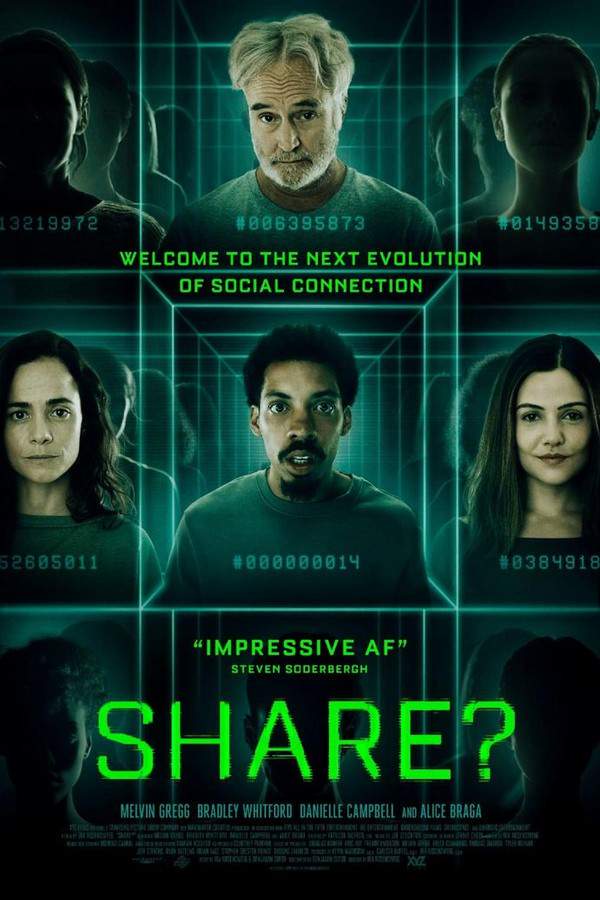
Share? (2023) movie poster

Plot Summary

Share? (2023) Plot Summary Explained

Release, runtime and language
2023 · English
Echo score 77
Directed by
Ira Rosensweig
Starring
Alice Braga, Melvin Gregg, Bradley Whitford, Danielle Campbell, Melvin Vaughan, Macy Minear

In a bleak, dystopian world where entertainment serves as currency, a man finds himself imprisoned and stripped of his possessions. With the assistance of a rudimentary AI, he must explore this unfamiliar and unsettling environment to discover the reason for his confinement and seek a possible escape. Along the way, he grapples with profound questions about the true meaning of survival and the importance of freedom.

On this page (6)
  1. 1 Where to watch
  2. 2 What happens: full plot
  3. 3 Plot questions answered
  4. 4 Movie threads
  5. 5 Movies like Share?
  6. 6 Every angle

Where to watch

Where to Watch Share? (2023)

Where can you watch Share?? Stream, rent or buy it in the US, including on Hoopla, Tubi TV and Amazon Video: current JustWatch availability with up-to-date prices.

Streaming availability powered by JustWatch

Full plot summary · contains spoilers

What Happens in Share?: Full Plot Summary

The whole story of Share? (2023) explained, from the opening scene to the final frame: every key event, every twist and what it all adds up to. Read it as a quick recap before the sequel, to check a scene you missed, or to finally understand what really happened.

The unnamed protagonist, Melvin Gregg, wakes up in his underwear in a spare, prison-like room with no memory of how he arrived. A wall-mounted, rudimentary computer watches his every move and rewards him with credits whenever he performs actions that often reduce him to looking foolish. Those credits let him buy basic goods or services to survive inside the claustrophobic space.

At first he believes he is alone, until a surly older man—Bradley Whitford—appears in a picture-in-picture window on his monitor. The older man has been trapped in another room for a long time, and he reveals that many others are scattered across the system, though they can only be observed, not reached. The two men clash at first but soon strike a bargain: the older man coaches the protagonist in crafting a comedic persona to draw more followers and credits, while the protagonist shares some of his earnings to help the older man survive.

With rising fame, the protagonist makes contact with a woman obsessed with escaping, Alice Braga. Together they dream of a broader rebellion that could free everyone inside the system after the older man meets a tragic end.

Just as the plan starts to take shape, another woman—Danielle Campbell—speaks from a different angle, urging him to accept their fate and seek happiness within the system. [Alice Braga] suspects Danielle is a system agent sent to sabotage the movement, and the protagonist struggles to decide who to trust. As he tries to unite the followers, each woman pushes her faction to silence the other, leading to the deaths of both.

As the movement unfolds, the wider world hints at other prisoners: two trapped girls, Sydney Breithaupt and Jenna Hogan, as well as a trapped man, Gabo Olmeda. When the protagonist’s computer and room briefly shut down and then reboot, a door opens offering a chance to leave. He begins recording his actions instead, showcasing them to an unseen audience, and the door slowly closes again.

Last updated: October 09, 2025 at 16:13

Was this helpful?

Plot questions answered

Share? Plot Explained: Your Questions Answered

The questions people ask most about Share? (2023): what happens in the confusing scenes, why the characters do what they do, the twists, hidden details and what the ending means. Each answer contains spoilers.

Q1

Why was the protagonist imprisoned in the system?

The protagonist wakes up with no memory of how he arrived, which is deliberately ambiguous. The system appears to round up people and trap them in these surveillance rooms, though the exact criteria for selection is never explained. What matters is that once inside, they're forced to generate content for an unseen audience in exchange for survival credits.

  • imprisonment
  • system
  • captivity
  • memory loss
  • surveillance
Q2

How does the credit system work in the movie?

The wall-mounted computer rewards credits for actions that entertain the unseen audience, typically by making the prisoner look foolish or vulnerable. These credits can then be used to purchase basic goods and services delivered into the room. The system incentivizes self-degradation while creating a false sense of progression and comfort.

  • credits
  • surveillance
  • entertainment
  • currency
  • exploitation
Q3

Why does the older man agree to coach the protagonist?

The older man has been trapped much longer and understands the system's mechanics. He needs the protagonist's credits to survive since he can no longer generate enough entertainment value himself. In exchange, he shares his knowledge about crafting a comedic persona that attracts followers, essentially teaching the protagonist how to game the system while exploiting him simultaneously.

  • older man
  • coaching
  • alliance
  • credits
  • survival
Q4

What happens to the older man and why does he die?

The older man meets a tragic end that the protagonist witnesses through his monitor. His death demonstrates the system's cruelty, he's essentially discarded once he can no longer generate value. His death removes the protagonist's mentor and forces him to rely on the two women who emerge afterward, shifting the power dynamics.

Foreshadowing: The older man mentions he's been trapped for a long time and can only be observed, hinting at his expendability.

  • older man
  • death
  • system cruelty
  • mentor
  • discarded
Q5

Why does the protagonist choose to stay when the door opens?

When the door opens, the protagonist faces a choice between escape and continuing his performance. Instead of leaving, he begins recording and showcasing his survival to the unseen audience. This choice reflects the system's ultimate victory, he's been so conditioned by the need for validation and credits that he voluntarily remains trapped, having internalized his captivity.

  • ending
  • escape
  • door
  • choice
  • conditioning
  • conformity
Q6

What happens to Alice Braga's character in the story?

Alice Braga (#052605011) becomes the protagonist's ally in planning a revolution to free everyone trapped in the system. However, she suspects Danielle Campbell's character (#038491828) is a system agent sent to sabotage their movement. The two women's factions turn violent against each other, and both women are killed by their own followers in the crossfire, representing how the system manipulates prisoners into destroying each other.

  • Alice Braga
  • revolution
  • death
  • faction
  • system agent
Q7

What is Danielle Campbell's role in the movie?

Danielle Campbell (#038491828) appears later as a voice urging acceptance of their fate and finding happiness within the system. She represents the counter-revolutionary perspective, that resistance is futile and one should simply adapt. Alice Braga suspects she's a system agent, and their conflict escalates into mutual destruction, with both dying as their followers silence each other.

  • Danielle Campbell
  • acceptance
  • fate
  • system agent
  • death
Q8

Why do both women die in the conflict?

The system's true weapon isn't direct violence, it's division. When the revolution gains momentum, the system exploits the tension between Alice Braga's escape faction and Danielle Campbell's acceptance faction. Each woman accuses the other of being a system agent, triggering their followers to kill both women. This eliminates the revolutionary leadership while making the prisoners complicit in their own oppression.

  • women death
  • division
  • system manipulation
  • revolution
  • factions
Q9

What does the opening door represent at the end?

The door opening appears to be either a test or a rare malfunction, a genuine chance at escape. The protagonist's choice to stay and perform instead of leaving confirms that he's been fully conditioned. The door closing symbolizes the futility of resistance and the system's total psychological control over its prisoners.

  • door
  • escape
  • ending
  • test
  • conditioning
  • control
Q10

What does the ending of the movie mean?

The ending is deliberately bleak, the protagonist, despite having an actual chance to escape, chooses to remain and continue performing for his audience. This reflects the movie's core theme that true freedom requires the willingness to reject external validation. By staying, he proves the system's ultimate success: the prisoners don't need walls because they've internalized their captivity.

  • ending
  • interpretation
  • freedom
  • choice
  • psychological control
  • theme
Q11

Why can't the prisoners communicate with each other directly?

The system isolates each prisoner in separate rooms with only picture-in-picture windows that allow observation but not direct contact. The older man explains that many others exist across the system but they can only be observed, not reached. This isolation prevents coordinated resistance and keeps each prisoner dependent on the system for any interaction.

  • isolation
  • communication
  • prisoners
  • system
  • surveillance

Movie threads

More Movies Like Share?, by Mood & Story

Curated lists built around what makes Share? tick: the same mood, the same kind of story or the same emotional payoff. Each list explains why these movies belong together.

Movies about oppressive systems like Share?

Stories of individuals crushed by oppressive, inescapable societal structures. If you liked the bleak, systemic oppression in Share?, explore these movies that depict characters struggling against dehumanizing dystopian societies. These films share a dark tone and heavy emotional weight, focusing on the crushing reality of life under total control.

  • dystopian
  • oppressive
  • claustrophobic
  • paranoid
  • hopeless
  • anxious
  • Tone: dark, oppressive, bleak
  • Pacing: steady, deliberate
Why these movies?

The story pattern: The narrative typically follows a protagonist who becomes aware of the true nature of a controlling system, often a prison, corporation, or government. Their attempts to understand, rebel, or escape are met with escalating resistance, leading to a realization of their powerlessness within the vast, uncaring machinery of control.

Why they belong together: These films are grouped by their shared focus on the individual vs. the system, a consistently dark and tense tone, and themes of dehumanization, surveillance, and the commodification of life. They create a feeling of claustrophobia and existential dread, even in large settings.
Psychological prison thrillers similar to Share?

Claustrophobic tales of confinement that are more mental than physical. For viewers who enjoyed the claustrophobic, mind-bending confinement in Share?, this list features movies with a similar vibe. These thrillers focus on the psychological torment of being trapped, often featuring unreliable perspectives and a steady build of paranoid tension.

  • claustrophobic
  • paranoid
  • psychological
  • isolating
  • unsettling
  • tense
  • Tone: tense, paranoid, dark
  • Pacing: steady, escalating
Why these movies?

The story pattern: The plot revolves around a character trapped in an enigmatic institution or situation. The mystery of 'why' they are there is as important as 'how' to escape. The narrative unfolds through a series of revelations that challenge the protagonist's perception of reality, often involving a manipulative authority figure or system.

Why they belong together: These films share a core experience of psychological tension and claustrophobia. They are united by a steady, anxious pacing, a high-stakes personal conflict, and a focus on the mental deterioration of a protagonist facing an incomprehensible and isolating ordeal.

If you liked this

Movies Like Share?

Similar movies to Share?: the same genre, themes or kind of story. Each one comes with its own plot summary, timeline and ending explained.

Browse all movie summaries

Every angle

Share? (2023) Explained: Plot, Timeline & Characters

Everything about Share? in one place: what happens in the plot summary, the timeline in chronological order, the characters and meaning and a spoiler-free summary. What's After the Movie adds the cast, box office and post-credit scenes.

Coming soon on iOS and Android

The Plot Explained Movie Summary App

Plot summaries, endings explained and timelines on your phone. Catch up on any movie in minutes, save your favorites and never miss a twist again.

Be the first to know when we launch. Your email stays private, always.

Learn more about the app