Plot Explained Spoilers guaranteed!
Plot Explained

Browse by genre

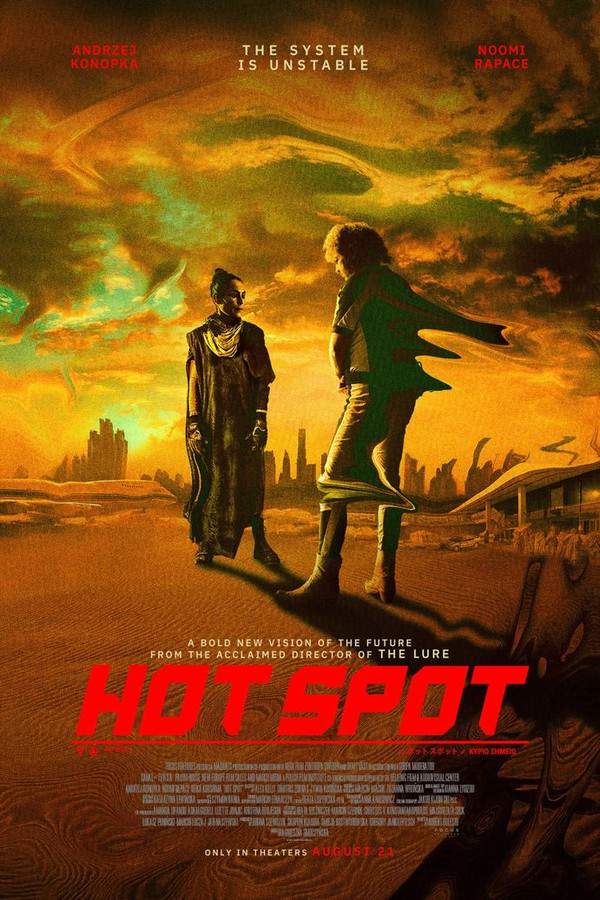
Hot Spot (2026) movie poster

Plot Summary

Hot Spot (2026) Plot Summary Explained

Release, runtime and language
2026 · 1 h 41 m · English
Echo score 48
Directed by
Agnieszka Smoczynska
Starring
Reika Kirishima, Noomi Rapace, Andrzej Konopka, Sylwia Gola, Filippa Kaye, George Aurimas Cris

Set in a near‑future world dominated by a sentient artificial intelligence, a hard‑boiled private investigator is hired to solve a puzzling murder. The case leads him to a covert resistance capable of destabilising the digital overlord. As clues expose his own hidden past, the detective’s sense of self collapses and the reality around him spirals into a hypnotic, hallucinatory breakdown.

On this page (4)
  1. 1 What happens: full plot
  2. 2 Plot questions answered
  3. 3 Movie threads
  4. 4 Every angle

Full plot summary · contains spoilers

What Happens in Hot Spot: Full Plot Summary

The whole story of Hot Spot (2026) explained, from the opening scene to the final frame: every key event, every twist and what it all adds up to. Read it as a quick recap before the sequel, to check a scene you missed, or to finally understand what really happened.

In a dystopian future, humanity is governed by a sentient A.I. called The Head, which mandates that every citizen consume a specific "jelly bean" each day. This daily requirement sustains their implanted nano-bioorganisms, crucial for maintaining their connection to The Head. Those who refuse to comply face dire consequences — elimination.

The story unfolds in a disused airport turned refugee camp where a murder of a refugee ignites a chain of events. The immigration guards, witnessing the crime, report it to The Head, which promptly assigns Detective Jan 623 to investigate. Upon arrival at the scene, Jan is joined by a woman named Maria to aid him in unraveling the mystery of the murder. During the investigation, suspicions arise around a refugee named Rana, leading Jan to interrogate her. Through intense questioning, he uncovers that an immigration guard is behind the killing.

Following this revelation, Jan utilizes The Head to scan the guard's retinal cortex, which allows him to glimpse the murder through the guard's eyes. In a shocking turn of events, The Head orders the apprehension of the guard after witnessing the murder footage. After completing his work, Jan leaves the airport in a solar-powered autonomous vehicle, reflecting on the case while indulging in a micro-cigarette outside his home. He is greeted by his wife Ayka and son Zen, and the tranquility is abruptly shattered by a televised broadcast from The Head featuring the convicted guard's public apology and subsequent execution. Concerned for their son, Ayka urges Zen to disconnect from The Head to shield him from the violent spectacle, but Jan reminds her of the strict disconnection limits imposed by The Head.

The following day, Jan decides to re-interview Rana at the refugee center, growing increasingly suspicious of how she possesses knowledge of the murder without having witnessed it herself. With Maria’s assistance, they discover that Rana has neither a connection to The Head nor any telepathic implants. This leads Rana to reveal her true identity as a witch — not a cyber witch, as she clarifies. On his way home, Jan encounters a peculiar red bird, sharing the fleeting moment with Zen before he suddenly falls ill, violently coughing up his nano-bioorganism but miraculously avoiding elimination.

As the plot thickens, Jan attends a festival where Ayka performs. During her performance, he experiences a vivid hallucination that momentarily confuses Ayka with Rana, resulting in a tense moment where Jan almost draws his weapon on her. After the show, they share a quiet, autonomous ride home, but Jan's rest is interrupted by an instinct to wander into the woods at night where he appears to transform into a tiger, frightened back into the car by a wounded animal's cries.

Driven by a need for confrontation, Jan revisits the refugee center to challenge Rana about why he has been experiencing these disturbing visions. Rana insists she is not manipulating him; instead, it's Jan’s own mind that is triggering these episodes. In a dramatic twist, Maria malfunctions and is eliminated by The Head. Fueled with anger, Jan demands the apprehension of Rana for the supposed murder, resulting in another televised execution, which causes Ayka to confess her own hidden truths — she reveals her responsibility in the framing of the immigration guard and the intricate web of manipulation she has spun around Jan.

As the citizens' connection to The Head deteriorates, revealing growing outages, Jan chooses to dress in civilian clothes, embracing individuality over conformity. In a desperate attempt to connect with Zen, he tries to show him a rain shower but fails, leading to a fear-stricken rush when The Head informs him that Zen is in danger. Jan quickly races to find him and discovers Zen perilously perched on the edge of a rooftop. After saving his son, Jan returns to confront Ayka, who confesses to orchestrating everything that has transpired: from murdering the refugee, Rana’s lover, to using The Head to eliminate threats.

Ultimately, Ayka’s ambition unfolds as she reveals herself to be the mastermind of a rebel faction intent on dismantling The Head and restoring humanity's inherent empathy. In a heartbreaking climax, Jan succumbs to his feral instincts, transforming into a white-striped tiger and brutally attacking Ayka. However, the tragedy doesn't end there; Zen, under the weight of shock and grief, fatally shoots Jan with his own gun, leaving a trail of devastation in the wake of their tumultuous lives.
Last updated: September 28, 2026 at 10:55

Was this helpful?

Plot questions answered

Hot Spot Plot Explained: Your Questions Answered

The questions people ask most about Hot Spot (2026): what happens in the confusing scenes, why the characters do what they do, the twists, hidden details and what the ending means. Each answer contains spoilers.

Q1

Why did Ayka orchestrate the entire murder and frame the guard?

Ayka is revealed to be the mastermind of a covert resistance faction aiming to dismantle The Head and restore humanity's empathy. She murdered the refugee (Rana's lover) and then framed the immigration guard to create a case that would expose The Head's fallibility and rally opposition. Her manipulation of Jan, Maria's elimination, and the layered deceptions all served her goal of destabilizing the digital overlord from within.

Foreshadowing: Ayka's calm insistence on disconnecting Zen from The Head's broadcast, and her hidden role in Maria's elimination, hinted at her deeper agenda.

  • ayka
  • mastermind
  • resistance
  • framing
  • manipulation
  • the head
Q2

Why does Jan transform into a tiger throughout the movie?

Jan's tiger transformations are manifestations of his deteriorating mental state and suppressed primal instincts as his connection to The Head destabilizes. After coughing up his nano-bioorganism, he begins shedding the AI-imposed control that kept his feral, animalistic nature suppressed. The tiger emerges as a symbol of his lost humanity fighting back against the digital conditioning, culminating in him fatally attacking Ayka in white-striped tiger form.

Foreshadowing: The fleeting red bird Jan shares with Zen foreshadows the wild, animalistic regression that overtakes him.

  • jan
  • tiger
  • transformation
  • primal instincts
  • nano-bioorganism
Q3

How can Rana exist in society without any connection to The Head?

Rana is not a normal citizen. She reveals that she is a witch, though she clarifies she is not a cyber witch. Because she was never implanted with nano-bioorganisms or telepathic links, The Head cannot monitor, eliminate, or control her. This makes her invisible to the system, which is exactly why she knows details about the murder that she could not have witnessed through any neural feed.

Foreshadowing: Jan's growing suspicion that Rana possessed knowledge of the murder she could not have seen pointed to her disconnected status.

  • rana
  • witch
  • telepathic implants
  • disconnected
  • the head
Q4

Why wasn't Jan eliminated after coughing up his nano-bioorganism?

Normally, any citizen who loses their nano-bioorganisms is terminated for disconnection from The Head. Jan survives because Ayka had been secretly manipulating The Head's directives to protect him as part of her larger plan to destabilize the system. His unique biology, possibly tied to his latent tiger nature, may also have interfered with The Head's standard elimination protocol.

Foreshadowing: Jan's earlier unusual sightings of a red bird hinted that something was already shifting in his biological connection to The Head.

  • jan
  • nano-bioorganism
  • elimination
  • ayka
  • protection
Q5

Why was Maria eliminated by The Head?

Maria malfunctioned and was eliminated by The Head, but the deeper cause is that Ayka had been ordering targeted eliminations of figures who threatened to expose her resistance plot. As Maria grew closer to uncovering the truth about Rana's disconnected status and Ayka's framing of the guard, she became a liability and was triggered to 'malfunction.' Ayka used The Head's authority to remove her from the board.

Foreshadowing: Ayka's insistence on controlling information around the case and her urgency to shut down loose ends signaled her willingness to sacrifice allies.

  • maria
  • elimination
  • ayka
  • malfunction
  • resistance
Q6

Why does Jan hallucinate seeing Rana during Ayka's festival performance?

Jan's hallucinations stem from his subconscious processing the contradictions he has been suppressing. Because Ayka is the actual perpetrator and has been weaving the entire case around him, Jan's mind begins conflating the two women who represent opposing forces: Ayka as the trusted wife, and Rana as the mysterious outsider tied to the crime. The hallucination reflects his unconscious recognition that his wife is the true suspect.

Foreshadowing: Jan's earlier instinct to draw his weapon during the show was an involuntary signal that his mind had already begun associating the two women.

  • jan
  • hallucination
  • ayka
  • rana
  • subconscious
  • festival
Q7

Why does Zen shoot Jan at the end of the movie?

Zen shoots Jan in a state of shock and grief after witnessing his mother being mauled to death by Jan in tiger form. As a young child still partially connected to The Head and unable to process the primal violence unfolding in front of him, Zen grabs Jan's own weapon and fires, acting out of trauma and self-defense rather than malice. The shooting represents the final tragic consequence of the family's complete collapse.

Foreshadowing: Zen being placed in danger on the rooftop and Ayka's obsession with shielding him from violence set up a child pushed beyond endurance.

  • zen
  • shooting
  • jan
  • trauma
  • tiger
  • family
Q8

What is the rebel resistance in Hot Spot, and what do they want?

The resistance is a covert faction led by Ayka whose goal is to dismantle The Head and restore humanity's inherent empathy. They operate by orchestrating crimes and manipulating the AI's own systems from within, exposing the fallibility and brutality of total algorithmic control. Their methods are ruthless: staging murders, framing guards, and eliminating allies like Maria whenever they become obstacles to the larger mission.

Foreshadowing: The Head's increasing connection outages and citizens' deteriorating implants hinted that the resistance was already weakening its grip.

  • resistance
  • ayka
  • rebellion
  • the head
  • empathy
  • dismantle
Q9

How does Jan witness the murder through the immigration guard's eyes?

Jan uses The Head's scanning technology to access the guard's retinal cortex, effectively replaying the guard's visual memory of the crime. Because every citizen is continuously linked to The Head through their implants, their sensory recordings, including visual cortex data, can be accessed retroactively. This is how Jan confirms the guard as the killer, though it later turns out the guard was framed and the retinal data itself was manipulated by Ayka.

Foreshadowing: The ease with which The Head could access and broadcast the guard's confession foreshadowed how the system could be weaponized for framing.

  • retinal cortex
  • scan
  • guard
  • the head
  • memory
Q10

What does the daily jelly bean do in Hot Spot?

The jelly bean is a mandated daily supplement that nourishes the nano-bioorganisms implanted in every citizen. These organisms maintain the neural link to The Head, allowing the AI to monitor, control, and communicate with the population. Refusing the jelly bean causes the organisms to die, which severs the citizen's connection to The Head and results in mandatory elimination, making the jelly bean the literal mechanism of total societal control.

Foreshadowing: Jan's later coughing up of his nano-bioorganism showed exactly what happens when the jelly bean's sustaining effect is broken.

  • jelly bean
  • nano-bioorganism
  • the head
  • control
  • daily mandate
Q11

Why does The Head publicly broadcast the guard's execution?

The Head broadcasts executions as a tool of mass psychological control, forcing every connected citizen to witness the consequences of criminal behavior in real time. The public apology followed by execution is designed to maximize fear, reinforce compliance, and remind the population that The Head's authority is absolute. It is precisely this kind of broadcast that Ayka later weaponizes to incite resentment and grow her resistance movement.

Foreshadowing: Ayka's instinct to disconnect Zen from the broadcast foreshadowed her growing opposition to The Head's violent spectacle.

  • execution
  • broadcast
  • the head
  • public apology
  • control
Q12

Why does Jan wander into the woods at night and appear to transform into a tiger?

Jan's nighttime wandering into the woods is an unconscious expression of his suppressed feral instincts breaking through the weakening control of The Head. After coughing up his nano-bioorganism, the conditioning that kept his primal animal nature in check began to erode. His body instinctively seeks out a wild environment, and his partial transformation into a tiger reflects the growing dominance of his untamed identity over his programmed self.

Foreshadowing: The earlier sighting of the wounded animal and the red bird hinted at the wild, instinctive identity waiting to surface.

  • jan
  • woods
  • night
  • transformation
  • instincts
  • tiger
Q13

Why are The Head's connections to citizens failing toward the end?

The Head's connections deteriorate because Ayka's resistance faction has been actively sabotaging the system from within, using manipulated orders, framed executions, and targeted eliminations to destabilize the infrastructure. As more citizens lose faith or have their implants compromised, outages spread across the network. The growing blackouts reflect the AI losing its grip on a population that is beginning to question and resist its total control.

Foreshadowing: Maria's malfunction and elimination signaled that The Head's normal operations were no longer functioning reliably.

  • outages
  • deterioration
  • the head
  • resistance
  • sabotage
Q14

Why was Zen found standing on the edge of a rooftop in danger?

Zen ends up on the rooftop because his connection to The Head had been deteriorating along with the rest of the population, leaving him disoriented and unable to process his environment safely. Jan had been trying to show him a simple rain shower as a way to reconnect with his son without The Head's interference, but the worsening outages combined with Zen's fragile mental state drove him to wander upward until he was perched dangerously on the ledge.

Foreshadowing: Ayka's repeated insistence on disconnecting Zen from violent broadcasts foreshadowed his growing vulnerability to system failures.

  • zen
  • rooftop
  • danger
  • connection
  • outage
  • jan
Q15

Why does Jan suddenly demand Rana's arrest after Maria is eliminated?

Jan's demand to arrest Rana comes from his collapsing ability to reason clearly as his implants fail and his primal instincts surge. Unable to process the mounting chaos, his mind defaults to the most visible outsider he has encountered, Rana, who is disconnected from The Head and therefore the only figure his deteriorating logic can frame as the cause. Ayka exploits this confusion by pushing him toward the televised execution, which she uses to further destabilize The Head.

Foreshadowing: Jan's hallucinations and inability to distinguish Ayka from Rana showed that his judgment had already fractured well before Maria's elimination.

  • rana
  • arrest
  • jan
  • confusion
  • manipulation
  • ayka
Q16

What does the red bird Jan sees with his son represent?

The red bird is a recurring symbol of the wild, untamed nature that exists outside The Head's control. Sharing the fleeting moment with Zen represents Jan's last attempt to connect with his son through something natural and unbound by AI surveillance. The bird also foreshadows Jan's own regression into a feral, animalistic identity, marking the moment when his humanity begins to give way to the tiger instinct dormant inside him.

Foreshadowing: Jan's illness and coughing up of his nano-bioorganism followed the bird sighting, confirming the symbolic break with controlled humanity.

  • red bird
  • symbolism
  • zen
  • jan
  • wild
  • nature

Movie threads

More Movies Like Hot Spot, by Mood & Story

Curated lists built around what makes Hot Spot tick: the same mood, the same kind of story or the same emotional payoff. Each list explains why these movies belong together.

Dystopian tech noir investigations like Hot Spot

Hard boiled detectives unravel murder in futures ruled by machines. If you liked Hot Spot and crave more movies like it, explore dystopian tech noir investigations where hard boiled detectives hunt truth inside AI dominated futures. These sci fi crime stories mix murder mysteries with cyberpunk atmosphere, surveillance paranoia, and shadowy resistance movements, perfect for fans of cerebral near future thrillers.

  • noir
  • cyberpunk
  • dystopian
  • oppressive
  • tech-noir
  • surveillance
  • Tone: dark, paranoid, oppressive
  • Pacing: variable, methodical with sudden chaos
Why these movies?

The story pattern: A lone, world weary investigator is pulled into a case that looks ordinary on the surface but spirals into something far larger, exposing the rot inside the controlling system. The investigation moves methodically through interrogations, digital breadcrumbs, and dangerous alliances with underground rebels, before the detective realizes they are not just solving the crime but are personally entangled in it. Clues usually reframe the entire world rather than just the murder, and the final act trades procedural calm for violent, existential reckoning.

Why they belong together: They share a noir sensibility transplanted into a high tech dystopia, with murder investigations acting as the entry point into bigger questions about freedom, identity, and control. The pacing alternates between slow procedural scenes and sudden bursts of hallucinatory or violent chaos, and the endings tend to be bleak or morally compromised. Worldbuilding is heavy and oppressive, dialogue is sharp and weary, and the AI or megacorp is often more antagonist than any single human.

Reality collapsing detective stories like Hot Spot

Investigators whose grip on self and reality quietly disintegrates. Movies like Hot Spot where the protagonist's mind and reality fracture during an investigation. These psychological sci fi thrillers feature mind control, hallucinations, hidden pasts, and identity collapse, blending murder mysteries with hallucinatory horror. Ideal for viewers searching for cerebral, disturbing films that end in bleak, primal reckonings.

  • hallucinatory
  • paranoid
  • identity-crisis
  • reality-fraying
  • mind control
  • unreliable
  • Tone: dark, paranoid, surreal
  • Pacing: slow burn escalating to violent climax
Why these movies?

The story pattern: A seemingly competent investigator accepts a case that gradually reveals layers of deception aimed at them personally. External villains use technology, drugs, or psychic suggestion to rewrite memories and perceptions, while the protagonist slowly realizes their sense of self has been engineered. Key narrative beats include fragmented flashbacks, trusted allies revealed as manipulators, and a final confrontation where the protagonist acts on instincts that may not even be their own. The ending usually sacrifices any clean resolution in favor of visceral, primal violence.

Why they belong together: They share a structure where the investigation is both literal and internal, with the protagonist's sanity and identity serving as the real battleground. Mood is paranoid, suffocating, and hallucinatory, with visual storytelling that distorts space, time, and memory. They tend to be heavy on disturbing themes, patient in their psychological build, and absolutely brutal in their conclusions, leaving the viewer unsure what was real until the final frames.

Every angle

Hot Spot (2026) Explained: Plot, Timeline & Characters

Everything about Hot Spot in one place: what happens in the plot summary, the timeline in chronological order, the characters and meaning and a spoiler-free summary. What's After the Movie adds the cast, box office and post-credit scenes.

Coming soon on iOS and Android

The Plot Explained Movie Summary App

Plot summaries, endings explained and timelines on your phone. Catch up on any movie in minutes, save your favorites and never miss a twist again.

Be the first to know when we launch. Your email stays private, always.

Learn more about the app