Plot Explained Spoilers guaranteed!
Plot Explained

Browse by genre

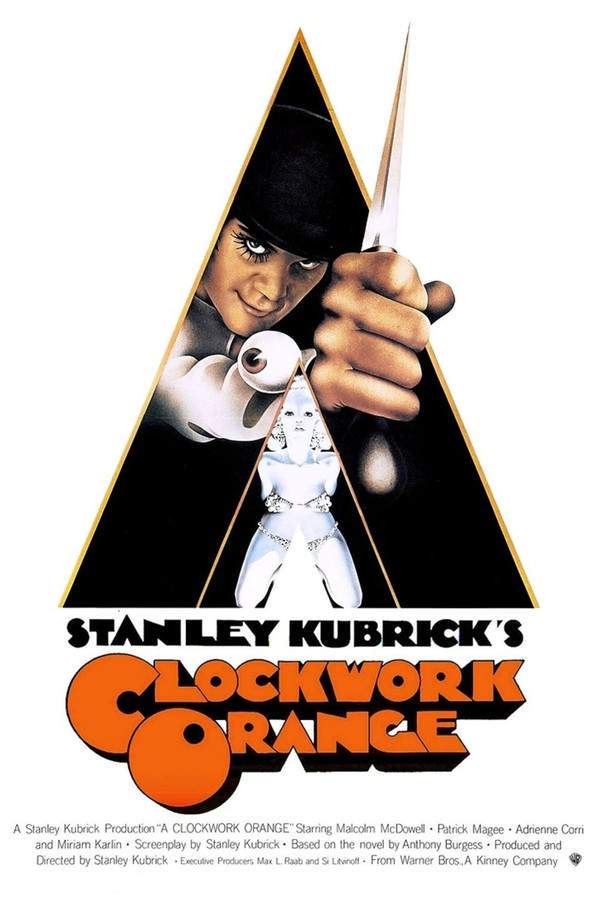
A Clockwork Orange (1971) movie poster

Plot Summary

A Clockwork Orange (1971) Plot Summary Explained

Release, runtime and language
1971 · 136 min · English
JustWatch #185 126
Directed by
Stanley Kubrick
Starring
Malcolm McDowell, Patrick Magee
Budget
$2.2M

In a chilling dystopian future, a charismatic delinquent named Alex leads a gang of droogs in a reign of ultra-violence. After being captured, he volunteers for an experimental aversion therapy program intended to reform him. This controversial treatment leaves him unable to commit violent acts, but also strips away his free will, turning him into a "clockwork orange"—a person who appears reformed but remains inherently flawed. The film explores complex themes of morality, free will, and the potential dangers of societal control.

On this page (6)
  1. 1 Where to watch
  2. 2 What happens: full plot
  3. 3 Plot questions answered
  4. 4 Movie threads
  5. 5 Movies like A Clockwork Orange
  6. 6 Every angle

Where to watch

Where to Watch A Clockwork Orange (1971)

Where can you watch A Clockwork Orange? Stream, rent or buy it in the US, including on HBO Max, Amazon Video and Apple TV Store: current JustWatch availability with up-to-date prices.

Streaming availability powered by JustWatch

Full plot summary · contains spoilers

What Happens in A Clockwork Orange: Full Plot Summary

The whole story of A Clockwork Orange (1971) explained, from the opening scene to the final frame: every key event, every twist and what it all adds up to. Read it as a quick recap before the sequel, to check a scene you missed, or to finally understand what really happened.

"A bit of the old ultra-violence." Set in a bleak future London, the narrative follows Alex DeLarge (Malcolm McDowell), our somewhat unhinged protagonist, and his gang of thugs known as droogs: Georgie (James Marcus), Dim (Warren Clarke), and Pete (Michael Tarn). At the onset, they find themselves in the infamous Korova Milk Bar, indulging in drug-laced milk.

Soon the gang embarks on a night of extreme violence. In their exploits, they encounter a homeless man in an underpass, whom they mercilessly beat. Their journey continues to a decrepit theatre where they confront a rival gang led by Billy Boy, stopping short of a tragic assault on a young woman by engaging in a fierce fight instead. Their victory leads them into the countryside, where they recklessly drive a stolen Durango 95 sports car, causing havoc on the roads, until they decide to invade a secluded home.

Under the guise of a car accident victim, Alex deceives writer Frank Alexander (Patrick Magee), gaining access to brutally attack him and gang-rape his wife (Adrienne Corri). This horrific scene is accompanied by Alex singing "Singin' in the Rain," which becomes a chilling motif of his character's twisted pleasure in violence.

Returning to the Korova, Alex's jubilance is interrupted by Dim's crude antics. The day drags on, leading to Alex's eventual confrontation with his parents, depicted as foolish and helpless figures. His probation officer, Mr. Deltoid (Aubrey Morris), warns him of the consequences of his delinquency, but Alex, emboldened by his thirst for chaos, continues his reckless lifestyle.

Eventually, cracks form in the bond between Alex and his droogs. Feeling threatened by Georgie's ambition to rob a wealthy owner, Alex asserts his dominance, but in a turn of betrayal, Dim and Georgie allied against him. After brutal treatment by his former companions and incarceration, Alex receives a 14-year sentence filled with attempts to manipulate his way towards a reduction.

Two years into his imprisonment, he exploits the prison system to volunteer for the Ludovico Technique, a controversial behavioral conditioning treatment promising early release. Alex undergoes horrific methods to condition him against violence, culminating in sessions filled with horrifying imagery and Beethoven’s music that he can no longer endure.

Upon release, Alex finds his home occupied by a lodger named Joe, who chastises him for his past actions. Stripped of his free will but still craving his previous life, he soon encounters his former droogs, now officers of the law, who take revenge against him for their shared past.

In a cruel twist of fate, he stumbles upon Frank Alexander, unaware that this individual is the very man whose life he shattered years ago. Invited into the home, Alex is soon trapped in a web of revenge, grappling with the consequences of his former actions.

In a harrowing finale, overwhelmed by Beethoven's Ninth Symphony played incessantly, Alex attempts to end his own life. Surviving the leap, he finds himself in a hospital where revelations about the government's actions lead to public outcry against their inhumane practices.

Ultimately, after a series of psychiatric evaluations that reveal cracks in his mind, Alex is approached by the Interior Minister, who seeks to manipulate him for political gain. An ambivalent resolution culminates in Alex donning the façade of recovery while inside, he remains the same violent, pleasure-seeking individual he has always been. As he muses, “I was cured, all right,” leaving the audience to ponder the effects of conditioning on the essence of humanity.
Last updated: November 15, 2024 at 19:56

Was this helpful?

Plot questions answered

A Clockwork Orange Plot Explained: Your Questions Answered

The questions people ask most about A Clockwork Orange (1971): what happens in the confusing scenes, why the characters do what they do, the twists, hidden details and what the ending means. Each answer contains spoilers.

Q1

Why does Alex volunteer for the Ludovico Technique?

Alex volunteers for the Ludovico Technique primarily to secure an early release from prison. After spending two years incarcerated, he manipulates the prison system by volunteering for the experimental treatment, which promises a reduced sentence. However, his motivation is also driven by a desire to regain freedom so he can continue his violent lifestyle, as he believes he can simply wait out the treatment's effects. The irony is that the treatment ultimately robs him of the very free will he sought to preserve.

Foreshadowing: Early in the film, Alex demonstrates his manipulative nature by deceiving Frank Alexander with feigned injury, showing his talent for psychological manipulation that he later applies to the prison system.

  • ludovico technique
  • alex volunteers
  • prison release
  • early release
Q2

What is the Ludovico Technique?

The Ludovico Technique is an experimental aversion therapy used in the film to condition Alex against violence. The treatment involves forcing Alex to watch violent films while experiencing simultaneous nausea through drugs, with the goal of creating a psychological association between violence and physical illness. Crucially, the treatment is paired with his beloved Beethoven music, which becomes a trigger for his conditioned response, effectively destroying his capacity to enjoy the art he once loved.

Foreshadowing: The Korova Milk Bar features women chained in provocative positions designed to stimulate violence, establishing the film's exploration of pleasure and violence as intertwined.

  • ludovico technique
  • aversion therapy
  • conditioning
  • behavior modification
Q3

Why do Dim and Georgie betray Alex?

The betrayal stems from growing tensions within the gang and Alex's increasingly authoritarian leadership. Alex becomes jealous and threatened when Georgie expresses ambition to rob a wealthy cat lady. During a confrontation, Alex physically dominates Georgie, asserting his position as leader. This act of aggression, combined with resentment over Alex's self-appointed authority and perhaps the desire to seize control of the gang themselves, leads Dim and Georgie to ally against Alex. They brutally beat him and leave him vulnerable for arrest.

Foreshadowing: Earlier at the Korova Milk Bar, Dim's crude antics already create discord, hinting at the growing resentment among the droogs toward Alex's leadership.

  • dim
  • georgie
  • betrayal
  • droogs
  • gang betrayal
Q4

Is Alex truly reformed at the end of the film?

No, Alex is not truly reformed. At the film's conclusion, his famous final line 'I was cured, all right' is delivered with bitter irony. While the Ludovico Technique has physically conditioned him against committing violence, his internal thoughts and desires remain unchanged. He still craves ultra-violence and feels the same sadistic pleasure he always did. The 'reformation' is entirely superficial, a political façade created by the government to demonstrate their program's success, while internally Alex remains the same violent person.

Foreshadowing: The opening scenes establish Alex's monologue about choosing 'pleasure' and 'doing what is projected,' setting up that his fundamental nature cannot be genuinely altered by external conditioning.

  • alex cured
  • reformation
  • ending
  • free will
  • clockwork orange meaning
Q5

What does "clockwork orange" mean in the film?

A clockwork orange is a metaphorical reference to a person who appears to have been reformed or changed on the surface, but whose internal nature remains fundamentally unchanged. The term combines 'clockwork' (mechanical, artificial transformation) with 'orange' (a reference to the novel's title, which author Anthony Burgess reportedly chose for its phonological qualities rather than specific meaning). The film uses this concept to explore whether behavioral conditioning can truly reform an individual's nature, or merely create a mechanical façade that masks an unchanged core.

Foreshadowing: The title itself, established before the film begins, signals the central theme of artificial versus genuine transformation.

  • clockwork orange meaning
  • title
  • metaphor
  • free will
Q6

Why does Alex sing "Singin' in the Rain" during the home invasion?

Alex sings 'Singin' in the Rain' while assaulting Frank Alexander's wife as a twisted expression of his sadistic pleasure and artistic refinement. The moment demonstrates the disturbing disconnect in his character, he is a lover of classical music and high art who derives profound enjoyment from brutal violence. The song's cheerful melody contrasts violently with the horrific scene, serving as a chilling motif that underscores Alex's warped relationship between beauty and brutality.

Foreshadowing: The opening scene establishes Alex's appreciation for 'the old ultra-violence' alongside his love for Beethoven, showing his unique blend of aesthetic sensibility and violent tendency.

  • singin in the rain
  • singing
  • home invasion
  • music
  • beethoven
Q7

Why doesn't Alex recognize Frank Alexander when he meets him?

Alex fails to recognize Frank Alexander because nearly two years have passed since the home invasion, and Alex never saw Frank's face during the attack, he brutally beat him while Frank was conscious but unable to fight back. When Alex arrives at Alexander's home as a rehabilitated citizen seeking work, he is unaware that this writer is the very man he attacked years earlier. This dramatic irony creates the setup for Frank's revenge plot, as Frank immediately recognizes Alex and orchestrates his elaborate torture as retaliation.

Foreshadowing: The timeline shows a significant gap between Alex's crime and release, making the reunion plausible while maximizing the dramatic impact of their encounter.

  • frank alexander
  • recognition
  • revenge
  • home invasion
Q8

Why do Alex's former droogs become police officers?

Alex's former droogs, Dim and Georgie, become police officers as a form of social rehabilitation that mirrors Alex's own forced reformation. In the dystopian society of the film, former criminals are apparently integrated into positions of authority. When Alex encounters them as officers, they use their power to brutally assault him, an act of payback for their old betrayal and Alex's previous dominance over them. This reversal illustrates how the system claims to reform criminals while actually perpetuating cycles of violence and oppression.

Foreshadowing: The social system depicted in the film already uses institutions like the Ludovico Technique for control, suggesting a society that superficially reforms but fundamentally corrupts.

  • dim
  • georgie
  • police
  • droogs
  • authority
  • revenge
Q9

What is the government's political motivation for using the Ludovico Technique?

The government uses the Ludovico Technique as a political tool to demonstrate the effectiveness of their criminal justice system. After Alex's public suicide attempt exposes the brutality of the treatment, the Interior Minister approaches Alex seeking to 'cure' him publicly for political gain. The regime wants to prove that their methods work and that society can be safely 'reformed,' using Alex as a propaganda success story. This reveals the film's critique of authoritarian systems that prioritize political optics over genuine rehabilitation or individual rights.

Foreshadowing: The Minister's arrival at the hospital and his offer to get Alex 'anything he wants' reveals the government's interest in using Alex as a political asset rather than genuinely helping him.

  • government
  • politics
  • interior minister
  • conditioning
  • authoritarianism
Q10

How does the Ludovico Technique condition Alex against music?

The Ludovico Technique conditions Alex against violence by pairing violent imagery with nausea-inducing drugs, but it also inadvertently destroys his ability to enjoy Beethoven. During treatment sessions, Alex is strapped with his eyes forced open to watch violent films while listening to Beethoven, his previously beloved composer. The conditioning creates an association between Beethoven and the physical suffering of the treatment, causing Alex to develop an aversion to the music itself. This is particularly devastating because music was his primary source of aesthetic pleasure, making the punishment psychologically profound.

Foreshadowing: Alex's love for Beethoven is established early, making its destruction through conditioning a particularly cruel aspect of his punishment.

  • beethoven
  • music aversion
  • conditioning
  • ludovico technique
  • psychological torture

Movie threads

More Movies Like A Clockwork Orange, by Mood & Story

Curated lists built around what makes A Clockwork Orange tick: the same mood, the same kind of story or the same emotional payoff. Each list explains why these movies belong together.

Stylized dystopian satire like in A Clockwork Orange

Bleak, exaggerated futures that critique society through a darkly humorous lens. If you liked the unsettling, satirical dystopia of A Clockwork Orange, explore more movies that use stylized worlds to critique society. This thread features films with bleak futures, dark humor, and a focus on social decay, perfect for fans of thought-provoking sci-fi.

  • dystopian
  • satirical
  • unsettling
  • oppressive
  • anarchic
  • stylized
  • Tone: dark, satirical, unsettling
  • Pacing: steady, deliberate
Why these movies?

The story pattern: These films often follow a protagonist navigating a bizarre and oppressive society, where the conflict is less about individual villains and more about the crushing weight of a flawed system. The narrative serves the satire, using character journeys to highlight the absurdity and horror of the world's underlying ideology.

Why they belong together: Movies are grouped here for their shared commitment to creating a cohesive, stylized dystopian atmosphere underpinned by sharp social commentary. They share a darkly humorous tone, a high-concept setting, and a focus on how systems corrupt individuals.

Philosophical thrillers about free will like in A Clockwork Orange

Psychological journeys that question the nature of choice, control, and humanity. For viewers who appreciated the deep philosophical themes of A Clockwork Orange, this thread collects movies that explore free will, conditioning, and psychological manipulation. Discover similar complex thrillers and dramas that challenge your perceptions of morality and control.
  • psychological
  • unsettling
  • thought-provoking
  • morally ambiguous
  • disturbing
  • oppressive
  • Tone: dark, psychologically intense, morally ambiguous
  • Pacing: steady, thought-provoking
Why these movies?

The story pattern: The narrative pattern often involves a character undergoing a forced or voluntary process that alters their fundamental nature—their capacity for violence, love, or choice. The central conflict explores the consequences of this transformation, questioning whether a modified behavior can be considered true goodness and what is lost in the process.

Why they belong together: These films are united by their primary focus on the philosophical conflict between individual autonomy and external control. They share a high level of narrative complexity, a dark tone, and a heavy emotional weight derived from psychological torment and existential dread.

If you liked this

Movies Like A Clockwork Orange

Similar movies to A Clockwork Orange: the same genre, themes or kind of story. Each one comes with its own plot summary, timeline and ending explained.


Browse all movie summaries

Every angle

A Clockwork Orange (1971) Explained: Plot, Timeline & Characters

Everything about A Clockwork Orange in one place: what happens in the plot summary, the timeline in chronological order, the characters and meaning and a spoiler-free summary. What's After the Movie adds the cast, box office and post-credit scenes.

Coming soon on iOS and Android

The Plot Explained Movie Summary App

Plot summaries, endings explained and timelines on your phone. Catch up on any movie in minutes, save your favorites and never miss a twist again.

Be the first to know when we launch. Your email stays private, always.

Learn more about the app