Plot Explained Spoilers guaranteed!
Plot Explained

Browse by genre

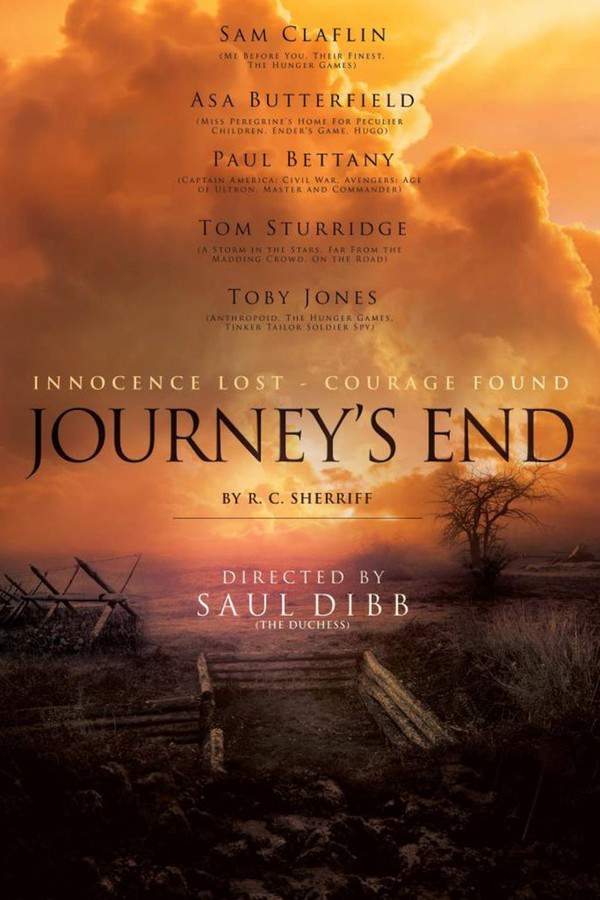
Journey's End (2018) movie poster

Plot Summary

Journey's End (2018) Plot Summary Explained

Release, runtime and language
2018 · 107 min · English
Echo score 67
JustWatch #5,445 2
Directed by
Saul Dibb
Starring
Toby Jones, Paul Bettany, Stephen Graham, Asa Butterfield, Theo Barklem Biggs, Sam Claflin

During World War I, a company of British soldiers awaits a German attack in the trenches of northern France. Captain Stanhope struggles with the immense pressure of his command and his own inner turmoil, finding little comfort beyond alcohol and memories of the past. A young, idealistic officer named Raleigh joins the unit, full of hope and unaware of the brutal realities of war. As the men face relentless shelling and the constant threat of death, they seek solace in camaraderie and fleeting moments of respite.

On this page (7)
  1. 1 Where to watch
  2. 2 What happens: full plot
  3. 3 Plot questions answered
  4. 4 The book behind the movie
  5. 5 Movie threads
  6. 6 Movies like Journey's End
  7. 7 Every angle

Where to watch

Where to Watch Journey's End (2018)

Where can you watch Journey's End? Stream, rent or buy it in the US, including on Amazon Prime Video, Fawesome and Hoopla: current JustWatch availability with up-to-date prices.

Streaming availability powered by JustWatch

Full plot summary · contains spoilers

What Happens in Journey's End: Full Plot Summary

The whole story of Journey's End (2018) explained, from the opening scene to the final frame: every key event, every twist and what it all adds up to. Read it as a quick recap before the sequel, to check a scene you missed, or to finally understand what really happened.

During the tumultuous period of the First World War, young Second Lieutenant Raleigh, portrayed by Asa Butterfield, is dispatched to the front lines located in Northern France. With a heartfelt request to his uncle, General Raleigh, he seeks to serve under the command of Captain Stanhope, a man Sam Claflin who was a few years ahead of him at school and shared memorable holidays with both Raleigh and his sister, Margaret.

While Captain Stanhope is recognized as an exceptional leader, having earned the Military Cross for his bravery at the Battle of Vimy Ridge, he battles his own demons, relying on heavy drinking to cope with the grim realities of war. Surrounding Stanhope are other key officers, including the compassionate Lieutenant Osborne, played by Paul Bettany, affectionately referred to as ‘Uncle’ by his peers; the older, lower-class officer 2nd Lt. Trotter, represented by Stephen Graham; and 2nd Lt. Hibbert, whose desperate attempts to avoid the front line through feigned eye pain earn him the ire of Stanhope.

The officers of C Company form a close-knit team, uniting over three-course meals each evening, though these typically consist of whatever the mess cook can whip up from scarce supplies, starkly contrasting with the lavish dinners reserved for more senior officers. As Raleigh acclimates to his new role, he diligently carries out his duties, which include inspecting the trenches, overseeing the morning "stand to" for dawn defense, and learning the names of his men.

The looming threat of a German offensive weighs heavily on the battalion, especially after the commander informs Stanhope that intelligence from a deserter anticipates an assault on Thursday, 21 March 1918. To gather vital information for an upcoming visit from a brigadier, Stanhope is ordered to send two officers and ten men on a risky daylight raid into no man’s land with the objective of capturing German prisoners. The unfortunate selection of officers includes Lieutenant Osborne and Second Lieutenant Raleigh. Tragically, of the men sent, only four and Raleigh return, with one prisoner revealing the presence of a unit from Württemberg.

The aftermath of the raid leaves Stanhope heartbroken over Osborne's death. In his grief, he turns to alcohol, which ultimately leads to a volatile confrontation with Raleigh. As dawn breaks on 21 March, chaos ensues as shelling erupts, casting shadows of destruction. Amidst the turmoil, Raleigh suffers severe back injuries. Stanhope, in a moment of profound despair, lays him on a bed within the officers' dugout. Ignoring the urgent requests from the sergeant-major for him to regain command, he stays with the dying soldier, offering comfort as Raleigh, shivering from the cold, takes his last breath under a blanket.

Following this tragic moment, Stanhope exits in shock, surrounded by the deafening explosions that mark the battlefield. The following day reveals the harrowing scene of the Germans in gas masks, inspecting the captured trenches littered with the lifeless bodies of British soldiers. Back home, Margaret finally receives a letter from her brother, sent shortly after his arrival at the front lines, marking a poignant connection amidst the heartbreaking chaos of war.
Last updated: September 18, 2026 at 08:59

Was this helpful?

Plot questions answered

Journey's End Plot Explained: Your Questions Answered

The questions people ask most about Journey's End (2018): what happens in the confusing scenes, why the characters do what they do, the twists, hidden details and what the ending means. Each answer contains spoilers.

Q1

Why did Raleigh specifically request to serve under Stanhope?

Raleigh asked his uncle, General Raleigh, to assign him to Captain Stanhope's company because the two had been close friends at school and Stanhope had spent holidays with the Raleigh family, including Raleigh's sister Margaret. The request was driven by personal loyalty and a desire to reunite with a trusted mentor, not by any strategic military reason. This personal connection makes the eventual breakdown of their relationship far more devastating.

  • ralph raleigh
  • stanhope
  • uncle
  • request
  • school friends
  • margaret
Q2

Why is Captain Stanhope drinking so heavily in Journey's End?

Stanhope uses alcohol to cope with the crushing psychological burden of command and the constant exposure to death in the trenches of Journey's End. Despite being a decorated officer who earned the Military Cross at Vimy Ridge, he has become dependent on whisky to survive day-to-day life at the front. His fellow officers, particularly Osborne, worry that the man Margaret remembers from peacetime is slowly being destroyed by the war.

  • stanhope
  • drinking
  • alcoholism
  • coping
  • military cross
  • command pressure
Q3

Why did the battalion order a daylight raid into no man's land?

The raid was ordered to gather intelligence before a brigadier's inspection, with the goal of capturing German prisoners who could be questioned about enemy troop positions. With intelligence suggesting a major German assault was imminent for 21 March 1918, the higher command needed confirmation of enemy strength and intentions. Stanhope was required to send two officers and ten men on the mission, a dangerous task that ultimately cost the company heavily.

  • raid
  • no man's land
  • prisoners
  • intelligence
  • brigadier
  • german assault
Q4

What does the captured prisoner reveal about the Württemberg unit?

The German prisoner taken during the raid confirmed that a unit from Württemberg was stationed opposite the British trenches, meaning the company was facing elite, well-trained German troops. This information told Stanhope exactly how formidable the coming attack would be. It transformed the already tense anticipation of the spring offensive into a near-certainty of overwhelming enemy strength on 21 March.

  • wurttemberg
  • german prisoner
  • raid
  • intelligence
  • elite troops
Q5

Why were Osborne and Raleigh chosen for the dangerous raid?

Stanhope selected Osborne and Raleigh partly because they were willing volunteers, but also because sending them served his personal agenda. Removing Raleigh from the front helped shield him (and his sister Margaret's hopes) from the worst dangers before the expected offensive, while Osborne's experience made him a reliable partner. The decision backfired catastrophically when Osborne was killed, destroying Stanhope's closest remaining friendship.

  • osborne
  • raleigh
  • raid
  • volunteers
  • stanhope selection
Q6

Why does Stanhope turn on Raleigh after Osborne's death?

Stanhope's grief over Osborne's death, compounded by his alcoholism, makes him lash out at the only available target, Raleigh, who witnessed the raid and represents the innocent idealism Stanhope has long since abandoned. Raleigh's letters home to Margaret, combined with his horrified reaction to Stanhope's drinking, force Stanhope to confront the man he has become. The confrontation is less about Raleigh and more about Stanhope's guilt and self-loathing.

  • stanhope
  • raleigh
  • osborne death
  • confrontation
  • grief
  • alcoholism
Q7

Why does Stanhope treat Hibbert so harshly for his eye problem?

Stanhope despises Hibbert's attempts to avoid frontline duty through feigned eye pain because it represents everything Stanhope has been forced to suppress within himself. As a commanding officer, Stanhope cannot afford to show fear or seek escape, and Hibbert's behaviour mirrors the cowardice Stanhope fears in himself. The harshness is a projection of Stanhope's own struggle to keep functioning under unbearable pressure.

  • hibbert
  • eye pain
  • cowardice
  • stanhope
  • fear
Q8

How is Raleigh injured and why does he die in Journey's End?

Raleigh is hit during the relentless German shelling on the morning of 21 March 1918, suffering severe injuries to his back that leave him unable to move. The combination of shrapnel wounds, blood loss, and exposure proves fatal despite being carried to the relative safety of the officers' dugout. He dies shivering from the cold, a deliberately understated moment that emphasises how little comfort the trenches could offer even the dying.

  • raleigh
  • injury
  • back wound
  • shelling
  • death
  • dugout
Q9

Why does Stanhope refuse to leave Raleigh's side during the shelling?

By the time of Raleigh's death, Stanhope is psychologically shattered, having lost Osborne and watched his command collapse under the German bombardment. Staying with the dying Raleigh is the only act of meaning he can perform, a refusal to abandon another soldier as he feels the war has abandoned him. Ignoring the sergeant-major's plea to resume command shows that Stanhope has finally broken and can no longer function as an officer.

  • stanhope
  • raleigh
  • shelling
  • sergeant-major
  • breakdown
  • command
Q10

Why do the officers insist on formal three-course dinners in the trenches?

The three-course dinners are a deliberate ritual that allows the officers of C Company to preserve a sense of civilisation and normalcy amid the chaos of the trenches. Even when the food consists of poor rations, the formality of the meal reinforces their identity as gentlemen and officers rather than victims. The ritual also functions as psychological defence, giving the men something predictable to cling to as the threat of the German offensive looms.

  • three-course dinner
  • ritual
  • officers
  • civilisation
  • trenches
Q11

What does Raleigh's letter to Margaret symbolize at the end of Journey's End?

The letter Margaret receives was written by Raleigh shortly after his arrival at the front, capturing his initial optimism and idealism before the war destroyed him. Its arrival after his death means Margaret learns of her brother's fate through words that no longer reflect who he became, heightening the tragedy. The letter becomes a symbol of how the home front remained insulated from the reality of the trenches until it was too late.

  • letter
  • margaret
  • raleigh
  • symbolism
  • home front
  • idealism
Q12

What does the final scene with the German gas-masked soldiers mean?

The final scene shows German soldiers in gas masks surveying the captured British trenches filled with the bodies of the dead, confirming that C Company's position has been overrun. The image makes concrete what the men had dreaded throughout the film: the spring offensive succeeded and the front line has fallen. It also visually symbolises the dehumanising nature of modern warfare, where soldiers become anonymous casualties behind masks and rubble.

  • german soldiers
  • gas masks
  • captured trenches
  • aftermath
  • dead
Q13

Why is Stanhope so anxious about Raleigh writing home to his sister?

Stanhope fears Raleigh's letters because Margaret, his former sweetheart, would learn from them that he has become a drunk and broken officer. The man Margaret remembers from home is not the man Stanhope has become, and any honest letter from Raleigh threatens to expose that transformation. Stanhope's anxiety is therefore about protecting his image and the memory Margaret holds, which is one of the few things still tethering him to his former self.

  • stanhope
  • margaret
  • raleigh
  • letters
  • reputation
  • sweetheart
Q14

What is the significance of Stanhope's Military Cross at Vimy Ridge?

The Military Cross earned at Vimy Ridge establishes that Stanhope was once an exceptionally brave and capable officer before the war ground him down. It marks the contrast between the heroic young captain Margaret remembers and the alcoholic, broken man now drinking himself to death in the dugout. This backstory makes his collapse feel like a loss, not just of one man but of the entire generation of leadership the war consumed.

  • military cross
  • vimy ridge
  • stanhope
  • bravery
  • backstory

Movie threads

More Movies Like Journey's End, by Mood & Story

Curated lists built around what makes Journey's End tick: the same mood, the same kind of story or the same emotional payoff. Each list explains why these movies belong together.

Bleak war films like Journey's End

Soldiers bound by fate face impossible odds in claustrophobic hellscapes of war. If you liked Journey's End, explore these bleak war movies with doomed brotherhoods and crushing losses. This thread gathers trench warfare dramas and anti-war films that share the claustrophobic trenches, somber tone, and slow burn dread of Journey's End. Find similar WWI films, soldier ensemble stories, and military dramas with no redemptive ending and heavy emotional weight.

  • claustrophobic
  • doomed
  • brotherhood
  • somber
  • grim
  • war-torn
  • Tone: bleak, somber, haunting
  • Pacing: slow burn, variable
Why these movies?

The story pattern: Films in this thread typically follow a tight ensemble of soldiers through a compressed timeframe, often confined to a single location under siege. The narrative arc moves from uneasy calm through mounting dread to a devastating climax, with major characters dying and no clean resolution. Stories emphasize the absurdity of military ritual against inevitable death, and the way ordinary men form extraordinary bonds when facing annihilation together. The audience leaves drained, not inspired.
Why they belong together: These films share a claustrophobic sense of place, whether literal trenches, bunkers, or besieged positions. They blend quiet character moments with sudden overwhelming violence, maintain a somber tone throughout, and refuse redemptive endings. Pacing often builds slowly before erupting, and emotional weight comes from loss rather than triumph, creating a deeply draining but affecting viewing experience.

Leadership breakdown dramas like Journey's End

Officers and leaders unravel as impossible choices pile up and idealism shatters. Discover character-driven dramas like Journey's End that explore military leadership under extreme pressure, alcoholism, and the erosion of youthful idealism. If you were moved by Captain Stanhope's unraveling in Journey's End, these movies share its slow build psychological weight, morally heavy tone, and focus on authority figures cracking under sustained crisis. Ideal for fans of intimate war character studies.

  • psychological
  • tense
  • broken
  • pressure
  • alcoholism
  • disillusionment
  • Tone: bleak, tense, melancholic
  • Pacing: slow build, character driven
Why these movies?

The story pattern: Stories in this thread revolve around a central authority figure whose competence and psyche are tested by sustained crisis. A younger, more idealistic character often serves as a mirror, forcing the leader to confront who they have become. The narrative builds through small pressures rather than single dramatic events, culminating in either a moral reckoning, a breakdown, or both. Substance abuse or other self-destructive patterns frequently feature as coping mechanisms for impossible responsibility.

Why they belong together: These films center psychological realism over action, with most tension coming from internal conflict rather than external threats. They share a focus on command responsibility, the gap between a leader's public mask and private torment, and the way crisis exposes character. Pacing tends toward slow accumulation with heavy emotional weight, and the audience is asked to empathize with flawed, sometimes unsympathetic protagonists.

If you liked this

Movies Like Journey's End

Similar movies to Journey's End: the same genre, themes or kind of story. Each one comes with its own plot summary, timeline and ending explained.

Browse all movie summaries

Every angle

Journey's End (2018) Explained: Plot, Timeline & Characters

Everything about Journey's End in one place: what happens in the plot summary, the timeline in chronological order, the characters and meaning and a spoiler-free summary. What's After the Movie adds the cast, box office and post-credit scenes.

Coming soon on iOS and Android

The Plot Explained Movie Summary App

Plot summaries, endings explained and timelines on your phone. Catch up on any movie in minutes, save your favorites and never miss a twist again.

Be the first to know when we launch. Your email stays private, always.

Learn more about the app