Plot Explained Spoilers guaranteed!
Plot Explained

Browse by genre

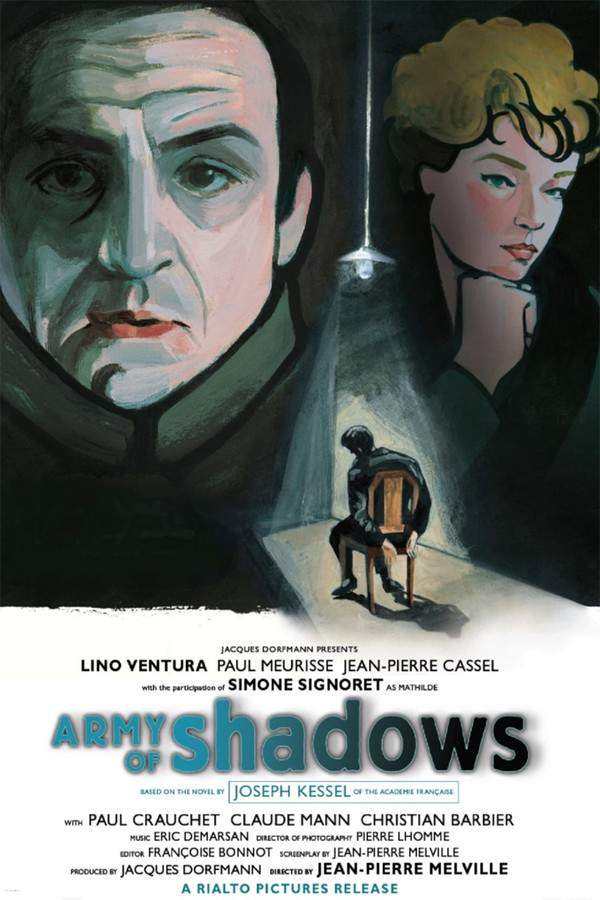
Army of Shadows (2006) movie poster

Plot Summary

Army of Shadows (2006) Plot Summary Explained

Release, runtime and language
2006 · 145 min · French
Loading streaming availability…
Directed by
Jean-Pierre Melville

During World War II, Philippe Gerbier becomes involved with the French Resistance in occupied France. The film portrays the harsh realities faced by those fighting against the Nazi regime, depicting a grim and unglamorous struggle for survival. Gerbier's quiet resolve is pushed to its limits as he endures betrayal, torture, and the constant threat of discovery while operating in Marseilles. His quest for justice and revenge becomes a dangerous and relentless battle against overwhelming odds, marked by suspicion and paranoia within the Resistance itself.

On this page (5)
  1. 1 Where to watch
  2. 2 What happens: full plot
  3. 3 Plot questions answered
  4. 4 Movie threads
  5. 5 Every angle
Loading streaming availability…

Full plot summary · contains spoilers

What Happens in Army of Shadows: Full Plot Summary

The whole story of Army of Shadows (2006) explained, from the opening scene to the final frame: every key event, every twist and what it all adds up to. Read it as a quick recap before the sequel, to check a scene you missed, or to finally understand what really happened.

Philippe Gerbier finds himself at the forefront of the French Resistance when he is arrested by the Vichy French police, who suspect him of engaging in Resistance activities. Despite his eventual acquittal due to insufficient evidence, he is sent to an internment camp. Here, he teams up with a young Communist to devise an escape plan, but before they can make their move, Gerbier is transferred to Paris. There, awaiting interrogation by the Gestapo, he seizes the opportunity to kill a guard and make his daring escape.

Upon arriving in Marseille, Gerbier, along with his comrades Félix Lepercq, Guillaume "Le Bison" Vermersch, and Claude "Le Masque" Ullmann, successfully lures Paul Dounat to a rendezvous, uncovering that Dounat is the young agent responsible for Gerbier’s betrayal. Instead of executing their plan with firearms, which they cannot use due to the neighboring house’s new occupants, they resort to strangling their former associate.

In a twist of fate, Félix encounters his long-time friend Jean-François Jardie at a bar and persuades the thrill-seeking ex-pilot to join their underground operations. During a mission in Paris, Jean-François visits his brother Luc, a distinguished philosopher leading a seemingly detached life. Subsequently, he travels to the Mediterranean to assist in evacuating Allied soldiers, along with Gerbier and the shadowy "Big Boss" to London by submarine. In a surprising turn of events, Jean-François doesn’t recognize that the Big Boss is, in fact, Luc, whose true identity remains a closely guarded secret.

Once in London, Gerbier attempts to solicit additional resources for the Resistance from Free French leaders while Luc is honored with a decoration from Charles de Gaulle. However, Gerbier quickly learns of Félix’s capture by the Gestapo and makes a hasty return, parachuting back into the French countryside to confront the situation.

Meanwhile, Mathilde, a Parisian housewife entrenched in the Resistance, takes charge of Gerbier's cell in Lyon. Her skills impress Gerbier, leading him to keep her involved. She crafts a bold plan to rescue Félix, who has been subjected to brutal torture at Gestapo headquarters. Amid this turmoil, Jean-François decides to resign from the Resistance, incriminating himself to ensure he ends up sharing a cell with Félix. Mathilde, Le Masque, and Le Bison pursue a risky rescue attempt in German disguises, armed with a forged transfer order, but their plot unravels when the prison doctor declares Félix unfit for transport due to his severe condition. As a final act, Jean-François offers Félix his lone cyanide pill after witnessing the failure of their mission.

Despite Mathilde's pleas for him to lay low, Gerbier refuses to abandon the fight, asserting that there is no one else capable of stepping into his shoes at this critical juncture. However, he is apprehended by Vichy police and delivered into the hands of the Germans. Facing execution, Gerbier and his comrades learn that if they can reach the far wall of a room before the machine guns cut them down, they may gain a brief reprieve. As the gunfire erupts, Gerbier dashes for safety, just as Mathilde and Le Bison create a diversion by throwing smoke bombs, enabling him to escape.

Gerbier spends a month in hiding within an abandoned farmhouse. One day, Luc arrives, expressing concern for Mathilde, who has been captured and is in danger of revealing critical information due to threats against her daughter. As the tension escalates, Luc hides when Le Masque and Le Bison arrive with news of Mathilde’s release, along with details of two Resistance members being taken prisoner. In a shocking turn, Gerbier orders Mathilde's execution, yet Le Bison staunchly refuses to carry out the order, vowing to save her. It falls to Luc to reason with Le Bison, persuading him that Mathilde would prefer to die rather than betray her comrades.

Together, Luc, Gerbier, Le Bison, and Le Masque venture back to Paris, where they finally locate Mathilde on the street. In a heartbreaking moment, Le Bison shoots her twice before they make their escape. The film concludes with the somber revelation that within less than a year, all four men were captured and faced grim fates, either by their own hands or at the mercy of the Nazis. Ultimately, Gerbier’s fate is chillingly recounted as “on 13 February 1944, he decided not to run this time.”
Last updated: November 16, 2024 at 18:41

Was this helpful?

Plot questions answered

Army of Shadows Plot Explained: Your Questions Answered

The questions people ask most about Army of Shadows (2006): what happens in the confusing scenes, why the characters do what they do, the twists, hidden details and what the ending means. Each answer contains spoilers.

Q1

Why was Philippe Gerbier arrested by the Vichy French police?

Gerbier was arrested because the Vichy French police suspected him of being involved in Resistance activities against the Nazi regime. Although he was eventually acquitted due to insufficient evidence, the authorities still sent him to an internment camp rather than releasing him, reflecting the arbitrary nature of Vichy cooperation with Nazi occupation.

  • arrest
  • vichy police
  • resistance
  • internment camp
  • gerbier
Q2

How did Gerbier escape from the Gestapo in Paris?

While awaiting interrogation by the Gestapo in Paris, Gerbier spotted an opportunity and killed a guard before making a daring escape. This escape marked a critical turning point that solidified his commitment to the Resistance cause.

  • escape
  • gestapo
  • paris
  • guard
  • interrogation
Q3

Who betrayed Gerbier to the Gestapo in Marseille?

Paul Dounat was the young agent responsible for betraying Gerbier to the Gestapo. After luring him to a rendezvous in Marseille, Gerbier and his comrades strangled Dounat to execute him, since they could not use firearms due to new occupants in a neighboring house.

  • paul dounat
  • betrayal
  • marseille
  • gestapo
  • execution
Q4

Who is the "Big Boss" that travels with Gerbier to London?

The mysterious "Big Boss" is Luc Jardie, the brother of Jean-François Jardie. Luc leads a seemingly detached life as a distinguished philosopher in Paris while secretly serving as a high-ranking Resistance leader. Neither Gerbier nor Jean-François realize they are working with Luc until his identity is revealed.

  • big boss
  • luc
  • jean-francois
  • underground
  • submarine
  • london
Q5

Why did Jean-François resign from the Resistance?

Jean-François resigned from the Resistance specifically to be imprisoned alongside his friend Félix, who had been captured by the Gestapo. By incriminating himself, he ensured they would share a cell, allowing him to be with Félix during his final moments.

  • jean-francois
  • resignation
  • félix
  • prison
  • gestapo
  • capture
Q6

Why did Mathilde's rescue mission at Gestapo headquarters fail?

Mathilde, Le Masque, and Le Bison attempted to rescue Félix by disguising themselves as Germans with a forged transfer order. Their plan failed when the prison doctor examined Félix and declared him unfit for transport due to the severe torture he had endured. This forced them to abandon the rescue.

  • mathilde
  • rescue
  • félix
  • forged order
  • prison doctor
  • torture
Q7

Why was Mathilde executed by her own Resistance comrades?

Mathilde had been captured by the Nazis, and there was a real possibility she would reveal critical Resistance information under threat against her daughter. Gerbier ordered her execution, and though Le Bison initially refused, Luc convinced him that Mathilde would prefer death over betraying her comrades. Le Bison then shot her twice in Paris.

  • mathilde
  • execution
  • le bison
  • gerbier
  • luc
  • captured
  • betrayal
Q8

What happens to Gerbier at the end of Army of Shadows?

After Mathilde's execution, Gerbier, Luc, Le Bison, and Le Masque return to Paris. The film reveals that within less than a year, all four men were captured. Gerbier was captured on 13 February 1944, and on that same day, he chose not to run, accepting his fate rather than attempting escape.

  • gerbier
  • fate
  • 13 february 1944
  • captured
  • execution
  • nazis
Q9

Why did Félix receive a cyanide pill from Jean-François?

After the failed rescue attempt, Jean-François gave Félix his only cyanide pill as a mercy killing. Félix had been severely tortured and was declared unfit for transport by the prison doctor, leaving him with no hope of escape or survival. The cyanide offered him a way to avoid further torture and potential betrayal under duress.

  • félix
  • cyanide pill
  • jean-francois
  • mercy
  • torture
  • gestapo
Q10

How did Mathilde become involved in the Resistance?

Mathilde was a Parisian housewife who became deeply entrenched in the Resistance movement. When Gerbier was in Lyon, she took charge of his Resistance cell, impressing him with her strategic skills and organizational abilities, which led him to involve her in dangerous operations including the rescue of Félix.

  • mathilde
  • lyon
  • housewife
  • resistance cell
  • gerbier

Movie threads

More Movies Like Army of Shadows, by Mood & Story

Curated lists built around what makes Army of Shadows tick: the same mood, the same kind of story or the same emotional payoff. Each list explains why these movies belong together.

Grim and Realistic War Movies like Army of Shadows

War stories that strip away heroism to reveal the grim, paranoid reality of survival. If you appreciated the unvarnished realism of Army of Shadows, explore these movies like it. This list features similar war dramas and historical films that share a bleak tone, heavy emotional weight, and a focus on the harsh, often hopeless, realities of conflict and resistance.

  • grim
  • tense
  • somber
  • fatalistic
  • claustrophobic
  • resigned
  • Tone: bleak, tense, grim
  • Pacing: steady, methodical
Why these movies?

The story pattern: These narratives follow characters trapped in oppressive situations, often with a fatalistic trajectory. The plot is less about grand victories and more about a series of grim events—betrayal, capture, and difficult choices—that methodically strip away hope, leading to an emotionally heavy conclusion.

Why they belong together: Movies are grouped here for their shared commitment to portraying war with brutal honesty, a consistently bleak and tense atmosphere, and a focus on the high personal cost of conflict rather than its glory.

Movies with Paranoia and Claustrophobic Tension like Army of Shadows

Stories of isolated groups fraying under constant threat and internal suspicion. For viewers who liked the tense, paranoid atmosphere of Army of Shadows, this section collects similar movies with a claustrophobic feel. These films, spanning thrillers, dramas, and war stories, feature characters under immense pressure, where survival hinges on navigating suspicion and betrayal.

  • paranoid
  • claustrophobic
  • tense
  • grim
  • suspenseful
  • fatalistic
  • Tone: tense, paranoid, bleak
  • Pacing: steady, deliberate
Why these movies?

The story pattern: The narrative pattern involves a close-knit group facing an external existential threat, which in turn breeds internal distrust and moral dilemmas. The pacing is often steady, building a sense of inescapable dread as alliances shift and the walls close in, both literally and figuratively.

Why they belong together: These films are connected by their potent mix of high tension, a claustrophobic mood, and a focus on the psychological unraveling of characters who are trapped together in a high-stakes situation filled with paranoia.

Every angle

Army of Shadows (2006) Explained: Plot, Timeline & Characters

Everything about Army of Shadows in one place: what happens in the plot summary, the timeline in chronological order, the characters and meaning and a spoiler-free summary. What's After the Movie adds the cast, box office and post-credit scenes.

Coming soon on iOS and Android

The Plot Explained Movie Summary App

Plot summaries, endings explained and timelines on your phone. Catch up on any movie in minutes, save your favorites and never miss a twist again.

Be the first to know when we launch. Your email stays private, always.

Learn more about the app