Plot Explained Spoilers guaranteed!
Plot Explained

Browse by genre

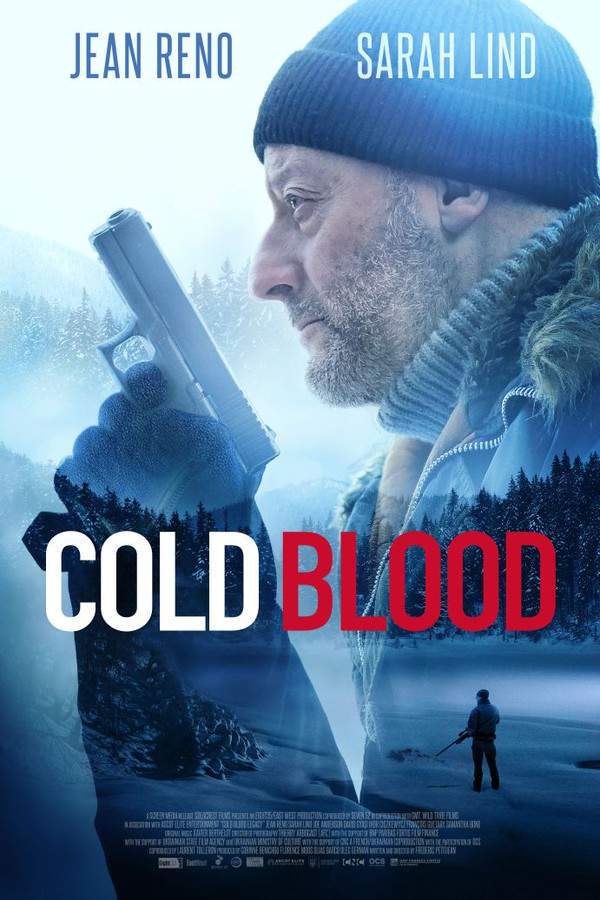
Cold Blood (2019) movie poster

Plot Summary

Cold Blood (2019) Plot Summary Explained

Release, runtime and language
2019 · 91 min · French
Echo score 34
JustWatch #15,186 13
Directed by
Frédéric Petitjean
Starring
Joe Anderson, Jean Reno, Sarah Lind, David Gyasi, Anna Butkevych, François Guétary
Budget
$2.7M

Deep within the icy expanse of North America, a retired assassin enjoys a quiet life until he intervenes in a snowmobile accident and saves a mysterious woman. His act of kindness plunges him into a dangerous world as he discovers her connection to a deadly conflict. Forced to confront his past, he must navigate a perilous game of deception and violence, jeopardizing the peace he fought so hard to achieve.

On this page (7)
  1. 1 Where to watch
  2. 2 What happens: full plot
  3. 3 Plot questions answered
  4. 4 Movie threads
  5. 5 Movies like Cold Blood
  6. 6 Categories
  7. 7 Every angle

Where to watch

Where to Watch Cold Blood (2019)

Where can you watch Cold Blood? Stream, rent or buy it in the US, including on fuboTV, YouTube TV and Fawesome: current JustWatch availability with up-to-date prices.

Streaming availability powered by JustWatch

Full plot summary · contains spoilers

What Happens in Cold Blood: Full Plot Summary

The whole story of Cold Blood (2019) explained, from the opening scene to the final frame: every key event, every twist and what it all adds up to. Read it as a quick recap before the sequel, to check a scene you missed, or to finally understand what really happened.

In a remote cabin near the frozen edge of the Canadian border, Henry, a professional assassin Jean Reno, retires from the world to live in deliberate quiet. The days pass with careful routine, the hush of wind through pines, and the creak of wood as he keeps to himself. His solitude is unsettled only when a crashed snowmobile drags a seriously injured young woman into his life, the air turning sharp with danger and questions. The woman—who introduces herself as Melody—arrives battered and frightened, clinging to life in a landscape that seems to mirror the emptiness of the work Henry used to do.

Henry tends to Melody with the caution of a man who has long controlled risk and consequence. With the simplest tools at hand, he works to steady her, pulling splinters from wounds and removing shards of wood that press against fragile tissue. The room becomes a makeshift clinic, and the tense quiet between them is filled with careful breath and small, clinical movements. Melody’s resilience grows, but Henry’s mind stays alert, reading every sign she gives off: the lack of identity documents, the absence of a cellphone, the way she avoids looking over her shoulder at the world beyond the cabin. Their uneasy coexistence deepens into a strange, fragile bond, even as Henry sternly insists that she leave as soon as she is able.

As Melody regains strength, the fragile balance of hospitality and threat tilts. One morning, Henry sits outside the cabin, a silhouette against the glacial land, seemingly fishing or simply waiting for the next quiet moment. Melody—the woman who has learned to move in silence—reassembles a gun hidden away in her backpack and fires a shot toward him. The impact lands in the air, a sudden crack that reveals itself not as a lethal strike but as a shot at a straw mannequin, a cruel misdirection that underscores the perilous game they are playing. Henry restrains Melody, and the tension gives way to a tense interrogation. She reveals her true name is Charlie Sarah Lind, and she has come to kill Henry to avenge her father. Her father, a wealthy businessman who supposedly neglected her, becomes the ruthless incentive behind her quest for a memory that he never spared for her. Charlie’s motive is cold and personal, a calculation of honor and retribution in a world where loyalty is rare and promises are fragile.

Henry acknowledges a harder truth that he had kept hidden: the contract that brought him to this remote place included a second, equally fatal objective—an assassination of Charlie herself. The revelation shifts the stakes from mere survival to a grim ethical equation, forcing both of them to confront the possibility that their lives have always been bargains in a larger, unseen order. Despite this fatal symmetry, Henry makes a startling choice and releases Charlie back into the wild, hoping the distance will restore the balance of power and perhaps give them both a chance at a different ending. Yet the wild has a stubborn memory, and Charlie returns to the cabin, drawn back by the questions that neither of them can quite escape.

The quiet is shattered when a former bodyguard of Charlie’s father arrives, stepping into the cabin with a singular, dangerous purpose: to rescue Charlie by removing Henry from the scene. A brutal shootout erupts, and Henry defeats the intruder, his killing decisive but loaded with the weight of a life spent in the margins of morality. With dawn breaking over the snow, the decision to walk away from a life of assassination proves too heavy to bear. Henry phones the police, yielding himself to the consequences of a career built on removal and secrecy—the ultimate act of surrender to a system he can no longer stomach.

The moment of reckoning arrives with a cruel twist. Charlie strikes Henry in a moment of rage or despair, and a nearby wolf—a symbol of the wild and indifferent world around them—appears in the melee. Henry manages to shoot the animal, but the struggle leaves him mortally wounded. The police arrive, and Henry—the man who lived by silencing others—meets a final, lawful judgment at the edge of the forest. Charlie is taken into custody, her fate now tied to the law and the life she has chosen, the memory of the man who tried to shape her ending lingering on her shoulders.

In the aftermath, Charlie returns to Henry’s cottage, only to discover a quiet testament to the man who shaped her path. He leaves her a copy of The Art of War and a hidden number—the contact who hired him. The book’s presence looms as a final echo of the lessons Henry lived by: strategy, restraint, and the possibility that knowledge might outlive a life spent in the shadows. The number hints at an unseen network still at work, suggesting that the true intrigues behind the violent encounter go beyond a single contract or a single night. Yet what survives most clearly is the paradox at the heart of Henry’s world—a life spent calculating risk and consequence, now ending in a police siren’s cry, with a fragile, unresolved future for the young woman who once wandered into his isolated life.
Last updated: January 28, 2026 at 12:45

Was this helpful?

Plot questions answered

Cold Blood Plot Explained: Your Questions Answered

The questions people ask most about Cold Blood (2019): what happens in the confusing scenes, why the characters do what they do, the twists, hidden details and what the ending means. Each answer contains spoilers.

Q1

Why did Charlie shoot at the straw mannequin instead of Henry?

Charlie fired the shot as a psychological test rather than a genuine assassination attempt. She needed to gauge Henry's reflexes and survival instincts before committing to her actual plan. Missing intentionally allowed her to observe how he would respond to a threat, revealing whether he was truly the dangerous assassin she had prepared to confront.

Foreshadowing: Earlier, Henry notes that Charlie avoids looking over her shoulder, suggesting she's used to living in a state of heightened awareness and strategic calculation.

  • charlie
  • straw mannequin
  • shot
  • henry
  • test
Q2

Why did Henry keep the contract to kill Charlie hidden?

Henry discovered Charlie's identity and the second contract during or after tending her wounds. By keeping it secret, he maintained control over the situation and time to assess whether he would actually carry out the contract. Revealing it immediately would have escalated the conflict before he understood his own intentions.

Foreshadowing: Henry's careful questioning during interrogation gave him the information he needed while observing Charlie's behavior for signs of threat.

  • henry
  • contract
  • charlie
  • secret
  • kill
Q3

Why did Henry release Charlie after she came to kill him?

Henry chose not to complete the contract because killing an unarmed woman who came seeking revenge for her father would have contradicted his decision to retire from assassination. Releasing her was his attempt to break the cycle of violence that defined his past, even though it meant accepting the risk that she might return.

Foreshadowing: Henry's retreat to isolation was already a rejection of his violent profession, suggesting he was seeking redemption through peaceful living.

  • henry
  • charlie
  • release
  • free
  • contract
Q4

Why did Henry turn himself in to the police?

After killing the bodyguard, Henry reached a breaking point. He was exhausted from a lifetime of killing and wanted accountability for his actions. Surrendering represented his final moral choice, a deliberate rejection of the shadowy world he had inhabited and an acceptance of consequence.
Foreshadowing: Henry's decision to retire to isolation already indicated his desire to escape his violent past.
  • henry
  • police
  • surrender
  • turn self in
  • bodyguard
Q5

Who kills Henry at the end of the movie?

Henry is fatally shot by the police who arrive at the cabin. During the chaotic confrontation with Charlie and the wolf attack, the police perceive Henry as a threat and fatally wound him. He dies from these gunshot wounds, not from the wolf attack itself.

Foreshadowing: Henry's phone call to surrender himself set the police arrival in motion, bringing the outside world into his isolated refuge.

  • henry
  • police
  • killed
  • shoot
  • death
  • finale
Q6

What was the second contract Henry was hired to complete?

Henry reveals that alongside his original target, he was also contracted to kill Charlie, the very woman who came to kill him. This means someone hired Henry to eliminate both Charlie and her father, making Henry a link in a larger scheme to remove both of them.

Foreshadowing: Charlie mentioned her father was wealthy, suggesting he had enemies who would hire a professional assassin.

  • contract
  • charlie
  • assassination
  • henry
  • hire
Q7

Why did Charlie come back to the cabin after Henry freed her?

Charlie returned because she couldn't leave without answers. Her entire mission was centered on confronting Henry about her father's death, and simply walking away left her unresolved. Additionally, she may have had nowhere else to go and recognized that Henry was her only connection to understanding what happened.

Foreshadowing: Henry noted she had no ID, no cellphone, and nowhere else to go, making the cabin her only anchor.

  • charlie
  • cabin
  • return
  • henry
  • free
Q8

What is the significance of The Art of War that Henry leaves Charlie?

Henry leaves Charlie a copy of The Art of War as a final lesson in strategy and survival. The book represents the philosophy that guided his career, calculating odds, understanding enemies, and knowing when to act. By giving it to Charlie, he's equipping her with the tools to navigate the dangerous world she's now part of, including the phone number of the person who hired him.

Foreshadowing: Henry's methodical approach to everything from wound care to combat demonstrated strategic thinking throughout the film.

  • art of war
  • charlie
  • henry
  • gift
  • strategy
Q9

Why did the bodyguard come to the cabin?

The bodyguard was sent by Charlie's father to rescue her from Henry, viewing Henry as the kidnapper who had taken his daughter. He arrived intending to eliminate Henry and bring Charlie back. This external threat forced Henry and Charlie into an uneasy alliance despite their mutual intent to kill each other.

Foreshadowing: Charlie mentioned her father was wealthy, implying he had resources and people loyal enough to send help.

  • bodyguard
  • cabin
  • charlie
  • father
  • rescue
Q10

Why did Charlie attack Henry during the final confrontation?

Charlie struck Henry in a moment of emotional turmoil. She was caught between rage at his role in her father's death and the realization that he was about to be taken away by police. The attack represented her inability to process the complex emotions stirred by their encounter, vengeance denied and a complicated mentor figure slipping away.

Foreshadowing: Throughout their interactions, Charlie struggled to reconcile her desire for revenge with Henry's unexpected mercy.

  • charlie
  • henry
  • attack
  • strike
  • emotion
Q11

Why did Henry shoot the wolf during the final confrontation?

The wolf attacked during the chaotic moment when Charlie had struck Henry and police were approaching. Henry shot the wolf to protect Charlie, demonstrating that despite everything, he still viewed her as someone worth saving. This act completed his transformation from assassin to protector.

Foreshadowing: Earlier in the film, Henry defended Charlie against wolves circling the cabin, establishing his protective instinct toward her.

  • wolf
  • henry
  • shoot
  • charlie
  • protect
Q12

What happens to Charlie after Henry's death?

Charlie is taken into police custody following the confrontation at the cabin. Later, she returns to Henry's cottage and discovers he left her The Art of War and the phone number of the person who hired him to kill her. This gives her a path forward, potentially seeking revenge against whoever orchestrated the contracts.

Foreshadowing: Henry's final gesture suggests he wanted Charlie to have agency over her own fate rather than being controlled by unseen players.

  • charlie
  • police
  • custody
  • art of war
  • future

Movie threads

More Movies Like Cold Blood, by Mood & Story

Curated lists built around what makes Cold Blood tick: the same mood, the same kind of story or the same emotional payoff. Each list explains why these movies belong together.

Retired Assassin Movies like Cold Blood

When a violent past violently interrupts a peaceful present. If you enjoyed Cold Blood, you'll find a similar tension in these movies about retired killers forced to confront their past. These films explore themes of redemption, survival, and the brutal consequences of a life left behind.

  • tense
  • violent
  • melancholic
  • methodical
  • redemption
  • isolation
  • Tone: dark, melancholic, tense
  • Pacing: steady, methodical
Why these movies?

The story pattern: The narrative typically begins in a state of hard-won tranquility, which is shattered by an external threat or a mistake born of lingering humanity. The protagonist is reluctantly pulled back into a world of violence, using their dormant skills to protect themselves or others, while wrestling with the moral and emotional weight of their history.

Why they belong together: These films are grouped by their shared central character archetype and the core conflict of a peaceful life violently disrupted. They share a dark, heavy tone, a steady pacing that builds to intense confrontations, and a focus on the psychological toll of a violent past.

Paranoid Winter Thrillers like Cold Blood

Trust no one when the world outside is as dangerous as the people within. Discover more movies like Cold Blood that master the art of icy suspense. These tense thrillers use bleak, isolated settings to amplify feelings of paranoia and deception, creating a claustrophobic experience where survival depends on outthinking hidden enemies.

  • paranoid
  • isolated
  • claustrophobic
  • tense
  • cold
  • deception
  • Tone: dark, tense, claustrophobic
  • Pacing: steady, escalating dread
Why these movies?

The story pattern: The plot hinges on mounting suspicion and the unraveling of trust. Characters are often isolated, with danger coming from both a known external threat and the potential betrayal of those close by. The hostile environment limits escape and resources, forcing tense standoffs and a constant state of high alert.

Why they belong together: This thread connects films through their oppressive atmosphere and central theme of paranoia. They share a dark, tense tone, a steady pacing that builds dread, and a high level of psychological intensity. The setting acts as a crucible, heightening the stakes and the characters' isolation.

If you liked this

Movies Like Cold Blood

Similar movies to Cold Blood: the same genre, themes or kind of story. Each one comes with its own plot summary, timeline and ending explained.

Browse all movie summaries

Categories

Movie Lists Featuring Cold Blood

Cold Blood appears in these hand-built movie categories. Each one groups movies by a specific mood, theme or story type, with their plot summaries and endings explained.

View all movie categories

Every angle

Cold Blood (2019) Explained: Plot, Timeline & Characters

Everything about Cold Blood in one place: what happens in the plot summary, the timeline in chronological order, the characters and meaning and a spoiler-free summary. What's After the Movie adds the cast, box office and post-credit scenes.

Coming soon on iOS and Android

The Plot Explained Movie Summary App

Plot summaries, endings explained and timelines on your phone. Catch up on any movie in minutes, save your favorites and never miss a twist again.

Be the first to know when we launch. Your email stays private, always.

Learn more about the app