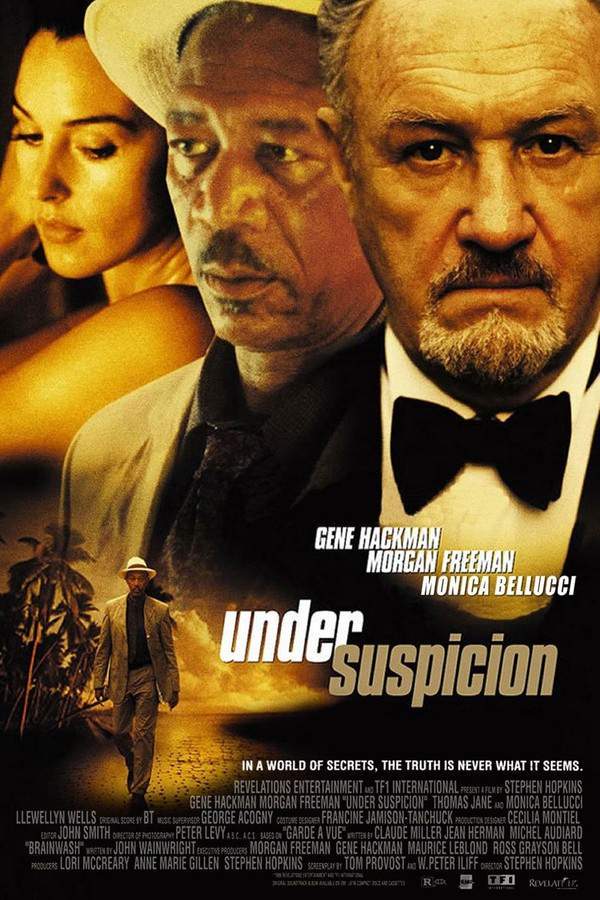
Under Suspicion

Under Suspicion

Year: 1991

Runtime: 99 mins

Language: English

Director: Simon Moore

ThrillerCrime

In late‑1950s Britain, officer Tony Aaron quits the police after an affair with Hazel, the wife of a man he was assigned to guard. Posing as a private investigator, he photographs staged “affairs” for divorcing couples, using Hazel as the subject. When Hazel is murdered, Tony begins an affair with the dead man’s lover, Angeline, while racing to prove his innocence.

Warning: spoilers below!

Haven’t seen Under Suspicion yet? This summary contains major spoilers. Bookmark the page, watch the movie, and come back for the full breakdown. If you're ready, scroll on and relive the story!

Under Suspicion (1991) – Full Plot Summary & Ending Explained

Read the complete plot breakdown of Under Suspicion (1991), including all key story events, major twists, and the ending explained in detail. Discover what really happened, and what it all means.

Tony Aaron [Liam Neeson] is a keen but weary police investigator based in Brighton, on the pristine South Coast of Great Britain, towards the end of the 1950s. He teams up with his colleague and friend, Frank Vance [Kenneth Cranham], to shadow Powers [Alan Talbot], a local criminal. Tony ultimately leaves Frank outside Powers’ house to continue observing, while he succumbs to a dangerous, secret liaison with Powers’ wife, Hazel [Maggie O’Neill]. When Powers returns unexpectedly and uncovers the affair, he grabs his shotgun to punish the trespassers, but Frank intervenes and a violent struggle ensues, culminating in Powers injuring and unintentionally killing another police officer, Colin [Martin Grace], during the chaos.

Two years later, during the 1959 Christmas season, Tony has stepped away from the force and is struggling as an unsuccessful private detective. His crooked specialty is fabricating adultery evidence to help clients obtain divorces—an ugly but lucrative game in England and Wales at the time. He preys on vulnerability, coaching clients through elaborate ruses that require hotel stays and staged affairs. One day, a routine pickup at the station introduces him to a new client who becomes central to the next wave of trouble. Tony’s hotel-room photography session ends in horror when he discovers that both spouses have been shot dead. The murdered couple belonged to the painter Stasio [Michael Almaz], who sought a divorce so he could marry another woman named Angeline [Laura San Giacomo]. In a macabre twist, Stasio’s thumb is severed after the murder.

The investigation spirals as Tony and Frank pursue different leads. They visit Angeline and Selina [Alphonsia Emmanuel], the latter being Stasio’s estranged partner, while Stasio’s will reveals the painter has left everything to Angeline and nothing to Selina. A charged new alliance forms: Tony and Angeline become lovers, and he digs through Stasio’s studio in search of authentic clues. He learns that Stasio had imprinted his thumb onto his paintings to establish provenance and authenticity, a crucial thread that could exonerate him—or implicate others.

As the case darkens, suspicion quickly lands on Tony when the murder weapon turns up in the hotel furnace and the evidence points toward him. Frank pushes Roscoe [Stephen Moore], a key witness who is entangled with rent boys, to reveal Tony’s innocence, but Roscoe falls apart and leaves behind a suicide note that paints Tony as guilty. Tony is arrested and tried for the murders, where the prosecution contends that he married for money and intended to leave his wife. Angeline becomes a surprise witness for the prosecution, testifying that she saw a man climbing over the hotel roof and performing a peculiar lighter-banging gesture that aligned with Tony’s own method—an indelible clue used to convict him.

With the verdict sealed, Tony accepts a death sentence for the killings, but the plot takes a dramatic turn on the eve of his execution. Frank returns to Stasio’s house and discovers Stasio’s thumb nestled inside Angeline’s paint box, prompting him to speed back to the prison just in time to intervene and stop the hanging. Angeline herself is arrested later, accused of involvement in the painter’s murder as well. Tony, meanwhile, plans to flee the country, visiting Angeline in prison, where she unveils a chilling theory: Tony and Selina had conspired to frame her. A whispered confrontation follows in which Tony hints to Angeline whether he was responsible for the other deaths, including Hazel’s.

The finale transports Tony to Miami, where he encounters Selina [Alphonsia Emmanuel] again. She reveals that she has begun releasing Stasio’s paintings to the public and hands him a payment as she scolds him for falling in love with Angeline, suggesting that Timelines and loyalties have shifted. The film closes on a bleak note: a despondent Tony, still haunted by the weight of the crimes and the role he played, uses his lighter in a way that echoes Angeline’s testimony, lingering on the same gesture that sealed his fate in court.


Last updated: October 09, 2025 at 15:01

Was this helpful?

Under Suspicion (1991) Plot Questions Answered – Summary FAQ

Explore frequently asked questions about Under Suspicion (1991) with spoiler-rich answers covering the full plot summary, major story beats, character motivations, hidden details, and ending meaning. This movie summary FAQ helps explain confusing scenes, plot twists, and narrative decisions in clear, searchable detail.

Q1

Why did Tony leave the police force after the incident at Powers' house?

A.

Tony left the police force because he was having an affair with Hazel, the wife of Powers, someone he was assigned to guard. When Powers returned unexpectedly and discovered the affair, a violent struggle ensued. During the chaos, Powers shot and killed police officer Colin Grace. Tony's involvement in the extramarital affair and the resulting scandal made his position on the force untenable, so he resigned and became a private detective.

Earlier, Tony's willingness to risk his assignment by pursuing Hazel foreshadows his tendency to prioritize personal desires over professional duty.

Tony Aaronpolice corruptionBrightonHazelPowersresignation
Q2

How did Officer Colin get killed during the Powers incident?

A.

When Powers returned home unexpectedly and discovered Tony's affair with Hazel, he grabbed his shotgun to confront the intruders. In the ensuing struggle between Powers, Tony, and Frank (Tony's colleague), the gun went off. Powers accidentally shot and killed Officer Colin Grace, who had been part of the surveillance team outside the house. It was not a deliberate killing by anyone, the chaos and violence escalated unintentionally.

The reckless chaos at Powers' house establishes a pattern where Tony's illicit actions trigger unintended violent consequences.

Colin GracePowersshotgunBrightonpolice officer killed
Q3

Why did Tony become a private detective who faked adultery evidence?

A.

After leaving the police force, Tony struggled financially as a private detective. He discovered a lucrative but crooked niche: fabricating evidence of adultery for people seeking divorces. At the time, divorce laws in England and Wales required proof of infidelity, making his services profitable. Tony would stage photographs showing clients' spouses in compromising situations, often coaching them through elaborate ruses and insisting on expensive hotel rooms to maximize his earnings.

Tony's willingness to exploit vulnerable clients for money hints at his moral flexibility, which later makes him a plausible suspect in the murders.

private detectivedivorceadultery evidenceBrightonextorting clients
Q4

Why was Stasio's severed thumb important to the murder case?

A.

Stasio had a unique method of authenticating his paintings, he would imprint his thumb onto each canvas to prove provenance. When he was murdered, his thumb was severed and stolen, likely to forge his paintings and sell them as authentic works. This detail became crucial evidence because it revealed a financial motive beyond the apparent love triangle: someone wanted to steal Stasio's thumb to forge his art and profit from his estate.

Tony discovers Stasio's thumb-printing technique while searching the studio, linking the murder to the painter's valuable artistic method.

Stasiosevered thumbpaint forgerypainting authenticationart theft
Q5

What did Stasio's will reveal about his relationships?

A.

Stasio's will revealed that he intended to leave everything, including his paintings, to Angeline, his lover, and nothing to Selina, his estranged partner. This was significant because it provided a clear motive for Selina: she would be cut out of Stasio's fortune while Angeline would inherit everything. The will also showed Stasio's intention to divorce Selina and marry Angeline, which deepened the suspicion around who might benefit from his death.

The will creates immediate suspicion toward Angeline as the primary beneficiary, while Selina appears wronged, a dynamic that fuels later conspiracy theories.

Stasio willAngelineSelinainheritancedivorce
Q6

Why did suspicion fall on Tony for the hotel murders?

A.

Several circumstantial factors pointed to Tony. The murder weapon was traced to Tony, and he had a clear motive: he had met Stasio as a client seeking divorce evidence, giving him access to the hotel room. Additionally, his profession involved staging infidelity scenes and photographing couples in hotels, making him appear capable of orchestrating the murders. The evidence was circumstantial but damning enough to arrest and convict him.

Tony's own dishonest profession, which involves creating false evidence in hotel rooms, becomes the very evidence used to frame him.

Tony Aaronmurder weaponhotel roomsuspicionframe
Q7

What was Roscoe's role in the investigation and why did he commit suicide?

A.

Roscoe was a key witness who had connections to rent boys and was being pressured by Frank to reveal information that could clear Tony. Under intense pressure, Roscoe broke down and committed suicide. Before dying, he left a note that directly implicated Tony in the murders, further strengthening the case against him. The suicide note proved devastating to Tony's defense despite being written by someone in emotional distress.

Roscoe's breakdown and suicide echo the film's theme of moral collapse under pressure, adding more circumstantial evidence against Tony.

Roscoesuicide notewitnessFrank Vancefalse accusation
Q8

Why did Angeline testify against Tony at his trial?

A.

Angeline testified against Tony because she genuinely believed he was guilty. She claimed she saw a man climbing over the hotel roof on the night of the murders, and importantly, she described a distinctive lighter-banging gesture the killer made. This gesture matched Tony's own mannerism, something Angeline had observed during their relationship. Her testimony about the lighter and rooftop escape became the critical evidence that convicted Tony.

The lighter gesture that Angeline describes in court directly mirrors Tony's own behavior, creating a haunting detail that seems to confirm his guilt.

Angelinetestifytriallighter gesturerooftopguilty verdict
Q9

What was the lighter gesture that helped convict Tony?

A.

During the murders, the killer made a distinctive gesture, banging a lighter in a peculiar way. Angeline testified that she saw this same gesture when she observed someone escaping over the hotel roof. Since Tony was known to use his lighter in this exact manner, the prosecution used this as proof of his identity. The gesture became an indelible clue that linked Tony to the crime scene, and the film ends with Tony repeatedly performing this same gesture, leaving his guilt ambiguous.

The lighter gesture recurs at the film's end, suggesting either Tony's guilt or his psychological torment from being falsely accused, or perhaps both.

lighter gestureconvictionlighter bangAngeline testimonyidentity
Q10

How did Frank discover Stasio's thumb in Angeline's paint box?

A.

On the night before Tony's execution, Frank returned to Stasio's house to investigate further. While searching, he discovered Stasio's severed thumb hidden inside Angeline's paint box. This crucial evidence suggested that Angeline had been involved in the murder, likely to obtain the thumb for forging paintings. Frank raced to the prison just in time to stop the hanging, proving Tony's innocence of at least that crime.

The thumb's discovery in Angeline's possession reverses the case entirely, exposing the true culprit while Tony remains condemned for other murders.

Frank VanceStasio thumbpaint boxAngeline arrestexecution stay
Q11

What did Angeline accuse Tony and Selina of in prison?

A.

When Tony visited Angeline in prison after her arrest, she accused him of conspiring with Selina to frame her for the murders. Angeline believed Tony and Selina had worked together to orchestrate the entire situation, possibly to steal Stasio's paintings and profits. This accusation created a rift between them and introduced another layer of conspiracy into the already complex case.

This accusation plants doubt about whether Tony is entirely innocent or if he orchestrated events from the beginning, adding ambiguity to the finale.

AngelineSelinaconspiracyframeTony accusation
Q12

What happened when Tony met Selina in Miami at the end?

A.

Tony travels to Miami after his release, where he encounters Selina, who has begun releasing Stasio's paintings onto the public market. Selina hands Tony payment and scolds him for falling in love with Angeline, implying their previous alliance involved money and loyalty. The meeting suggests Selina has been profiting from the art sales while Tony was imprisoned, and she hints that Tony's emotions complicated their original plan.

The Miami meeting reveals that Selina has been operating in the shadows, benefitting financially from Stasio's death while Tony was blamed.

SelinaMiamiStasio paintingsmoneyreunion
Q13

What does the final scene with the lighter imply about Tony's guilt?

A.

In the closing moments, Tony is shown using his lighter in the exact manner described by Angeline in her courtroom testimony, the distinctive banging gesture that supposedly identified him as the killer. The ambiguous ending leaves viewers uncertain whether Tony is guilty of the murders, whether he's traumatized by false accusation, or perhaps both. The gesture haunts him regardless of actual guilt, symbolizing how the trial and evidence have permanently marked him.

Tony Aaronlighter gestureambiguous endingguiltpsychological trauma
Mobile App Preview

Coming soon on iOS and Android

The Plot Explained Mobile App

From blockbusters to hidden gems - dive into movie stories anytime, anywhere. Save your favorites, discover plots faster, and never miss a twist again.

Sign up to be the first to know when we launch. Your email stays private, always.

Explore Movie Threads

Discover curated groups of movies connected by mood, themes, and story style. Browse collections built around emotion, atmosphere, and narrative focus to easily find films that match what you feel like watching right now.

Noir paranoia stories like Under Suspicion

Flawed protagonists become ensnared in conspiracies of their own making.If you liked the morally murky descent of Under Suspicion, explore more movies like it. This collection features similar neo-noir thrillers and suspenseful crime stories where flawed protagonists spiral into paranoia, framed for crimes and racing against a corrupt system.

noirparanoidsuspensefulgrimanxiouseroticfatalisticcynical

Narrative Summary

The narrative pattern involves a protagonist with a significant moral flaw (like adultery or greed) who becomes the prime suspect in a crime, often one they are tangentially connected to. As circumstantial evidence mounts, they must investigate the truth while their own life unravels, leading to a destructive and often bleak conclusion.

Why These Movies?

These films are grouped by their shared focus on psychological entrapment, moral decay, and a pervasive sense of doom. They blend erotic tension with criminal intrigue, creating a specific neo-noir vibe defined by high tension, dark tone, and a steady, fatalistic pacing that builds unbearable anxiety.

Thrillers about being framed like Under Suspicion

Innocent men uncover the truth while the walls of suspicion close in.Fans of Under Suspicion who enjoyed the 'race against time' plot will find similar movies here. These suspenseful crime thrillers feature protagonists wrongly accused of murder, forcing them to find the real killer before it's too late, often with a dark and intense tone.

suspensefulanxioustenseinvestigativeurgentcorruptionbetrayalnoir

Narrative Summary

The typical journey begins with an inciting incident—often a murder—that implicates the protagonist. With official channels either corrupt or convinced of their guilt, they take matters into their own hands, leading to a linear investigation filled with twists, betrayals, and narrow escapes, culminating in a final confrontation that may not offer full redemption.

Why These Movies?

These films share a core narrative engine: a desperate investigation under immense pressure. They are united by high-tension pacing, a focus on procedural unraveling of a conspiracy, and the heavy emotional weight of fighting for one's freedom against overwhelming odds.

Unlock the Full Story of Under Suspicion

Don't stop at just watching - explore Under Suspicion in full detail. From the complete plot summary and scene-by-scene timeline to character breakdowns, thematic analysis, and a deep dive into the ending - every page helps you truly understand what Under Suspicion is all about. Plus, discover what's next after the movie.

Under Suspicion Timeline

Track the full timeline of Under Suspicion with every major event arranged chronologically. Perfect for decoding non-linear storytelling, flashbacks, or parallel narratives with a clear scene-by-scene breakdown.

Under Suspicion Timeline

Characters, Settings & Themes in Under Suspicion

Discover the characters, locations, and core themes that shape Under Suspicion. Get insights into symbolic elements, setting significance, and deeper narrative meaning - ideal for thematic analysis and movie breakdowns.

Characters, Settings & Themes in Under Suspicion

Under Suspicion Spoiler-Free Summary

Get a quick, spoiler-free overview of Under Suspicion that covers the main plot points and key details without revealing any major twists or spoilers. Perfect for those who want to know what to expect before diving in.

Under Suspicion Spoiler-Free Summary

More About Under Suspicion

Visit What's After the Movie to explore more about Under Suspicion: box office results, cast and crew info, production details, post-credit scenes, and external links - all in one place for movie fans and researchers.

More About Under Suspicion