Plot Explained Spoilers guaranteed!
Plot Explained

Browse by genre

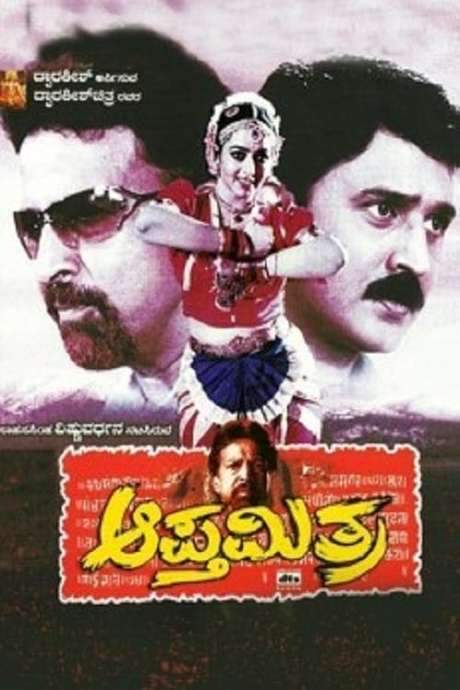
Apthamitra (2004) movie poster

Plot Summary

Apthamitra (2004) Plot Summary Explained

Release, runtime and language
2004 · 146 mins · Kannada
Loading streaming availability…
Directed by
P. Vasu
Starring
Vishnuvardhan, Ramesh Aravind, Dwarakish, Satyajith, Soundarya, Prema

Ramesh, an engineer, purchases an old palace rumored to house the spirit of Nagavalli, a dancer who died tragically. Believing the ghost resides in a locked room, Ganga, aided by Soumya, unlocks it, unleashing a series of supernatural disturbances. Vijay arrives at Ramesh’s home for a holiday, becoming entangled in the ensuing chaos.

On this page (6)
  1. 1 Where to watch
  2. 2 What happens: full plot
  3. 3 Plot questions answered
  4. 4 Movie threads
  5. 5 Movies like Apthamitra
  6. 6 Every angle
Loading streaming availability…

Full plot summary · contains spoilers

What Happens in Apthamitra: Full Plot Summary

The whole story of Apthamitra (2004) explained, from the opening scene to the final frame: every key event, every twist and what it all adds up to. Read it as a quick recap before the sequel, to check a scene you missed, or to finally understand what really happened.

Ramesh and Ganga are a married couple who relocate to Mysore to purchase an ancient palace, despite the objections of his uncle, Shivananda, and the family elders. The elder insists that the sealed first-floor room must remain untouched, a condition that casts a wary shadow over the new household. The couple are joined by the uncle’s two daughters, Vani and Hema, while a caretaker named Rangajja lives in the outhouse with his granddaughter Sowmya. As they settle in, a history of the palace begins to surface, hinting at a chilling past and a restless present.

The palace once belonged to Raja Vijaya Rajendra Bahaddur, a ruler who had a court dancer named Nagavalli from Andhra Pradesh. Nagavalli’s heart was torn between the Raja and a dancer named Ramanatha who hid behind the palace in a nearby house. When their affair is uncovered on a Durgashtami day, the Raja orders Ramanatha beheaded and Nagavalli burned alive. Before dying, Nagavalli vows that she will burn the Raja alive on the same Durgashtami day, a vow that lingers in the atmosphere of the palace and shadows every present moment.

Strange happenings begin to plague the household, and suspicion immediately falls on Sowmya, who is found near the sites of each incident. To clear the air, Ramesh calls his psychiatrist friend, Vijay, whose presence brings a new, rational lens to the unfolding mystery. However, Shivananda remains wary of Vijay’s methods, keeping a wary eye on him. Meanwhile, Vani becomes involved with an orphan dance teacher named Mahadev, who lives in the same house behind the palace. Learning of this, Vijay informs Shivananda, who approves the budding romance and its forthcoming union.

While the family is away in search of Mahadev to discuss the engagement, Ganga uses a key provided by Sowmya to unlock the forbidden first-floor room. From that moment, attempts on Ramesh’s life persist, and a mysterious force seems determined to erase any peace within the home. Each assault is thwarted by Vijay, which deepens the tension and mystery. Vani is also targeted by an unseen assailant, prompting Shivananda to call in Acharya Ramachandra Shastri, a renowned exorcist, to perform a peace ritual over the palace.

Despite his initial reluctance, Ramesh eventually agrees to follow Vijay’s guidance. On the eve of Mahadev and Vani’s engagement, Ganga accuses Mahadev of trying to molest her—an accusation that both Mahadev and Vijay deny. Anger rises in Ramesh towards Vijay, and Acharya Ramachandra Shastri urges Vijay to reveal the truth behind the haunting disturbances. Vijay then discloses a startling truth: Ganga is inhabited by the Nagavalli personality, drawn to Nagavalli’s diary and driven by a strange empathy for the dancer’s tragic history. This split within Ganga explains the recurring disturbances and the strange behavior that has unsettled the house.

As the revelation settles over the gathering, it becomes clear that Nagavalli’s spirit has latched onto Ganga with a singular objective: to kill Vijay, who had once posed as Raja Vijaya Rajendra Bahaddur on the anticipated Durgashtami day. In a dramatic confrontation in the dance hall on Durgashtami, Ganga, in Nagavalli’s persona, is allowed to burn Vijay alive. Acharya Ramachandra Shastri uses smoke and ash to shield Ganga’s face as she holds a torch, while Ramesh opens a trapdoor to enable Vijay’s escape; an effigy of the Raja is instead burned, signaling the end of the antique curse and the presumed death of the Raja’s restless spirit.

With the immediate danger past, the Nagavalli personality within Ganga withdraws, and she begins to recover. Vijay then helps Ganga regain her true self, guiding her through the psychological aftermath of the ordeal. In a quieter moment before departures, Vijay meets Sowmya in person and invites her to meet his parents if she truly loves him and wishes to marry. Their paths diverge as Mukunda, Shivananda’s elder brother, accompanies Vijay on his journey to the States, having developed a growing respect for him.

Last updated: October 09, 2025 at 15:20

Was this helpful?

Plot questions answered

Apthamitra Plot Explained: Your Questions Answered

The questions people ask most about Apthamitra (2004): what happens in the confusing scenes, why the characters do what they do, the twists, hidden details and what the ending means. Each answer contains spoilers.

Q1

Why did Nagavalli target Vijay for revenge?

Nagavalli targeted Vijay because he had posed as Raja Vijaya Rajendra Bahaddur on Durgashtami day, the same day she was burned alive. Although Vijay was merely playing a role in a drama or performance, Nagavalli's spirit believed he was the reincarnation of the Raja who ordered her death. Her vow was to burn the Raja on Durgashtami, so she fixated on Vijay as her target.

Foreshadowing: The film's opening establishes Nagavalli's vow to burn the Raja on Durgashtami, directly setting up Vijay's role as her target.

  • nagavalli
  • vijay
  • raja
  • durgashtami
  • revenge
  • possession
Q2

Why was the locked room in the palace forbidden?

The locked first-floor room contained the spirit of Nagavalli and possibly her diary and memorabilia connected to her tragic death. Shivananda knew the room was sealed to keep the restless spirit contained, warning the family never to open it. When Ganga unlocked it using Sowmya's key, she unleashed the supernatural disturbances that had been contained.

Foreshadowing: Shivananda's strict condition that the room remain sealed hints at the dangerous contents within.

  • locked room
  • forbidden room
  • nagavalli
  • shivananda
  • palace
Q3

How did Ganga become possessed by Nagavalli?

Ganga became possessed by Nagavalli after reading the dancer's diary, which she found in the palace. The diary contained Nagavalli's tragic story of love, betrayal, and her death. This created a psychological connection that allowed Nagavalli's spirit to inhabit Ganga's body, creating a split personality where Ganga was sometimes herself and sometimes Nagavalli seeking revenge.

Foreshadowing: The history of Nagavalli's tragic death is introduced early, preparing viewers for the possession reveal.

  • ganga
  • possession
  • nagavalli
  • split personality
  • diary
Q4

Why did the family allow Nagavalli to burn Vijay on Durgashtami?

The family and Acharya Ramachandra Shastri allowed Nagavalli to attempt burning Vijay as a strategic ritual to end the curse. They knew Nagavalli believed Vijay was the Raja reincarnated. By letting her try to burn him and then tricking her with an effigy of the Raja, they convinced her that her vow was fulfilled, allowing her spirit to finally rest.

Foreshadowing: Acharya's presence and preparation for the Durgashtami ritual foreshadows this deliberate setup.

  • durgashtami
  • effigy
  • acharya
  • ritual
  • curse
  • nagavalli
Q5

Why was Sowmya suspected of causing the supernatural events?

Sowmya was repeatedly found near the sites of each supernatural incident, making her an easy suspect for the family. However, she was actually innocent. Her key to the locked room had been stolen by Ganga, who used it to access the room where Nagavalli's spirit was bound. Sowmya's presence at incident sites was coincidental, likely drawn there by the same supernatural forces.

Foreshadowing: Early scenes show Sowmya appearing at disturbing locations, creating false suspicion.

  • sowmya
  • suspicion
  • key
  • locked room
  • innocent
Q6

What was the relationship between Nagavalli, the Raja, and Ramanatha?

Nagavalli was a court dancer loved by Raja Vijaya Rajendra Bahaddur, but she was also in love with another dancer named Ramanatha who lived hidden nearby. When their affair was discovered on Durgashtami, the Raja ordered Ramanatha executed and Nagavalli burned alive for her betrayal. Before dying, Nagavalli swore revenge to burn the Raja on the same Durgashtami day.

Foreshadowing: The tragic backstory is revealed through the palace history, establishing the revenge motive.

  • nagavalli
  • raja
  • ramanatha
  • love triangle
  • betrayal
  • durgashtami
Q7

Why did Ganga accuse Mahadev of trying to molest her?

Ganga accused Mahadev of molestation because at that moment, she was under the influence of Nagavalli's personality within her. Nagavalli's spirit was manipulating Ganga's actions to create chaos and prevent the engagement of Vani and Mahadev. This accusation occurred on the eve of their engagement and served to create conflict within the family.

Foreshadowing: The accusation happens suddenly and seems out of character, signaling something is wrong with Ganga.

  • ganga
  • mahadev
  • accusation
  • possession
  • nagavalli
  • engagement
Q8

How did the trapdoor save Vijay from being burned?

During the Durgashtami ritual, Acharya Ramachandra Shastri used smoke and ash to obscure Ganga's vision while she held a torch. Meanwhile, Ramesh opened a hidden trapdoor in the dance hall floor. Vijay escaped through this trapdoor at the last moment, and the family burned an effigy of the Raja instead. This clever trick convinced Nagavalli that her vow was fulfilled.

Foreshadowing: The dance hall's architecture is shown earlier, hinting at the trapdoor's existence.

  • trapdoor
  • vijay
  • escape
  • effigy
  • acharya
  • durgashtami
Q9

Why was Vijay's role as psychiatrist important to resolving the haunting?

Vijay's psychiatric background allowed him to recognize that Ganga's strange behavior stemmed from split personality disorder caused by Nagavalli's possession, rather than ordinary supernatural haunting. His understanding of psychological conditions helped identify the root cause and enabled the family to devise the ritual strategy that would finally release Nagavalli's spirit.

Foreshadowing: Vijay's arrival is framed as seeking rational explanations, leading to his crucial revelation.

  • vijay
  • psychiatrist
  • possession
  • split personality
  • explanation
Q10

What happened between Vijay and Sowmya at the end of the movie?

At the end, after the curse was lifted and Ganga was cured, Vijay met Sowmya in person and asked her to meet his parents if she truly loved him and wished to marry. This suggests a potential romantic relationship developing between them, with Vijay offering to take her away from the palace to start a new life.

Foreshadowing: Earlier scenes show Vijay and Sowmya developing a connection during the investigation.

  • vijay
  • sowmya
  • marriage
  • proposal
  • ending

Movie threads

More Movies Like Apthamitra, by Mood & Story

Curated lists built around what makes Apthamitra tick: the same mood, the same kind of story or the same emotional payoff. Each list explains why these movies belong together.

Gothic supernatural hauntings with historical curses like in Apthamitra

Atmospheric thrillers where ancient tragedies resurface to haunt the present. If you enjoyed the historical curse and atmospheric dread of Apthamitra, you'll like these movies. This section features similar supernatural thrillers where a tragic past haunts a location, leading to psychological terror and a climactic confrontation. Discover more movies like Apthamitra with gothic settings, ghostly legends, and tense atmospheres.

  • supernatural
  • gothic
  • atmospheric
  • suspenseful
  • mysterious
  • haunting
  • Tone: tense, mysterious, atmospheric
  • Pacing: steady, methodical
Why these movies?

The story pattern: These stories usually begin with characters encountering a place or object burdened by a dark history. The curse or ghostly presence is revealed through escalating supernatural events, often targeting the protagonists psychologically. The plot revolves around uncovering the truth of the past curse to find a way to break or confront it, culminating in a ritual or dramatic resolution.

Why they belong together: They are grouped by their shared focus on a gothic, atmospheric setting, a central supernatural mystery rooted in history, and a steady build-up of tension through psychological and supernatural threats. The mood is consistently suspenseful and mysterious.

Psychological possession thrillers with a dramatic exorcism like in Apthamitra

Stories where a malevolent entity takes control, leading to a climactic ritual. Fans of the psychological possession and exorcism plot in Apthamitra will find similar movies here. These films explore characters taken over by supernatural forces, leading to high tension and a final ritualistic confrontation. Find more movies like Apthamitra with themes of possession, psychological turmoil, and supernatural battle for a soul.

  • psychological
  • possession
  • tense
  • anxious
  • supernatural
  • dramatic
  • Tone: tense, anxious, dramatic
  • Pacing: steady, building to a climax
Why these movies?

The story pattern: The narrative pattern involves a character becoming a vessel for a vengeful spirit or demonic force, often linked to an unresolved past injustice. The story escalates as the possessed individual's behavior becomes dangerous, forcing allies to seek a solution. The climax is a high-stakes exorcism or ritual that tests the resolve of the characters and provides a clear, often happy, resolution.

Why they belong together: They share a core plot device of psychological possession, a tense and anxious mood as the threat turns inward, and a narrative structure that builds towards a definitive, ritual-based climax. The tone is consistently tense with a focus on supernatural conflict.

If you liked this

Movies Like Apthamitra

Similar movies to Apthamitra: the same genre, themes or kind of story. Each one comes with its own plot summary, timeline and ending explained.

Browse all movie summaries

Every angle

Apthamitra (2004) Explained: Plot, Timeline & Characters

Everything about Apthamitra in one place: what happens in the plot summary, the timeline in chronological order, the characters and meaning and a spoiler-free summary. What's After the Movie adds the cast, box office and post-credit scenes.

Coming soon on iOS and Android

The Plot Explained Movie Summary App

Plot summaries, endings explained and timelines on your phone. Catch up on any movie in minutes, save your favorites and never miss a twist again.

Be the first to know when we launch. Your email stays private, always.

Learn more about the app