Plot Explained Spoilers guaranteed!
Plot Explained

Browse by genre

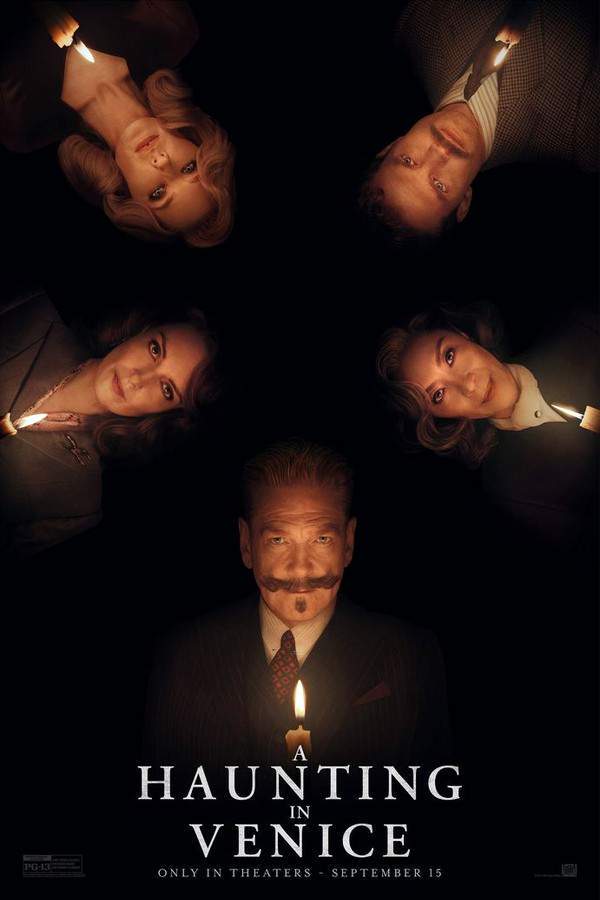
A Haunting in Venice (2023) movie poster

Plot Summary

A Haunting in Venice (2023) Plot Summary & Ending Explained

Release, runtime and language
2023 · 1 h 43 m · English
Echo score 75
Loading streaming availability…
Directed by
Kenneth Branagh
Starring
Michelle Yeoh, Tina Fey, Riccardo Scamarcio, Amir El-Masry, Kelly Reilly, Jamie Dornan
Budget
$60M

A renowned, retired Hercule Poirot is reluctantly pulled back into the world of crime when a sinister murder occurs during a bizarre seance in Venice. Held within a decaying palazzo cloaked in fog, Poirot must navigate a complex investigation filled with deceit and long-held secrets. As he explores the unsettling events, he is forced to face his own inner demons and confront the mysterious forces at play, threatening everyone present.

On this page (6)
  1. 1 Where to watch
  2. 2 What happens: full plot
  3. 3 Plot questions answered
  4. 4 How it ends
  5. 5 Movie threads
  6. 6 Every angle
Loading streaming availability…

Full plot summary · contains spoilers

What Happens in A Haunting in Venice: Full Plot Summary

The whole story of A Haunting in Venice (2023) explained, from the opening scene to the final frame: every key event, every twist and what it all adds up to. Read it as a quick recap before the sequel, to check a scene you missed, or to finally understand what really happened.

In the sultry ambiance of Venice, Italy, in 1947, we find the restless Hercule Poirot (Kenneth Branagh) grappling with the haunting shadows of his past. After retiring from his life as a detective, Poirot resides in this mesmerizing City of Water, yet the persistent whispers of unresolved mysteries and pleas for assistance taunt him, preventing him from finding any semblance of peace. At his side is Vitale Portfoglio (Riccardo Scamarcio), a former police officer turned loyal bodyguard, who fervently shields Poirot from the unrelenting calls for help.

One fortuitous evening, Ariadne Oliver (Tina Fey), an old friend and established author, arrives at Poirot's doorstep, her spirit dampened by the lackluster reception of her recent literary works. In a bid to uplift both their spirits, she extends an invitation to a Halloween soiree at the luxurious palazzo of Rowena Drake (Kelly Reilly), an ex-opera singer. The highlight of the evening promises to be a séance conducted by the enigmatic Joyce Reynolds (Michelle Yeoh), known in the press as "The Unholy Mrs. Reynolds."

Navigating through the winding canals, Poirot and Vitale join Ariadne and soon arrive at the palazzo, where children are mesmerized by eerie stories of the building’s tormented history. According to local legend, the palazzo was once an orphanage haunted by the tragic echoes of the Plague, birthing a curse known as the Children's Vendetta. Any person marked within this realm is said to be pursued by the vengeful spirits of children wronged in life. Among the guests is a young boy named Leopold (Jude Hill), who remains absorbed in the works of Edgar Allan Poe, favoring solitude over the raucous gathering. Meanwhile, the air is thick with sorrow as Rowena mourns the recent death of her daughter, Alicia (Rowan Robinson), leaving her struggling with profound grief.

In this chaotic ambiance, Olga Seminoff (Camille Cottin), the housemaid, senses Leopold's unease as he longs for his father, Dr. Leslie Ferrier (Jamie Dornan), who remains consumed by the loss of Alicia. The evening further escalates with the arrival of Joyce Reynolds and her assistant, Desdemona Holland (Emma Laird), who introduce an air of mystique. However, the situation intensifies when Maxime Gerard ([Kyle Allen]) unexpectedly surfaces, claiming to have been summoned by another, igniting tension among the grieving family members.

As they delve into the séance, Joyce takes center stage, her eerie presence creating a sense of dread among the attendees. Olga reveals to Poirot that Alicia experienced eerie visions before her demise, and as Joyce appears to channel Alicia's spirit, Poirot’s keen observation soon unveils a hidden accomplice, Nicholas ([Ali Khan]), secretly manipulating events from a concealed chimney. The atmosphere grows increasingly unsettling as Joyce displays bizarre behavior, reminiscent of Alicia's torment.

Despite the disquiet, Poirot attempts to exit but is held back by Ariadne, prompting a deep conversation with Joyce, who reveals her fear of being a mere pretender. She encourages the detective to lighten his emotional burden, as if she can sense the weight of his own tragic past.

As the night darkens, a sudden attack leaves Poirot stunned and gasping for air, only to be revived by Vitale. Just then, a blood-curdling scream disrupts the gathering as Joyce's lifeless body is discovered, grotesquely impaled. With a tempest roaring outside and the floodwaters rising, the guests find themselves trapped within the palazzo's walls, stoked by a rising tide of panic and paranoia regarding the malevolent force that may have taken Joyce's life. Poirot, an astute detective, locks all exits, igniting his investigative instincts as he teams up with Ariadne to sift through narratives and unveil the truth.

Their inquiry leads them to rediscover a lost stuffed rabbit, once beloved by Alicia, which ignites Poirot's curiosity and methodical approach. Moments of insight come to him while reflecting in the restroom, where he believes he sees Alicia's ghost in the mirror's surface. In a series of interviews, he gauges the motives and hidden pasts of Nicholas and Desdemona, revealing their history as Romani refugees and the undercurrents of petty theft that may connect them to their recent misfortune.

Suddenly, a phone call adds to the unease, bringing forth a harrowing silence before Poirot glimpses the figure of one of the ghostly children. As Ariadne's timely appearance distracts him, the haunting sounds of a child’s song echo through the palazzo, leading Poirot to believe that the source lies in the basement—only to be dismissed by Rowena. Driven by curiosity, the group descends, uncovering a hidden chamber marked by the cryptic word "dottore," a direct connection to the painful history of the Children's Vendetta.

Amidst the simmering tensions, Dr. Ferrier's anxiety culminates in a tumultuous confrontation with Maxime, quelled only by Leopold's intervention. As events unfold quickly, Poirot observes details about the fragile relationships between the guests while investigating Maxime's claim about the life-altering bond he shared with Alicia, one crafted amid love and maternal disapproval.

Tracking down clues tied to Maxime, Poirot deciphers a message tied to an apple, escalating his curiosity further. Just as Ariadne arrives bearing an apple—potentially crucial to the case—truths unfold revealing the intricacies of the group’s interconnections. The implications of betrayal intertwine as Poirot confronts the evident conspiracies woven into their narratives.

However, chaos ensues as Ferrier's body is later discovered, a cruel twist of fate bereft of hope for both him and Leopold. With the storm’s rage echoing outside, Olga shares revelations about Rowena's consistent devotion to Alicia, tinged with anxiety over the whispers from beyond that plagued the household—an omen of treachery.

As Poirot examines memories, he stumbles upon poignant images of a young Alicia, stirring echoes of familiarity while uncovering a flower hidden within a cherished photograph. An accidental act by a parrot draws his attention to the remaining fragment of mystery, and the detective’s mind races, connecting the dots into a coherent narrative.

Ultimately, Poirot exposes the shocking reality: Rowena herself is behind the gruesome acts. Her elaborate scheme, masked by her grief, aligns to create illusions of guilt, driven by jealousy and the need to control.

As Poirot's confrontation reveals the dark depths of revenge and manipulation—Rowena, consumed by her own motives, resorts to a desperate escape. The tragic allure of the water beckons her, drawing a chilling parallel to Alicia's earlier death and leaving her fate sealed in a watery grave.

In the aftermath of anguish and revelation, Poirot and Ariadne share a bittersweet farewell before he sets off on a new, perhaps unending, investigation, encountering a sorrowful stranger whose tale demands his extraordinary acumen to unravel yet another myriad of deceit and tragedy.
Last updated: November 22, 2024 at 19:17

Was this helpful?

Plot questions answered

A Haunting in Venice Plot Explained: Your Questions Answered

The questions people ask most about A Haunting in Venice (2023): what happens in the confusing scenes, why the characters do what they do, the twists, hidden details and what the ending means. Each answer contains spoilers.

Q1

Why did Rowena kill Joyce Reynolds during the seance?

Rowena orchestrated Joyce's murder to create the illusion of a supernatural curse, specifically the "Children's Vendetta" that she claims has plagued the palazzo. By making Joyce's death appear as a paranormal killing, Rowena could eliminate someone she had reason to hate while simultaneously reinforcing the ghostly narrative surrounding her daughter Alicia's death. Joyce was killed with a blade hidden in the room, and the setup was designed to make it seem like vengeful spirits had struck.

Foreshadowing: Earlier in the evening, children tell stories about the palazzo's haunted history and the Children's Vendetta curse, which Rowena uses as cover for her crimes.

  • rowena drake
  • joyce reynolds
  • murder
  • seance
  • children's vendetta
Q2

Why did Rowena kill Dr. Leslie Ferrier?

Dr. Ferrier was killed because he was secretly Alicia's husband and the father of her child Leopold. Rowena, obsessed with preserving her daughter's memory and potentially resentful of the life Alicia built away from her, viewed Dr. Ferrier's existence as a betrayal. His continued presence, especially with Leopold, represented everything Rowena resented about Alicia's life after leaving her mother.

Foreshadowing: Olga mentions that Alicia experienced eerie visions before her death, hinting at the troubled household dynamics.

  • dr ferrier
  • leslie ferrier
  • rowena
  • alicia
  • leopold
  • murder
Q3

How did Rowena fake the supernatural events during the seance?

Rowena used multiple methods to create the illusion of paranormal activity. During the seance, Nicholas (a young boy working with Rowena) was hidden in a chimney, manipulating props and creating sounds while Joyce pretended to channel Alicia's spirit. The ghostly child Poirot sees is later revealed to be a mechanical trick, and the eerie child song heard throughout the palazzo was orchestrated to reinforce the supernatural narrative.

Foreshadowing: Poirot notices Joyce displaying bizarre behavior during the seance that seems connected to Alicia's torment, which he later realizes was an act.

  • seance
  • fake haunting
  • nicholas
  • rowena
  • supernatural
  • illusion
Q4

What was Maxime Gerard's relationship to Alicia?

Maxime Gerard claimed to have had a significant romantic relationship with Alicia, describing a bond forged in secret amid her mother's disapproval. This revelation creates tension during the investigation, as multiple men (including Dr. Ferrier) seem connected to Alicia, making the web of relationships increasingly complex.

Foreshadowing: Maxime's unexpected arrival at the party, claiming to have been summoned by another, hints at his mysterious connection to the family.

  • maxime gerard
  • alicia
  • relationship
  • romance
  • rowena
Q5

What was the significance of the lost stuffed rabbit?

The stuffed rabbit was Alicia's beloved childhood toy that Rowena kept after her daughter's death. Poirot discovers this lost rabbit during his investigation, which serves as an emotional anchor connecting him to Alicia's past. The rabbit represents both Alicia's childhood and Rowena's inability to let go of her daughter, which becomes crucial to understanding Rowena's psychological state.

Foreshadowing: Olga reveals that Alicia experienced eerie visions before her demise, showing her connection to the supernatural elements Rowena would later exploit.

  • stuffed rabbit
  • alicia
  • rowena
  • childhood
  • emotional significance
Q6

What caused Alicia's original death?

While the exact details of Alicia's death are kept somewhat ambiguous, it is established that she died recently before the events of the film. The circumstances around her death remain unclear, though Rowena uses the grief over this loss as justification for her murderous scheme. The film implies Alicia may have taken her own life or died under mysterious circumstances that Rowena could not accept.

Foreshadowing: Rowena's profound grief and the whispered messages from beyond that plagued the household suggest Alicia's death was traumatic and unresolved.

  • alicia
  • death
  • rowena
  • mysterious death
  • suicide
Q7

How did Poirot deduce that Rowena was the killer?

Poirot pieces together the truth through several key observations: he notices the apple message tied to clues about Maxime, sees Alicia's ghost in the mirror which is revealed as a projection, uncovers the hidden basement marked with "dottore" connected to the Children's Vendetta, and realizes the crimes benefit only Rowena. Most critically, he understands that Rowena's grief has twisted into a desire for revenge against those she blames for her daughter's death, and her consistent presence throughout the evening matches the opportunity needed to commit the murders.

Foreshadowing: Poirot's conversation with Joyce, who reveals her fear of being a pretender, mirrors Rowena's own deception and hints at the theme of false appearances.

  • poirot
  • rowena
  • killer
  • deduction
  • evidence
  • investigation
Q8

Why did Rowena escape to the water at the end?

Rowena fled to the rising floodwaters as a desperate attempt to escape Poirot's confrontation and inevitable arrest. The water carries symbolic significance, drawing a parallel to how Alicia may have died, suggesting Rowena chose a watery grave over facing justice. Her tragic fate underscores the film's theme of grief consuming those who cannot let go.

Foreshadowing: Throughout the film, the storm and rising floodwaters create a sense of mounting danger, paralleling Rowena's desperation as her plan unravels.

  • rowena
  • water
  • escape
  • death
  • flood
  • drowning
Q9

Why did Poirot see Alicia's ghost in the mirror?

Poirot's vision of Alicia's ghost was a projection device created by Rowena to enhance the supernatural atmosphere and reinforce the ghostly narrative. This elaborate trick was designed to frighten guests and support the story of the Children's Vendetta curse. Poirot initially believed he was seeing a real spirit, but later realizes it was another layer of Rowena's deception.

Foreshadowing: The eerie atmosphere and stories about the haunted palazzo establish early that supernatural elements may be part of the illusion.

  • alicia ghost
  • mirror
  • projection
  • rowena
  • illusion
  • haunting
Q10

What was the Children's Vendetta curse?

The Children's Vendetta is a local legend about a curse connected to the palazzo's past as an orphanage during the Plague. According to legend, wronged children became vengeful spirits that pursue anyone marked within this realm. Rowena exploited this legend to create a cover for her murders, making the deaths appear as supernatural vengeance rather than human crimes.

Foreshadowing: Children at the party share unsettling stories about the building's haunted history, establishing the legend early in the evening.

  • children's vendetta
  • curse
  • orphanage
  • plague
  • legend
  • supernatural

Ending explained

What Happens at the End of A Haunting in Venice?

How A Haunting in Venice (2023) ends, in short: the final scene, the last twist and what it means for the characters. The full ending explained, with every spoiler, lives on its own page.

Read the full ending explained

Hercule Poirot, after retiring in Venice, is pulled into a mysterious case when a séance performed at the house of Rowena Drake, a former opera singer, reveals a hidden past full of tragedy. The séance seems supernatural, with Reynolds, the psychic, typing answers as if guided by spirits, but Poirot quickly exposes her tricks—she and her assistants had faked the paranormal activity. As Poirot investigates, he uncovers that Rowena’s daughter Alicia died a year earlier, pushed from the balcony by her mother to hide the truth. Alicia’s death was the result of a tragic scheme involving a hallucinogenic honey formula designed by Rowena to suppress her daughter’s romantic feelings for a man she disapproved of. When Alicia’s death was discovered, Rowena faked the ghostly marks to cover it up and threw her daughter’s body from the balcony to make it seem as if she was haunted by spirits.

Throughout the film, Poirot also uncovers Rowena’s series of murders—she had killed her psychic and her family doctor, Dr. Leslie Ferrier, to keep her secret safe. Rowena’s fear of being exposed and her desperation to cover her crimes drove her to commit these murders, further revealing her need for control and her guilt. Her final act takes her to the mansion’s tower, where she admits to killing her daughter and, in a moment of hysteria, is pushed off the balcony by the ghost of Alicia—seen by some as a supernatural retribution or a hallucination caused by her own hallucinogenic poison. In truth, Poirot concludes that Rowena’s death was most likely a suicide driven by guilt, although some might interpret the supernatural presence as real due to the haunting atmosphere of the house. The story ends with Poirot returning to his home, now open for more cases, signaling his renewed readiness to re-engage with detective work, and the haunted house standing quietly in the aftermath of the female’s destructive secrets.

A Haunting in Venice ending explained in full

Movie threads

More Movies Like A Haunting in Venice, by Mood & Story

Curated lists built around what makes A Haunting in Venice tick: the same mood, the same kind of story or the same emotional payoff. Each list explains why these movies belong together.

Gothic Claustrophobic Mysteries like A Haunting in Venice

Sinister secrets unravel within decaying, atmospheric mansions and isolated estates. If you liked the oppressive atmosphere of A Haunting in Venice, you'll enjoy these movies. This section features films with similar settings—decaying mansions, isolated estates, and trapped environments—where the location is central to a tense, atmospheric mystery, perfect for fans of dark tales and gothic horror.

  • claustrophobic
  • gothic
  • sinister
  • atmospheric
  • oppressive
  • suspenseful
  • Tone: tense, sinister, melancholic
  • Pacing: steady, investigative
Why these movies?

The story pattern: These stories typically involve a central investigator or protagonist forced to confront a mystery within a confined, atmospheric location. The narrative unfolds as they interview a cast of suspicious characters, each with hidden motives tied to the setting's dark past. The plot is driven by peeling back layer upon layer of deception and long-buried secrets, often culminating in a revelation that is as tragic as it is illuminating.

Why they belong together: Movies are grouped here for their shared emphasis on a powerfully atmospheric and confined setting that generates a sense of claustrophobia and dread. They blend mystery with gothic or horror elements, featuring a steady, investigative pace that builds tension towards a complex, often emotionally heavy, conclusion.

Psychologically Heavy Detective Stories like A Haunting in Venice

Where solving the case forces the investigator to confront their own haunted past. For viewers who enjoyed the emotional depth of A Haunting in Venice, this section features detective films where the mystery is deeply personal. These movies focus on sleuths confronting their own demons while solving a complex crime, leading to heavy, bittersweet endings that resonate long after the case is closed.

  • melancholic
  • anxious
  • heavy
  • psychological
  • suspenseful
  • unsettling
  • Tone: tense, heavy, bittersweet
  • Pacing: steady, methodical
Why these movies?

The story pattern: The narrative pattern follows a seasoned but troubled investigator who is drawn into a case that reflects or challenges their own inner turmoil. The process of uncovering the truth becomes a catalyst for their own introspection and emotional reckoning. The resolution of the mystery often provides clarity but little comfort, leaving the protagonist—and the audience—with a sense of poignant, hard-won resolution.

Why they belong together: These films are grouped by their focus on the detective's psychological arc as being equally important to the plot. They share a heavy emotional weight, a complex mystery, and a tone that balances intellectual puzzle-solving with deep, often melancholic, character study, resulting in a powerful and draining viewing experience.

Every angle

A Haunting in Venice (2023) Explained: Plot, Ending, Timeline & Characters

Everything about A Haunting in Venice in one place: what happens in the plot summary, the timeline in chronological order, the characters and meaning, the ending explained and a spoiler-free summary. What's After the Movie adds the cast, box office and post-credit scenes.

Coming soon on iOS and Android

The Plot Explained Movie Summary App

Plot summaries, endings explained and timelines on your phone. Catch up on any movie in minutes, save your favorites and never miss a twist again.

Be the first to know when we launch. Your email stays private, always.

Learn more about the app