














Plot Explained Spoilers guaranteed!
Plot Explained

Browse by genre

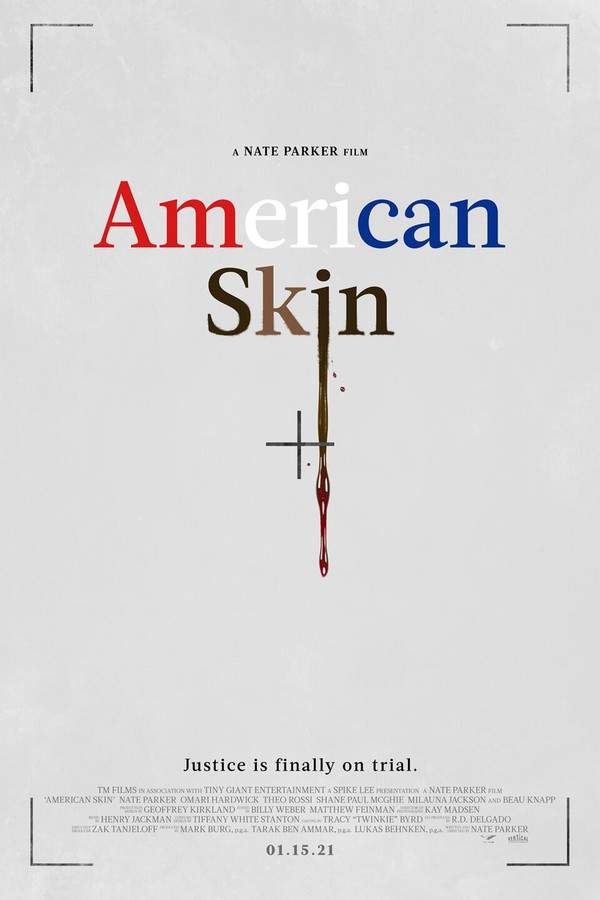
American Skin (2021) movie poster

Plot Summary

American Skin (2021) Plot Summary Explained

Release, runtime and language
2021 · English
Echo score 58
JustWatch #19,647 5
Starring
Milauna Jemai, Omari Hardwick, Theo Rossi, Beau Knapp, Nate Parker, Dominic Bogart

After his teenage son is fatally injured during a traffic stop involving police, a father embarks on a desperate search for justice and understanding. Consumed by grief and a desire for accountability, he confronts the complexities of the legal system and the difficult questions surrounding police brutality, ultimately seeking to uncover the truth behind the tragic event.

On this page (6)
  1. 1 Where to watch
  2. 2 What happens: full plot
  3. 3 Plot questions answered
  4. 4 Movie threads
  5. 5 Movies like American Skin
  6. 6 Every angle

Where to watch

Where to Watch American Skin (2021)

Where can you watch American Skin? Stream, rent or buy it in the US, including on ALLBLK Amazon channel , Amazon Prime Video and Philo: current JustWatch availability with up-to-date prices.

Streaming availability powered by JustWatch

Full plot summary · contains spoilers

What Happens in American Skin: Full Plot Summary

The whole story of American Skin (2021) explained, from the opening scene to the final frame: every key event, every twist and what it all adds up to. Read it as a quick recap before the sequel, to check a scene you missed, or to finally understand what really happened.

Lincoln Jefferson, portrayed by Nate Parker, is a recently divorced U.S. Marine and an Iraq War veteran trying to secure a better future for his son, Kajani Jefferson (Tony Espinosa). To ensure Kajani avoids the struggles faced by many other black students, Lincoln takes a job as a janitor at a predominantly white private school. However, their lives take a tragic turn one fateful night when they are stopped by the police while returning from a friend's house in an upscale neighborhood. During this harrowing encounter, Kajani is shot and killed by officer Mike Randall, a moment that is captured on body and dashcams.

Fast forward a year, Lincoln is approached by a documentary crew led by student filmmaker Jordin King, just as the Grand Jury's decision regarding officer Randall is set to be broadcast. When Randall is deemed not guilty and no trial is initiated, unrest ignites throughout the city. A police captain desperately seeks out Kajani's mother, Tayana, played by Milauna Jemai, urging her to publicly call for calm in the aftermath of the injustice.

Motivated by Tayana's televised statement, Lincoln decides to take a stand. He takes the police captain hostage and enters the precinct with the film crew in tow. Although initially horrified, the crew sees an opportunity to capture a true documentary. With the help of fellow veterans, Lincoln swiftly gains control of the police station, taking both officers and civilians hostage. He demands a trial for Kajani—something that was so unjustly denied before.

In an improvised mock trial, jurors are assembled from both prisoners and civilians, allowing open discussions about race relations and the tensions that exist within society. During the trial, officer Randall ultimately admits to racial bias, revealing the fear that led to the tragic event. He confesses that his actions stemmed from a place of fear and that he had been trained to respond violently in similar situations. After a brief deliberation, the jury finds Randall guilty, and Lincoln decides to administer his own form of justice.

In a shocking turn of events, Lincoln, with Randall on the phone to say goodbye to his family, prepares to execute him. However, it is then revealed that Lincoln's gun is empty, sparing Randall's life. A moment of connection occurs between the two men before tragedy strikes again; Lincoln is shot by a sniper as he exits the police station. The film concludes with various perspectives unfolding, speculating on the motivations behind Lincoln's dramatic actions, leaving audiences to ponder the complexities of justice, race, and fatherhood.

Last updated: October 25, 2024 at 12:36

Was this helpful?

Plot questions answered

American Skin Plot Explained: Your Questions Answered

The questions people ask most about American Skin (2021): what happens in the confusing scenes, why the characters do what they do, the twists, hidden details and what the ending means. Each answer contains spoilers.

Q1

Why does Lincoln take a job as a janitor at a private school?

Lincoln takes the janitorial job at a predominantly white private school to provide his son Kajani with better educational opportunities. As a divorced Marine veteran, he wants to ensure Kajani avoids the struggles faced by many Black students in public schools and has a chance at a better future.

  • Lincoln Jefferson
  • janitor job
  • Kajani
  • private school
  • opportunity
Q2

Why does Officer Randall shoot Kajani during the traffic stop?

Officer Randall shoots Kajani due to racial bias and fear. During the mock trial, Randall admits that his actions stemmed from fear and that he had been trained to respond violently in similar situations. He confesses that racial bias led him to perceive Kajani as a threat, resulting in the fatal shooting.

Foreshadowing: The traffic stop occurs in an upscale neighborhood where Lincoln and Kajani are visibly out of place, establishing the racial tension that fuels Randall's fear.

  • Officer Mike Randall
  • Kajani shooting
  • racial bias
  • traffic stop
  • fear
Q3

Why is Officer Randall found not guilty by the Grand Jury?

The Grand Jury declares Randall not guilty, deciding there is insufficient evidence to indict him. This controversial decision sparks widespread unrest in the city, highlighting the difficulties of holding police officers accountable for shootings during traffic stops, especially when body camera footage is contested or interpreted differently.

  • Grand Jury
  • not guilty
  • police accountability
  • verdict
Q4

Why does Lincoln take the police captain hostage and storm the precinct?

Lincoln decides to take action after the Grand Jury's not guilty verdict denies him any form of legal justice for his son's death. Motivated by Tayana's televised call for calm, he chooses to seize control of the police station with the help of fellow veterans, demanding a trial for Kajani that was unjustly denied.

Foreshadowing: The documentary crew's arrival just before the verdict creates the opportunity for Lincoln to stage his confrontation with both media documentation and military precision.

  • Lincoln Jefferson
  • hostage
  • police precinct
  • justice
  • protest
Q5

What is the purpose of the mock trial that Lincoln organizes?

Lincoln organizes an improvised mock trial inside the police station to create a platform for discussing race relations and the tensions within society. By assembling jurors from both prisoners and civilians, he forces an open dialogue about racial inequality and holds Officer Randall accountable in a way the legal system failed to do.

  • mock trial
  • race relations
  • discussion
  • jury
  • accountability
Q6

Why does Officer Randall confess to racial bias during the trial?

During the mock trial, Randall admits to experiencing racial bias and reveals the fear that led to his actions. He confesses that he had been trained to respond violently in similar situations, and his fear of a Black teenager in an upscale neighborhood caused him to shoot Kajani.

  • Randall confession
  • racial bias
  • fear
  • training
  • admission
Q7

Why is Lincoln's gun empty when he prepares to execute Randall?

When Lincoln prepares to execute Randall after the guilty verdict, it is revealed that his gun is empty, sparing Randall's life. This twist suggests Lincoln may have wanted Randall to face the consequences of his confession publicly rather than acting as an executioner, or that he couldn't go through with murder despite his thirst for revenge.

Foreshadowing: Lincoln's decision to let Randall call his family before the execution shows hesitation and humanizes both men, foreshadowing the mercy shown through the empty gun.

  • empty gun
  • execution
  • mercy
  • Lincoln decision
  • twist
Q8

What happens to Lincoln at the end of the movie?

After sparing Randall's life with the empty gun, Lincoln exits the police station and is shot by a sniper. His tragic death leaves the question of justice unresolved, suggesting the cycle of violence continues despite the mock trial's catharsis.

  • Lincoln death
  • sniper
  • ending
  • justice
  • tragedy
Q9

Why is the documentary crew present during Lincoln's takeover?

The documentary crew, led by student filmmaker Jordin King, approaches Lincoln just before the Grand Jury decision is announced. They document his entire hostage situation, initially horrified but then seeing an opportunity to capture a true documentary. Their presence provides both a narrative frame for the film and raises questions about media exploitation of tragedy.

  • documentary crew
  • Jordin King
  • media
  • filming
  • storytelling
Q10

Why does the police captain reach out to Tayana after the verdict?

After the Grand Jury's not guilty verdict sparks unrest, the police captain contacts Kajani's mother Tayana, urging her to publicly call for calm. This reveals the city's desperation to prevent further violence and highlights how authorities rely on victims' families to de-escalate situations they themselves created.

  • Tayana
  • police captain
  • calm
  • community
  • plea
Q11

What happens to Officer Randall after the mock trial finds him guilty?

After the jury finds Randall guilty in the improvised trial, Lincoln prepares to execute him as personal justice. However, Lincoln's gun is empty, Randall speaks to his family on the phone, and Lincoln is subsequently shot by a sniper while exiting the precinct, leaving Randall's ultimate fate ambiguous.

  • guilty verdict
  • Randall fate
  • execution
  • sniper
  • aftermath

Movie threads

More Movies Like American Skin, by Mood & Story

Curated lists built around what makes American Skin tick: the same mood, the same kind of story or the same emotional payoff. Each list explains why these movies belong together.

Vigilante Justice Movies Driven by Grief Like American Skin

Pushed to the edge by tragedy, ordinary people take the law into their own hands. If you were gripped by the father's desperate quest in American Skin, explore these movies where a tragic loss ignites a vigilante pursuit of justice. These films share a heavy emotional weight, tense confrontations, and a focus on the moral ambiguity of taking the law into one's own hands.

  • grieving
  • urgent
  • confrontational
  • somber
  • desperate
  • morally complex
  • Tone: tense, grim, confrontational
  • Pacing: steady, methodical build
Why these movies?

The story pattern: These narratives typically begin with a devastating, inciting tragedy that the established system fails to properly address. The protagonist, driven by grief and a sense of powerlessness, transitions from victim to vigilante, often employing extreme measures that put them and others in danger. The journey is as much about confronting external antagonists as it is about the protagonist's internal moral collapse and search for catharsis.

Why they belong together: Movies in this thread are united by a core narrative engine: a personal catastrophe that justifies, in the protagonist's eyes, extralegal action. They share a heavy, somber mood, high emotional stakes, and a tense, confrontational tone that forces viewers to grapple with difficult questions about justice, revenge, and systemic failure.

Claustrophobic Social Thrillers Similar to American Skin

High-stakes confrontations in confined spaces that dissect urgent social issues. For viewers who appreciated the tense, single-location tension and social commentary of American Skin, this list features movies that trap characters together to force a confrontation with difficult truths. These films are defined by their steady pacing, high tension, and focus on topical societal conflicts.

  • tense
  • claustrophobic
  • anxious
  • thought-provoking
  • urgent
  • confrontational
  • Tone: tense, anxious, thought-provoking
  • Pacing: steady, methodical
Why these movies?

The story pattern: The narrative pattern often involves characters from opposing sides of a social conflict being forced into a single location—a room, a building, a hostage situation—where they must directly confront their differences. The plot unfolds through intense dialogue, revelations, and power struggles, using the confined space to metaphorically represent a larger, inescapable societal problem. The resolution is often bittersweet or bleak, underscoring the complexity of the issues at hand.

Why they belong together: These films are grouped by their shared use of tension and spatial confinement to explore weighty social themes. They prioritize a steady, anxious pacing and a dominant tense tone to create a consistently gripping atmosphere that is both intellectually stimulating and emotionally draining.

If you liked this

Movies Like American Skin

Similar movies to American Skin: the same genre, themes or kind of story. Each one comes with its own plot summary, timeline and ending explained.

Browse all movie summaries

Every angle

American Skin (2021) Explained: Plot, Timeline & Characters

Everything about American Skin in one place: what happens in the plot summary, the timeline in chronological order, the characters and meaning and a spoiler-free summary. What's After the Movie adds the cast, box office and post-credit scenes.

Coming soon on iOS and Android

The Plot Explained Movie Summary App

Plot summaries, endings explained and timelines on your phone. Catch up on any movie in minutes, save your favorites and never miss a twist again.

Be the first to know when we launch. Your email stays private, always.

Learn more about the app