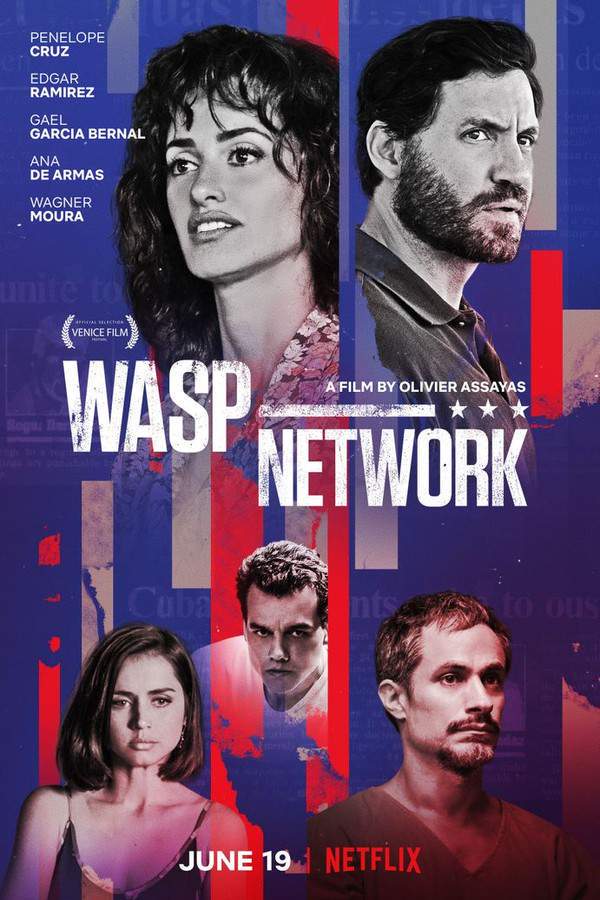
In Havana in the early 1990s, the pilot René González, Edgar Ramírez, leaves his wife Olga, Penélope Cruz, and their daughter Irma, Carolina Peraza Matamoros, behind as he secretly flies to the United States on a stolen Antonov An-2. The move sets off a chain of dangerous choices that pull him into a murky world where personal loyalties collide with political intrigue. René soon slips into the orbit of a group of Cuban exiles and anti-Castro activists operating from Florida, a coalition that seems to promise freedom but often blurs the line between justice and violence. Amid the shifting allegiances, he encounters the shadow network known as la Red Avispa, or the “Wasp Network,” a clandestine operation that becomes central to the film’s tense moral questions. The role of this hidden organization is brought to life on screen through Gael García Bernal, who embodies Manuel Viramontez, the man credited with steering the network’s activities as it tries to undermine the Cuban government from abroad.
Within this web of missions and counter-missions, the film also traces the political and real-world forces shaping the 1990s. The Cuban American National Foundation (CANF) and Brothers to the Rescue push propaganda campaigns that aim to sway public opinion and pressure Havana from outside, while the operatives on the ground engage in more dangerous work, including the smuggling of drugs and weapons and, at times, terror-style activities back in Cuba. The plot underscores the increasingly blurred line between anti-regime resistance and violent action, a tension that becomes most palpable in the film’s depiction of the infamous operations attributed to the would-be bombers led by Luis Posada Carriles, brought to life on screen by Tony Plana. The narrative is framed by the presence of larger-than-life figures whose authority the characters wrestle with, including the controversial stance of Fidel Castro, whose perspective the movie presents through archive footage of the Cuban leader, Fidel Castro.
As the story unfolds, political crosscurrents intensify. The exiles’ world collides with U.S. security concerns as the FBI and other authorities record the escalating risk. One pivotal thread follows Juan Pablo Roque’s defection—an event that propels the network toward new levels of risk and complexity. Amid the upheaval, the film keeps the human stakes front and center: Olga and their daughter Irma must navigate fear and secrecy while trying to hold their family together in the face of global forces far beyond their control. Olga is played by Penélope Cruz, who embodies a woman torn between protecting her loved ones and confronting the truth about her husband’s dangerous double life. The family’s ultimate reassembly—Olga and Irma joining René in Miami—highlights the personal costs at the heart of the larger geopolitical drama.
The film does not shy away from the darker consequences of covert operations. In 1997, a plot involving a recruited operative—plausibly connected to the anti-Castroist circle—aims to strike in Havana, a sequence that underscores how fragile peace can be when political aims override human security. The consequences of these actions ripple outward, touching tourists, locals, and the families connected to everyone involved. When the truth finally comes to light, René González, Manuel Viramontez, and the broader Wasp Network find themselves ensnared by federal authorities, facing charges that include conspiracy to commit espionage and conspiracy to commit murder, all of which are laid out in the federal court proceedings. The courtroom and its aftermath form a crucial counterweight to the thrill of the operatives’ clandestine life, revealing the costs of living inside a world where loyalty and betrayal wear the same face.
Throughout this chronicle, the film alternates between intimate, character-driven moments and panoramic depictions of political machinations. The emotional core rests on the bonds between René, Olga, and Irma, and on the tension between personal allegiance and collective ideology. As the story moves toward its denouement, the characters confront the consequences of their choices, and the audience is left to weigh the ethics of espionage against the human desire for safety and belonging. The director crafts a nuanced portrait of a period marked by Cold War remnants, shifting alliances, and the fragile nature of truth in a world where information is power and loyalty is constantly renegotiated.
In the end, the film preserves a careful balance between factual history and cinematic interpretation. It presents a compelling meditation on the costs of clandestine warfare, the complexities of exile and homeland, and the often-painful truth that personal sacrifice can be both heroic and tragic. The closing moments offer a somber reminder that the line between defender and traitor can blur under pressure, and that stories of espionage are as much about the people who live them as they are about the geopolitical currents that set them in motion.