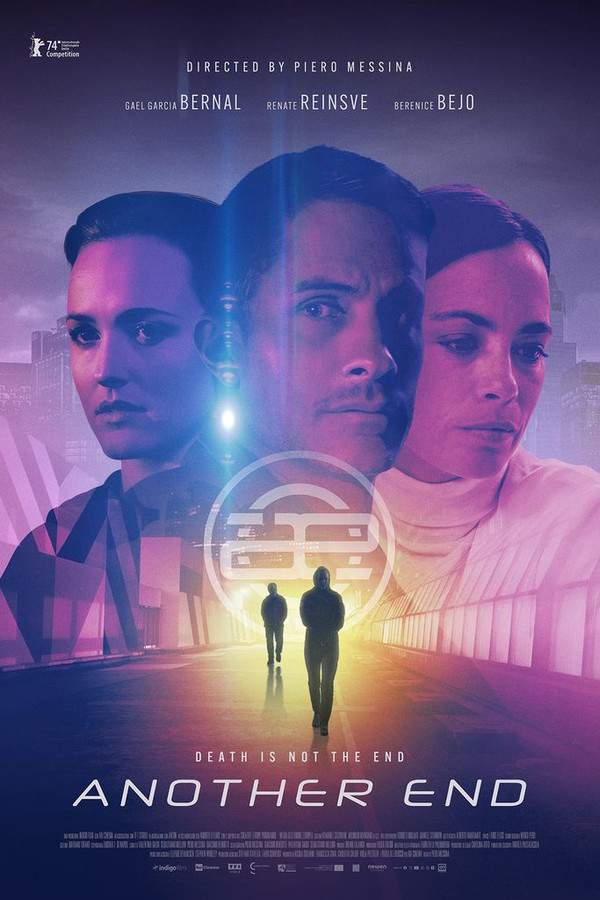
After Sal loses Zoe, the love of his life, in a car crash, he sinks into a deep, unrelenting depression. His sister Ebe, who watches over him with growing concern, dreams of a way to help him reclaim some sense of connection to the world he’s lost. She works at Aeternum, a company that has unveiled a provocative new technology called “Another End” — a program that lets grieving relatives say goodbye in a uniquely intimate way. In this process, the memories and consciousness of the deceased are stored in a vast database and then fed into a suitable host. The bereaved can interact with their loved one while they inhabit someone else’s body, in one or more sessions, in the hopes that this will provide them with a final, meaningful encounter. The company’s motto frames this as offering an “another end” to their sorrow, a chance to close the chapter on grief from a new, if unsettling, angle.
The host’s brain absorbs the memories of the deceased every time they fall asleep. The memories fade over time, and the process cannot be repeated indefinitely. At first, neither Sal nor Zoe’s parents are eager to try this untested coping method. Sal blames himself for Zoe’s death — he was driving the car — and he even slips toward a reckless, suicidal impulse before his sister can intervene. Ebe finds him in time and stops him, and she also manages to persuade Zoe’s mother, Clara, to consider Zoe’s resuscitation. Sal hesitates, wary that a reunion might not feel like a real connection if Zoe no longer resembles the person he lost. A therapist and a colleague of Ebe’s lay out the process more clearly, slowly convincing him to give it a chance. Yet his skepticism lingers as he contemplates what it would mean to love a version of Zoe that wears another body.
When the moment comes, Sal’s doubts begin to crack. Following the therapist’s guidance, he begins to interact with the host and soon recognizes Zoe in the form of Ava, the host’s new body. The moment is electric and disorienting: Sal finds himself arguing with Ava while sensing Zoe’s memories flicker through, and in that clash of identities he starts to feel something he believes he has lost forever. This unexpected recognition rekindles a spark, and Sal falls in love with the person he’s temporarily inhabiting, even as he wrestles with the ethical and emotional boundaries of the experiment. He pleads with Ebe to extend the program, seeking more time with Zoe-Ava, a move that puts her professional job and the company’s rules at risk.
Sal’s growing attachment pushes him toward a dangerous line: he can’t bear the thought of Zoe’s presence slipping away again once the host session ends. He undertakes covert visits to Ava’s life, traveling to her workplace, which is a strip club, and meeting her repeatedly without disclosing that he is the man behind the host. In these encounters, he learns a painful truth about Ava: she has lost a child and now offers herself as a host as a way to cope with the grind of daily life. The session limit has already been exceeded, and Ava begins to remember only fragments of Zoe’s past, making the connection between the two lives more fragile and bittersweet.
As memories blur and boundaries blur, Ava starts to glimpse who Sal is, and she withdraws, haunted by the revelation. Sal sinks back into depression, wondering if the chance to be with his late partner has vanished again. Ebe finally breaks the news that Ava has reached out and wants to meet Sal, a discovery that lands with major consequences. The company’s management becomes aware of the risks of Ebe’s decision to resuscitate Sal, and she is fired for keeping Zoe and Sal’s history intertwined against policy. Yet the final turn comes when the two lives, the Salvaged body and the Zoe-Ava host, wake up together after spending the night united, and a quiet, hopeful smile breaks across both their faces, suggesting that perhaps a new, fragile bond can endure beyond the limits of the experiment.