Plot Explained Spoilers guaranteed!
Plot Explained

Browse by genre

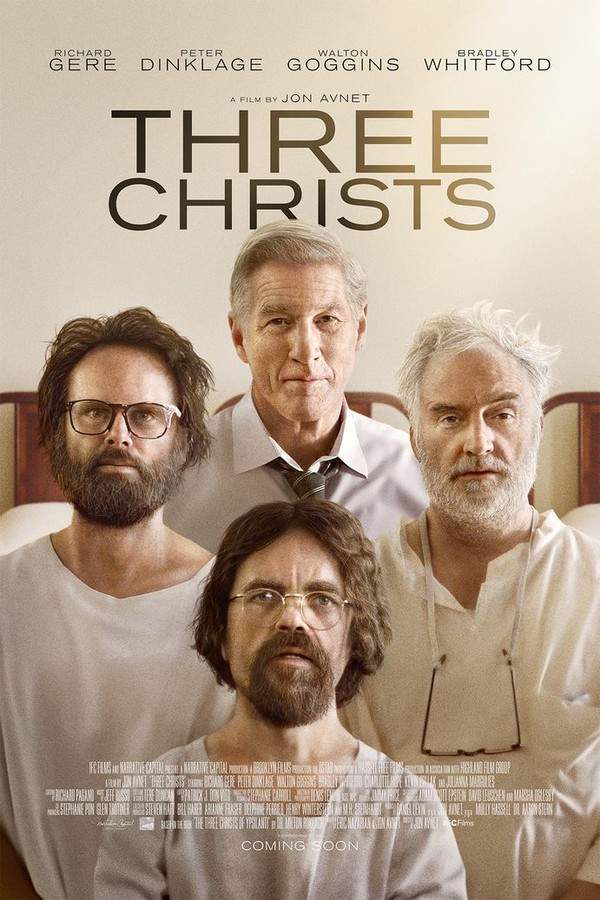
Three Christs (2017) movie poster

Timeline

Three Christs (2017) Timeline Explained – Every Event in Order

Release, runtime and language
2017 · 117 mins · English
Loading streaming availability…
Directed by
Jon Avnet
Starring
Peter Dinklage, Bradley Whitford, James Monroe Iglehart, Walton Goggins, Jane Alexander, Richard Gere

Dr. Alan Stone breaks new ground for treatment of the mentally ill through an experiment on three paranoid schizophrenic patients who believe they are Jesus Christ.

On this page (6)
  1. 1 Where to watch
  2. 2 Events in order (12)
  3. 3 Timeline questions answered
  4. 4 Movie threads
  5. 5 Movies like Three Christs
  6. 6 Every angle
Loading streaming availability…

12 events in order · contains spoilers

Three Christs Timeline: Events in Chronological Order

Every key event of Three Christs (2017) in order, scene by scene, with when and where it takes place. Use it to untangle flashbacks, time jumps and parallel storylines, to refresh your memory before the sequel or to find the exact scene you are thinking of.

  1. Stone leaves NYU to work at Ypsilanti State Mental Asylum

    Dr. Alan Stone leaves NYU in 1954 to work directly with patients at Ypsilanti State Mental Asylum. He focuses on schizophrenic patients and challenges the era's heavy reliance on sedation, insulin shock, and electroshock therapies. This marks the beginning of his controversial, talk-centered approach to treatment.

    When
    1954
    Where
    Ypsilanti State Mental Asylum
  2. Stone meets two Jesus-believing patients

    At Ypsilanti, Stone meets two patients who insist they are Jesus: Joseph Cassell and Clyde Benson. He begins observing their interactions and the dynamics of the ward, recognizing that their beliefs reveal deeper psychological issues. He starts shaping a new format of group talk therapy to study their behavior together.

    When
    circa 1954-1955
    Where
    Ypsilanti State Mental Asylum
  3. Gabor joins the group to form a trio

    Stone adds Leon Gabor, another Christ-believer, to the group, forming a trio for close study. He sees that each man's problems stem from different traumas and temperaments. The exercise exposes how religious delusion can manifest in distinct ways within an asylum setting.

    When
    circa 1954-1955
    Where
    Ypsilanti State Mental Asylum
  4. Stone rejects physical punishment

    Stone discards the era's punitive methods and resists the use of electroshocks as a routine treatment. He relies on conversation, reflective letters, and direct engagement to reach the patients. His humane approach contrasts sharply with colleagues who rely on shocks and sedation.

    When
    mid-1950s
    Where
    Ypsilanti State Mental Asylum
  5. Stone gains professional attention

    Stone's progress earns him a feature on the cover of a professional journal. The exposure triggers envy from Dr. Orbus, the asylum's head, who seeks credit and influence. The rivalry foreshadows conflicts over authority and treatment philosophy.

    When
    mid to late-1950s
    Where
    Ypsilanti State Mental Asylum
  6. Orbus schemes to take control

    Orbus moves to bypass Stone and gets involved by interviewing Cassell alone. It is revealed that Stone wrote the letters to Cassell on Orbus's behalf after Orbus initially declined the task, straining trust. The manipulation signals growing tension between the two clinicians.

    When
    late-1950s
    Where
    Ypsilanti State Mental Asylum
  7. Cassell betrays trust; shocks renewed

    Cassell feels betrayed and begins to slip back into abusive behavior. Orbus orders renewed electric shocks for him, escalating the coercive cycle. Stone rushes to intervene but cannot prevent the procedure, and a confrontation with another doctor ensues, injuring both.

    When
    late-1950s
    Where
    Ypsilanti State Mental Asylum
  8. Stone is expelled from the institution

    After the violent incident, Stone is expelled from the institution, and Orbus regains control over his former patients. The asylum's governance consolidates around Orbus, marginalizing Stone's methods. The episode highlights the institutional resistance to humane reform.

    When
    late-1950s
    Where
    Ypsilanti State Mental Asylum
  9. Cassell dies in the chapel bell tower

    Cassell, feeling powerless and despairing, encounters Orbus in the chapel's bell tower and leaps to his death. The tragedy underscores the human costs of the power struggle and Stone's unfinished mission. Orbus's manipulation and the roar of the system contribute to the fatal outcome.

    When
    late-1950s
    Where
    Ypsilanti State Mental Asylum – chapel bell tower
  10. Hearing verdict: Stone fired but allowed to continue study

    In a formal hearing, Stone accuses Orbus of negligent decisions and interprets Cassell's last words as a critique of Orbus's sins. The hearing ends with Stone being fired, but he is granted permission and funding to continue his studies with the two remaining patients in New York. The outcome preserves his ideas while ending his tenure at Ypsilanti.

    When
    late-1950s
    Where
    Hearing room / court
  11. Orbus remains in name; final scene in New York

    Orbus remains formally in charge but without decision-making powers until retirement. Stone and the remaining two patients in New York press on with the study. The film closes with Stone taking Cassell's seat and playing cards with the two Jesuses, signaling a somber, symbolic end to the experiment.

    When
    late-1950s
    Where
    New York / Ypsilanti (final scenes)
  12. Final reflection on therapy and its costs

    The film notes that Stone's therapeutic approach did not prove effective within the system, though it would have helped him personally. It emphasizes the tension between humane therapy and institutional politics. The closing scenes frame talk therapy as a humane but costly pursuit that lingers beyond the courtroom and the ward.

    When
    post-hearing / final scenes
    Where
    New York / Ypsilanti

Last updated: October 01, 2025 at 13:04

Was this helpful?

Timeline questions answered

Three Christs Timeline Explained: Your Questions Answered

When does it happen, and why in that order? The questions people ask about the chronology of Three Christs (2017): time jumps, flashbacks, cause and effect between scenes and the correct order of events, each answered with spoilers.

Q1

Why does Joseph Cassell commit suicide in the bell tower?

Joseph Cassell commits suicide after feeling betrayed by Dr. Stone and realizing his chances of leaving the asylum are fading. Stone had written letters to Cassell on Dr. Orbus's behalf after Orbus refused to do so, which CasCassell felt was a betrayal of their therapeutic relationship. With Stone expelled and Orbus regaining control, Cassell sees no way out and chooses to end his life in the chapel's bell tower, interpreting his death as a form of enduring suffering similar to Jesus.

Foreshadowing: Earlier scenes show Cassell's deep fear of losing his sanity due to past insulin shock therapy, establishing his desperation about remaining trapped in the institution.

  • joseph cassell suicide
  • bell tower scene
  • cassell death
  • three christs ending
Q2

Why is Dr. Alan Stone expelled from Ypsilanti?

Dr. Alan Stone is expelled after a violent confrontation with another doctor. When Orbus orders renewed electric shock treatments for Cassell despite Stone's objections, Stone rushes to intervene. The confrontation escalates physically, leaving both doctors injured. As a result, the institution expels Stone, ending his tenure at Ypsilanti.

Foreshadowing: Stone's consistent refusal to use punitive methods and his open criticism of institutional practices created tension with hospital administration throughout the film.

  • alan stone fired
  • stone expelled
  • ypsilanti asylum
  • three christs ending
Q3

What causes the conflict between Dr. Stone and Dr. Orbus?

The conflict stems from competing treatment philosophies and professional rivalry. Stone's humane talk therapy approach gains recognition and appears on a professional journal cover, triggering Orbus's envy. Orbus attempts to bypass Stone by conducting a private interview with Cassell and seeks credit for Stone's methods. When Stone reveals he wrote letters for Orbus, trust breaks down. Orbus then resumes harsh treatments, leading to the confrontation that expels Stone.

Foreshadowing: Stone's journal feature and Orbus's visible jealousy establish the power struggle early in the film.

  • dr orbus
  • dr stone conflict
  • institutional politics
  • mental health treatment 1950s
Q4

Why do the three patients each believe they are Jesus Christ?

Each patient's delusion stems from different trauma: Leon Gabor's beliefs come from a deeply religious mother and trauma experienced during military service. Clyde Benson is haunted by his wife's death following an abortion. Joseph Cassell is prone to sudden violent anger and fears losing his sanity after undergoing insulin shock therapy. Dr. Stone's group therapy experiment aims to understand how these distinct backgrounds manifest in similar religious delusions.

Foreshadowing: The film establishes each patient's unique backstory early, showing that while they share the same delusion, the roots differ completely.

  • paranoid schizophrenia
  • jesus delusion
  • patient trauma
  • mental illness treatment
Q5

What happens to the patients after Dr. Stone is fired?

After Stone is expelled, Dr. Orbus assumes control over his former patients, including Cassell. Orbus orders renewed electric shock treatments for Cassell. The hearing later grants Stone permission and funding to continue his study with the two remaining patients in New York. Cassell, however, dies by suicide before this transfer can happen.

Foreshadowing: The institutional routine and Orbus's control were established as the default state before Stone's intervention, making the return to old methods inevitable once Stone left.

  • patients after stone
  • orbus control
  • remaining patients
  • three christs conclusion
Q6

What was Dr. Stone's treatment approach at Ypsilanti?

Dr. Stone pioneered talk therapy as an alternative to the era's standard methods of insulin shock therapy, electric shocks, and heavy sedation. He refused to use physical punishment, instead relying on conversation, reflective letter-writing, and direct engagement with patients. He designed group therapy sessions where three patients who each believed they were Jesus Christ could interact, hoping to understand their distinct psychological needs rather than simply suppressing their symptoms.

Foreshadowing: Stone's departure from NYU in 1954 signals his commitment to direct patient work over conventional academic or punitive approaches.

  • talk therapy
  • group therapy
  • treatment methods
  • humane mental health care
Q7

Why does Dr. Orbus want to take control of the patients?

Dr. Orbus seeks control primarily due to professional jealousy and a desire for prestige. When Stone's innovative therapy approach gains recognition and features on a professional journal cover, Orbus becomes envious and wants credit for the work. He schemes to involve himself by interviewing Cassell privately and bypassing Stone, aiming to share in the recognition and influence rather than accept Stone's methods as superior.

Foreshadowing: Orbus's jealousy is established when he sees Stone's achievement featured professionally, and his refusal to write letters for Cassell reveals his self-serving nature early on.

  • dr orbus motives
  • professional jealousy
  • institutional power
  • three christs antagonist
Q8

What do Cassell's final words mean during the hearing?

During the hearing, Dr. Stone interprets Cassell's last words as a rebuke of Orbus's sins, echoing the idea of Jesus bearing mankind's wrongs. Cassell's suicide in the chapel's bell tower and his final statements become a critique of Orbus's harmful leadership and the institutional failures that ultimately trapped him. Stone uses this interpretation to accuse Orbus of negligent decisions that contributed to Cassell's despair.

Foreshadowing: The chapel setting carries religious symbolism throughout, and Cassell's identification with Jesus makes his final act a deliberate statement about suffering and judgment.

  • cassell last words
  • hearing scene
  • interpretation
  • symbolic meaning
Q9

Why does Joseph Cassell feel betrayed by Dr. Stone?

Cassell feels betrayed when he discovers that Stone wrote letters to him on Dr. Orbus's behalf. Initially, Orbus had refused to write these letters, but Stone took on the task himself. When Cassell learns the truth, he realizes that his correspondence was not genuine but orchestrated by Stone, damaging the trust in their therapeutic relationship. This betrayal convinces Cassell that his chances of ever leaving the institution are disappearing.

Foreshadowing: The letter-writing was introduced as Stone's method of connecting with patients, making the revelation of authorship a direct violation of that trust.

  • cassell betrayal
  • letter writing
  • trust broken
  • stone cassell relationship
Q10

What is the significance of the final scene with playing cards?

The final scene shows Dr. Stone sitting in Cassell's former seat and playing cards with the two remaining patients, Benson and Gabor. This image serves as a somber reminder of what Stone's therapy sought to achieve: human connection through dialogue rather than punishment. Though Cassell's death represents a tragic failure and Stone was fired, the scene suggests the therapy's principles persist. The card game symbolizes Stone's continued commitment to treating patients as people, even after everything that happened.

Foreshadowing: The therapeutic value of simple human interaction was established through Stone's conversation-based approach throughout the film.

  • final scene ending
  • card game
  • symbolic conclusion
  • three christs closing scene
Q11

Why was grouping three Jesus-believing patients together significant?

Dr. Stone's group therapy experiment was designed to observe how three different individuals with the same religious delusion would interact. By bringing together Joseph Cassell, Clyde Benson, and Leon Gabor, Stone aimed to understand that their beliefs, while similar on the surface, stemmed from entirely different psychological traumas. The experiment challenged the era's one-size-fits-all treatment approach and revealed that even identical delusions can have unique roots requiring personalized understanding.

Foreshadowing: Stone recognizes early that the three men have distinct backstories, making the group setting a deliberate scientific observation tool.

  • group therapy experiment
  • three jesus patients
  • psychological study
  • treatment approach

Movie threads

More Movies Like Three Christs, by Mood & Story

Curated lists built around what makes Three Christs tick: the same mood, the same kind of story or the same emotional payoff. Each list explains why these movies belong together.

Movies about ethical dilemmas in institutions like Three Christs

Stories where professionals face severe moral crises within rigid systems. If you liked the ethical tension and institutional conflict in Three Christs, you'll appreciate these movies. They feature similar stories of professionals challenging flawed systems, leading to intense moral drama and personal cost. Discover other films about ethical crises within hospitals, asylums, and other rigid establishments.

  • tense
  • thoughtful
  • procedural
  • unsettling
  • tragic
  • psychological
  • Tone: dark, tense, thoughtful
  • Pacing: steady, procedural
Why these movies?

The story pattern: A protagonist, often an expert or reformer, enters a flawed institution with a progressive idea. They clash with conservative authorities while grappling with the high-stakes consequences of their actions on vulnerable individuals. The narrative typically builds towards a tragic or bittersweet climax involving professional failure or a Pyrrhic victory.

Why they belong together: They share a focus on procedural detail, intense moral questioning, and a dark, sober tone. The central conflict is between an individual's ethics and an unyielding system, creating a consistently high-tension, thoughtful viewing experience.
Somber psychological movies with tragic endings like Three Christs

Heavy, character-driven stories that explore deep trauma and end in sorrow. For viewers who appreciated the heavy emotional weight and tragic conclusion of Three Christs. These movies offer a similar experience: intense psychological exploration, a somber and unsettling mood, and stories that deal head-on with grief, trauma, and mental illness, often ending on a note of profound sadness.

  • psychological
  • somber
  • tragic
  • unsettling
  • heavy
  • thoughtful
  • Tone: dark, tragic, unsettling
  • Pacing: steady, deliberate
Why these movies?

The story pattern: The narrative centers on characters grappling with severe psychological distress, trauma, or delusion. There is a deep focus on their internal world, often set against a bleak or confined environment. The story builds a sense of inevitable tragedy, leading to a climax of loss, suicide, or irreversible personal collapse.

Why they belong together: They are united by a dominant mood of psychological unease, a focus on tragic character arcs, and a heavy emotional payload. The pacing is often deliberate to steep the viewer in the characters' suffering, resulting in a powerfully sad and thoughtful experience.

If you liked this

Movies Like Three Christs

Similar movies to Three Christs: the same genre, themes or kind of story. Each one comes with its own plot summary, timeline and ending explained.

Browse all movie summaries

Every angle

Three Christs (2017) Explained: Plot, Timeline & Characters

Everything about Three Christs in one place: what happens in the plot summary, the timeline in chronological order, the characters and meaning and a spoiler-free summary. What's After the Movie adds the cast, box office and post-credit scenes.

Coming soon on iOS and Android

The Plot Explained Movie Summary App

Plot summaries, endings explained and timelines on your phone. Catch up on any movie in minutes, save your favorites and never miss a twist again.

Be the first to know when we launch. Your email stays private, always.

Learn more about the app