Plot Explained Spoilers guaranteed!
Plot Explained

Browse by genre

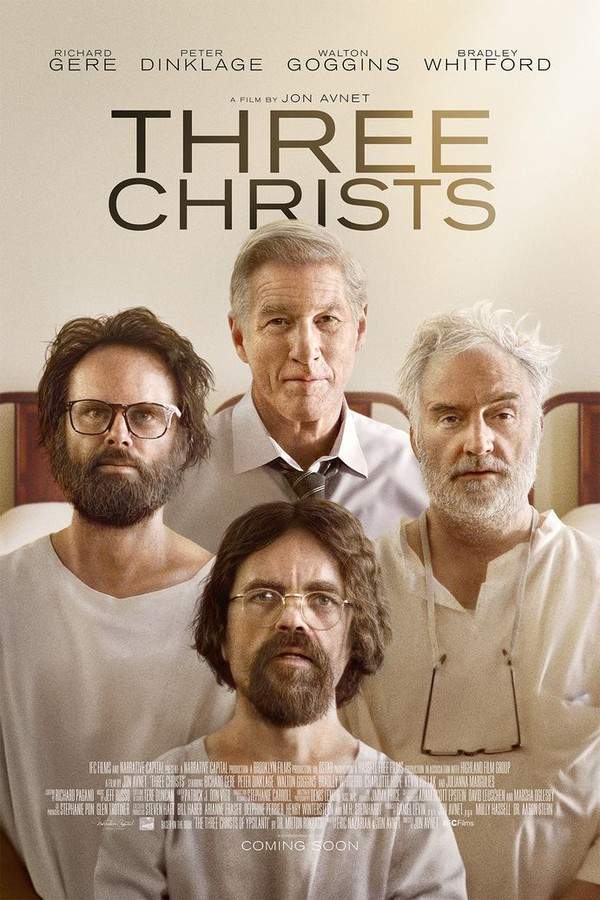
Three Christs (2020) movie poster

Plot Summary

Three Christs (2020) Plot Summary Explained

Release, runtime and language
2020 · 109 min · English
Echo score 51
JustWatch #16,336 4
Directed by
Jon Avnet
Starring
Peter Dinklage, Bradley Whitford, James Monroe Iglehart, Walton Goggins, Jane Alexander, Richard Gere

A psychiatrist embarks on a groundbreaking and unconventional experiment when he encounters three men who all believe they are Jesus Christ. Dr. Alan Stone attempts to treat them, exploring the boundaries of empathy and the nature of belief. As he delves deeper into their shared delusion, he begins a transformative journey of his own. Based on a true story, this drama examines the complexities of the human mind and the profound impact of connection.

On this page (6)
  1. 1 Where to watch
  2. 2 What happens: full plot
  3. 3 Plot questions answered
  4. 4 Movie threads
  5. 5 Movies like Three Christs
  6. 6 Every angle

Where to watch

Where to Watch Three Christs (2020)

Where can you watch Three Christs? Stream, rent or buy it in the US, including on AMC+, Philo and Sundance Now: current JustWatch availability with up-to-date prices.

Streaming availability powered by JustWatch

Full plot summary · contains spoilers

What Happens in Three Christs: Full Plot Summary

The whole story of Three Christs (2020) explained, from the opening scene to the final frame: every key event, every twist and what it all adds up to. Read it as a quick recap before the sequel, to check a scene you missed, or to finally understand what really happened.

Dr. Alan Stone, a groundbreaking psychologist in 1954, took a bold step by leaving his studies at New York University to delve deep into the operations of the Ypsilanti State Mental Asylum. His primary focus was on the treatment of schizophrenic patients, and he quickly gained a reputation as a staunch critic of the prevailing mental health system. At this time, many individuals suffering from mental illness were often placed in institutions and treated harshly, relying heavily on insulin shock and electroconvulsive therapies, while talk therapy played a minimal role in their recovery.

Within the asylum's somber halls, Dr. Stone encountered two particularly fascinating patients, both of whom believed they were Jesus Christ. Joseph Cassell, an intellectually astute man, and Clyde Benson, a rough and troubled individual, posed unique challenges for the psychologist. This unexpected encounter led Stone to pioneer an innovative method of group talk therapy. He eventually brought in Leon Gabor, another patient who also believed in his own divine identity, to further explore this trio's collective dynamic.

Dr. Stone's insights shed light on the stark contrasts between their experiences. Gabor was deeply traumatized by the oppressive influence of his mother and harbored wounds from multiple assaults during his military service. Benson, grieving the death of his wife who had undergone an abortion, struggled to manage his sorrow. Cassell, grappling with violent outbursts, lived in constant fear of losing his grip on reality, especially after enduring repeated electric shock treatments. Despite the skepticism of his peers, including Dr. Orbus, Stone courageously chose a path that shunned physical punishment. He leaned on compassionate dialogues and heartfelt written correspondence to genuinely connect with his patients.

As Stone began to receive accolades for his pioneering treatment methods, highlighted on the cover of a renowned medical journal, a shadow fell over Dr. Orbus, who found his own credentials threatened by his colleague's success. Desperate to reassert control, Orbus attempted to interfere in Cassell's therapy sessions, much to Stone's dismay. When Cassell found himself summoned to Orbus' office, he discovered that the head psychiatrist had been subtly maneuvering events to his advantage, having previously avoided writing to Cassell himself and instead leaning on Stone. This betrayal drove Cassell into despair, resulting in explosive outbursts that led Orbus to reinstate aggressive electroshock therapies.

In a desperate attempt to shield Cassell from further harm, Stone tried to intervene but was unfortunately powerless to prevent the onslaught. The emotional turmoil escalated into a confrontation with another physician, leaving both men injured. The final straw came when Orbus ousted Stone from the asylum, leaving him feeling utterly defeated.

Under Orbus' sinister influence, Cassell started perceiving the psychiatrist as a malevolent manipulator. In a harrowing moment of realization, Cassell understood that Stone's true intention to help him was overshadowed by Orbus' malevolence. Fueled by this insight, Cassell made a tragic choice, leaping from the chapel bell tower in a potent rejection of Orbus' oppressive control.

In the aftermath of Cassell's heartbreaking death, Stone was called to testify at a hearing wherein he held Orbus accountable for his reckless actions. He interpreted Cassell's last words as a profound testament to the young man's struggle for self-justification through sacrifice. The result was harrowing: Stone found himself dismissed from his position but was allowed to pursue his research in New York, accompanied by the remaining patients.

Despite this, Orbus continued his reign, stripped of authority until his eventual retirement. As the film concludes, viewers find Stone sitting alongside the two Jesus figures, engaged in a serene game of cards—a poignant reminder that amidst loss, there lies the potential for hope, redemption, and profound personal transformation.
Last updated: November 19, 2024 at 20:23

Was this helpful?

Plot questions answered

Three Christs Plot Explained: Your Questions Answered

The questions people ask most about Three Christs (2020): what happens in the confusing scenes, why the characters do what they do, the twists, hidden details and what the ending means. Each answer contains spoilers.

Q1

Why did Joseph Cassell jump from the bell tower?

Cassell jumped from the chapel bell tower after Dr. Orbus manipulated him into believing Dr. Stone was his enemy rather than his ally. Under Orbus's influence, Cassell came to see Stone as a malevolent manipulator. In a desperate act of rejection against what he perceived as oppressive control, Cassell made the tragic choice to leap, viewing his sacrifice as a final statement against the system that had failed him.

Foreshadowing: Earlier in the film, Cassell lives in constant fear of losing his grip on reality after repeated electric shock treatments, establishing his fragile psychological state.

  • joseph cassell suicide
  • bell tower
  • dr orbus manipulation
  • three christs ending
Q2

What caused the conflict between Dr. Stone and Dr. Orbus?

Dr. Orbus felt threatened by Dr. Stone's success with innovative group talk therapy. While Stone's compassionate methods gained recognition and appeared on the cover of a medical journal, Orbus's traditional harsh treatments, including insulin shock and electroconvulsive therapy, were being questioned. Orbus's credentials were tied to these older, physical approaches, making Stone's success a direct challenge to his authority and professional standing.

Foreshadowing: Stone is established early as a staunch critic of harsh mental health practices, directly opposing Orbus's established methods.

  • dr stone
  • dr orbus
  • conflict
  • psychiatric rivalry
  • ypsilanti asylum
Q3

Why did Dr. Stone bring three patients who all believed they were Jesus together?

Stone pioneered group talk therapy to explore the psychological dynamics between these three men. By bringing Joseph Cassell, Clyde Benson, and Leon Gabor together, he aimed to understand how each patient's delusion operated, what similarities or differences existed in their beliefs, and whether confrontation between their competing identities might lead to therapeutic insight. This was a radical departure from the isolating treatments typically used at the time.

Foreshadowing: Stone's reputation as an innovator who questioned institutional methods is established from his first days at the asylum.

  • group therapy
  • jesus delusion
  • alan stone treatment method
  • ypsilanti patients
Q4

How did Cassell become convinced that Dr. Stone was against him?

Dr. Orbus manipulated Cassell by deliberately avoiding direct contact while secretly controlling the therapy sessions. When Cassell was summoned to Orbus's office, he discovered that the head psychiatrist had been subtly maneuvering events and had never genuinely engaged with him, instead relying on Stone. This perceived betrayal, combined with Orbus framing Stone as manipulative, caused Cassell to view his actual ally as his enemy.

Foreshadowing: Orbus's pattern of interference in Cassell's therapy sessions is established when he first attempts to undermine Stone's work.

  • cassell stone betrayal
  • orbus manipulation
  • delusion
  • therapeutic relationship
Q5

What happened to Dr. Stone after he testified against Dr. Orbus?

After testifying at the hearing where he held Orbus accountable for his reckless actions, Dr. Stone was dismissed from his position at Ypsilanti. However, he was allowed to continue his research in New York, accompanied by the remaining patients, Benson and Gabor. This represented a bittersweet outcome: defeated professionally at Ypsilanti but able to pursue his compassionate treatment methods elsewhere.

Foreshadowing: Stone interprets Cassell's final words as a testament to the young man's struggle for self-justification through sacrifice, setting the tone for his testimony.

  • dr stone fired
  • new york research
  • after hearing
  • three christs ending
Q6

Why did Dr. Orbus want to undermine Dr. Stone's treatment?

Dr. Orbus undermined Stone's treatment because his own professional credibility was directly threatened. Stone's success with group talk therapy and compassionate care challenged the institutional status quo that Orbus represented. The older methods, insulin shock, electroconvulsive therapy, and physical punishment, were Orbus's domain. Stone's recognition on a medical journal cover made Orbus feel his authority and credentials were being eclipsed.

Foreshadowing: The film establishes early that many patients relied heavily on harsh therapies while talk therapy played a minimal role, precisely the system Orbus maintained.

  • dr orbus jealousy
  • professional rivalry
  • psychiatric methods
  • institutional power
Q7

What traumas drove each of the three patients who believed they were Jesus?

Each patient's delusion stemmed from distinct traumas: Leon Gabor was traumatized by an oppressive mother and multiple assaults during military service; Clyde Benson struggled with grief over his wife's death following an abortion; Joseph Cassell grappled with violent impulses and lived in constant fear of losing his sanity after repeated electric shock treatments. Their shared delusion of being Jesus represented different attempts to make meaning of their suffering.

Foreshadowing: Stone uncovers these traumas through his group talk therapy sessions, revealing how each man's past shaped his psychological break.

  • patient backstories
  • trauma
  • joseph cassell
  • leon gabor
  • clyde benson
  • schizophrenia
Q8

What does the final card game scene mean?

The final scene shows Dr. Stone sitting with the two remaining patients, Benson and Gabor, playing cards in a peaceful moment. This image represents hope, redemption, and the potential for healing despite the tragedy of Cassell's death. It suggests that Stone's compassionate approach, though it couldn't save everyone, created genuine connection and offered the patients dignity. The bittersweet ending implies that his work continues and that connection itself is a form of healing.

Foreshadowing: The film notes that while the ending is bittersweet with a major tragedy, the final image suggests a quiet, hard-won connection and continuation of Stone's compassionate work.

  • ending interpretation
  • card game scene
  • redemption
  • hope
  • three christs resolution

Movie threads

More Movies Like Three Christs, by Mood & Story

Curated lists built around what makes Three Christs tick: the same mood, the same kind of story or the same emotional payoff. Each list explains why these movies belong together.

Movies about therapists on the edge like Three Christs

Stories where the therapist's own sanity is tested by their challenging patients. If you liked the ethical and psychological challenges faced by Dr. Stone in Three Christs, explore these movies about therapists and psychiatrists. This collection features intense dramas where medical professionals confront their own demons while treating patients, offering similar stories of professional crisis and personal transformation.

  • psychological
  • tense
  • gripping
  • thoughtful
  • somber
  • ethical dilemmas
  • Tone: dark, psychologically tense
  • Pacing: steady, methodical
Why these movies?

The story pattern: The narrative typically follows a dedicated but perhaps naive professional entering a difficult environment, such as an asylum or prison. They form intense, boundary-pushing relationships with their patients, which force them to question their methods and their own understanding of sanity. The conflict often escalates to an ethical or personal breaking point.

Why they belong together: Movies in this thread share a focus on the therapist's perspective, combining high emotional weight with a dark tone. They explore the complex, often dangerous, dynamics of the therapeutic relationship, where the act of healing becomes a two-way street that challenges the healer's own foundation.

Bittersweet dramas about failed institutions like Three Christs

Sobering stories of personal connection amidst institutional failure and tragedy. For viewers seeking movies like Three Christs that explore the grim reality of institutional failure, this thread gathers powerful dramas. These stories often feature a well-intentioned protagonist fighting a broken system, culminating in a tragic yet bittersweet ending that highlights the enduring power of human compassion.

  • somber
  • melancholic
  • tragic
  • thoughtful
  • gripping
  • oppressive
  • Tone: dark, somber, bittersweet
  • Pacing: steady, building
Why these movies?

The story pattern: The plot revolves around a compassionate figure attempting reform within a rigid, often cruel institution. They achieve small victories in human connection, but the overarching system proves too powerful, resulting in a major loss or tragedy. The ending acknowledges the failure while suggesting that the effort itself held value, leaving a bittersweet residue.
Why they belong together: This thread groups films characterized by a steady, somber pace, a dark tone, and a bittersweet conclusion. They share a heavy emotional weight derived from the collision of idealism with systemic inertia, focusing on the poignant, imperfect connections made in the shadow of larger tragedies.

If you liked this

Movies Like Three Christs

Similar movies to Three Christs: the same genre, themes or kind of story. Each one comes with its own plot summary, timeline and ending explained.

Browse all movie summaries

Every angle

Three Christs (2020) Explained: Plot, Timeline & Characters

Everything about Three Christs in one place: what happens in the plot summary, the timeline in chronological order, the characters and meaning and a spoiler-free summary. What's After the Movie adds the cast, box office and post-credit scenes.

Coming soon on iOS and Android

The Plot Explained Movie Summary App

Plot summaries, endings explained and timelines on your phone. Catch up on any movie in minutes, save your favorites and never miss a twist again.

Be the first to know when we launch. Your email stays private, always.

Learn more about the app