Year: 2017
Runtime: 117 mins
Language: English
Director: Jon Avnet
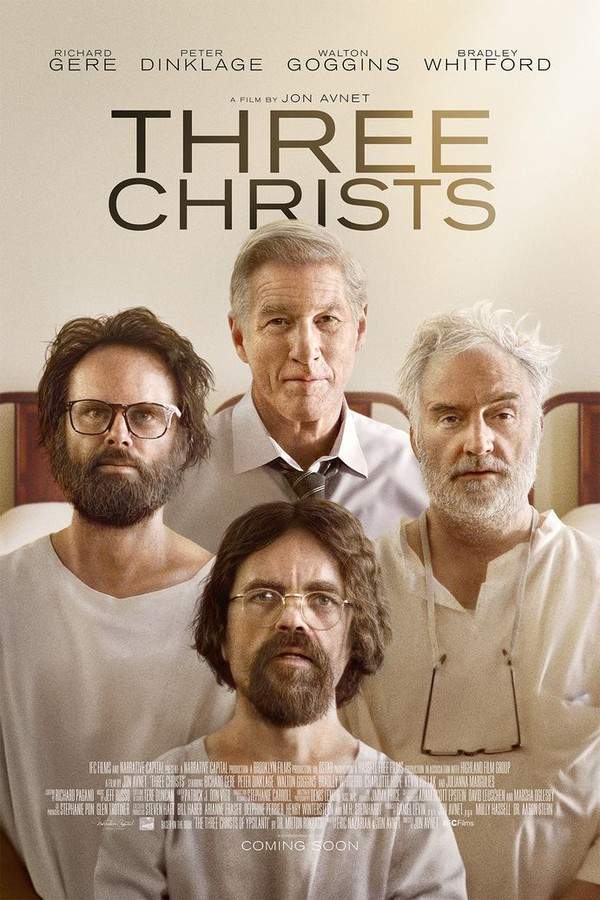
Dr. Alan Stone breaks new ground for treatment of the mentally ill through an experiment on three paranoid schizophrenic patients who believe they are Jesus Christ.
Warning: spoilers below!
Haven’t seen Three Christs yet? This summary contains major spoilers. Bookmark the page, watch the movie, and come back for the full breakdown. If you're ready, scroll on and relive the story!
Read the complete plot breakdown of Three Christs (2017), including all key story events, major twists, and the ending explained in detail. Discover what really happened—and what it all means.
Dr. Alan Stone, [Richard Gere], a progressive psychologist who left New York University in 1954 to work directly with patients at the Ypsilanti State Mental Asylum, becomes a central figure in a tense era for mental health care. Stone specializes in schizophrenic patients and is widely seen as a critic of the system, which in the 1950s relied heavily on institutionalization and sedation. Insulin shock therapy and electric shocks were common tools, while true talk therapy remained a marginal practice.
At Ypsilanti, Stone encounters two patients who each believe they are Jesus Christ: the intellectually sharp Joseph Cassell [Peter Dinklage] and the rough, emotionally scarred Clyde Benson [Bradley Whitford]. From this odd convergence, Stone designs a new format of group talk therapy aimed at better understanding their minds. He then brings in a third patient, Leon Gabor [Walton Goggins], who also claims Christ-like status, to observe how such beliefs play out in a shared setting. Stone quickly learns that their troubles are not the same in origin or expression: Gabor’s struggles stem from a deeply religious mother and a past marked by trauma during service; Benson is haunted by the death of his wife following an abortion; Cassell is prone to sudden, violent anger. The institutional routine had previously relied on electrical sedation for Cassell, which contributed to his fear of losing his sanity.
Stone’s approach challenges conventional methods and draws skepticism, even from the head of the asylum, Dr. Orbus [Kevin Pollak]. Rather than resort to punishment, Stone seeks to connect through conversation and letter-writing, hoping to reach the patients on a human level. His method gains recognition when a professional journal features his ideas on the cover, fueling Orbus’s envy and his desire to share in the prestige and in the treatment itself. As Stone remains cautious and principled, Orbus sidesteps him, arranging a private interview with Cassell. It is revealed that Stone authored Cassell’s letters to Orbus on Orbus’s behalf after the latter originally refused the task. Cassell feels betrayed and becomes wary that his chances of leaving the clinic are fading. Although he behaves well for a time, the old pattern resurges, and Orbus orders renewed electric shocks. Stone rushes to intervene, but the damage is done; a confrontation with another doctor leaves Stone injured and leads to his expulsion from the institution.
With Stone removed, Orbus assumes control over his former patients, including Cassell. Cassell, recognizing Stone’s sacrifice and sensing his own dwindling prospects, turns away from Orbus and clings to a vision of enduring suffering. The tension culminates in a conversation in the chapel’s bell tower, where Cassell, feeling betrayed and cornered, ends his life. In the subsequent hearing, Stone accuses Orbus of harmful, negligent decisions. He also interprets Cassell’s last words as a rebuke of Orbus’s sins, echoing the idea of Jesus bearing mankind’s wrongs. The hearing ends with Stone being fired, yet he is granted permission and funds to continue his study, including the two remaining patients in New York. Orbus, meanwhile, remains formally in his post but deprived of real decision-making power until retirement. The film closes with a stark, almost ceremonial image: Stone sits in Cassell’s seat and plays cards with the two Jesuses, a quiet, enduring reminder of what the therapy sought to achieve, even if the method proved uncertain and controversial.
Last Updated: October 01, 2025 at 13:04
Discover curated groups of movies connected by mood, themes, and story style. Browse collections built around emotion, atmosphere, and narrative focus to easily find films that match what you feel like watching right now.
Stories where professionals face severe moral crises within rigid systems.If you liked the ethical tension and institutional conflict in Three Christs, you'll appreciate these movies. They feature similar stories of professionals challenging flawed systems, leading to intense moral drama and personal cost. Discover other films about ethical crises within hospitals, asylums, and other rigid establishments.
A protagonist, often an expert or reformer, enters a flawed institution with a progressive idea. They clash with conservative authorities while grappling with the high-stakes consequences of their actions on vulnerable individuals. The narrative typically builds towards a tragic or bittersweet climax involving professional failure or a Pyrrhic victory.
They share a focus on procedural detail, intense moral questioning, and a dark, sober tone. The central conflict is between an individual's ethics and an unyielding system, creating a consistently high-tension, thoughtful viewing experience.
Heavy, character-driven stories that explore deep trauma and end in sorrow.For viewers who appreciated the heavy emotional weight and tragic conclusion of Three Christs. These movies offer a similar experience: intense psychological exploration, a somber and unsettling mood, and stories that deal head-on with grief, trauma, and mental illness, often ending on a note of profound sadness.
The narrative centers on characters grappling with severe psychological distress, trauma, or delusion. There is a deep focus on their internal world, often set against a bleak or confined environment. The story builds a sense of inevitable tragedy, leading to a climax of loss, suicide, or irreversible personal collapse.
They are united by a dominant mood of psychological unease, a focus on tragic character arcs, and a heavy emotional payload. The pacing is often deliberate to steep the viewer in the characters' suffering, resulting in a powerfully sad and thoughtful experience.
Don't stop at just watching — explore Three Christs in full detail. From the complete plot summary and scene-by-scene timeline to character breakdowns, thematic analysis, and a deep dive into the ending — every page helps you truly understand what Three Christs is all about. Plus, discover what's next after the movie.
Track the full timeline of Three Christs with every major event arranged chronologically. Perfect for decoding non-linear storytelling, flashbacks, or parallel narratives with a clear scene-by-scene breakdown.
Discover the characters, locations, and core themes that shape Three Christs. Get insights into symbolic elements, setting significance, and deeper narrative meaning — ideal for thematic analysis and movie breakdowns.
Get a quick, spoiler-free overview of Three Christs that covers the main plot points and key details without revealing any major twists or spoilers. Perfect for those who want to know what to expect before diving in.
Visit What's After the Movie to explore more about Three Christs: box office results, cast and crew info, production details, post-credit scenes, and external links — all in one place for movie fans and researchers.
Discover movies like Three Christs that share similar genres, themes, and storytelling elements. Whether you’re drawn to the atmosphere, character arcs, or plot structure, these curated recommendations will help you explore more films you’ll love.
Three Christs (2017) Scene-by-Scene Movie Timeline
Three Christs (2017) Movie Characters, Themes & Settings
Three Christs (2017) Spoiler-Free Summary & Key Flow
Movies Like Three Christs – Similar Titles You’ll Enjoy
Three (2016) Plot Summary & Ending Explained
Jesus' Son (2000) Movie Recap & Themes
Three Christs (2020) Ending Explained & Film Insights
Crazy as Hell (2002) Detailed Story Recap
Jesus Christ: Serial Rapist (2004) Plot Summary & Ending Explained
No Mercy, No Future (1981) Detailed Story Recap
The Three Kings (1987) Story Summary & Characters
Jesus Egon Christ (2021) Detailed Story Recap
3 Men in White (1944) Plot Summary & Ending Explained
Jesus (1979) Full Summary & Key Details
The Unholy Three (1930) Movie Recap & Themes
Cristo (1977) Full Summary & Key Details
Three in the Attic (1968) Plot Summary & Ending Explained
In Search of Historic Jesus (1979) Complete Plot Breakdown
Three on a Couch (1966) Film Overview & Timeline