Plot Explained Spoilers guaranteed!
Plot Explained

Browse by genre

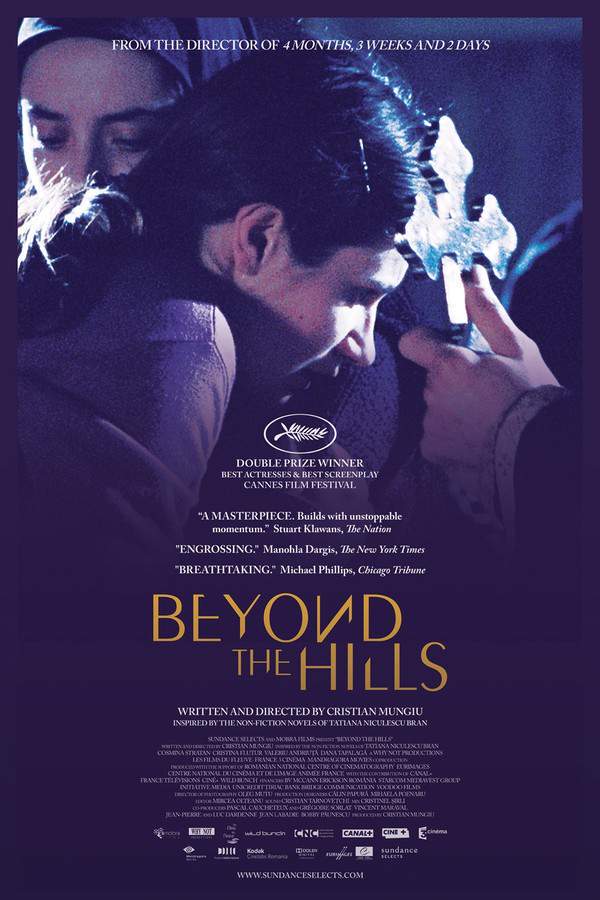
Beyond the Hills (2013) movie poster

Plot Summary

Beyond the Hills (2013) Plot Summary Explained

Release, runtime and language
2013 · 150 min · Romanian
Loading streaming availability…
Directed by
Cristian Mungiu
Starring
Valeriu Andriuta, Cosmina Stratan, Cristina Flutur, Dana Tapalaga

Within the walls of a remote monastery, a deep friendship faces a crisis when Alina attempts to convince her friend Voichita to leave her secluded life and move to Germany. As Voichita strengthens her commitment to the monastic life, Alina's efforts become increasingly desperate, culminating in a powerful and emotional confrontation that reveals the complexities of their connection and the challenges of their intertwined fates.

On this page (5)
  1. 1 Where to watch
  2. 2 What happens: full plot
  3. 3 Plot questions answered
  4. 4 Movie threads
  5. 5 Every angle
Loading streaming availability…

Full plot summary · contains spoilers

What Happens in Beyond the Hills: Full Plot Summary

The whole story of Beyond the Hills (2013) explained, from the opening scene to the final frame: every key event, every twist and what it all adds up to. Read it as a quick recap before the sequel, to check a scene you missed, or to finally understand what really happened.

Two young women from Romania, Voichița and Alina, find themselves at a Romanian Orthodox convent during the season of Lent. As they reminisce, Voichița reveals to Alina that a sacred icon in the altar is known to grant wishes. The two share a complicated history; they were once roommates at a children’s home and had a physical relationship while Alina worked in Germany. At the convent, they encounter a 30-year-old Priest who harshly critiques the diminishing faith in Western Europe, pointing to issues like same-sex marriage, and he strictly forbids non-believers from entering the monastery.

Concerned about Alina's spirituality, the Priest questions Voichița about her friend's church attendance and urges Alina to confess. Despite Alina's desire to reconnect intimately with Voichița, the latter advises caution, reminding her that it is Lent.

After some time, when Alina leaves the convent, Voichița fetches her back, only to reveal that she has taken vows to become a nun. Voichița declares that her love for Alina has transformed; her commitment to God now defines her existence. However, Alina yearns for escape and pleads with Voichița to leave with her. When Voichița declines, Alina, in distress, attempts to jump down a well, a move that leads to her being restrained by the nuns and subsequently taken to the hospital. Here, she is also bound to prevent harm, and the nuns read her passages about sin as part of her recovery.

Alina decides to undergo a strict Black Fast, but when she tries to approach the altar to make a wish to the icon, the Priest confronts her. He acknowledges the icon's power but warns her that entering the altar is a grave sin, claiming that Alina is influenced by the Devil within the convent.

As Alina's mental and physical state deteriorates, the nuns take her back to the hospital, where she is pronounced dead upon arrival. Medical staff discover the marks left from her restraints and assert that this could be classified as homicide. Fearing the implications, the nuns learn that law enforcement will investigate the convent. An officer examines the scene and interprets the board used for restraint as reminiscent of a cross, stating that this form of restraint leading to death constitutes homicide. Despite the Priest's claims of no malicious intent—drawing a parallel to a parent’s right to enforce medical treatment—the officer counters that Alina neither was a child nor did the Priest hold guardianship over her.

In a twist of fate, the nuns cite Alina’s formidable strength, while Voichița alleges that Alina practiced martial arts. Ultimately, the police take the Priest and the nuns implicated in Alina's restraints into custody, and Voichița makes the painful choice to join them. This story unfolds a gripping narrative about love, faith, and the haunting consequences of belief.
Last updated: November 16, 2024 at 15:35

Was this helpful?

Plot questions answered

Beyond the Hills Plot Explained: Your Questions Answered

The questions people ask most about Beyond the Hills (2013): what happens in the confusing scenes, why the characters do what they do, the twists, hidden details and what the ending means. Each answer contains spoilers.

Q1

Why does Voichița decide to become a nun after being with Alina?

Voichița transforms her deep love for Alina into religious devotion. After their time together at the children's home and Alina's work in Germany, Voichița finds faith at the convent and chooses to dedicate her life to God instead of returning to their romantic relationship. When Alina returns to convince her to leave, Voichița explains that her love has changed, it now belongs to God rather than to Alina.

Foreshadowing: Earlier at the altar, Voichița tells Alina about the sacred icon that grants wishes, hinting at her spiritual awakening.

  • voichita
  • nun
  • convent
  • religious conversion
  • love
Q2

Why does Alina try to jump down the well?

Alina attempts suicide after Voichița reveals she has taken vows to become a nun and refuses to leave with her. Overwhelmed by rejection and unable to accept that her only chance at a life with Voichița is gone, Alina desperately jumps down the well as a final act of despair. This moment marks the turning point where her emotional turmoil turns into physical crisis.

Foreshadowing: Voichița previously warns Alina that they cannot be intimate during Lent, foreshadowing the religious barrier between them.

  • alina
  • well
  • suicide attempt
  • desperation
  • rejection
Q3

Why do the nuns physically restrain Alina?

After Alina's suicide attempt, the nuns bind her to prevent further self-harm. They view her through a religious lens, believing she is possessed by the Devil and that her actions are spiritually motivated. The nuns read passages about sin to her and keep her restrained as a form of spiritual healing, though this treatment contributes to her eventual death.

Foreshadowing: The Priest warns that Alina is influenced by the Devil within the convent, establishing the religious framework for how she will be treated.

  • nuns
  • restraint
  • binding
  • spiritual healing
  • abuse
Q4

What causes Alina's death at the hospital?

Alina dies after being taken back to the hospital from the convent. Medical staff discover marks on her body from the restraints used by the nuns. The combination of her deteriorated physical and mental health, the effects of the Black Fast, and the prolonged restraint leads to her death. The police later classify it as homicide due to the unlawful restraint of a person who was not a child nor under their guardianship.

Foreshadowing: Alina's health had been declining throughout the film after her suicide attempt and subsequent restrictive treatment.

  • alina death
  • restraint marks
  • homicide
  • hospital
  • police investigation
Q5

What is the Priest's involvement in Alina's death?

The Priest orchestrates the treatment of Alina as a spiritual matter rather than a medical one. He forbids her from approaching the altar, labeled her as influenced by the Devil, and permitted the nuns to restrain her. When confronted by police, he defends the restraint as similar to a parent's right to enforce medical treatment on a child. However, the officer counters that Alina was neither a child nor under his guardianship, making the restraint unlawful.

Foreshadowing: The Priest's harsh critique of Western faith and his strict rules about non-believers establishes his controlling nature over the convent.

  • priest
  • spiritual authority
  • restraint
  • legal responsibility
  • church
Q6

Why does Voichița go with the police at the end?

Voichița chooses to accompany the Priest and nuns into police custody, despite not being directly implicated in the restraint that caused Alina's death. This decision represents her acceptance of responsibility for what happened and her commitment to truth and accountability. It also signifies her final break from the convent life, she chooses human connection and moral accountability over religious seclusion.

Foreshadowing: Throughout the film, Voichița struggles between her love for Alina and her devotion to God, foreshadowing this ultimate choice.

  • voichita
  • police custody
  • responsibility
  • accountability
  • choice
Q7

What is the sacred icon that grants wishes?

The sacred icon is a religious artifact in the convent's altar that Voichița tells Alina is known to grant wishes. This revelation occurs early in the film during Lent when the two women reminisce about their past. The icon becomes significant when Alina later attempts to approach it during her Black Fast, seeking divine intervention or a wish to restore her relationship with Voichița.

Foreshadowing: Voichița's knowledge of the icon's power hints at her deep religious faith that eventually leads her to become a nun.

  • sacred icon
  • altar
  • wishes
  • lent
  • convent
Q8

Why does Alina decide to do a Black Fast?

Alina undertakes a strict Black Fast as a desperate spiritual attempt to prove her faith and perhaps earn the right to approach the sacred icon. She hopes this extreme act of devotion will allow her to make a wish at the altar, likely to reunite with Voichița. The fast physically weakens her already fragile state, contributing to her deteriorating health.

Foreshadowing: The Priest's emphasis on confession and spirituality earlier suggests that Alina might try religious acts to prove herself worthy.

  • black fast
  • spiritual devotion
  • altar
  • faith
  • desperation
Q9

Why does the Priest forbid non-believers from entering the monastery?

The Priest expresses harsh criticism about the diminishing faith in Western Europe, specifically condemning issues like same-sex marriage. He views non-believers as spiritually dangerous and corrupt influences on the faithful. This ideology drives his antagonism toward Alina, whom he sees as an unbeliever attempting to pull Voichița away from her calling.

Foreshadowing: The Priest's critique establishes his rigid, exclusionary interpretation of faith that shapes all his decisions.

  • priest
  • non-believers
  • monastery rules
  • faith
  • western europe
Q10

What was Alina and Voichița's relationship before the convent?

Alina and Voichița were roommates at a children's home and developed a physical romantic relationship. Later, Alina worked in Germany while Voichița remained in Romania. When Alina returns, she expects to resume their intimate relationship, but finds that Voichița has channeled their shared love into religious devotion instead. This history explains Alina's desperation and Voichița's internal conflict throughout the film.

Foreshadowing: The opening scene establishes their reunion during Lent, immediately suggesting a complicated shared past.

  • alina
  • voichita
  • past relationship
  • children home
  • germany
Q11

Why does the police officer compare the restraint board to a cross?

When examining the scene, the officer notes that the board used to restrain Alina resembles a cross in shape. This observation emphasizes the tragic irony of the situation, religious objects and practices meant for salvation are instead instruments of death. The officer uses this comparison to support his classification of the case as homicide, highlighting how the nuns' religious conviction led to unlawful restraint.

Foreshadowing: The repeated emphasis on the cross and religious symbolism throughout the film builds to this dark interpretation.

  • restraint board
  • cross
  • police investigation
  • homicide
  • symbolism

Movie threads

More Movies Like Beyond the Hills, by Mood & Story

Curated lists built around what makes Beyond the Hills tick: the same mood, the same kind of story or the same emotional payoff. Each list explains why these movies belong together.

Slow burn institutional dread like in Beyond the Hills

Stories where rigid systems trap characters in escalating psychological tension. If you were captivated by the suffocating atmosphere of 'Beyond the Hills,' this collection features movies with similar slow pacing and high emotional weight. Discover other dramas where characters face psychological deterioration within the confines of oppressive systems, leading to desperate confrontations.

  • claustrophobic
  • oppressive
  • somber
  • tense
  • psychological
  • desperate
  • Tone: dark, tense, bleak
  • Pacing: slow, deliberate
Why these movies?

The story pattern: These narratives typically unfold within the confines of a strict institution—religious, medical, or societal—where a protagonist's desires clash with unyielding rules. The story is a gradual, inescapable build of tension, focusing on the psychological toll of confinement and the inevitable, often devastating, confrontation with authority.

Why they belong together: Movies are grouped here for their shared mood of oppressive claustrophobia, their slow-burn pacing that amplifies dread, and their central theme of an individual being psychologically crushed by an inflexible system.

Tragic friendship dramas with heavy emotion like Beyond the Hills

Intense, codependent relationships that lead to heartbreaking consequences. For viewers moved by the devastating friendship in 'Beyond the Hills,' this section highlights similar movies about intense, codependent bonds tested to their breaking point. Explore stories of love and loyalty that turn tragic, featuring high emotional weight and somber, character-driven narratives.

  • somber
  • desperate
  • tragic
  • melancholic
  • intense
  • codependent
  • Tone: melancholic, desperate, tragic
  • Pacing: slow, character driven
Why these movies?

The story pattern: The narrative pattern centers on a deep friendship where one character's unwavering devotion or a radical life choice creates an irreconcilable rift. The story explores the painful, desperate attempts to reconnect or save the other, ultimately revealing that the strength of their bond is also the source of their mutual destruction.

Why they belong together: These films are united by their exploration of a specific, intense dynamic between friends, the heavy emotional weight of their fractured connection, and the somber, often tragic, resolution of their struggle.

Every angle

Beyond the Hills (2013) Explained: Plot, Timeline & Characters

Everything about Beyond the Hills in one place: what happens in the plot summary, the timeline in chronological order, the characters and meaning and a spoiler-free summary. What's After the Movie adds the cast, box office and post-credit scenes.

Coming soon on iOS and Android

The Plot Explained Movie Summary App

Plot summaries, endings explained and timelines on your phone. Catch up on any movie in minutes, save your favorites and never miss a twist again.

Be the first to know when we launch. Your email stays private, always.

Learn more about the app