









Plot Explained Spoilers guaranteed!
Plot Explained

Browse by genre

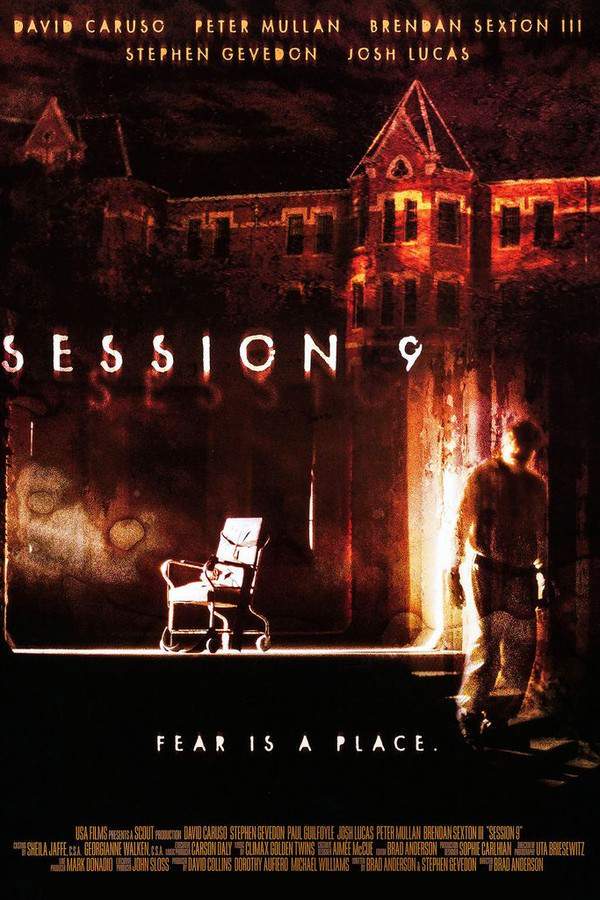
Session 9 (2001) movie poster

Timeline

Session 9 (2001) Timeline Explained – Every Event in Order

Release, runtime and language
2001 · 97 min · English
JustWatch #269 72
Directed by
Brad Anderson
Starring
David Caruso

A team of asbestos removal workers takes on a job at the isolated Danvers State Mental Hospital, which has been closed for fifteen years. As they work within the decaying structure, each member begins to unravel, haunted by unsettling sounds and visions. The hospital's dark history and the psychological impact of the environment begin to affect them, blurring the line between reality and paranoia, and revealing unsettling secrets about the institution’s past.

On this page (6)
  1. 1 Where to watch
  2. 2 Events in order (14)
  3. 3 Timeline questions answered
  4. 4 Movie threads
  5. 5 Movies like Session 9
  6. 6 Every angle

Where to watch

Where to Watch Session 9 (2001)

Where can you watch Session 9? Stream, rent or buy it in the US, including on AMC+, Philo and Amazon Video: current JustWatch availability with up-to-date prices.

Streaming availability powered by JustWatch

14 events in order · contains spoilers

Session 9 Timeline: Events in Chronological Order

Every key event of Session 9 (2001) in order, scene by scene, with when and where it takes place. Use it to untangle flashbacks, time jumps and parallel storylines, to refresh your memory before the sequel or to find the exact scene you are thinking of.

  1. Establishment of Kirkbride Mental Health Hospital

    Kirkbride Mental Health Hospital was established in 1871, serving as a facility for mental health treatment for over a century. After years of operation, its dark history and numerous incidents contributed to its closure in 1985.

    When
    1871
    Where
    Kirkbride Mental Health Hospital
  2. Transformation into Town Hall

    After being closed for nearly fifteen years, the hospital begins its transformation into a town hall in 2000. Renovations are initiated by the Hazmat Elimination Company, led by Gordon Fleming and his associate Phil.

    When
    2000
    Where
    Kirkbride Mental Health Hospital
  3. Guided Tour of the Asylum

    The movie opens with a guided tour of the ominous asylum conducted by Bill Griggs. Gordon and Phil experience eerie encounters during the tour, with Gordon hearing a disembodied voice that heightens the sense of dread.

    Where
    Kirkbride Mental Health Hospital
  4. Gordon's Family Moment

    Following the tour, Gordon reflects on his life while looking at photos of his newborn daughter. This moment is abruptly disrupted by unsettling screams, casting doubt over his domestic life and hinting at deeper issues.

  5. Introduction of Gordon's Crew

    As the story unfolds, we are introduced to Gordon's crew, which includes Hank, his nephew Jeff, and Mike, who has a complex past tied to the hospital's notoriety. Each character brings their unique dynamics and history into the haunting environment.

    Where
    Kirkbride Mental Health Hospital
  6. Mike Discovers Patient #444

    Mike uncovers old recorded sessions of patient #444, Mary Hobbes, who suffers from multiple personalities. These revelations deepens the mystery surrounding the hospital and captivates Mike's attention, foreshadowing danger.

    Where
    Kirkbride Mental Health Hospital
  7. Hank Goes Missing

    Tension rises when Hank goes on a late-night expedition and mysteriously disappears. His sudden absence adds to the crew's anxiety, highlighting the terrifying atmosphere of the abandoned hospital.

    Where
    Kirkbride Mental Health Hospital
  8. Gordon's Turmoil and Conflict

    The strain on Gordon's personal life becomes more evident as tensions rise with his wife, coupled with frustrations between him and Phil. The escalating fear and anger within the crew set the stage for catastrophic events.

  9. Search for Hank Intensifies

    With Hank still missing, panic engulfs the remaining team. They realize the hospital may hold sinister secrets that are becoming increasingly dangerous as they delve deeper into its dark past.

    Where
    Kirkbride Mental Health Hospital
  10. Gordon's Violent Confession

    Gordon confides in Phil about a violent incident with his wife, indicating his deteriorating mental state. This revelation marks a pivotal moment that heightens the stakes and underscores the creeping horrors of their environment.

  11. The Discovery of Hank

    In a shocking moment, Hank is discovered lying on the floor of the hospital, still alive. However, the situation becomes grim as the reality of Gordon's actions begins to unfold.

    Where
    Kirkbride Mental Health Hospital
  12. Gordon’s Descent into Madness

    As tensions peak, it is revealed that Gordon has murdered each of his employees, showcasing his unraveling sanity. The haunting presence looms larger, driven by his fractured psyche influenced by Mary Hobbes' personalities.

    Where
    Kirkbride Mental Health Hospital
  13. Final Apologies

    Gordon kneels beside a broken phone, apologizing to the memory of his deceased wife. This poignant moment reflects the culmination of his guilt and madness, revealing the true cost of the turmoil shaped by the hospital's history.

    Where
    Kirkbride Mental Health Hospital
  14. Revelation of Simon

    In a haunting conclusion, the voice that plagued Gordon throughout the film is disclosed as Simon, the third personality of Mary Hobbes. His chilling statement, 'I live in the weak and the wounded,' encapsulates the film's dark themes.

    Where
    Kirkbride Mental Health Hospital

Last updated: November 03, 2024 at 14:11

Was this helpful?

Timeline questions answered

Session 9 Timeline Explained: Your Questions Answered

When does it happen, and why in that order? The questions people ask about the chronology of Session 9 (2001): time jumps, flashbacks, cause and effect between scenes and the correct order of events, each answered with spoilers.

Q1

Why does Gordon murder his employees and his own wife and child?

Gordon's mental state deteriorates progressively due to the oppressive atmosphere of the abandoned mental hospital and his pre-existing violent tendencies. The film's revelation shows he killed his wife and child before arriving at the job, and he subsequently murders his entire crew, Jeff, Hank, and presumably Phil, during their time in the hospital. His breakdown is triggered and intensified by exposure to the hospital's haunting environment and the voice of Simon, which preys on his guilt and fractured mind.

Foreshadowing: Earlier scenes show Gordon receiving disturbing calls and having violent conflicts with his wife, hinting at the domestic tragedy that already occurred.

  • gordon fleming
  • murder
  • crew
  • wife
  • child
  • madness
  • breakdown
Q2

Who is Simon and what is his connection to Gordon?

Simon is the third personality of patient #444, Mary Hobbes, a multiple personality patient who was institutionalized at the hospital. The voice that haunts Gordon throughout the film is Simon, who reveals himself in the final scene, stating 'I live in the weak and the wounded.' Simon represents the predatory aspect of Mary's dissociative identity disorder, and his voice somehow reaches Gordon, exploiting his guilt and mental vulnerabilities to drive him toward further violence.

Foreshadowing: Mike discovers the recorded therapy sessions featuring Mary's different personalities, with Simon's voice being distinctly different from her other identities.

  • simon
  • mary hobbes
  • voice
  • patient 444
  • multiple personalities
  • haunting
Q3

What happened to Hank after he went missing in the hospital?

Hank disappears during a late-night exploration of the hospital, adding to the mounting tension and fear among the crew. He is later discovered lying on the floor of the hospital, still alive but in a distressed state. However, given Gordon's subsequent murderous rampage, Hank's fate becomes part of the collective tragedy that unfolds as Gordon descends completely into madness.

Foreshadowing: Hank's decision to explore the hospital alone at night sets the stage for his mysterious disappearance, which haunts the remaining crew.

  • hank
  • missing
  • disappeared
  • hospital
  • exploration
Q4

What is the significance of patient #444 Mary Hobbes and her recorded sessions?

Patient #444 Mary Hobbes is a former patient at the hospital who suffered from dissociative identity disorder, manifesting at least three distinct personalities. Her recorded therapy sessions become the catalyst for the film's horror, as Mike becomes obsessed with listening to them. The tapes reveal her different personas, including the sinister Simon, and serve as the mechanism through which Simon's voice enters the film and targets Gordon specifically, using his guilt and weakness as a conduit for destruction.

Foreshadowing: Mike finds the sessions early in the film, and the recurring motif of the number 444 on doors and tombstones reinforces Mary's presence throughout the story.

  • mary hobbes
  • patient 444
  • recorded sessions
  • therapy
  • tapes
  • multiple personalities
Q5

Why does Gordon hear the disembodied voice in the hospital?

Gordon hears Simon's voice because Simon specifically targets 'the weak and the wounded,' and Gordon is mentally vulnerable due to his guilt over killing his wife and child. The hospital's history of psychological torment and Mary's traumatic experiences there have created some kind of supernatural or psychological conduit through which Simon's voice can reach Gordon. The voice exploits Gordon's fractured mental state, pushing him deeper into madness and guiding his violent actions.

Foreshadowing: Gordon first hears the voice during the initial tour when he's alone in the haunting hallway, right after being unsettled by the eerie atmosphere.

  • voice
  • disembodied
  • simon
  • gordon
  • hearing
  • hallucination
Q6

Why does Mike become so obsessed with listening to the patient recordings?

Mike becomes obsessed with Mary Hobbes' therapy sessions because his father's past actions indirectly contributed to the hospital's closure following a patient lawsuit in 1984. This personal connection to the hospital's dark history makes him deeply curious about its past and the fate of its patients. His obsession also stems from a genuine fascination with Mary's different personalities, particularly the enigmatic and dangerous Simon, which ultimately leads him to uncover the disturbing truth behind the voice that haunts the building.

Foreshadowing: Mike's background is established early, the hospital's closure in 1984 was caused by his father's legal actions as a lawyer.

  • mike
  • tapes
  • recordings
  • obsession
  • patient 444
  • father
  • hospital history
Q7

What triggers Gordon's mental breakdown at the hospital?

Gordon's breakdown is triggered by a combination of factors: the oppressive, psychologically charged atmosphere of the abandoned mental hospital, his pre-existing violent nature and guilt over killing his family, and the influence of Simon's voice exploiting his vulnerabilities. The hospital's dark history and the echoes of past patient suffering create an environment that amplifies Gordon's psychosis. His irritability grows visibly throughout the film as the crew works deeper into the decaying building, and Simon's voice gradually takes hold of his fractured mind.

Foreshadowing: Gordon's irritability increases daily, and he becomes increasingly erratic as the job progresses, with Phil noticing his deteriorating behavior.

  • gordon
  • breakdown
  • mental
  • collapse
  • psychosis
  • atmosphere
  • simon
Q8

What is the significance of the number 444 appearing throughout the film?

The number 444 is the patient identifier for Mary Hobbes, whose recorded therapy sessions are central to the film's mystery. This number appears on room doors throughout the hospital and on tombstones, reinforcing Mary's pervasive presence in the building even after her departure. The recurring motif serves as a constant reminder of the hospital's dark past and the unresolved trauma of its patients, particularly Mary and her multiple personalities including the dangerous Simon.

Foreshadowing: The number appears increasingly as Mike delves deeper into the recordings, connecting the visual motif to Mary's identity.

  • 444
  • number
  • patient
  • mary hobbes
  • recurring
  • motif
  • tombstones
Q9

Why does Gordon confess to Phil about the violent incident with his wife?

Gordon confides in Phil about a violent incident with his wife as his mental state deteriorates and guilt overwhelms him. This confession represents a breaking point where Gordon can no longer contain his secret, and it signals his complete descent into madness. The confession also serves to deepen the horror of the film's revelation, viewers later learn Gordon killed his wife and child, making his confession a pivotal moment that foreshadows the tragic ending.

Foreshadowing: Phil is visibly disturbed by the confession, and this moment marks a turning point in Gordon's relationship with his crew.

  • gordon
  • phil
  • confess
  • confession
  • wife
  • violence
  • guilt
Q10

Why does the abandoned hospital have such a powerful psychological effect on the crew?

The Kirkbride Mental Health Hospital carries decades of dark history, including patient abuse, overcrowding, and traumatic treatments that created an atmosphere of psychological suffering. This accumulated trauma, combined with the building's decaying, oppressive architecture designed to control patients, creates an environment that affects everyone who enters. For Gordon, whose mind is already fragile from his crimes, the hospital's energy becomes a conduit for Simon's influence. For the other crew members, the building's history manifests as paranoia, nightmares, and mounting dread that isolates them from each other.

Foreshadowing: The guided tour at the beginning establishes the hospital's ominous history, with the tour guide mentioning its dark past.

  • kirkbride
  • hospital
  • abandoned
  • psychological
  • effect
  • atmosphere
  • dark history

Movie threads

More Movies Like Session 9, by Mood & Story

Curated lists built around what makes Session 9 tick: the same mood, the same kind of story or the same emotional payoff. Each list explains why these movies belong together.

Atmospheric slow burn horror movies like Session 9

Stories where dread is built patiently through atmosphere and psychological breakdown. Explore movies like Session 9 that master the slow burn. These atmospheric horror and thriller films build dread patiently through psychological tension and eerie settings, leading to bleak and unsettling conclusions. If you enjoyed the creeping paranoia and sense of place in Session 9, you'll find similar immersive experiences here.

  • atmospheric
  • slow burn
  • psychological
  • unsettling
  • eerie
  • dread-filled
  • Tone: dark, tense, bleak
  • Pacing: slow burn, deliberate
Why these movies?

The story pattern: Narratives in this pattern typically involve individuals or groups confined in or affected by a single, powerful location. The plot unfolds deliberately, focusing on the environmental and psychological pressure that erodes the characters' sense of reality, often culminating in a tragic revelation or breakdown.

Why they belong together: Movies are grouped here due to their shared reliance on atmosphere over action, a slow and deliberate pacing that builds palpable dread, and a central focus on psychological horror stemming from either internal or environmental factors. The viewing experience is defined by a sustained, oppressive mood.

Movies about psychological collapse in haunted places like Session 9

Where the true horror isn't ghosts, but the psychological collapse they trigger. Discover films like Session 9 where the setting itself infects the mind. These movies explore the intersection of haunted places and psychological trauma, creating stories where characters' sanity unravels in oppressive environments. If you liked the mental disintegration and unsettling asylum atmosphere of Session 9, this thread is for you.

  • psychological
  • unsettling
  • atmospheric
  • eerie
  • paranoid
  • claustrophobic
  • Tone: dark, unsettling, bleak
  • Pacing: slow, atmospheric
Why these movies?

The story pattern: The narrative pattern involves characters confronting a location with a troubled past. As they interact with the space, their own personal traumas and insecurities are amplified, leading to a breakdown of reality. The story explores whether the haunting is real or a psychological projection, often ending ambiguously or tragically.

Why they belong together: These films are connected by their central theme: the symbiotic relationship between a malevolent location and the fragile human psyche. They share a dark tone, an emphasis on psychological themes over physical threats, and a pervasive mood of existential dread concerning the nature of insanity.

If you liked this

Movies Like Session 9

Similar movies to Session 9: the same genre, themes or kind of story. Each one comes with its own plot summary, timeline and ending explained.

Browse all movie summaries

Every angle

Session 9 (2001) Explained: Plot, Timeline & Characters

Everything about Session 9 in one place: what happens in the plot summary, the timeline in chronological order, the characters and meaning and a spoiler-free summary. What's After the Movie adds the cast, box office and post-credit scenes.

Coming soon on iOS and Android

The Plot Explained Movie Summary App

Plot summaries, endings explained and timelines on your phone. Catch up on any movie in minutes, save your favorites and never miss a twist again.

Be the first to know when we launch. Your email stays private, always.

Learn more about the app