Plot Explained Spoilers guaranteed!
Plot Explained

Browse by genre

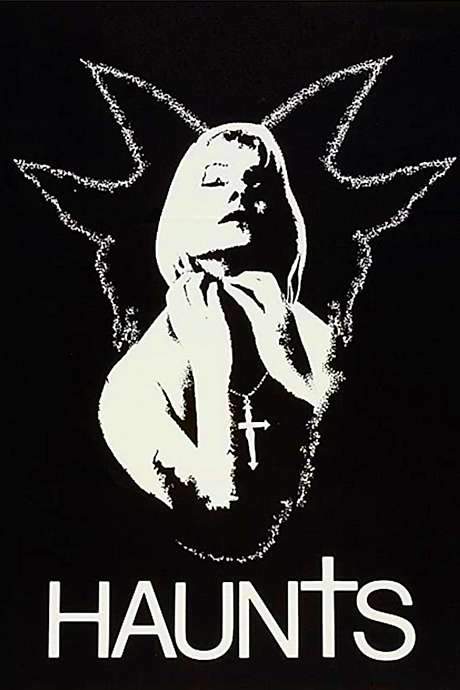
Haunts (1976) movie poster

Plot Summary

Haunts (1976) Plot Summary Explained

Release, runtime and language
1976 · 97 mins · English
Directed by
Herb Freed
Starring
Cameron Mitchell, Ben Hammer, E.J. André, Aldo Ray, Jim McKeny, May Britt

Past traumas begin to manifest as present terror when a woman is plagued by psychosexual nightmares and a deranged killer stalks the town with brutal scissor murders. A small‑town sheriff races to uncover the link between her haunting visions and the murders before the nightmare claims more victims.

On this page (6)
  1. 1 Where to watch
  2. 2 What happens: full plot
  3. 3 Plot questions answered
  4. 4 Movie threads
  5. 5 Movies like Haunts
  6. 6 Every angle

Where to watch

Where to Watch Haunts (1976)

Where can you watch Haunts? Stream, rent or buy it in the US, including on Fawesome, Mometu and YouTube Free: current JustWatch availability with up-to-date prices.

Streaming availability powered by JustWatch

Full plot summary · contains spoilers

What Happens in Haunts: Full Plot Summary

The whole story of Haunts (1976) explained, from the opening scene to the final frame: every key event, every twist and what it all adds up to. Read it as a quick recap before the sequel, to check a scene you missed, or to finally understand what really happened.

Ingrid Swenson, Ingrid Swenson is a young Swedish woman living with her American uncle Carl Henderson, Carl Henderson, on a quiet farm in rural Northern California. The town pockets its routine with the steady creak of farm doors and the soft hush of creek water, until a troubling spark arrives: a local young girl is found murdered with a pair of scissors, a crime that baffles the close-knit community. Into this unsettled mood steps Bill Spry, Bill Spry, a newer member of the church choir in which Ingrid sings, who takes an unsettling interest in her that she resists. One night, as Ingrid makes her way home, she is attacked by a masked figure but manages to escape. The assault unleashes buried memories of sexual abuse she endured at the hands of her father, a trauma that is intricately tied to the sorrowful suicide of her mother.

That same evening, a local woman Nell, Nell, is found attacked and murdered in her car following a heated exchange with Bill at a tavern. The town’s fear deepens as Ingrid grapples with her own vulnerability, haunted by the possibility that the violence creeping through the community might be targeting someone seemingly safe and innocent. The morning after, Ingrid discovers Nell’s mutilated body on the farm—the killer’s signature is again the scissors. She confides in the police but is left alone at the farmhouse to process what she fears and what she remembers. While she is alone and showering, the nightmare intensifies: Frankie, Frankie, a local butcher, breaks in, assaulting and raping her. Carl returns home mid-attack, unaware of the assault taking place, and Frankie threatens Ingrid before slipping away.

The danger escalates when Ingrid seeks solace at the church. There, the vicar, Vicar, listens to her plea for sanctuary, but Frankie returns to confront her outside. The attempted rape is interrupted when the vicar hears her scream, and the moment forces Ingrid to confront the terrifying possibility that the town’s violence associates with her deepest wounds. Later, Ingrid is hospitalized, and Sheriff Peterson, Sheriff Peterson, visits her with grave news. Outside Ingrid’s room, the vicar informs him that his daughter Loretta, Loretta Peterson, is pregnant by Frankie, a revelation that heightens the stakes for everyone involved. Peterson acts swiftly, driving to Frankie’s home, arresting him in a tense confrontation and warning Loretta about the consequences of her choices.

As the investigation develops, the police pursue a masked assailant who attacks a woman on the street, leading to a dramatic confrontation at the saw mill. Just before they can arrest Frankie for the killings, a phone call relays that the killer has been cornered, and the deputies report that the suspect is Bill, Bill Spry. The town reels as Ingrid watches news footage declaring that Bill is the killer. Yet the narrative twists further when Frankie arrives at the house that night, binding and gagging Carl. Ingrid defends herself with a fire poker and then stabs Frankie to death. Carl, urging her to stay quiet and not contact the authorities, helps conceal Frankie’s body. Despite this, Ingrid travels to the police station to tell what happened, and the investigation continues to unspool around the farmhouse.

The next morning, Peterson and his deputies raid the property in a tense search for the truth. Carl has disappeared, leaving Ingrid to face the consequences alone. In a chilling turn, Frankie himself appears at the house at the moment the deputies uncover Ingrid’s goat buried in a shallow grave in the yard. Peterson ascends the stairs to confront Ingrid, where he finds her dead in the bathroom—suicide, a decision born perhaps of the unrelenting pressure and the harrowing sequence of events that have surrounded her.

At Ingrid’s funeral, Carl, now aged, meets Peterson and the two walk away together. Peterson explains a disturbing perspective: the evidence collected after Ingrid’s alleged encounters with Frankie showed no sign that Frankie had been present at those scenes, and the autopsy reportedly confirmed she was a virgin. Carl reveals that he has not visited Ingrid in a very long time, hinting that their shared history—whether real or imagined—may be more complicated than anyone wants to admit. Returning to the farmhouse, he steps into the bathroom, and steam fills the room as Ingrid’s apparition appears in the vanity mirror, a final, ghostly reminder that truth and memory can blur, and that some wounds may never fully close. The film lingers on this unsettling image, leaving the audience with a sense of how memory, guilt, and fear can shape a town—and a mind—long after the surface events have faded.

Last updated: October 09, 2025 at 11:28

Was this helpful?

Plot questions answered

Haunts Plot Explained: Your Questions Answered

The questions people ask most about Haunts (1976): what happens in the confusing scenes, why the characters do what they do, the twists, hidden details and what the ending means. Each answer contains spoilers.

Q1

Who was revealed to be the masked killer at the saw mill?

Bill Spry was revealed to be the masked killer when the police cornered and shot him at the saw mill. He had been stalking the town and committing the scissor murders all along. This twist surprises both the characters and viewers, as Bill had shown an unsettling interest in Ingrid but was not directly connected to the attacks on her.

Foreshadowing: Bill's earlier fixation on Ingrid and his angry exchange with Nell at the tavern hinted at his violent tendencies.

  • bill spry
  • masked killer
  • scissor murders
  • saw mill
  • town killer
Q2

Were Frankie's attacks on Ingrid real or imagined?

The evidence suggests Frankie's attacks were largely imagined by Ingrid. Sheriff Peterson reveals that no physical evidence placed Frankie at the scenes of the alleged attacks, and the autopsy confirmed Ingrid was a virgin. Her traumatized mind likely projected her childhood abuse memories onto present-day events, creating false memories of assault.

Foreshadowing: The attacks began after Ingrid's masked attacker triggered buried memories of her father's sexual abuse.

  • frankie
  • assault
  • hallucination
  • trauma
  • virginity
  • false memories
Q3

Why did Ingrid commit suicide?

Ingrid took her own life likely due to the overwhelming psychological toll of her unresolved trauma. She had been experiencing violent nightmares, was haunted by resurfacing memories of childhood sexual abuse, and faced the cumulative trauma of real attacks (from Bill) combined with her mind's false projections. The relentless assault on her mental state proved unbearable.

Foreshadowing: Her mother's suicide after discovering Ingrid's abuse established a tragic family pattern of broken spirits.

  • ingrid suicide
  • death
  • trauma
  • abuse
  • psychological breakdown
Q4

What was the significance of the goat buried in the yard?

The buried goat represents the lingering darkness on the farm and possibly hints at Carl's own disturbing actions. When deputies uncover the goat's grave during their morning search, it symbolizes the hidden secrets and decay beneath the rural tranquility. The goat's burial suggests Carl may have been involved in darker activities beyond what was explicitly shown.

Foreshadowing: Early scenes establish the farm as an isolated, somewhat sinister setting with Carl's control over Ingrid.

  • goat
  • buried
  • farm
  • carl
  • secret
  • evidence
Q5

Why was Bill so fixated on Ingrid if he wasn't attacking her?

Bill's fixation on Ingrid appears to be a separate obsession from his killer activities. As a new church choir member, he targeted Ingrid as the object of his disturbed attention, distinct from his violent murders. His interest in her was sexual and predatory, though unrelated to the scissor attacks that he committed against other women in town.

Foreshadowing: Bill joined the church specifically to access the choir where Ingrid sang, showing premeditated targeting.

  • bill spry
  • obsession
  • ingrid
  • choir
  • stalking
Q6

Why did Sheriff Peterson and Carl walk away together at the end?

The ending suggests an unsettling alignment between Carl and Peterson. Peterson reveals that evidence showed Ingrid's attacks from Frankie were hallucinations, yet he still walks away peacefully with Carl. This implies either a cover-up, mutual understanding of dark secrets, or that Carl may have orchestrated events in ways that protect himself. Their partnership at the end hints at deeper corruption or shared guilt.

Foreshadowing: Carl's earlier behavior of arriving home mid-attack but remaining unaware, and his insistence that Ingrid stay quiet.

  • carl henderson
  • sheriff peterson
  • ending
  • alliance
  • cover up
Q7

Was Ingrid's apparition in the bathroom mirror real?

The final apparition is deliberately ambiguous. As Carl returns to the farmhouse, steam fills the bathroom and Ingrid's ghost appears in the mirror behind him. This could represent Carl's guilt manifesting as a hallucination, a supernatural element suggesting Ingrid's spirit remains, or simply the lingering psychological presence of the trauma he enabled. The film leaves this unclear, reinforcing its themes of blurred reality.

Foreshadowing: Ingrid's history of visions and nightmares established that seeing things that aren't there runs through the narrative.

  • apparition
  • ghost
  • bathroom
  • mirror
  • carl
  • final scene
Q8

What was the significance of Loretta's pregnancy by Frankie?

Loretta Peterson's pregnancy by Frankie added another layer of corruption to the town's fabric. The vicar's revelation that his own daughter carried the butcher's child shocked Sheriff Peterson and intensified the web of sin surrounding Frankie. This subplot showed how Frankie had been actively preying on the community beyond just Ingrid, and it motivated Peterson to confront Frankie violently.

Foreshadowing: Frankie was established as a predatory figure in town, preying on multiple women.

  • loretta peterson
  • pregnancy
  • frankie
  • vicar
  • sheriff
  • scandal
Q9

Why did the masked attack trigger Ingrid's buried memories?

The masked attack on Ingrid by Bill externally resembled her childhood trauma, being attacked by her father. This similarity caused her traumatized mind to resurface the deeply buried memories of sexual abuse she suffered from her father. The psychological link between the present attack and past abuse caused her mind to blur reality with memory, leading to the false memories of Frankie assaulting her.

Foreshadowing: The film's opening establishes Ingrid's history of childhood sexual abuse and her mother's suicide.

  • masked attack
  • memories
  • abuse
  • father
  • trauma
  • psychology
Q10

Why did Carl help Ingrid bury Frankie's body?

Carl urged Ingrid not to contact the authorities and helped bury Frankie's body to protect them both from legal consequences. Though Carl arrived home during the attack, he claims ignorance of what transpired. His willingness to conceal a murder suggests either his own complicity in protecting the farm's dark secrets or a pragmatic desire to avoid police scrutiny of their household.

Foreshadowing: Carl's suspicious behavior throughout, he arrives home during attacks but never discovers them, and he pushes Ingrid to stay silent.

  • carl henderson
  • bury body
  • frankie
  • silence
  • police
  • cover up

Movie threads

More Movies Like Haunts, by Mood & Story

Curated lists built around what makes Haunts tick: the same mood, the same kind of story or the same emotional payoff. Each list explains why these movies belong together.

Dark Psychological Mysteries with Unreliable Narrators like Haunts

A troubled protagonist's fragile mind blurs the line between past trauma and a present murder investigation. If you liked the tense, ambiguous investigation in Haunts, you'll find similar movies here. This thread gathers thrillers and noirs where a protagonist's psychological trauma fuels a murder mystery, creating a deeply unsettling and claustrophobic experience where the truth is as fragile as the main character's mind.

  • unreliable narrator
  • psychological thriller
  • small town secrets
  • investigation
  • mental unraveling
  • oppressive
  • Tone: dark, unsettling, ambiguous
  • Pacing: steady, methodical dread
Why these movies?

The story pattern: The narrative follows a character, often haunted by a dark past, who becomes involved in or conducts an investigation. Their personal demons and unstable mental state interweave with the central mystery, creating a story where the external threat is mirrored and amplified by internal psychological horror, leading to an ambiguous or bleak resolution.

Why they belong together: They are grouped by their shared focus on a psychologically fragile protagonist navigating a dangerous situation. The mood is consistently anxious and oppressive, the tone is dark, and the pacing is steady, building a sense of dread rooted in both external danger and internal collapse.

Bleak Horror Movies About Trauma and Violence like Haunts

Stories where past abuse manifests as inescapable present terror, leading to a tragic end. For viewers who appreciated the heavy emotional weight and bleak ending of Haunts. These similar movies explore dark themes of childhood trauma, abuse, and grief through a lens of intense horror and violence, offering a harrowing and cathartic viewing experience for those seeking stories with high emotional impact.

  • bleak
  • grim
  • traumatic
  • violent
  • psychological horror
  • melancholic
  • Tone: dark, bleak, tragic
  • Pacing: steady, oppressive
Why these movies?

The story pattern: The narrative pattern involves a character being relentlessly pursued by horrors that are a direct manifestation of their own traumatic history. The line between psychological torment and real-world threat is deliberately blurred, leading to a climax where the character is ultimately consumed by their pain, resulting in a tragic and hopeless ending.

Why they belong together: These films are united by their uncompromisingly dark tone, high intensity, and heavy emotional weight centered on themes of abuse and loss. They share a bleak outlook and a steady, oppressive pacing that creates a sense of inescapable doom, making the viewing experience consistently grim and emotionally draining.

If you liked this

Movies Like Haunts

Similar movies to Haunts: the same genre, themes or kind of story. Each one comes with its own plot summary, timeline and ending explained.

Browse all movie summaries

Every angle

Haunts (1976) Explained: Plot, Timeline & Characters

Everything about Haunts in one place: what happens in the plot summary, the timeline in chronological order, the characters and meaning and a spoiler-free summary. What's After the Movie adds the cast, box office and post-credit scenes.

Coming soon on iOS and Android

The Plot Explained Movie Summary App

Plot summaries, endings explained and timelines on your phone. Catch up on any movie in minutes, save your favorites and never miss a twist again.

Be the first to know when we launch. Your email stays private, always.

Learn more about the app