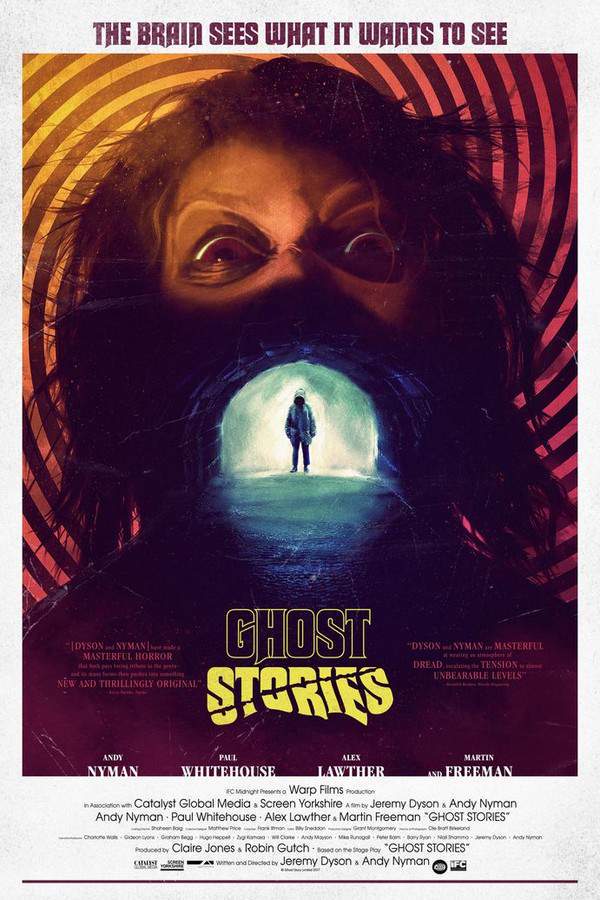
Ghost Stories

Ghost Stories

Year: 2018

Runtime: 98 min

Language: English

Director: Jeremy Dyson

Echo Score: 55
DramaHorror

A skeptical professor of paranormal psychology investigates three separate cases that challenge his rational worldview. He examines a night watchman plagued by disturbing visions within a derelict asylum, a chilling incident involving a car accident, and a wealthy banker haunted by a dark secret from his past. As he delves deeper into each story, the lines between reality and horror become increasingly blurred, forcing him to confront the possibility that some experiences defy logical explanation.

Warning: spoilers below!

Haven’t seen Ghost Stories yet? This summary contains major spoilers. Bookmark the page, watch the movie, and come back for the full breakdown. If you're ready, scroll on and relive the story!

Ghost Stories (2018) – Full Plot Summary & Ending Explained

Read the complete plot breakdown of Ghost Stories (2018), including all key story events, major twists, and the ending explained in detail. Discover what really happened—and what it all means.

In 1979, Philip Goodman’s father, Mr Goodman, a stern and traditional man, drives his sister from the family after she begins dating an Asian man. As an adult, Goodman is a solitary but accomplished professor and television presenter whose show aims to debunk fraudulent psychics, a vocation he believes can shield people from the heartbreak his own family endured. He receives a mysterious invitation to meet the renowned 1970s paranormal investigator Charles Cameron, who inspired him as a boy but has been missing for decades and now lives in a sickly, impoverished caravan. Cameron asks him to reexamine three cases of supposedly real supernatural sightings.

The first case follows Tony Matthews, a night watchman whose wife died of cancer and who feels guilt for not visiting his daughter, who is living with locked-in syndrome. He is haunted by the specter of a young girl while working in a shuttered asylum for women. The second case shifts to a teenager, Simon Rifkind, who is deeply obsessed with occult rituals and has a fraught relationship with his parents. His car breaks down after he apparently strikes something in the woods, a moment that unsettles Goodman despite his attempts to find a rational explanation, chalking it up to neuroses and imagination.

The third case centers on a City financier, Mike Priddle, tormented by a poltergeist while awaiting the birth of his child. His wife appears to him as she dies, suggesting something unnatural about the baby to come, and soon afterward Priddle takes his own life with a shotgun. As Goodman digs into these accounts, Cameron pushes him to confront the possibility that each incident may be more than mere illusion.

Goodman’s investigation takes a shocking turn when Cameron removes his latex disguise, revealing that he is actually [Mike Priddle]. Goodman initially suspects a hoax, yet the boundaries between truth and illusion begin to blur, and the investigation spirals out of control. The two men travel back to a childhood moment in which Goodman witnessed two bullies lure a mentally disabled boy into a drain, where the boy dies from an asthma attack. The memory haunts Goodman as a living tormentor, and the apparition of the bullied boy reappears to torment him, guiding him toward a hospital bed.

The hospital scene unfolds with bone-chilling clarity. A ghoul-like figure presses down, and Goodman is drawn into a nightmarish sequence where the ghoul inserts a finger into his mouth, forcing him to relive the moment while crying, “No, not again!” The line marks a bone-deep repetition of guilt and fear that has haunted him since childhood. >“No, not again!”

In the stark contrast of the real world, Goodman lies in a hospital bed with tubes in his mouth, the victim of a suicide attempt that has left him in a state of locked-in syndrome. Every character and event he experienced during the investigation appears to be a projection born from the hospital room’s staff, objects, and atmosphere rather than independent hauntings. The medical team misreads his condition as a persistent vegetative state, with grim forecasts offered by a junior doctor who bluntly says Goodman is “here for keeps” and has no hope of recovery. As the doctors debate his fate, a cleaner moves a mirror, offering a different view of the room and a glimmer of possible awareness in Goodman’s world.

The film maintains a careful balance between probing psychological guilt and supernatural suggestion, offering a stark meditation on trauma, memory, and the way a single lifetime can accumulate haunting narratives. Throughout, the tension between belief and skepticism is rendered not as a clash of philosophies but as a personal struggle inside Goodman’s body and mind. The nameless settings—the dilapidated asylum, the claustrophobic caravan, and the sterile hospital—serve as stages where memory, guilt, and the fear of losing agency intersect, culminating in a revelation about the fragility of perception itself.
Last Updated: January 08, 2026 at 12:00

Ending Explained – What Happens at the End of Ghost Stories?

Still wondering what the ending of Ghost Stories (2018) really means? Here’s a spoiler-heavy breakdown of the final scene, major twists, and the deeper themes that shape the film’s conclusion.

The ending of “Ghost Stories” reveals that everything Philip Goodman experiences is actually a hallucination caused by his coma after a suicide attempt. Throughout the film, Goodman witnesses three supernatural tales, but these are not real; instead, they’re manifestations of his guilt and unresolved issues. The shocking twist comes when Goodman, in a hospital bed, is shown to be in a coma. As the story unfolds, a horrifying secret is revealed: the man he believed was a paranormal investigator is actually him, and the supernatural events were constructed by his subconscious to confront his repressed feelings. In the final scene, a rotting corpse that looks like a boy named Callahan appears and forces Goodman to put his finger into his mouth—revealing that what was thought to be a ghost was actually Callahan’s breathing tube. This disturbing image solidifies that Goodman has been trapped in his mind, reliving his guilt and regret. The film emphasizes that the stories were all symbolic expressions of Goodman’s mental state—his regrets over neglecting his father, hiding the truth about Callahan’s death, and his failure to open up emotionally. The central theme is that men’s struggles with expressing vulnerability and dealing with guilt can turn destructive, and the movie’s haunting twist underscores how unresolved trauma can consume a person. Ultimately, “Ghost Stories” exposes that what seemed supernatural was in fact a haunting reflection of Goodman’s own psyche and the dark secrets he refuses to face.

Last Updated: June 25, 2025 at 08:44

Mobile App Preview

Coming soon on iOS and Android

The Plot Explained Mobile App

From blockbusters to hidden gems — dive into movie stories anytime, anywhere. Save your favorites, discover plots faster, and never miss a twist again.

Sign up to be the first to know when we launch. Your email stays private — always.

Explore Movie Threads

Discover curated groups of movies connected by mood, themes, and story style. Browse collections built around emotion, atmosphere, and narrative focus to easily find films that match what you feel like watching right now.

Psychological Horror Movies Where Trauma Distorts Reality Like Ghost Stories

Psychological thrillers where reality is unreliable and trauma creates the monster.For viewers who appreciated the mind-bending horror of Ghost Stories, this section features movies with unreliable narrators, psychological breakdowns, and stories where trauma is the source of terror. If you liked the way Ghost Stories questioned what was real, you'll find similar unsettling experiences here.

unreliable narratorpsychologicaldisorientingdreamlikeexistential dreadguilttraumaunsettling

Narrative Summary

These narratives typically follow a protagonist investigating a mystery or confronting a threat, only for the story to gradually reveal that the events are manifestations of their own repressed guilt, trauma, or mental illness. The plot structure often features twists that reframe the entire story as an internal struggle.

Why These Movies?

Movies in this thread are united by their focus on internal horror over external threats. They share a dark, bleak tone, high psychological intensity, and a complex narrative structure that gradually subverts the audience's perception of reality, leading to a disturbing and emotionally heavy conclusion.

Anthology Horror Films with Interlocking Stories Like Ghost Stories

Anthology-style films where separate stories interconnect into a shocking whole.If you were captivated by the nested storytelling of Ghost Stories, this collection is for you. These movies present multiple horror tales that are cleverly linked by a central narrative, creating a complex and rewarding puzzle for viewers who enjoy intricate plot structures and shocking final revelations.

anthologyinterlocking storiesmind-bendingpuzzletwist endingunsettlingcomplex narrativebleak

Narrative Summary

The narrative pattern involves a protagonist (often an investigator or skeptic) being introduced to a series of unexplained cases. As they explore each story, clues are subtly embedded that seem unrelated at first. The climax recontextualizes all the separate tales, showing they are fragments of a single, traumatic event or psychological state.

Why These Movies?

These films are grouped by their unique storytelling mechanics. They share a variable pacing that accelerates towards the end, a high degree of narrative complexity, and a dark tone that culminates in a bleak, mind-bending twist connecting all the threads.

Unlock the Full Story of Ghost Stories

Don't stop at just watching — explore Ghost Stories in full detail. From the complete plot summary and scene-by-scene timeline to character breakdowns, thematic analysis, and a deep dive into the ending — every page helps you truly understand what Ghost Stories is all about. Plus, discover what's next after the movie.

Ghost Stories Timeline

Track the full timeline of Ghost Stories with every major event arranged chronologically. Perfect for decoding non-linear storytelling, flashbacks, or parallel narratives with a clear scene-by-scene breakdown.

Ghost Stories Timeline

Characters, Settings & Themes in Ghost Stories

Discover the characters, locations, and core themes that shape Ghost Stories. Get insights into symbolic elements, setting significance, and deeper narrative meaning — ideal for thematic analysis and movie breakdowns.

Characters, Settings & Themes in Ghost Stories

Ghost Stories Ending Explained

What really happened at the end of Ghost Stories? This detailed ending explained page breaks down final scenes, hidden clues, and alternate interpretations with expert analysis and viewer theories.

Ghost Stories Ending Explained

Ghost Stories Spoiler-Free Summary

Get a quick, spoiler-free overview of Ghost Stories that covers the main plot points and key details without revealing any major twists or spoilers. Perfect for those who want to know what to expect before diving in.

Ghost Stories Spoiler-Free Summary

More About Ghost Stories

Visit What's After the Movie to explore more about Ghost Stories: box office results, cast and crew info, production details, post-credit scenes, and external links — all in one place for movie fans and researchers.

More About Ghost Stories

Similar Movies to Ghost Stories

Discover movies like Ghost Stories that share similar genres, themes, and storytelling elements. Whether you’re drawn to the atmosphere, character arcs, or plot structure, these curated recommendations will help you explore more films you’ll love.