




Plot Explained Spoilers guaranteed!
Plot Explained

Browse by genre

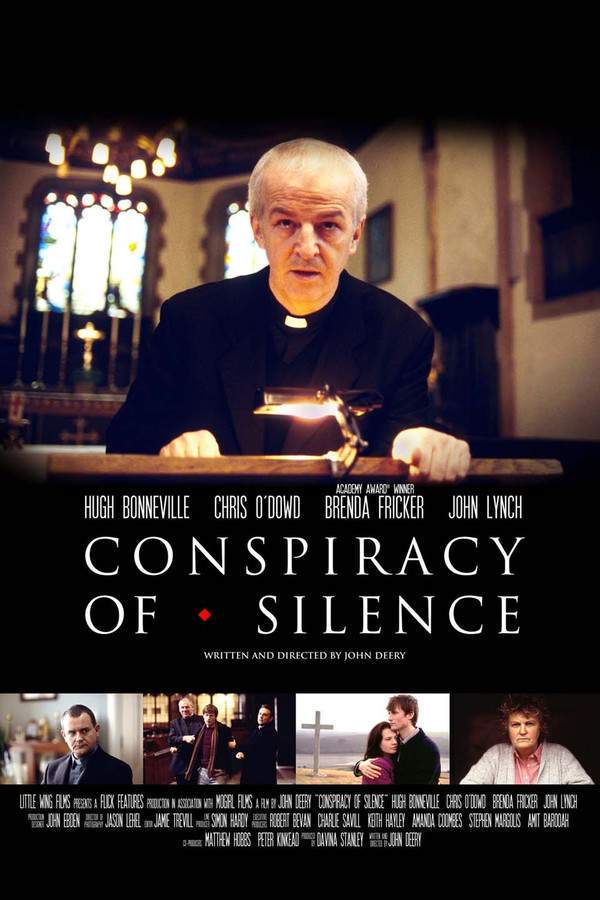
Conspiracy of Silence (2004) movie poster

Timeline

Conspiracy of Silence (2004) Timeline Explained – Every Event in Order

Release, runtime and language
2004 · 90 min · English
Directed by
John Deery

A seminarian's expulsion triggers a series of unsettling events, jeopardizing the silence surrounding the death of a priest. A determined journalist investigates, uncovering a web of secrets and challenging the unwavering loyalty of the community. As the truth emerges, long-held deceptions are exposed, forcing those involved to confront their roles in a deeply unsettling situation and seek a path toward redemption.

On this page (6)
  1. 1 Where to watch
  2. 2 Events in order (14)
  3. 3 Timeline questions answered
  4. 4 Movie threads
  5. 5 Movies like Conspiracy of Silence
  6. 6 Every angle

Where to watch

Where to Watch Conspiracy of Silence (2004)

Where can you watch Conspiracy of Silence? Stream, rent or buy it in the US, including on Amazon Prime Video, Amazon Video and Apple TV Store: current JustWatch availability with up-to-date prices.

Streaming availability powered by JustWatch

14 events in order · contains spoilers

Conspiracy of Silence Timeline: Events in Chronological Order

Every key event of Conspiracy of Silence (2004) in order, scene by scene, with when and where it takes place. Use it to untangle flashbacks, time jumps and parallel storylines, to refresh your memory before the sequel or to find the exact scene you are thinking of.

  1. Sweeney's suicide and its immediate consequences

    Father Sweeney, a gay Catholic priest living with HIV, commits suicide, shocking his community. His death prompts local investigative journalist David Foley to pursue a story about Sweeney's illness and possible church concealment. Foley's piece publicly identifies Sweeney as HIV-positive, triggering controversy and scrutiny of church leaders.

    Where
    Sweeney's residence
  2. Foley begins a story linking Sweeney to HIV status

    Foley writes a report that publicly reveals Sweeney's HIV status, challenging the church's image and handling of the priest's life. The article sets in motion a broader inquiry into celibacy, sexuality, and clerical oversight.

    Where
    local newsroom
  3. Seminary expels two near-ordaination students for appearances

    At the local seminary, two students who are near ordination are expelled after one is seen leaving the room of the other. Niall is gay and Daniel straight; they did not engage in sexual activity, but they are expelled to preserve appearances. The decision tests Daniel's path toward priesthood.

    Where
    local seminary
  4. Daniel returns home; torn between calling and Sinead

    Daniel returns home, torn between his calling to the priesthood and his love for his ex-girlfriend Sinead. He grapples with the consequences of his expulsion while considering his future. The personal turmoil foreshadows the broader public conflict to come.

    Where
    Daniel's home
  5. Foley's follow-up article targets Vatican AIDS protest and celibacy

    Daniel meets with Foley, who writes a follow-up article exposing a covered-up AIDS protest staged at the Vatican three years earlier and Daniel's dismissal. The piece also alleges that cardinals close to the Pope are involved in sexual relationships and calls on the Church to re-examine its celibacy requirement.

    Where
    Foley's office
  6. Bishop Quinn pressures editor not to run the second story

    Bishop Michael Quinn pressures the editor of the local paper to suppress the second story. He aims to shield the church from further scandal and control the narrative surrounding Sweeney's death and Daniel's fate.

    Where
    editor's office
  7. Editor reluctantly relents; forwards story to Irish Times

    The local editor, initially reluctant, relents after reading the story and forwards it to the Irish Times. This shift moves the controversy from a local issue to a national stage, increasing pressure on church authorities.

    Where
    local newspaper office
  8. Irish Times publishes the story

    The Irish Times prints the story, bringing wider attention to Sweeney's case and the Vatican-related allegations. The publication intensifies scrutiny of church leadership and celibacy practices.

    Where
    Irish Times newsroom
  9. Live TV debate features the bishop, Foley and Daniel

    The next day, the bishop, his aide, Foley and Daniel appear together in a live television debate. The confrontation centers on accountability, celibacy, and the church's handling of Sweeney's death and the subsequent revelations.

    When
    the day after Irish Times publication
    Where
    live television studio
  10. Church threats Foley before the broadcast

    Before the broadcast, agents of the Church threaten to harm Foley's family unless he retracts his story. The intimidation underscores the high-stakes pressure faced by reporters and the institutional power at stake.

    When
    immediately before broadcast
    Where
    studio/backstage
  11. Bishop offers to reinstate Daniel if he admits wrong

    During the broadcast, the bishop offers to reinstate Daniel if he admits he has been wrong. The offer tests Daniel's resolve and probes the boundaries between faith, truth, and institutional authority.

    When
    during broadcast
    Where
    live debate stage
  12. Foley capitulates; Daniel refuses to admit fault

    On-air Foley capitulates and retracts, but Daniel refuses to concede. The moment highlights a clash between journalistic truth and ecclesiastical power, and until-then quiet dissent comes to the fore.

    When
    during broadcast
    Where
    live broadcast
  13. Confrontation: suicide note reveals affair

    When the bishop refuses to answer, Father Sweeney's partner, former priest Matthew Francis, confronts Quinn with Sweeney's suicide note revealing an affair between Quinn and Sweeney. The revelation deepens the scandal and intensifies public pressure on church leaders.

    When
    immediately after debate
    Where
    studio/backstage
  14. Ending: Daniel returns home with Sinead

    In the film's ending, Daniel is back at home with his former girlfriend Sinead. The conclusion leaves him to weigh his future and the church's role in his life, without a clean resolution to the wider scandal.

    When
    end
    Where
    Daniel's home

Last updated: November 22, 2025 at 15:58

Was this helpful?

Timeline questions answered

Conspiracy of Silence Timeline Explained: Your Questions Answered

When does it happen, and why in that order? The questions people ask about the chronology of Conspiracy of Silence (2004): time jumps, flashbacks, cause and effect between scenes and the correct order of events, each answered with spoilers.

Q1

Why did Father Sweeney commit suicide?

Father Sweeney was a gay Catholic priest living with HIV who faced the dual burden of his sexual orientation and illness within a church that demanded celibacy. The pressure of hiding his identity and health while serving in the clergy, combined with the church's stance on homosexuality, led him to take his own life. His death became the catalyst for the entire investigation.

  • father sweeney
  • suicide
  • gay priest
  • hiv
  • church hypocrisy
Q2

Why were Daniel and Niall expelled from the seminary?

Daniel and Niall were expelled after Niall was seen leaving Daniel's room, despite not engaging in any sexual activity. Niall was gay while Daniel was straight, but the seminary expelled them both for appearances sake, maintaining the church's image rather than addressing the actual situation. Daniel's expulsion became a key part of Foley's follow-up story.

Foreshadowing: Earlier scenes show Daniel struggling with his calling, hinting at his internal conflict about priesthood.

  • seminary expulsion
  • daniel
  • niall
  • gay priest
  • ordination
Q3

What was the Vatican AIDS protest that Foley exposed?

Three years before the events of the movie, Father Sweeney had staged an AIDS protest at the Vatican, which the church covered up. Foley's follow-up article exposed this hidden protest along with allegations that cardinals close to the Pope were engaged in sexual relationships, challenging the church's celibacy requirements.

  • vatican aids protest
  • celibacy
  • church cover-up
  • cardinals
Q4

Why did Bishop Quinn pressure the editor to suppress the story?

Bishop Quinn pressured the editor to protect the church from scandal. His motive became clearer later when it was revealed he had previously had an affair with Father Sweeney. Quinn needed to suppress stories that might expose his own conduct and the church's broader hypocrisy regarding sexuality among the clergy.

Foreshadowing: The bishop's strong opposition to the story hints at personal stakes beyond institutional protection.

  • bishop quinn
  • pressure
  • editor
  • church scandal
  • suppression
Q5

What happened during the live TV debate?

During the live broadcast, church agents threatened Foley's family unless he retracted his story on air. Bishop Quinn also offered to reinstate Daniel if he admitted he was wrong. Foley capitulated and retracted his allegations, but Daniel refused to concede, directly asking the bishop if he practiced celibacy. The bishop's refusal to answer led to the dramatic revelation of Sweeney's suicide note.

  • live debate
  • tv confrontation
  • bishop quinn
  • daniel
  • foley retraction
Q6

What did Sweeney's suicide note reveal?

Sweeney's suicide note, presented by his partner Matthew Francis, revealed that Bishop Quinn and Father Sweeney had previously had a sexual affair. This explosive revelation exposed the bishop's hypocrisy, publicly enforcing celibacy while secretly engaging in the very conduct he condemned, and intensified the scandal beyond the original reporting.

  • suicide note
  • affair
  • bishop quinn
  • matthew francus
  • revelation
Q7

Why did Foley retract his story on air?

Foley retracted his story because church agents threatened to harm his family before the broadcast. The intimidation worked, he chose to protect his family over maintaining his journalistic integrity on live television, a moment that highlighted the extreme pressure and institutional power arrayed against him.

  • foley retraction
  • threats
  • family
  • intimidation
  • journalist
Q8

Why was Foley's first article about Sweeney controversial?

Foley's initial article publicly identified Father Sweeney as HIV-positive after his suicide, which was controversial because it revealed the priest's medical status without considering privacy concerns. The article challenged the church's handling of Sweeney's illness and sparked the broader investigation into church hypocrisy regarding sexuality and celibacy.

  • hiv status
  • privacy
  • controversy
  • journalist
  • church handling
Q9

What happened to Daniel at the end of the movie?

At the end of the film, Daniel returns home to his former girlfriend Sinead, choosing personal love over his uncertain path to the priesthood. While the church scandal remains unresolved and Sweeney's death remains a tragedy, Daniel finds personal solace in reconnecting with Sinead, offering a bittersweet conclusion to his storyline.

Foreshadowing: Daniel's earlier conflict between his calling and his feelings for Sinead foreshadows his final choice.

  • daniel
  • sinead
  • ending
  • priesthood
  • reconciliation
Q10

Why did the church cover up Sweeney's HIV status and protest?

The church covered up Sweeney's HIV status and the Vatican AIDS protest to protect its public image and maintain the appearance of adherence to celibacy requirements. Revealing that a priest was HIV-positive and had protested at the Vatican would have exposed the gap between the church's official stance and the reality of clerical life, undermining its authority and credibility.

  • church cover-up
  • hiv
  • celibacy
  • reputation
  • institutional secrets

Movie threads

More Movies Like Conspiracy of Silence, by Mood & Story

Curated lists built around what makes Conspiracy of Silence tick: the same mood, the same kind of story or the same emotional payoff. Each list explains why these movies belong together.

Investigative dramas exposing powerful institutions like Conspiracy of Silence

When a single investigator challenges a powerful, secretive system. If you were gripped by the investigative journalism in Conspiracy of Silence, this thread features movies where a lone truth-seeker uncovers corruption in powerful, secretive organizations. These tense dramas share a steady pace, heavy emotional weight, and a focus on the moral conflict between individual conscience and institutional power.

  • tense
  • gripping
  • serious
  • unsettling
  • moral conflict
  • investigative
  • Tone: tense, serious, morally conflicted
  • Pacing: steady, procedural, methodical
Why these movies?

The story pattern: The narrative typically begins with a triggering event that hints at a deeper rot. A protagonist, driven by a sense of justice, methodically peels back layers of deception, facing intimidation and risking their safety. The structure is often procedural, revealing secrets step-by-step, culminating in a confrontation that exposes the truth, though the outcome is often bittersweet or morally complex.

Why they belong together: Movies in this thread are grouped by their central conflict: an individual versus a monolithic, secretive institution. They share a tense, serious tone, a steady investigative pace, and a heavy emotional weight derived from themes of betrayal, hypocrisy, and the high cost of truth.

Bittersweet dramas about moral reckoning like Conspiracy of Silence

Stories where uncovering a painful truth brings a hollow, complex victory. For viewers who appreciated the heavy emotional weight and bittersweet ending of Conspiracy of Silence, this list features similar dramas. These films explore difficult themes like hypocrisy, suicide, and secrecy, culminating in an ending that is partially redemptive but ultimately shadowed by tragedy and loss.

  • somber
  • contemplative
  • serious
  • unsettling
  • tragic
  • redemptive
  • Tone: somber, contemplative, bittersweet
  • Pacing: steady, character-driven
Why these movies?

The story pattern: These stories often revolve around a past tragedy or a deeply buried secret that is gradually brought to light. The emotional journey for the characters is one of confronting guilt, shame, or complicity. The climax is the revelation of truth, but the ending acknowledges that some wounds cannot be fully healed, leaving characters and viewers with a complex mix of sadness, relief, and somber reflection.

Why they belong together: These films are united by their exploration of heavy, real-world themes and their commitment to a bittersweet emotional resolution. They avoid simple happy endings, instead focusing on the nuanced and painful process of facing truth and seeking redemption in the wake of personal and collective failure.

If you liked this

Movies Like Conspiracy of Silence

Similar movies to Conspiracy of Silence: the same genre, themes or kind of story. Each one comes with its own plot summary, timeline and ending explained.

Browse all movie summaries

Every angle

Conspiracy of Silence (2004) Explained: Plot, Timeline & Characters

Everything about Conspiracy of Silence in one place: what happens in the plot summary, the timeline in chronological order, the characters and meaning and a spoiler-free summary. What's After the Movie adds the cast, box office and post-credit scenes.

Coming soon on iOS and Android

The Plot Explained Movie Summary App

Plot summaries, endings explained and timelines on your phone. Catch up on any movie in minutes, save your favorites and never miss a twist again.

Be the first to know when we launch. Your email stays private, always.

Learn more about the app