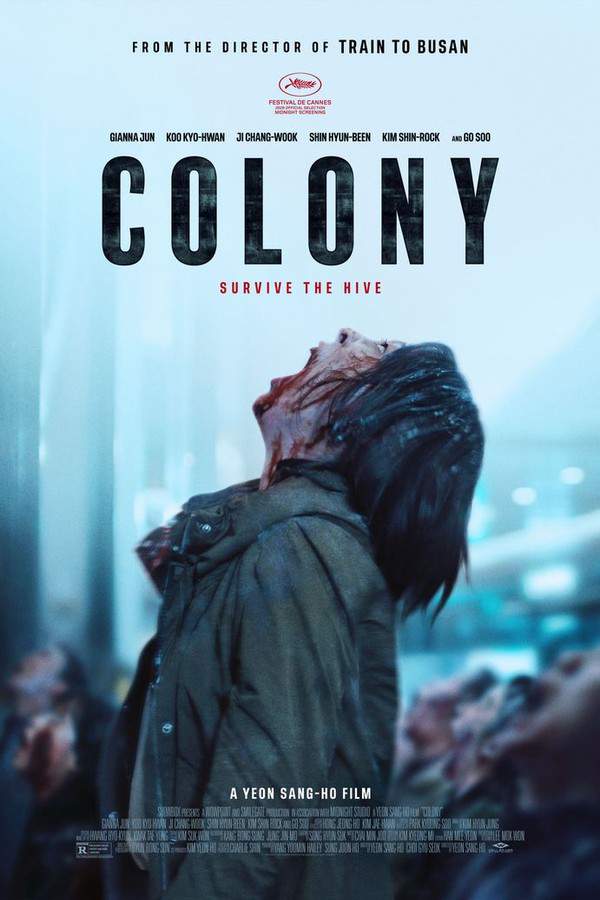
Year: 2026
Runtime: 2 h 2 m
Language: korean
Director: Sang-ho Yeon
When a rapidly mutating virus erupts at a biotech conference, Professor Se‑jeong (Ji‑hyun) finds herself and a handful of survivors sealed inside the facility. With no way out, they must battle the infected, whose gruesome transformations turn the building into a blood‑soaked nightmare as they struggle to stay alive.
Warning: spoilers below!
Haven’t seen Colony yet? This summary contains major spoilers. Bookmark the page, watch the movie, and come back for the full breakdown. If you're ready, scroll on and relive the story!
Read the complete plot breakdown of Colony (2026), including all key story events, major twists, and the ending explained in detail. Discover what really happened, and what it all means.
An urgent confrontation between science, ambition, and survival unfolds inside a single towering building. Scientist Seo Young-chul [Koo Kyo-hwan] warns the police that a bio-terror attack will be launched at the Dongwoo-ri Building, then self-administers a vaccine-like injection to a mutated slime mold bioweapon, setting off a catastrophic chain of events. In the same building, Chains Bio stages a high-profile presentation where its CEO unveils the slime mold’s cell regeneration capabilities, drawing attention from researchers, investors, and workers who are eager to witness the breakthrough up close.
Among the attendees is Kwon Se-jeong [Jun Ji-hyun], an ostracized and unemployed professor who has been invited to the event, hoping for a new opportunity with the company. Her invitation comes with the quiet support of her ex-husband Han Gyu Seong [Go Soo], who is preparing to emigrate overseas and sees a potential chance to move forward through this chance encounter. At the same time, security guard Choi Hyun-seok [Ji Chang-wook] accompanies his mobility-impaired older sister, Hyun-hee, through the mall-like spaces inside the building, trying to keep her safe as tensions rise.
What begins as a controlled demonstration quickly spirals. After the presentation, Young-chul confronts Woo-chul in a VIP room on the third floor, accusing him of plagiarizing the research. The confrontation ends with a brutal act: Young-chul injects the slime mold into Woo-chul’s body. The mutated organism spreads rapidly, infecting nearby employees and turning the building into a controlled environment for a spreading outbreak. A counter-terrorism unit led by Lee Bong-seok arrives with his squad, only to find themselves trapped as the facility locks down and the danger intensifies.
As the shopping mall within the building fills with terrified people—Se-jeong, Gyu-sung, Hyun-seok, Hyun-hee, Bong-seok, a school bullying victim named So-eun, and other civilians—the situation becomes a fight for survival. Gyu-sung sacrifices himself to save a delinquent student, a moment that underscores the human cost beneath the chaos. Se-jeong notes a disturbing property of the infected: they exhibit a high degree of swarm intelligence, able to share sensory data through the network of mycelium and learn from each attack, evolving at a frightening pace.
With the clock ticking, Bong-seok reveals that Young-chul is behind the outbreak and possesses the vaccine. The survivors make a dangerous bid to reach him on the building’s upper floors, using perfume and antifreeze to mask their movement and triggering fire sprinklers to disrupt the slime mold long enough to buy time. They push toward the 30th floor in search of an evacuation route, only to discover that Young-chul has a devastating new advantage—he can see through the infected’s perspectives.
Young-chul ambushes the group and escapes, causing several more deaths among the survivors. Parallel strands unfold: Gyu-sung’s wife Gong Seol-hee joins a research group investigating Young-chul’s laboratory, a facility built after his dismissal from Chains Bio. A wave of infected monkeys breaks loose, forcing a swat of officers to respond; a pivotal moment occurs when an officer kills one monkey labeled #1, stilling the rest for a moment as they freeze.
The remaining survivors navigate toward the underground control room, where Hyun-hee volunteers to stay behind, guiding the others via CCTV monitors and a mobile chat to stay on a safe path. They eventually locate Young-chul, who deliberately allows himself to be bitten by Woo-chul, gaining total control over the infected. An intense argument erupts between Bong-seok and Hyun-seok about what to do next, and the revelation of the control room’s location becomes a dangerous liability.
The group splits under mounting pressure. Bong-seok shoots a civilian to use as bait, but both he and the civilian are torn apart by the horde. The delinquent student betrays So-eun, pushing her into the crowd, only to be bitten by the infected So-eun in turn. A vengeful Hyun-seok closes in on Young-chul, but Young-chul summons Hyun-hee’s infected presence to halt him. Driven to a breaking point, Hyun-seok charges forward, and in a heartbreaking turn is fatally stabbed by his own sister.
In a final face-off, Young-chul confronts Se-jeong and reveals his motive: he invited her to the event as revenge because she had been a whistleblower against his father for embezzlement, a revelation that ties personal vendetta to a city-wide catastrophe. A SWAT breach interrupts, and Young-chul is briefly detained, but the group they thought they’d saved becomes his elite guard, infected with his control. He leads the infected SWAT units out into the city, unleashing chaos on the streets.
Se-jeong, with Seol-hee’s help—who provides crucial updates from the outside—uses a jacket soaked in mycelium to disguise herself within the horde and drives a car to ram Young-chul. She then casts the mycelium jacket over the head of one infected, triggering a cascade that overwhelms the swarm’s collective brain. The sensory flood crashes the hive mind, returning the infected to a primitive state, and Se-jeong seizes the moment to hide under a bus as the horde falters. The distraction pushes Young-chul into a burning car, where he dies, and, for a moment, the city breathes as the infected freeze in their tracks.
Yet the ending carries a chisel-like note of ambiguity. With Young-chul dead and the virus seemingly contained by the collapse of the hive mind, Se-jeong contemplates how to explain the outbreak to the public. As she walks away, a single infected figure suddenly stirs, leaving a chilling implication that the threat may not be fully vanquished and that the city’s ordeal could reawaken in an unexpected moment.
Last updated: September 03, 2026 at 09:21
Explore frequently asked questions about Colony (2026) with spoiler-rich answers covering the full plot summary, major story beats, character motivations, hidden details, and ending meaning. This movie summary FAQ helps explain confusing scenes, plot twists, and narrative decisions in clear, searchable detail.
Young-chul invited Kwon Se-jeong not as a job candidate but as part of a personal vendetta. In Colony's final act, he reveals that Se-jeong had been a whistleblower who exposed his father's embezzlement years earlier. Her presence at the event was engineered so Young-chul could confront her while the building descended into chaos, tying personal revenge to a city-wide catastrophe.
Se-jeong's invitation arrives at a moment when she is already unemployed and ostracized, and her ex-husband's quiet endorsement of the opportunity makes the setup feel unusually convenient before the reveal.
In Colony, the infected are linked through a network of mycelium that functions as a shared sensory system. Se-jeong observes that they exhibit swarm intelligence, pooling visual and tactical data across the hive so that each failed attack teaches the others. This is why standard tactics stop working quickly, every ambush, distraction, or trap the survivors attempt is absorbed into the collective within minutes.
The opening presentation explicitly highlights cell regeneration and networked behavior of the slime mold, seeding the idea that the organism behaves as one organism rather than many individuals.
Young-chul allows himself to be bitten by the mutated Woo-chul on purpose so that his nervous system becomes a node inside the same mycelium network as the infected. Once connected, he gains total control over the hive instead of being merely another victim. The bite is the mechanism that lets him command the swarm and later see through every infected body at once.
Earlier, Young-chul is shown injecting himself with a self-prepared 'vaccine,' hinting that he understands and has engineered his own integration with the organism.
Because Young-chul is physically joined to the mycelium network after letting Woo-chul bite him, he taps directly into the shared sensory feed the infected use to coordinate. Every infected body becomes a camera and a sensor for him, which is why he can ambush survivors on the 30th floor the moment they approach and why no stealth plan stays hidden for long.
The presentation's emphasis on the slime mold's ability to transmit biological signals between cells primes viewers for a network that can carry information, not just disease.
Se-jeong covers herself in a jacket soaked with concentrated mycelium and drives a car directly into Young-chul, treating herself as one node inside the hive. She then throws the mycelium-covered jacket over an infected head, flooding the shared network with a massive burst of conflicting sensory data. The overload crashes the collective intelligence, the infected collapse into a primitive state, and Young-chul is pushed into a burning car where he dies as the swarm freezes.
The team earlier uses perfume, antifreeze, and sprinkler water to disrupt the mycelium for short windows, establishing that chemical and physical interference can interrupt the network.
The infected are not acting as independent creatures, they are extensions of a single hive mind coordinated through mycelium, with Young-chul acting as the central controller after his self-inflicted bite. When Se-jeong's mycelium overload crashes that collective brain and Young-chul is killed in the burning car, the network has no fallback command structure. The infected drop into a dormant, animal-like state because there is no longer a shared consciousness directing them.
An officer earlier kills a single monkey labeled #1 and the rest of the monkeys briefly freeze, hinting that disrupting a key node in the network stalls the entire group.
The closing shot of a single infected figure twitching back to life signals that the hive mind collapse is not the same as eradication. Se-jeong has already begun debating how to publicly explain the outbreak, but this last movement undercuts any clean resolution. It implies that dormant mycelium remains in the environment or in survivors, so the threat could reignite unexpectedly long after Young-chul is gone.
Throughout the film, Se-jeong repeatedly notes that the slime mold mutates and adapts, suggesting it cannot be fully neutralized by defeating a single human controller.
When SWAT finally breaches the building and detains Young-chul, the unit is already inside the contaminated environment and has been exposed to the mycelium. Because Young-chul is the central node of the hive mind, newly infected officers are absorbed into his control network rather than acting as independent soldiers. He walks out of the building flanked by what was supposed to be his captors, turning a rescue into an escalation.
Counter-terrorism leader Lee Bong-seok's squad is trapped by the lockdown before SWAT arrives, foreshadowing that any responding force will be caught in the same closed ecosystem.
After the public presentation, Young-chul confronts Kang Woo-chul in a third-floor VIP room and accuses him of plagiarizing his original research on the slime mold. The injection is both revenge and ignition: he uses Woo-chul as patient zero inside the building, guaranteeing that the organism would spread through Chains Bio's own executives, investors, and staff during a high-profile event.
Young-chul's earlier warning to police that he would launch a bio-terror attack at the Dongwoo-ri Building establishes his intent before the confrontation in the VIP room.
The slime mold's coordination depends on chemical and humidity-sensitive signaling through the mycelium network. Strong scents from perfume disrupt the olfactory channels the infected use to track prey, while antifreeze damages the moisture-dependent cells directly. Combined with the fire sprinklers, these tools created short windows where the network's sensory link was too scrambled for the swarm to react, giving the survivors a path upward.
Se-jeong's observation that the infected share sensory data through mycelium establishes that anything that interferes with those signals would break coordination.
After Hyun-hee volunteers to stay behind in the underground control room to guide the others, Young-chul forces her to be bitten and converted into an infected. When Hyun-seok closes in for revenge, Young-chul uses his control over the newly infected Hyun-hee to halt her brother mid-charge. In the chaos, Hyun-hee fatally stabs Hyun-seok, turning the film's most personal relationship into one of its most tragic losses.
Hyun-hee's decision to stay behind alone in the control room already puts her in the most exposed position in the building, isolated from the group.
After her husband Gyu-sung dies saving a student, Gong Seol-hee joins an outside research group tracing Young-chul's private laboratory, a facility built after he was dismissed from Chains Bio. Her findings supply Se-jeong with critical real-time updates from outside the building, including intel on infected monkeys and on Young-chul's history, which directly enables the mycelium jacket plan that ends the outbreak.
Gyu-sung's earlier mention of emigrating overseas hints that Seol-hee will need her own storyline once he is gone from the narrative.
Once the slime mold began converting attendees, the facility's automated containment protocols engaged and sealed the building to prevent the contagion from escaping into the city. Counter-terrorism leader Lee Bong-seok's squad arrives during this lockdown and discovers that they cannot enter, evacuate, or call for reinforcements. The lockdown is what traps civilians, security, and the response team inside the same contaminated space.
Chains Bio's earlier presentation describes the slime mold as a high-containment biological asset, establishing that the building was designed to seal itself in the event of a biological breach.
Under extreme pressure and with his squad collapsing, Bong-seok decides to use a living person as decoy meat to redirect the horde away from the rest of the group. The brutal calculus reflects how the lockdown, the swarm intelligence, and constant losses have pushed even trained responders into morally compromised decisions. The tactic fails when the horde tears through both Bong-seok and the civilian, showing that the infected no longer respond predictably to simple lures.
Bong-seok's earlier argument with Hyun-seok about leadership and risk foreshadows that he is willing to make unilateral, ruthless calls under pressure.
Young-chul began as a wronged researcher who believed Chains Bio CEO Kang Woo-chul had stolen his slime mold work and built a company presentation around it without credit. His initial plan appears to be targeted revenge against Woo-chul, with the building-wide outbreak being a secondary consequence of using a live human as the injection site. Only after the city is exposed does his motive expand into a desire for total control through the hive mind, turning personal grievance into mass catastrophe.
His earlier self-administered 'vaccine' suggests he prepared for a one-on-one confrontation long before the public event, hinting that the attack was always personal rather than indiscriminate.
Discover curated groups of movies connected by mood, themes, and story style. Browse collections built around emotion, atmosphere, and narrative focus to easily find films that match what you feel like watching right now.
Trapped in one sealed location, survivors turn on each other as threats close in.Movies like Colony where survivors are sealed inside a single location and must fight both a relentless threat and each other. These claustrophobic siege stories lean on paranoia, dwindling resources, and graphic violence to keep pressure unbearable throughout. If you loved the trapped-in-a-building dread of Colony, these contained survival horrors will deliver the same suffocating tension.
Stories in this thread typically begin with an inciting disaster—an outbreak, attack, or collapse—that seals the characters inside a confined space. A small band of survivors, often strangers or uneasy allies, must navigate internal conflicts and shifting loyalties as the external threat intensifies. The structure usually oscillates between moments of planning, negotiation, or stealth and sudden bursts of brutal violence that thin the group. By the final act, the threat has usually infiltrated the group itself, forcing devastating moral choices, betrayals, or sacrifices. Endings tend to be bleak or ambiguous, leaving a lingering sense that no one truly escaped.
These films share the same core emotional cocktail: claustrophobia, paranoia, and a constant sense of dwindling options. They lean on limited settings to maximize dread, push group survival dynamics to their breaking point, and rarely offer clean redemption. Whether the threat is biological, supernatural, or human, the experience is about feeling trapped alongside the characters and watching fear corrode every relationship.
A mutating biological force reshapes every body it touches, turning survival into a visceral nightmare.Movies like Colony where a mutating biological force turns victims into something monstrous and the body itself becomes the battleground. These horror films blend scientific dread, parasitic infections, and graphic transformation to deliver a uniquely draining experience. If the slime mold swarm and grotesque body horror of Colony hooked you, these mutating bio-threat stories deliver the same visceral nightmare.
These stories often begin with corporate or scientific hubris—an experiment, a leaked sample, or an engineered organism—that escapes containment and begins transforming hosts. The narrative typically alternates between victims undergoing horrifying physical change and survivors trying to understand, contain, or escape the spread. Body horror escalates in stages: initial symptoms, visible mutations, behavioral shifts, and finally grotesque full transformation. Character arcs usually involve sacrifice, ethical compromise, or reluctant heroism against a threat that cannot be reasoned with. Endings often leave the threat unresolved, hinting that the biological horror has outlasted the survivors.
These films share a commitment to visceral, graphic physical transformation as the primary source of fear, paired with an undercurrent of scientific or corporate responsibility. They tend to use biological mechanics—parasites, fungi, viruses, mutagens—to make body horror feel plausible and intimate. The emotional experience is one of repulsion, dread, and helplessness, as the threat proves impossible to fully understand, negotiate with, or contain.
Don't stop at just watching - explore Colony in full detail. From the complete plot summary and scene-by-scene timeline to character breakdowns, thematic analysis, and a deep dive into the ending - every page helps you truly understand what Colony is all about. Plus, discover what's next after the movie.
Track the full timeline of Colony with every major event arranged chronologically. Perfect for decoding non-linear storytelling, flashbacks, or parallel narratives with a clear scene-by-scene breakdown.
Discover the characters, locations, and core themes that shape Colony. Get insights into symbolic elements, setting significance, and deeper narrative meaning - ideal for thematic analysis and movie breakdowns.