Plot Explained Spoilers guaranteed!
Plot Explained

Browse by genre

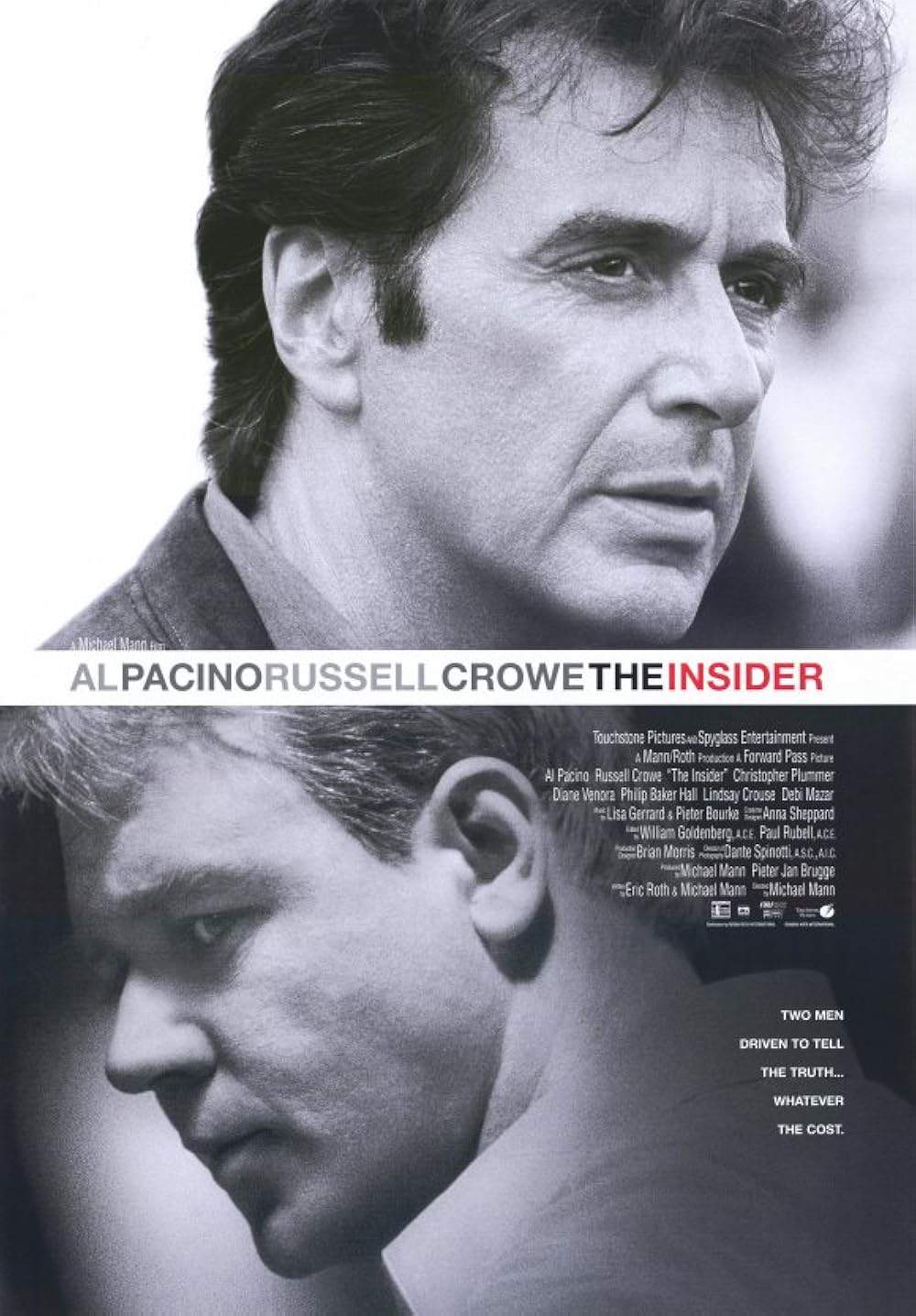
The Insider (1999) movie poster

Plot Summary

The Insider (1999) Plot Summary Explained

Release, runtime and language
1999 · 157 min · English
Directed by
Michael Mann
Starring
Russell Crowe, Al Pacino
Budget
$90M

A city faces potential collapse as detectives pursue a mysterious mastermind in a tense cat-and-mouse game. A tangled web of lies is exposed, leading to a startling revelation about an unassuming individual who has been secretly orchestrating a series of violent crimes. The investigation delves into the individual’s motives and the extent of their influence, threatening to destabilize the city.

On this page (6)
  1. 1 Where to watch
  2. 2 What happens: full plot
  3. 3 Plot questions answered
  4. 4 Movie threads
  5. 5 Movies like The Insider
  6. 6 Every angle

Where to watch

Where to Watch The Insider (1999)

Where can you watch The Insider? Stream, rent or buy it in the US, including on Amazon Video, Apple TV Store and Fandango At Home: current JustWatch availability with up-to-date prices.

Streaming availability powered by JustWatch

Full plot summary · contains spoilers

What Happens in The Insider: Full Plot Summary

The whole story of The Insider (1999) explained, from the opening scene to the final frame: every key event, every twist and what it all adds up to. Read it as a quick recap before the sequel, to check a scene you missed, or to finally understand what really happened.

In Lebanon, Hezbollah militants guide producer Lowell Bergman to meet Sheikh Fadlallah, the founder of Hezbollah. During this encounter, Lowell successfully persuades him to participate in an interview with Mike Wallace (Plummer) for the renowned CBS program 60 Minutes. Meanwhile, in Louisville, Kentucky, Jeffrey Wigand is seen packing his things as he departs from his office at Brown and Williamson. He returns to his family, which includes his wife Liane (Venora) and their two children, one of whom suffers from severe asthma. When Liane inquires about the boxes in his car, Wigand discloses that he lost his job that very morning.

Back in Berkeley, California, Bergman receives an anonymous package containing pivotal documents related to the tobacco giant Philip Morris. Seeking assistance, he contacts a friend at the FDA to obtain a translator's name and is led to Wigand. Initially resistant, Wigand ultimately agrees to meet with Bergman at the Seelbach Hotel in Louisville. In the confidentiality of their hotel room, Wigand consents to translate the tobacco documents but insists he cannot disclose any further information due to a confidentiality agreement.

After their meeting, Wigand is summoned by Brown and Williamson CEO Thomas Sandefur (Gambon), who pressures him to sign an expanded confidentiality agreement, threatening the revocation of his severance pay and legal action. Fueled by anger and suspicion that Bergman has disclosed their confidential discussion, Wigand confronts him over the phone.

The following day, Bergman visits Wigand at his home, explaining that he hasn’t shared anything with Brown and Williamson. This reassurance allows Wigand to open up about the CEOs of Big Tobacco lying to Congress regarding their knowledge of nicotine addiction, highlighting the power Wigand holds against them. Bergman urges him to decide for himself whether he’s willing to expose the tobacco industry.

After returning to CBS headquarters in New York City, Bergman discusses Wigand’s predicament with Wallace, contemplating the impact he could have on Big Tobacco. They face legal counsel who warns them that Wigand's confidentiality agreement coupled with the vast resources of Big Tobacco poses a substantial risk of litigation that could silence him. Bergman suggests that a court could compel Wigand to testify, potentially providing protection if he goes through with the 60 Minutes interview.

As the Wigand family transitions to a smaller, more affordable home, Wigand embarks on a new career teaching high school chemistry and Japanese. One night, his daughter wakes him, alerting him to suspicious noises outside. Upon inspecting the area, he finds a fresh shoe print in his garden, which feeds his paranoia. Later, at dinner with Bergman, they discuss incriminating incidents from Wigand's past that could be leveraged against him, yet he remains confident that they should not affect his testimony.

Bergman reaches out to Richard Scruggs (Feore) and Ron Motley (McGill), who, alongside the attorney general of Mississippi, Mike Moore, are suing Big Tobacco to reclaim Medicaid resources spent on tobacco-related health issues. They express interest in Wigand’s situation and encourage him to reach out. However, amidst escalating threats, including a bullet found in his mailbox, Wigand contacts the FBI for protection, although they question his mental state, confiscating his computer.

Angry for the danger posed to his family, Wigand calls Bergman, insisting on flying to New York to record his testimony. During the interview with Wallace, Wigand explains how Brown and Williamson enhanced nicotine absorption in the lungs to increase its addictive potential, openly admitting that they disregarded public health in pursuit of profit.

After settling into his teaching role in Louisville, Wigand meets with Scruggs. He soon realizes that Bergman has arranged for security personnel to protect him, yet the pressure strains his marriage, as Liane expresses her struggles. Soon, Wigand is served a restraining order from Kentucky prohibiting him from testifying, a tactic used by Brown and Williamson's attorneys. Though this order is nullified in Mississippi, the looming threat of imprisonment weighs heavily on him. Ultimately, Wigand decides to give his deposition, where he asserts that nicotine behaves like a drug. Following his testimony, he returns home only to find that Liane and the children have left him.

At this juncture, the narrative pivots towards Bergman. He attends a critical meeting with CBS Corporate regarding Wigand’s interview. They uncover a new legal concept called Tortious interference, indicating that increased truthfulness from Wigand could lead CBS into a multi-billion dollar lawsuit from Big Tobacco. Corporate interests propose to edit the interview to mitigate risks, but Bergman passionately disagrees, feeling that such actions would compromise their journalistic integrity. In a desperate bid to uphold the truth, Bergman insists that the uncensored interview must air.

In retaliation, Big Tobacco launches a smear campaign against Wigand, unearthing personal details and creating a damaging dossier. Recognizing this as a necessity to act, Bergman navigates the information with the Wall Street Journal to counter the misinformation. Despite difficulties at CBS, including being ordered on vacation due to conflicts with management, Bergman continues to fight for the truth.

Eventually, the edited interview airs, leading Bergman to attempt contacting Wigand, who initially does not respond. When he finally connects with Wigand, tensions rise as Wigand accuses him of manipulation. Bergman implores Wigand, emphasizing the importance of his truth and the rarity of heroes like him. Following this, Bergman informs the New York Times about the discrepancies surrounding the 60 Minutes interview, inciting a scathing critique of CBS for compromising its esteemed journalistic standards, while the Wall Street Journal defends Wigand, exposing Big Tobacco’s smear campaign as a disgraceful tactic.

In the film's concluding moments, 60 Minutes ultimately broadcasts the full, unedited interview with Wigand. The narrative culminates with Bergman confiding in Wallace about his resignation, boldly stating that the damage done to the network's legacy cannot be repaired. The camera captures him departing the building, with a series of title cards revealing the $246 billion settlement reached with Big Tobacco and honoring Wigand's achievements as a dedicated teacher awarded the Sallie Mae First Class Teacher of the Year prize in 1996. Meanwhile, Bergman finds his path leading him to the PBS program Frontline and to a teaching role at the Graduate School of Journalism at the University of California, Berkeley.

Last updated: November 16, 2024 at 11:22

Was this helpful?

Plot questions answered

The Insider Plot Explained: Your Questions Answered

The questions people ask most about The Insider (1999): what happens in the confusing scenes, why the characters do what they do, the twists, hidden details and what the ending means. Each answer contains spoilers.

Q1

Why did Jeffrey Wigand lose his job at Brown and Williamson?

Jeffrey Wigand was fired from his position as a senior executive at Brown and Williamson after discovering and becoming uncomfortable with the company's secret practices. He was let go while the company was in the process of laying off employees, but his termination was likely motivated by his growing knowledge of illegal activities within the company, particularly regarding nicotine manipulation.

  • jeffrey wigand
  • brown and williamson
  • firing
  • whistleblower
  • job loss
Q2

How did Brown and Williamson manipulate nicotine levels?

Brown and Williamson deliberately enhanced nicotine absorption in the lungs to increase the addictive potential of their cigarettes. During his 60 Minutes interview, Jeffrey Wigand revealed that the company intentionally increased nicotine levels knowing this would make smokers more dependent, prioritizing profit over public health.

  • nicotine
  • addiction
  • brown and williamton
  • manipulation
  • public health
Q3

Why did CBS edit the 60 Minutes interview with Jeffrey Wigand?

CBS corporate executives decided to edit the interview due to legal concerns about tortious interference. Their legal counsel warned that if Wigand's full, unedited testimony aired, Big Tobacco could sue CBS for billions of dollars. The network prioritized avoiding litigation over journalistic integrity.

Foreshadowing: Earlier warnings about Big Tobacco's vast legal resources and willingness to silence whistleblowers foreshadowed this conflict.

  • cbs
  • 60 minutes
  • interview editing
  • legal threat
  • tortious interference
Q4

Why did Lowell Bergman resign from CBS?

Bergman resigned because he was deeply disappointed that CBS Corporate compromised their journalistic integrity by editing Jeffrey Wigand's interview to protect the network from legal liability. He believed this betrayal of truth was irreparable and could not remain with an organization that would censor important public interest reporting.

  • lowell bergman
  • resignation
  • cbs
  • journalistic integrity
  • 60 minutes
Q5

What happened to Jeffrey Wigand's family after his testimony?

After Jeffrey Wigand gave his deposition and testified publicly about tobacco industry practices, his wife Liane and their two children left him. The intense pressure, threats, and legal battles had severely strained his marriage, and his family could not withstand the ongoing danger and stress.

Foreshadowing: Earlier scenes showing Liane expressing struggles with the mounting pressure foreshadowed this family breakdown.

  • wigand family
  • liane wigand
  • marriage
  • family leaving
  • divorce
Q6

Why did Big Tobacco launch a smear campaign against Jeffrey Wigand?

Big Tobacco launched a smear campaign to discredit Jeffrey Wigand and undermine his credibility as a witness. They created a damaging dossier containing personal information about him, hoping this would weaken his testimony and distract from the revelations about their nicotine manipulation practices.

  • big tobacco
  • smear campaign
  • discredit
  • dossier
  • character assassination
Q7

Why was the Mississippi lawsuit important to Jeffrey Wigand's case?

The Mississippi lawsuit, led by Attorney General Mike Moore along with Richard Scruggs and Ron Motley, was suing Big Tobacco to reclaim Medicaid funds spent on tobacco-related health issues. This case provided Wigand with legal support and demonstrated that multiple states were fighting the same battle against tobacco companies, giving his testimony broader significance.

  • mississippi
  • attorney general mike moore
  • big tobacco lawsuit
  • medicaid
  • scruggs
  • motley
Q8

What was the legal concept of tortious interference that CBS feared?

Tortious interference is a legal concept where one party intentionally disrupts the contractual or business relationship between two other parties. CBS corporate lawyers argued that by encouraging Wigand to break his confidentiality agreement, CBS could be sued for interfering with the contract between Wigand and Brown and Williamson, potentially exposing the network to billions in damages.

  • tortious interference
  • legal concept
  • cbs
  • contract
  • courts
Q9

Why did Jeffrey Wigand contact the FBI for protection?

Wigand contacted the FBI after receiving escalating threats, including a bullet found in his mailbox and a suspicious shoe print in his garden. These intimidation tactics, combined with his paranoia about his family's safety, led him to seek federal protection.

  • fbi
  • protection
  • threats
  • bullet
  • mailbox
  • intimidation
Q10

Why did Jeffrey Wigand decide to testify despite the risks?

Wigand decided to testify after realizing the massive scale of deception by tobacco CEOs who had lied to Congress about their knowledge of nicotine addiction. He recognized the powerful position he held as someone who could expose this corruption and felt a moral obligation to reveal the truth, encouraged by Bergman's persistence.

  • testimony
  • whistleblowing
  • congress
  • lying
  • exposure
  • moral obligation
Q11

What was the $246 billion settlement with Big Tobacco?

The $246 billion settlement was the massive multi-state settlement reached with tobacco companies in 1998, representing funds the industry agreed to pay to cover healthcare costs related to smoking-related illnesses. This was a landmark victory for public health and the result of years of legal battles initiated by state attorneys general.

  • settlement
  • 246 billion
  • tobacco industry
  • states
  • healthcare costs
  • master settlement agreement
Q12

Why was a restraining order issued against Jeffrey Wigand?

Brown and Williamson's attorneys obtained a restraining order from Kentucky courts prohibiting Wigand from testifying. This was a legal tactic to silence him and prevent his deposition from being used in the Mississippi lawsuit. Although the order was eventually nullified in Mississippi, it represented one of many attempts to block his testimony.

  • restraining order
  • kentucky
  • legal tactic
  • testimony ban
  • brown and williamson
Q13

Why did Lowell Bergman travel to meet Sheikh Fadlallah in Lebanon?

At the beginning of the film, Lowell Bergman traveled to Lebanon to secure an interview with Sheikh Fadlallah, the founder of Hezbollah, for CBS's 60 Minutes. This separate journalistic endeavor establishes Bergman's character as a determined producer skilled at obtaining high-profile interviews, while showing the contrasting world of dangerous foreign reporting versus the domestic corporate battles to come.

  • lebanon
  • sheikh fadlallah
  • hezbollah
  • interview
  • 60 minutes
  • bergman

Movie threads

More Movies Like The Insider, by Mood & Story

Curated lists built around what makes The Insider tick: the same mood, the same kind of story or the same emotional payoff. Each list explains why these movies belong together.

Whistleblower Dramas with Tension like The Insider

Ordernary individuals risk everything to expose powerful, dangerous truths. Explore movies like The Insider that delve into the high-stakes world of whistleblowing. If you enjoyed the tense cat-and-mouse game and heavy emotional weight of exposing corporate corruption, you'll find similar stories of journalistic integrity and personal sacrifice here.

  • tense
  • urgent
  • sobering
  • frustrated
  • dogged
  • paranoid
  • Tone: tense, sobering, urgent
  • Pacing: steady, methodical
Why these movies?

The story pattern: Stories in this thread typically begin with a discovery of wrongdoing, leading to a protagonist's agonizing decision to come forward. The narrative follows the escalating legal and personal threats they face, balancing the pursuit of justice with the devastating cost to their personal life and safety.

Why they belong together: These movies are grouped by their core premise of an individual confronting a powerful system. They share a tense, urgent tone, a methodical pace that builds suspense, and a heavy emotional focus on the consequences of telling the truth.

Gripping Journalistic Procedurals like The Insider

Stories where the slow, determined pursuit of a story builds gripping tension. Find movies similar to The Insider that capture the determined, step-by-step work of investigative journalism. These films share a steady pacing, a tense atmosphere, and a heavy emotional weight as reporters doggedly pursue a story against powerful opposition.

  • dogged
  • tense
  • sobering
  • frustrated
  • urgent
  • meticulous
  • Tone: tense, dogged, sobering
  • Pacing: steady, deliberate
Why these movies?

The story pattern: The narrative pattern involves reporters or investigators following a lead, facing obstacles and dead ends, and building their case piece by piece. The drama comes from the procedural details, editorial debates, and the mounting pressure to get the story right, often culminating in a publishing climax with significant repercussions.

Why they belong together: They are united by a focus on the journalistic method as the primary driver of the plot. This creates a shared vibe of intellectual rigor, dogged determination, and a specific kind of tension that comes from uncovering facts rather than action-oriented sequences.

If you liked this

Movies Like The Insider

Similar movies to The Insider: the same genre, themes or kind of story. Each one comes with its own plot summary, timeline and ending explained.

Browse all movie summaries

Every angle

The Insider (1999) Explained: Plot, Timeline & Characters

Everything about The Insider in one place: what happens in the plot summary, the timeline in chronological order, the characters and meaning and a spoiler-free summary. What's After the Movie adds the cast, box office and post-credit scenes.

Coming soon on iOS and Android

The Plot Explained Movie Summary App

Plot summaries, endings explained and timelines on your phone. Catch up on any movie in minutes, save your favorites and never miss a twist again.

Be the first to know when we launch. Your email stays private, always.

Learn more about the app