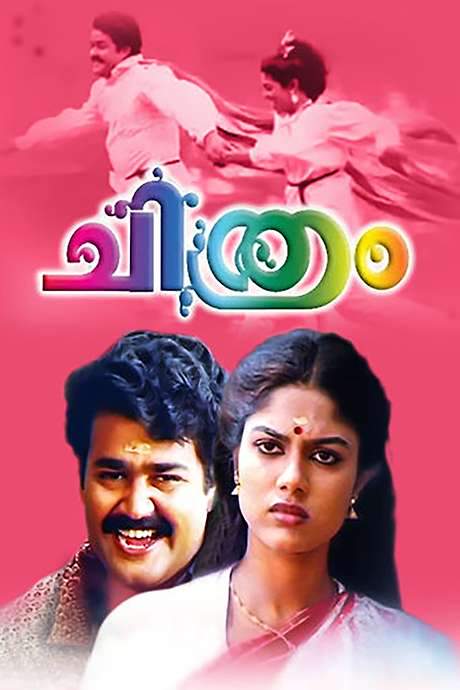
Kalyani, Ranjini, the daughter of a wealthy NRI Ramachandran Menon living in the United States, is raised in Madras by Purushothaman Kaimal, Nedumudi Venu. She falls in love with another man and, defying her father’s wishes, decides to marry him. When her fiancé learns that she would be disinherited, he abandons her at the altar. To salvage her happiness, her ill father sends a letter approving the match and suggests a fortnight’s vacation at his estate near a tribal community where Menon is the chief, hoping to create a joyful memory for his ailing self. In a bid to spare her dignity, Kaimal and Kalyani decide to keep the heartbreak under wraps and pretend the engagement never truly ended.
Kaimal then crosses paths with Vishnu, Mohanlal, a wily man who once pulled a fast one on a foreigner by fabricating a story that his brother cannot swim. When the foreigner leaps into the river, Vishnu makes off with the clothes, drawing a sharp rebuke. The foreigner questions Kaimal about the missing garments, and Kaimal ends up slapped in the confusion. Sensing a practical solution, Kaimal hires Vishnu to play the role of the husband for fourteen days, providing money in exchange for a chance at a life he hasn’t earned yet.
Meanwhile, Bhaskaran Nambiar, Sreenivasan, the estate’s caretaker and Kalyani’s cousin, is wary of losing the inheritance and is determined to derail the ruse. He makes a series of botched attempts to prove that Vishnu isn’t the real husband, using every trick in the book to unravel the arrangement before Menon returns or the truth surfaces.
At first, the pretend marriage is all friction and quarrels, with barbed humor and sharp exchanges as the two strangers collide. Yet as time passes, Kalyani begins to see something warmer in Vishnu’s heart. When a tense moment arrives, he ties the mangalasutra around her neck just before her father returns, a detail Bhaskaran had warned might come to light to protect the illusion—though he later reveals that he told Menon she didn’t have the ceremonial necklace. The growing bond gives Kalyani hope that love might truly be possible beyond the facade she agreed to.
A mysterious visitor then appears, claiming to be a relative of Vishnu, adding a layer of suspense and doubt. The truth about Vishnu’s past is soon revealed through a series of flashbacks: Vishnu is an escaped convict from jail, serving a death sentence, and the visitor turns out to be the prison warden. In another layer of memory, we learn that Vishnu was once a freelance photographer who married Revathy, a mute dancer, and they had a child together. Rumors and suspicions creep in as Vishnu uncovers troubling signs about Revathy’s fidelity. When he confronts what he discovers, Revathy dies in a struggle with a man who is actually her brother—her sibling, who also happens to be a naxalite.
Vishnu explains to Kalyani that he escaped to raise money for his child’s surgery, a motive that complicates the moral landscape of their relationship. The warden’s presence looms large, and the couple’s future feels precarious. On the final night of Vishnu’s stay, he asks the jail authority if there could be room for life beyond the bars, a question the warden cannot answer. After a blissful fortnight, Menon returns to the United States, unwittingly sealing Vishnu’s fate to the life he left behind.
The movie closes with a heartbreaking tableau: the warden escorts Vishnu back to jail, where an execution awaits him, while Kalyani watches from a distance. The two characters share a quiet farewell as they wave goodbye to one another, preserving a memory of what could have been while acknowledging the harsh realities that cannot be escaped.