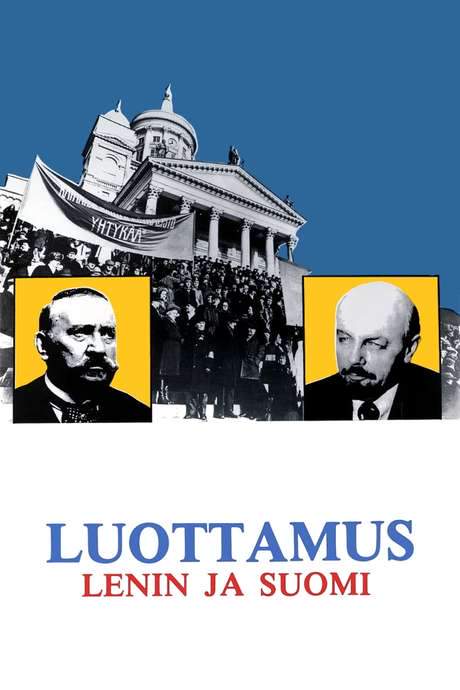
Trust unfolds at the end of December 1917, when the Finnish delegation travels to St. Petersburg to seek recognition for Finland's independence. Finnish Prime Minister P. E. Svinhufvud, Vilho Siivola, travels with diplomats Carl Enckell Yrjö Tähtelä and Gustaf Idman Yrjö Paulo to press Finland’s case, while Bolshevik leader Lenin, Kirill Lavrov, weighs how to respond to this bid and how it might shape his nationality policy and his personal stance toward Finland.
The film uses a rich tapestry of flashbacks to illuminate Finland’s path to autonomy and eventual independence, and to trace Lenin’s evolving relation to Finland across 1899–1917. It sketches a century of tension and negotiation, weaving together political pressure, ideological shifts, and personal entanglements that would influence both sides.
Among the pivotal moments it revisits are the rejection of the Great Petition in St. Petersburg in 1899, a dramatic episode that underscored Finland’s unresolved status under rule from Moscow. It recalls Eugen Schauman’s bold act in 1904, when Eugen Schauman shot Governor General Nikolai Bobrikov, an event that radiated through Finnish and Russian governance. The story then moves to 1907, when Lenin himself wanders the Turku archipelago after escaping Finland, an image that highlights the cross currents between exile, ideology, and national fate.
In 1910, Purishkevich delivers the infamous call in the Russian Duma:
> Finis Finlandiae!
This moment underscores the volatile mood of the era and the unresolved political drama surrounding Finnish autonomy. The film also depicts the 1910 parliamentary scene, where the chamber led by P. E. Svinhufvud refuses to accept national legislation, signaling the endless back-and-forth that defined Finland’s struggle.
As 1917 unfolds, the narrative shows the Finnish Parliament, led by speaker Kullervo Manner, convening in the autumn despite dissolution orders. It then follows Lenin’s shadowy presence in Helsinki, where he hides with Kustaa Rovio Eero Salmi during the fall of 1917. The drama intensifies as Kullervo Manner, Yrjö Sirola Jarno Hiilloskorpi, and K. H. Wiik attend Lenin’s December speeches, movements that frame the Irreducible tug-of-war between revolutionary currents and national sovereignty.
Ultimately, Lenin’s government grants Finland’s recognition to the Svinhufvud delegation in December 1917, a milestone that comes after centuries of negotiation and conflict. The film closes with a brisk montage that connects this turning point to the future, ending with a clip from a 1975 Helsinki OSCE meeting, which situates the Finland of 1917 within a longer arc of European diplomacy and memory.
Throughout, the film keeps a measured, documentary tone, letting history breathe through its carefully arranged vignettes while anchoring the human stories in well-drawn characters and their real-world counterparts. This is a movie about endurance, negotiation, and the stubborn, hopeful thread of national self-determination that runs through a century of upheaval.