Plot Explained Spoilers guaranteed!
Plot Explained

Browse by genre

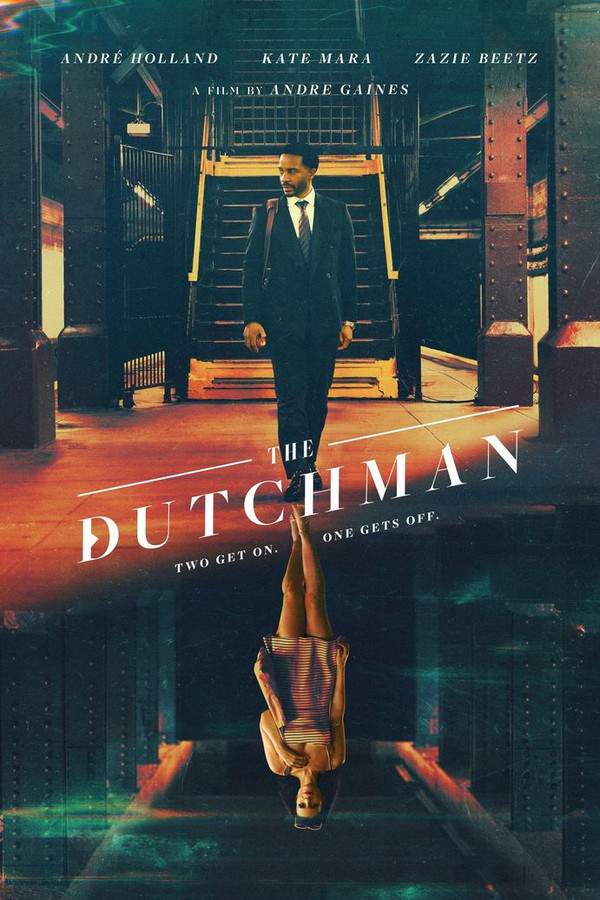
The Dutchman (2026) movie poster

Ending Explained

The Dutchman (2026) Ending Explained – Final Scene & Meaning

Release, runtime and language
2026 · 1 h 28 m · English
Echo score 64
Loading streaming availability…
Directed by
Andre Gaines
Starring
Zazie Beetz, Kate Mara, Aldis Hodge, Lauren E. Banks, Christopher McVay, Michael Laurence

Clay (André Holland), a successful yet troubled Black businessman, attends therapy with his wife, Kaya (Zazie Beetz), hoping to save their marriage. Their mysterious therapist soon appears outside the sessions, intruding on Clay’s daily life. The therapist even follows him onto a New York subway, where a tense encounter heightens the unease.

On this page (7)
  1. 1 Where to watch
  2. 2 What happens at the end
  3. 3 Final events in order
  4. 4 Ending questions answered
  5. 5 Movie threads
  6. 6 Movies like The Dutchman
  7. 7 Every angle
Loading streaming availability…

Ending explained · contains spoilers

What Happens at the End of The Dutchman?

How The Dutchman (2026) ends, what the final scene means, which earlier moments set it up and how to read the ending if the film leaves it open. The full ending explained, with every spoiler.

The ending of Andre Gaines' The Dutchman transforms the tragedy of Amiri Baraka's original 1965 play into a story of empowerment and self-discovery. In a significant departure from the source material, Clay survives his encounter with the demon Lula and breaks the cycle of violence that had claimed so many men before him. Throughout the film, Lula represents an ancient evil that preys on Black men who remain silent in the face of racism and humiliation. She is both a literal demon and a metaphor for the persistent, shape-shifting nature of racism in America—an old evil that continually reinvents itself. For decades, she has hunted young Black men on the subway, and each time, they chose to look away, to swallow their anger, and ultimately to become her victims.

Clay, however, refuses to follow that path. Guided by his therapist, Dr. Amiri—who is revealed to be the architect of this psychological journey—Clay confronts Lula not with the violence she provokes, but with something far more powerful: his voice. When Lula attacks him with a knife, Clay defends himself, and in the ensuing struggle, Lula is killed. The arrival of two white police officers who immediately assume Clay's guilt underscores the film's sharp critique of systemic bias, but a Black woman on the train, the Mystic Lady, captures video evidence that proves Clay acted in self-defense. This act of kindness from a stranger is what ultimately saves Clay, demonstrating that community and compassion are just as vital as individual courage.

The film's final scenes reveal that the entire subway ordeal may have unfolded within Clay's subconscious. Dr. Amiri had orchestrated this internal journey to help Clay resolve his crisis of identity and find his voice. When Clay returns home to his wife, Kaya, he is no longer the silent, conflicted man who could not articulate his pain. He holds a copy of Dutchman that is now completely blank inside, symbolizing that he has broken free from the script others had written for him. The past, as Dr. Amiri tells him, is prologue—but Clay understands that it does not have to define his future. He has reclaimed his narrative, choosing to face his fears, speak his truth, and forge a new path forward on his own terms.

Last updated: March 14, 2026 at 20:21

Was this helpful?

The last 4 events

How The Dutchman Ends: The Final Events in Order

The last events of The Dutchman (2026) in chronological order, the run-up to the ending explained above. The complete timeline has all 12 events, scene by scene.

Open the full timeline
  1. The theater inside the journey reveals Lula as Clay's darkest thoughts

    On the way home, Clay steps into a full-scale theater with shelves of Dutchman copies and realizes Lula's lines appear verbatim in the text. Amiri materializes to explain that Lula embodies his darkest thoughts. They debate whether Clay must die as the play’s tragedy dictates.

    When
    on the walk home
    Where
    mind's theater / inner journey
  2. Clay re-enters the subway; Lula reappears and initiates again

    Clay returns to the subway to continue the story and Lula magically materializes, intent on repeating the sexual encounter. He refuses, asserting his true self as a Black man and demanding autonomy. The tension escalates as the world seems to bend around their choices.

    When
    mid-journey
    Where
    subway car
  3. A knife, a stabbing, and a police take-down

    When Clay tries to exit, Lula attacks with a knife and he responds by stabbing her, deviating from the play's ending. Two officers board the train and arrest him, despite a Black eyewitness insisting his innocence. Lula later shows a video that sways the cops toward a reluctant stance.

    When
    immediately after the stabbing
    Where
    subway car
  4. Resolution: Clay walks home in the sunshine after reconciliation with Kaya

    With the video exonerating him and the arrest behind him, Clay walks home in the sunshine and makes amends with Kaya. The day’s trials resolve into a fragile peace, echoing the play's themes about truth, perception, and freedom. The city’s light contrasts with the earlier darkness of the journey.

    When
    end of the sequence
    Where
    city streets / home

Ending questions answered

The Dutchman Ending: Your Questions Answered

The questions people ask most about the ending of The Dutchman (2026): what the final scene means, how the twist works, what happens to each character and how to read the ending. Each answer contains spoilers.

Q1

Does Clay die at the end of The Dutchman?

No, Clay survives. In a major departure from Amiri Baraka's original 1964 play, in which the protagonist Clay is killed on the subway, the film version allows Clay to live. After killing Lula in self-defense and being briefly arrested, Clay is cleared thanks to video evidence and returns home to his wife, Kaya, having undergone a profound transformation.

Foreshadowing: Dr. Amiri's therapy sessions early in the film already hint that this Clay is on a different path than the one in the source material, preparing viewers for a rewritten outcome.

  • clay death
  • ending
  • survives
  • dutchman play comparison
Q2

Who or what is Lula in The Dutchman?

Lula is both a literal demon and a powerful metaphor for the persistent, shape-shifting nature of racism in America. She is described as an ancient evil that has hunted young Black men on the subway for decades, preying specifically on those who remain silent when confronted with racism and humiliation. Her role in the story is to provoke Black men into either responding with violence or succumbing to shame, and she has claimed countless victims who chose to look away.

Foreshadowing: Lula's cat-like movements and the unsettling dreamlike quality of the subway early in her scenes hint that she is not an ordinary woman.

  • lula
  • demon
  • racism metaphor
  • symbolism
Q3

Who is Dr. Amiri and what is revealed about him?

Dr. Amiri is Clay's therapist, and the film reveals that he is the architect of Clay's entire psychological journey. He deliberately orchestrated the internal confrontation with Lula as a form of therapeutic intervention, designed to help Clay confront his crisis of identity, find his voice, and break free from the destructive patterns that had been holding him back. The name 'Amiri' itself is a direct nod to Amiri Baraka, the author of the original play, suggesting that the therapist is guiding Clay through a reinterpretation of the very story the play tells.

Foreshadowing: Dr. Amiri's unusually probing questions during the early therapy sessions hint that he knows more about Clay's inner struggles than a typical therapist would.

  • dr amiri
  • therapist
  • identity journey
  • amiri baraka
Q4

Was the subway confrontation real or in Clay's mind?

The film deliberately leaves this ambiguous, but the final scenes strongly suggest that the subway ordeal unfolded primarily within Clay's subconscious. After killing Lula and being cleared by the police, Clay returns home as a changed man, and Dr. Amiri confirms that the past is merely prologue. The blank book Clay carries home and his healed relationship with Kaya both support the interpretation that the entire subway sequence was an internal reckoning, a psychological journey engineered to force Clay to find his voice and reclaim his identity.

Foreshadowing: Dr. Amiri's very name and the theatrical framing of the therapy sessions suggest from the beginning that the line between reality and performance is blurred in Clay's world.

  • subconscious
  • internal journey
  • reality
  • magical realism
Q5

Why is the copy of Dutchman blank at the end?

The blank book symbolizes Clay's freedom from the script that others, and history itself, had written for him. Throughout the film, Clay has been trapped in a predetermined narrative where Black men either submit to racism or are destroyed by it. By holding a book whose pages are now empty, Clay visually demonstrates that he has broken that cycle. The story no longer dictates his fate; he is the author of what comes next.

Foreshadowing: Clay's earlier inability to read or engage with the book during therapy foreshadows that its contents will eventually change to reflect his internal transformation.

  • blank book
  • symbolism
  • reclaiming narrative
  • dutchman book
Q6

What does Dr. Amiri mean when he says 'the past is prologue'?

Dr. Amiri uses this Shakespearean phrase to tell Clay that while history, trauma, and inherited patterns shape who he is, they do not have to determine where he goes. The past provides the opening chapter, the setup, but Clay is free to write everything that follows. For Clay, this means the violence and silence that defined generations of Black men confronting racism do not have to be his fate. He can begin a new story on his own terms.

Foreshadowing: The phrase echoes throughout the therapy scenes, where Dr. Amiri repeatedly asks Clay about his relationship to his own history and identity.

  • past is prologue
  • meaning
  • shakespeare
  • interpretation
Q7

Who is the Mystic Lady on the train?

The Mystic Lady is a Black woman passenger who witnesses Clay's struggle with Lula and uses her phone to record video evidence proving that Clay acted in self-defense. Her intervention is what saves Clay from being convicted by the biased police officers. Beyond her practical role, she represents the power of community and collective witness, a counterforce to the isolation that has allowed evil like Lula to thrive for so long. Her quiet act of solidarity reinforces the film's message that compassion from strangers can be as transformative as personal courage.

  • mystic lady
  • video evidence
  • community
  • solidarity
Q8

Why do the police immediately assume Clay is guilty?

The arrival of two white police officers who instantly side against Clay, despite clear evidence that Lula attacked him first, is the film's sharpest critique of systemic racial bias in law enforcement. The scene illustrates how Black men are routinely presumed guilty regardless of circumstance, and how institutional power can override truth. The film places this moment immediately after Clay's act of self-defense to highlight that even surviving an attack is not enough to escape the machinery of racial injustice.

Foreshadowing: Earlier conversations between Clay and Kaya about how Black men are perceived in public spaces foreshadow this moment of unjust confrontation.

  • police
  • systemic racism
  • false accusation
  • injustice
Q9

How does Clay defeat Lula on the subway?

Clay defeats Lula by refusing the role she has assigned him. Instead of remaining silent and becoming her victim, or matching her provocations with reactive violence, Clay finds his voice and confronts her directly on his own terms. When she ultimately attacks him with a knife, Clay defends himself physically and kills her, but the real victory is psychological: he broke the cycle that had destroyed generations of Black men before him. The film reframes this not as vengeance but as self-liberation.

Foreshadowing: Dr. Amiri's early insistence that Clay must 'find his voice' directly sets up the moment when Clay's words, not his fists, become his primary weapon.

  • clay victory
  • self-defense
  • finding voice
  • cycle of violence
Q10

How is the ending of The Dutchman different from the original play?

In Amiri Baraka's original 1964 play Dutchman, Clay is stabbed and killed by Lula on the subway, a tragic ending that symbolizes the destruction of Black men who dare to challenge white expectations. The 2026 film reimagines this ending as one of empowerment and survival. Clay lives, reconciles with his wife, and walks away having reclaimed his identity. The shift transforms the story from a tragedy about inevitable defeat into a meditation on breaking generational cycles and choosing one's own future.

Foreshadowing: Dr. Amiri's name and his role as a guide suggest from the start that the film intends to rewrite the play's fatalistic conclusion.

  • original play
  • comparison
  • amiri baraka
  • 1964 dutchman
Q11

What happens to Clay and Kaya's marriage in the end?

Clay and Kaya's marriage survives and appears to be healing. When Clay returns home after the subway ordeal, he is no longer the silent, conflicted man who could not articulate his pain. The emotional distance and unspoken resentment that had strained their relationship have been replaced by a willingness to speak honestly. While the film does not wrap up every thread neatly, the final reunion implies that Clay's internal breakthrough allows him to finally show up as a present and honest partner.

Foreshadowing: Kaya's frustration with Clay's emotional unavailability in the early therapy scenes establishes the marriage crisis that Clay's transformation ultimately resolves.

  • clay and kaya
  • marriage
  • reconciliation
  • relationship
Q12

What does the ending of The Dutchman symbolize overall?

The ending symbolizes liberation from inherited trauma and the reclamation of personal identity. Clay's survival, the blank book, and his reconciliation with Kaya all represent a break from the predetermined scripts of racism, silence, and self-destruction. The film suggests that healing is possible when a person finds their voice, accepts help from others, and refuses to let the past dictate the future. At the same time, the brief arrest and the still-present threat of systemic injustice leave a moral ambiguity, acknowledging that personal transformation is necessary but not always sufficient against larger forces.

Foreshadowing: Dr. Amiri's recurring question, 'Who are you when no one is watching?' foreshadows the ending's focus on Clay's private, internal identity rather than public performance.

  • ending meaning
  • symbolism
  • liberation
  • transformation

Movie threads

More Movies Like The Dutchman, by Mood & Story

Curated lists built around what makes The Dutchman tick: the same mood, the same kind of story or the same emotional payoff. Each list explains why these movies belong together.

Psychological manipulation thrillers like The Dutchman

When ordinary life becomes a slow tightening noose of manipulation and dread. Movies like The Dutchman where everyday interactions with a partner, therapist, or stranger twist into gaslighting, paranoia, and identity collapse. If you liked The Dutchman's suffocating tension, these psychological thrillers deliver similar mind games, claustrophobic dread, and a sense that reality itself is being rewritten around the protagonist.

  • oppressive
  • claustrophobic
  • paranoid
  • gaslighting
  • unsettling
  • tense
  • Tone: tense, paranoid, oppressive
  • Pacing: variable, slow burn to sudden escalation
Why these movies?

The story pattern: These stories follow a character who enters a seemingly safe space, such as a marriage, a session, or a public routine, only to discover that every conversation is a setup. The antagonist may be charming or seductive at first, then slowly weaponizes intimacy, guilt, or social dynamics. Reality becomes unreliable, the protagonist's grip on truth loosens, and the climax forces a violent or shattering reckoning that often comes too late to undo the damage.

Why they belong together: They share an oppressive, paranoid atmosphere where dread builds in quiet moments and erupts into confrontation. Tone stays tense throughout, pacing is variable rather than action-driven, and complexity comes from layered psychological games. The emotional weight is heavy, and endings tend to leave moral ambiguity unresolved rather than neatly restoring safety.


Surreal racial dramas like The Dutchman

Literary stories that use surrealism to crack open racial tension and identity. If you liked The Dutchman's blend of literary adaptation, magical realism, and racial tension, these films use dreamlike imagery and symbolic structures to explore Black identity, interracial marriage, and social hostility. Expect complex narratives, mixed or ambiguous endings, and emotionally heavy stories that resist easy answers.

  • surreal
  • racially charged
  • existential
  • dreamlike
  • literary
  • philosophical
  • Tone: heavy, uneasy, philosophically charged
  • Pacing: variable, contemplative with sudden ruptures
Why these movies?

The story pattern: Characters drift through encounters that feel staged or symbolic, often trapped in recurring patterns that mirror generational or societal violence. Conversations double as philosophical arguments about freedom, performance, and survival. The story resists realism, settings shift in mood, antagonists shift in meaning, and the narrative culminates in a confrontation that exposes the rot beneath a polished surface, leaving moral questions unresolved.

Why they belong together: They share literary DNA and a willingness to use surreal or theatrical devices to talk about race and identity. Pacing is variable, complexity is high, and the tone tends toward heavy and uneasy. Endings often feel mixed or ambiguous, and viewers looking for race stories that go beyond social realism will find their company here.

If you liked this

Movies Like The Dutchman

Similar movies to The Dutchman: the same genre, themes or kind of story. Each one comes with its own plot summary, timeline and ending explained.

Browse all movie summaries

Every angle

The Dutchman (2026) Explained: Plot, Ending, Timeline & Characters

Everything about The Dutchman in one place: what happens in the plot summary, the timeline in chronological order, the characters and meaning, the ending explained and a spoiler-free summary. What's After the Movie adds the cast, box office and post-credit scenes.

Coming soon on iOS and Android

The Plot Explained Movie Summary App

Plot summaries, endings explained and timelines on your phone. Catch up on any movie in minutes, save your favorites and never miss a twist again.

Be the first to know when we launch. Your email stays private, always.

Learn more about the app