Plot Explained Spoilers guaranteed!
Plot Explained

Browse by genre

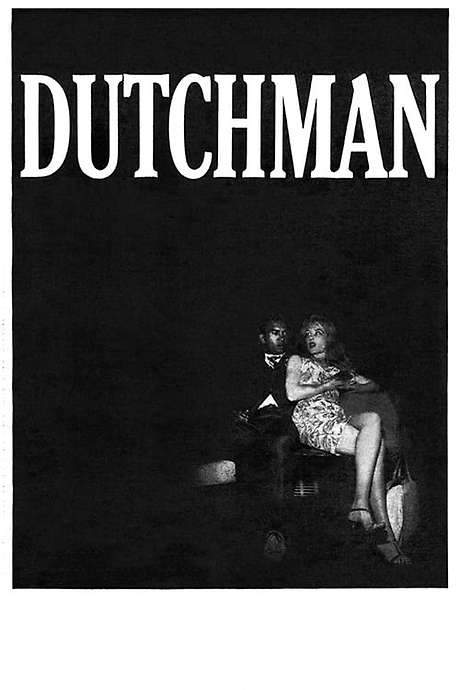
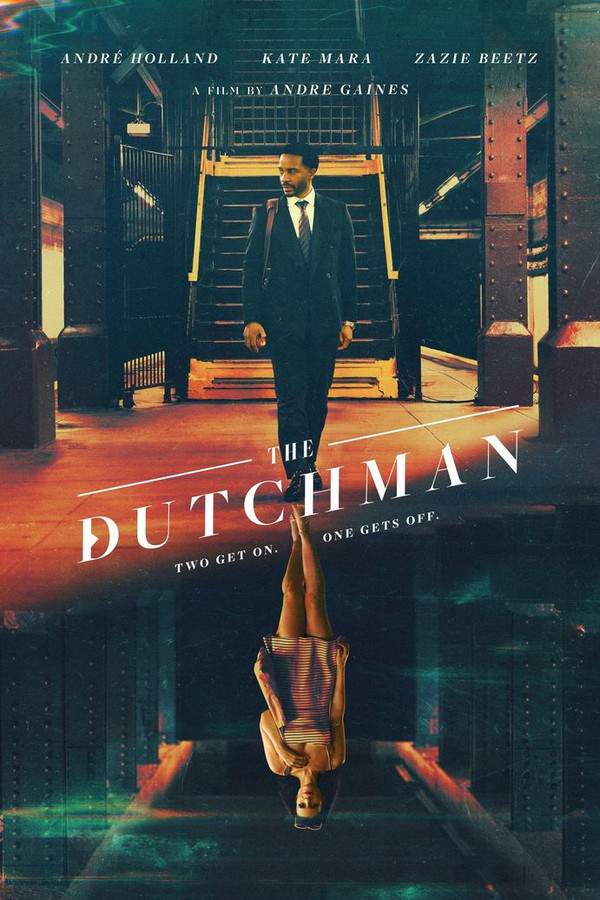
The Dutchman (2026) movie poster

Plot Summary

The Dutchman (2026) Plot Summary & Ending Explained

Release, runtime and language
2026 · 1 h 28 m · English
Echo score 64
Loading streaming availability…
Directed by
Andre Gaines
Starring
Zazie Beetz, Kate Mara, Aldis Hodge, Lauren E. Banks, Christopher McVay, Michael Laurence

Clay (André Holland), a successful yet troubled Black businessman, attends therapy with his wife, Kaya (Zazie Beetz), hoping to save their marriage. Their mysterious therapist soon appears outside the sessions, intruding on Clay’s daily life. The therapist even follows him onto a New York subway, where a tense encounter heightens the unease.

On this page (7)
  1. 1 Where to watch
  2. 2 What happens: full plot
  3. 3 Plot questions answered
  4. 4 How it ends
  5. 5 Movie threads
  6. 6 Movies like The Dutchman
  7. 7 Every angle
Loading streaming availability…

Full plot summary · contains spoilers

What Happens in The Dutchman: Full Plot Summary

The whole story of The Dutchman (2026) explained, from the opening scene to the final frame: every key event, every twist and what it all adds up to. Read it as a quick recap before the sequel, to check a scene you missed, or to finally understand what really happened.

In New York City, Dr. Amiri Baraka gives Clay, André Holland a copy of his play Dutchman, with the advice that understanding struggle can lead to freedom. When Clay talks on the phone with his friend Warren while entering the Subway, Amiri uses a magical theater model to transport him into a world where racism is more open and unflinching. The story unfolds with themes from the play, yet unfolds in fresh settings that keep the tension personal and immediate.

At the next station Lula, Kate Mara stares at Clay, enters his subway car, and strikes up a conversation. Clay remains unsure if anything she says is true, such as her guessing he has a friend named Warren who looks like him. Lula invites herself to the party he’s attending. They exit together and go to her apartment where she seduces him. After they have sex, Clay notices the same theater model in Lula’s apartment that he saw earlier at Amiri’s place. They get into an argument, and when Clay walks out the door, she screams loudly enough for the neighbors to hear. She then threatens to use the contents of a condom to accuse him of rape if he doesn’t take her to the party.

Lula, the only white person at the party, insults the guests with racist comments. When Clay asks one of them, his wife Kaya, Zazie Beetz about the conversation, they end up rehashing an argument about her infidelity. As Lula spirals further, Warren, Aldis Hodge, asks Clay to remove her for “murdering the vibe.” Instead, Clay experiences an existential crisis, questioning what he gained by living a life planned and never truly messing up.

Clay introduces city councilor Warren, who plans a project to improve Harlem. When Lula threatens to interrupt the speech, Clay runs away. She follows, screams for the police, and gets him arrested. In jail, Amiri, in the next cell, offers guidance before Kaya bails him out. They argue and she leaves.

On the way home, Clay finds himself in a full-scale version of the theater, with a shelf stuffed with copies of the play, and realizes that Lula’s words are embedded in the text verbatim. Amiri appears and explains that she is his darkest thoughts made manifest. They discuss whether Clay must die as the character in the play does.

Clay steps back onto the subway to continue the story. Lula magically reappears and tries to have sex with him. When he refuses, she makes a scene. He asserts that he will not be diminished and demands to be the black man he is. When he tries to get off the train, she attacks him with a knife. In a departure from the play, Clay stabs her instead. Two police officers board and arrest him, despite a black eyewitness proclaiming his innocence. When Lula shows a video of the attack on her phone, the cops relent. Clay walks home in the sunshine and makes up with Kaya.

Last updated: August 28, 2026 at 07:33

Was this helpful?

Plot questions answered

The Dutchman Plot Explained: Your Questions Answered

The questions people ask most about The Dutchman (2026): what happens in the confusing scenes, why the characters do what they do, the twists, hidden details and what the ending means. Each answer contains spoilers.

Q1

What is the magical theater model and how does it pull Clay into the play?

In The Dutchman, Dr. Amiri Baraka gives Clay a miniature theater model that functions as a portal into a heightened version of New York where racism is more direct and confrontational. When Clay is distracted on the subway, the model activates and transports him into a reality that mirrors the world of Amiri Baraka's original play. The same model later appears in Lula's apartment, reinforcing that Clay is no longer navigating his real life but a constructed space shaped by Amiri's themes.

Foreshadowing: Amiri hands Clay the copy of the play right before the model is used, warning that 'understanding struggle can lead to freedom,' hinting that the confrontation ahead is meant to teach him something.

  • magical theater model
  • Amiri Baraka
  • Clay
  • subway
  • play adaptation
  • portal
Q2

Who is Lula really in The Dutchman?

Lula appears to be a volatile white woman Clay meets on the subway, but Amiri later reveals that she is a manifestation of Clay's darkest thoughts made flesh. Her lines appear verbatim in the text of Amiri Baraka's play, confirming that she exists inside the symbolic world the theater model has created. Her provocations are not random cruelty but externalized self-doubt, racism Clay has absorbed, and the internalized pressure that keeps him compliant.

Foreshadowing: Lula guesses impossibly specific details about Clay, like his friend Warren, early in their subway conversation, hinting she already has access to his inner world.

  • Lula identity
  • darkest thoughts
  • manifestation
  • Amiri Baraka play
  • internalized racism
Q3

Why does Lula threaten Clay with a false rape accusation?

After Clay tries to leave her apartment following their argument, Lula screams loud enough to attract neighbors and then weaponizes the contents of a condom to coerce him. She threatens a rape accusation unless he takes her to the party, using the threat of institutional injustice to force compliance. The threat reflects the real-world vulnerability Black men face in such accusations and mirrors the predatory power dynamic at the heart of Baraka's original play.

Foreshadowing: Clay notices the same theater model in Lula's apartment immediately before the argument, suggesting the space itself is rigged against his exit.

  • Lula threat
  • false rape accusation
  • condom threat
  • power dynamic
  • subway scene
Q4

Why does Clay have an existential crisis at the party instead of removing Lula?

When Warren asks Clay to escort Lula out for 'murdering the vibe,' Clay freezes and instead interrogates his own life, wondering what he has actually gained by following every plan and never truly messing up. The crisis is triggered because Lula's racist provocations are surfacing the cost of his controlled, respectable existence. Removing her would mean returning to the script, while staying means confronting the rot underneath it, and he is not ready to do either.

Foreshadowing: Clay's therapy sessions with the mysterious therapist already hint at a buried dissatisfaction with the structure of his marriage and career.

  • existential crisis
  • party scene
  • Warren
  • Clay reflection
  • planned life
Q5

Why does Clay run away from Warren's speech instead of stopping Lula?

Clay is supposed to introduce Warren, a city councilor presenting a Harlem improvement project, but Lula threatens to interrupt the moment. Rather than confront her, Clay flees, which allows Lula to chase him, scream for police, and engineer his first arrest. His decision to run reveals that the symbolic world of the play punishes passivity; by avoiding the confrontation, he surrenders the narrative to her and proves the vulnerability Amiri warned him about.

Foreshadowing: Amiri's earlier warning that 'understanding struggle can lead to freedom' sets up the idea that only by facing the confrontation can Clay escape its loop.

  • Warren speech
  • Clay runs
  • Harlem project
  • Lula pursuit
  • first arrest
Q6

What does Clay discover when he enters the full-scale theater on his walk home?

On the way home after being bailed out, Clay steps into a life-sized version of the miniature theater, where shelves are stacked with copies of Amiri Baraka's play Dutchman. He realizes that Lula's exact words appear verbatim in the printed text, confirming that the entire ordeal has been an enactment of the play rather than a real-life encounter. Amiri then appears in person to explain that Lula is the embodiment of Clay's darkest thoughts and to debate whether he must die the way the play's protagonist does.

Foreshadowing: The miniature model appearing in both Amiri's apartment and Lula's bedroom already hinted that the spaces were linked by the same symbolic logic.

  • full-scale theater
  • verbatim text
  • Lula revelation
  • Amiri Baraka
  • darkest thoughts
Q7

Why does Clay stab Lula instead of dying like the character in the play?

In Amiri Baraka's original Dutchman, the Black protagonist is killed by Lula on the subway, completing a tragic cycle. When Clay reboards the train and Lula tries to seduce him again, he refuses to be diminished, asserts his identity as a Black man, and demands autonomy. When she attacks him with a knife as he tries to exit, he fights back and stabs her, breaking the script's predetermined ending. The deviation is the point: by refusing to play the doomed character, Clay claims authorship over his own story.

Foreshadowing: Amiri's earlier question about whether Clay must die like the character in the play sets up the climactic choice Clay ultimately rejects.

  • Clay stabs Lula
  • deviates from play
  • subway stabbing
  • refuses script
  • autonomy
Q8

How is Clay cleared of charges after stabbing Lula on the subway?

After Clay stabs Lula, two police officers board the train and arrest him despite a Black eyewitness insisting on his innocence. The situation shifts when Lula produces a video on her phone that captures the attack, showing that she drew the knife first and Clay acted in self-defense. The video convinces the officers to back off, and Clay is released. The exoneration is partial and ironic, because the same justice system that ignored the eyewitness quickly accepts a piece of recorded evidence.

Foreshadowing: Lula's earlier willingness to weaponize accusations foreshadows her strategic use of evidence here to control the narrative in her favor.

  • Clay exonerated
  • stabbing video
  • subway police
  • eyewitness
  • evidence
Q9

What does Amiri mean when he says understanding struggle can lead to freedom?

When Amiri hands Clay the play and tells him that understanding struggle can lead to freedom, he is outlining the thesis of the entire film. Amiri argues that Clay's polished, controlled life has been a way of avoiding the messy, confrontational work of actually being a Black man in America. By forcing Clay through the escalating humiliations of Baraka's play, Amiri makes him confront the suppressed rage, fear, and identity questions he has been dodging. Freedom, in Amiri's reading, only comes after Clay refuses to die inside the script.

Foreshadowing: The line is delivered in the opening scene with the miniature theater model, before Clay is even pulled into the symbolic world, framing everything that follows as a guided lesson.

  • Amiri Baraka
  • struggle and freedom
  • play thesis
  • Clay lesson
  • opening scene
Q10

Why does Kaya leave Clay after bailing him out of jail?

Kaya posts bail expecting a reconciliation, but Clay arrives home destabilized by his symbolic journey and unable to communicate what has happened. Their argument reignites the unresolved infidelity fight that surfaced earlier at the party, and Clay cannot offer the reassurance Kaya needs. Kaya leaves because the distance between them is no longer just about her affair but about Clay's refusal to be fully present, a gap the surreal day has made impossible to ignore.

Foreshadowing: The earlier argument at the party already foreshadowed that the infidelity wound was never healed and would resurface under pressure.

  • Kaya leaves
  • bails out
  • infidelity
  • marriage conflict
  • post-jail argument
Q11

Why does the same theater model appear in both Amiri's apartment and Lula's apartment?

The recurring miniature theater is a visual signal that the two spaces belong to the same constructed world rather than to Clay's actual life. Because Lula is a manifestation of Clay's inner thoughts placed inside the play's symbolic frame, her apartment must operate by the same rules as Amiri's office. Seeing the model twice confirms to Clay, and to the audience, that the subway, the party, and the bedroom are all staged sets in Amiri's lesson rather than coincidental encounters in New York.

Foreshadowing: Amiri tells Clay that the model is meant to teach him, so when it reappears in Lula's apartment it immediately marks her space as part of the same test.

  • theater model
  • Amiri apartment
  • Lula apartment
  • symbolic world
  • recurring object
Q12

Why does Clay reconcile with Kaya at the end of The Dutchman?

After being exonerated, Clay walks home in sunlight rather than retreating into the symbolic world of the play. The violent break with the script and the survival of his arrest give him a clarity he lacked all day, allowing him to finally be honest with Kaya about what he has been avoiding. The reconciliation is fragile, signaled by the meta notes describing a 'mixed' ending, but it works because Clay has stopped performing respectability and started showing up as himself.

Foreshadowing: The therapist framing in the opening scenes established that Clay's marriage could only survive if he confronted the role he was playing in it.

  • Clay Kaya reconciliation
  • ending
  • fragile peace
  • final scene
  • walk home
Q13

How does the film connect to Amiri Baraka's original play Dutchman?

The Dutchman borrows its central scenario directly from Amiri Baraka's 1964 play: a Black man named Clay meets a confrontational white woman named Lula on a New York subway, and the encounter ends in violence shaped by racial tension. The film modernizes the setting, adds a magical realist theater model, and expands Clay's life to include a wife and a Harlem political storyline, but the dialogue in key scenes is taken verbatim from the source text. The theatrical framing, including Amiri Baraka himself appearing as a guide, signals that the movie is a direct conversation with the play rather than a loose adaptation.

Foreshadowing: The opening scene in which Amiri hands Clay the printed play establishes that every later confrontation will be measured against Baraka's original script.

  • Amiri Baraka play
  • original Dutchman
  • 1964 adaptation
  • verbatim dialogue
  • literary source

Ending explained

What Happens at the End of The Dutchman?

How The Dutchman (2026) ends, in short: the final scene, the last twist and what it means for the characters. The full ending explained, with every spoiler, lives on its own page.

Read the full ending explained

The ending of Andre Gaines' The Dutchman transforms the tragedy of Amiri Baraka's original 1965 play into a story of empowerment and self-discovery. In a significant departure from the source material, Clay survives his encounter with the demon Lula and breaks the cycle of violence that had claimed so many men before him. Throughout the film, Lula represents an ancient evil that preys on Black men who remain silent in the face of racism and humiliation. She is both a literal demon and a metaphor for the persistent, shape-shifting nature of racism in America—an old evil that continually reinvents itself. For decades, she has hunted young Black men on the subway, and each time, they chose to look away, to swallow their anger, and ultimately to become her victims.

Clay, however, refuses to follow that path. Guided by his therapist, Dr. Amiri—who is revealed to be the architect of this psychological journey—Clay confronts Lula not with the violence she provokes, but with something far more powerful: his voice. When Lula attacks him with a knife, Clay defends himself, and in the ensuing struggle, Lula is killed. The arrival of two white police officers who immediately assume Clay's guilt underscores the film's sharp critique of systemic bias, but a Black woman on the train, the Mystic Lady, captures video evidence that proves Clay acted in self-defense. This act of kindness from a stranger is what ultimately saves Clay, demonstrating that community and compassion are just as vital as individual courage.

Continue reading the ending (1 more paragraphs)

The film's final scenes reveal that the entire subway ordeal may have unfolded within Clay's subconscious. Dr. Amiri had orchestrated this internal journey to help Clay resolve his crisis of identity and find his voice. When Clay returns home to his wife, Kaya, he is no longer the silent, conflicted man who could not articulate his pain. He holds a copy of Dutchman that is now completely blank inside, symbolizing that he has broken free from the script others had written for him. The past, as Dr. Amiri tells him, is prologue—but Clay understands that it does not have to define his future. He has reclaimed his narrative, choosing to face his fears, speak his truth, and forge a new path forward on his own terms.

The Dutchman ending explained in full

Movie threads

More Movies Like The Dutchman, by Mood & Story

Curated lists built around what makes The Dutchman tick: the same mood, the same kind of story or the same emotional payoff. Each list explains why these movies belong together.

Psychological manipulation thrillers like The Dutchman

When ordinary life becomes a slow tightening noose of manipulation and dread. Movies like The Dutchman where everyday interactions with a partner, therapist, or stranger twist into gaslighting, paranoia, and identity collapse. If you liked The Dutchman's suffocating tension, these psychological thrillers deliver similar mind games, claustrophobic dread, and a sense that reality itself is being rewritten around the protagonist.

  • oppressive
  • claustrophobic
  • paranoid
  • gaslighting
  • unsettling
  • tense
  • Tone: tense, paranoid, oppressive
  • Pacing: variable, slow burn to sudden escalation
Why these movies?

The story pattern: These stories follow a character who enters a seemingly safe space, such as a marriage, a session, or a public routine, only to discover that every conversation is a setup. The antagonist may be charming or seductive at first, then slowly weaponizes intimacy, guilt, or social dynamics. Reality becomes unreliable, the protagonist's grip on truth loosens, and the climax forces a violent or shattering reckoning that often comes too late to undo the damage.

Why they belong together: They share an oppressive, paranoid atmosphere where dread builds in quiet moments and erupts into confrontation. Tone stays tense throughout, pacing is variable rather than action-driven, and complexity comes from layered psychological games. The emotional weight is heavy, and endings tend to leave moral ambiguity unresolved rather than neatly restoring safety.


Surreal racial dramas like The Dutchman

Literary stories that use surrealism to crack open racial tension and identity. If you liked The Dutchman's blend of literary adaptation, magical realism, and racial tension, these films use dreamlike imagery and symbolic structures to explore Black identity, interracial marriage, and social hostility. Expect complex narratives, mixed or ambiguous endings, and emotionally heavy stories that resist easy answers.

  • surreal
  • racially charged
  • existential
  • dreamlike
  • literary
  • philosophical
  • Tone: heavy, uneasy, philosophically charged
  • Pacing: variable, contemplative with sudden ruptures
Why these movies?

The story pattern: Characters drift through encounters that feel staged or symbolic, often trapped in recurring patterns that mirror generational or societal violence. Conversations double as philosophical arguments about freedom, performance, and survival. The story resists realism, settings shift in mood, antagonists shift in meaning, and the narrative culminates in a confrontation that exposes the rot beneath a polished surface, leaving moral questions unresolved.

Why they belong together: They share literary DNA and a willingness to use surreal or theatrical devices to talk about race and identity. Pacing is variable, complexity is high, and the tone tends toward heavy and uneasy. Endings often feel mixed or ambiguous, and viewers looking for race stories that go beyond social realism will find their company here.

If you liked this

Movies Like The Dutchman

Similar movies to The Dutchman: the same genre, themes or kind of story. Each one comes with its own plot summary, timeline and ending explained.

Browse all movie summaries

Every angle

The Dutchman (2026) Explained: Plot, Ending, Timeline & Characters

Everything about The Dutchman in one place: what happens in the plot summary, the timeline in chronological order, the characters and meaning, the ending explained and a spoiler-free summary. What's After the Movie adds the cast, box office and post-credit scenes.

Coming soon on iOS and Android

The Plot Explained Movie Summary App

Plot summaries, endings explained and timelines on your phone. Catch up on any movie in minutes, save your favorites and never miss a twist again.

Be the first to know when we launch. Your email stays private, always.

Learn more about the app