

Plot Explained Spoilers guaranteed!
Plot Explained

Browse by genre

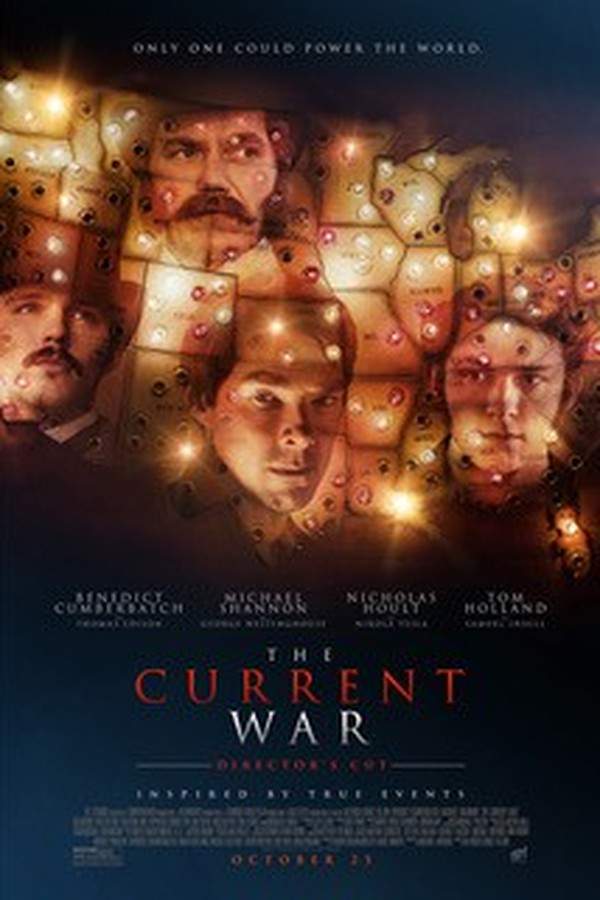
The Current War: Director's Cut (2019) movie poster

Timeline

The Current War: Director's Cut (2019) Timeline Explained – Every Event in Order

Release, runtime and language
2019 · 108 min · English
Echo score 64
Directed by
Alfonso Gomez-Rejon
Starring
Benedict Cumberbatch, Tom Holland, Michael Shannon, Nicholas Hoult, Simon Manyonda, Katherine Waterston
Budget
$30M

A fierce rivalry erupts between Thomas Edison and George Westinghouse as they vie to power America. Edison's direct current (DC) system faces a challenge from Westinghouse's alternating current (AC) technology, with the brilliance of Nikola Tesla driving the innovation. Their escalating competition sparks a dramatic corporate feud, forever changing the landscape of industry and the path to success.

On this page (6)
  1. 1 Where to watch
  2. 2 Events in order (15)
  3. 3 Timeline questions answered
  4. 4 Movie threads
  5. 5 Movies like The Current War: Director's Cut
  6. 6 Every angle

Where to watch

Where to Watch The Current War: Director's Cut (2019)

Where can you watch The Current War: Director's Cut? Stream, rent or buy it in the US, including on Fandango At Home: current JustWatch availability with up-to-date prices.

Streaming availability powered by JustWatch

15 events in order · contains spoilers

The Current War: Director's Cut Timeline: Events in Chronological Order

Every key event of The Current War: Director's Cut (2019) in order, scene by scene, with when and where it takes place. Use it to untangle flashbacks, time jumps and parallel storylines, to refresh your memory before the sequel or to find the exact scene you are thinking of.

  1. Edison's Electric Light-Bulb Unveiling

    In 1880, Thomas Edison unveils his invention of the electric light-bulb in New Jersey. This breakthrough technology promises to revolutionize lighting, offering a cleaner alternative to gaslight, albeit with significant infrastructure costs.

    When
    1880
    Where
    New Jersey
  2. Meeting with the President

    Edison travels to the White House to demonstrate his phonograph to President of the United States and investor J.P. Morgan. Despite an enticing investment offer of $150K from Morgan, Edison declines, maintaining his moral stance against using his inventions for lethal purposes.

    Where
    White House
  3. Lighting Up the NYSE

    On September 4, 1882, Edison successfully lights up the New York Stock Exchange, marking a significant milestone in his efforts to electrify Manhattan's 1st district. This demonstration illustrates the potential of his Direct Current system.

    When
    September 4, 1882
    Where
    New York Stock Exchange
  4. Westinghouse's Dinner Invitation

    Seeking to learn more about Edison's work, businessman and inventor George Westinghouse invites Edison to dinner. However, Edison snubs the invitation and chooses to bypass Pittsburgh entirely.

    Where
    Pittsburgh
  5. Westinghouse's AC Demonstration

    In March 1886, Westinghouse conducts a demonstration of Alternating Current (AC) technology in Great Barrington. This showcase highlights the AC's ability to transmit power over greater distances with reduced costs, setting the stage for competition with Edison's DC system.

    When
    March 1886
    Where
    Great Barrington
  6. Tesla's Disappointment

    Nikola Tesla arrives in the United States and begins working with Edison. However, he quickly grows disillusioned by Edison's refusal to embrace AC technology and his dismissal of Tesla's ideas, leading Tesla to leave Edison's team.

    Where
    Edison Labs
  7. Edison's Publicity War

    Edison launches a campaign to discredit AC, suggesting it is dangerous and lethal. He engages in a publicity war against Westinghouse, who counters by promoting the technical merits of his AC system.

  8. Edison's Personal Tragedy

    Edison's wife, Mary Stilwell, tragically passes away, adding to the emotional strain as he navigates the electric current wars. At the same time, Westinghouse also faces personal loss with the death of his friend in an electrical accident.

  9. Tesla's Electric Company

    Tesla starts his own electric company and begins working on building electric arcs for electricity distribution. However, he encounters severe issues with investors and is eventually fired from his own company, struggling to fund his projects.

  10. Edison Commercializes the Phonograph

    In 1890, Edison commercially sells his phonograph, demonstrating his ability to generate funds despite the ongoing battles over electric current. At the same time, he secretly assists in the creation of the electric chair, showcasing his complex moral position.

    When
    1890
  11. First Electrocution

    William Kemmler becomes the first person to be executed by electrocution, leading to public outrage as media coverage labels the event as 'Far Worse Than Hanging.' This incident forces Westinghouse to hire lawyers to defend AC's morality in court.

  12. Westinghouse's Rebellion

    In the face of adversity, Westinghouse refuses J.P. Morgan's $5 million buyout of his company, even as he faces increasing pressure. Despite disagreement from his wife, Westinghouse decides to continue fighting for AC technology.

  13. World's Columbian Exposition

    The rivalry culminates at the 1893 World's Columbian Exposition in Chicago, where both Edison and Westinghouse present proposals to illuminate the fair. Ultimately, Westinghouse's AC technology triumphs, dazzling fairgoers with its brilliance.

    When
    1893
    Where
    Chicago
  14. Tesla and Westinghouse's Partnership

    Tesla partners with Westinghouse to develop a practical AC motor, leveraging Westinghouse's funding to realize Tesla's vision. This collaboration signifies a shift in the electric current battle, with Tesla's designs proving critical.

  15. Edison's Legacy

    As Edison passes away, the nation honors his contributions by dimming lights for a minute. His inventions, including the motion picture technology, leave a lasting impact on the world, even as Tesla's innovative spirit is ultimately left unrecognized.

Last updated: February 02, 2025 at 08:46

Was this helpful?

Timeline questions answered

The Current War: Director's Cut Timeline Explained: Your Questions Answered

When does it happen, and why in that order? The questions people ask about the chronology of The Current War: Director's Cut (2019): time jumps, flashbacks, cause and effect between scenes and the correct order of events, each answered with spoilers.

Q1

Why did Edison turn down J.P. Morgan's $150,000 investment?

Edison refused the investment because he refused to exploit his inventions to endanger lives. When Morgan proposed the partnership during Edison's demonstration of the Phonograph at the White House, Edison declined on moral grounds, believing his inventions should not be used as weapons. Morgan later decided to support Edison's electrification of Manhattan anyway, leading to Edison lighting the New York Stock Exchange in 1882.

Foreshadowing: This moral stance would later be dramatically undermined when Edison secretly helped develop the electric chair to discredit AC current.

  • j.p. morgan
  • investment
  • thomas edison
  • phonograph
  • white house
Q2

Why did Edison refuse to meet with George Westinghouse?

Edison snubbed Westinghouse's dinner invitation in Pittsburgh because he chose to bypass Pittsburgh entirely during his travels. This personal rejection stred Westinghouse to champion Alternating Current (AC) as a superior technology that could travel larger distances at significantly lower costs than Edison's Direct Current (DC) system, directly fueling their fierce rivalry.

Foreshadowing: Westinghouse's rejection became the catalyst for his commitment to AC technology and his determination to prove Edison wrong.

  • george westinghouse
  • dinner invitation
  • thomas edison
  • pittsburgh
  • Alternating Current
  • Direct Current
Q3

Why did Nikola Tesla leave Edison's company?

Tesla left Edison's company because he became disillusioned with Edison's refusal to embrace new methodologies. Tesla believed fervently that AC was the superior technology requiring far fewer resources. His departure was finalized when Tesla realized Edison's promise of a $50,000 reward for solving five challenges was merely a jest, not a genuine offer.

Foreshadowing: Tesla would later partner with Westinghouse to develop the AC motor that would win the current war.

  • nikola tesla
  • thomas edison
  • alternating current
  • $50000 reward
  • resignation
Q4

How did the electric chair impact the Current War?

The electric chair severely damaged Westinghouse's AC reputation. Edison secretly assisted in developing the electric chair to discredit AC, even though he had previously opposed using inventions to kill. When William Kemmler became the first person executed by electrocution in 1890, it was labeled "Far Worse Than Hanging." However, when called to testify, Edison stated AC was painless, exposing his duplicity and causing public backlash against him.

Foreshadowing: Westinghouse used Edison's hypocrisy to swing public opinion back in his favor, revealing Edison's behind-the-scenes role in the electric chair.

  • electric chair
  • william kemmler
  • execution
  • alternating current
  • thomas edison
  • public relations war
Q5

Why did Westinghouse refuse J.P. Morgan's $5 million buyout offer?

Westinghouse refused Morgan's $5 million offer because he refused to let the future of electrical power depend on Edison's choice. Even when his wife Marguerite urged him not to forsake the company he established, Westinghouse chose to continue fighting for AC technology despite immense financial pressure and the controversy surrounding the electric chair.

Foreshadowing: Westinghouse's refusal proved pivotal when AC technology triumphed at the 1893 World's Columbian Exposition.

  • j.p. morgan
  • $5 million
  • george westinghouse
  • buyout
  • Alternating Current company
Q6

What was the outcome of the 1893 World's Columbian Exposition?

Westinghouse's AC technology triumphed spectacularly at the 1893 World's Columbian Exposition in Chicago. Both Edison and Westinghouse submitted proposals to illuminate the fair, with Samuel Insull representing Edison. Westinghouse's AC exhibit dazzled fairgoers with its innovative lighting solution, securing the contract and proving AC's superiority for large-scale power distribution.

Foreshadowing: This victory cemented AC as the dominant electrical system and marked the turning point in the Current War.

  • worlds columbian exposition
  • chicago 1893
  • westinghouse
  • lighting
  • alternating current
  • samuel insull
Q7

Why did Nikola Tesla die in poverty despite his contributions?

Tesla died impoverished in a New York hotel room despite his revolutionary contributions to electrical engineering. While his partnership with Westinghouse initially showed promise and could have made him a millionaire, Tesla struggled with investors, was fired from his own company, and never achieved financial stability from his inventions. His alternating current patents eventually expired, leaving him without income in his later years.

Foreshadowing: This tragic fate contrasts sharply with Westinghouse's eventual recognition and Edison's lasting commercial success.

  • nikola tesla
  • poverty
  • death
  • hotel room
  • inventor
  • alternating current patents
Q8

Why did Westinghouse receive the Edison Medal?

In 1911, Westinghouse received the prestigious Edison Medal from the American Association of Electrical Engineers, recognizing his contributions to electrical engineering despite his bitter rivalry with Edison. This ironic honor acknowledged that AC technology, which Westinghouse championed and ultimately won with, represented the superior system for power distribution.

Foreshadowing: This recognition came years after their fierce rivalry had ended and represented a form of reconciliation in the engineering community.

  • westinghouse
  • edison medal
  • 1911
  • award
  • american association of electrical engineers
  • recognition
Q9

How did AC current eventually win the rivalry against DC?

AC won because it was 75% more efficient than DC and could transmit power over thousands of miles with just one generator, compared to DC's requirement of 100,000 feet of copper wiring for every 100 customers. Westinghouse's technical superiority, demonstrated at Great Barrington in 1886 and culminating in the 1893 World's Columbian Exposition victory, convinced cities to adopt AC. Additionally, Tesla's innovative motor designs and the Niagara Falls power project proved AC's viability for large-scale distribution.

Foreshadowing: The collaboration between Tesla and Westinghouse at Niagara Falls set the standard for modern electrical distribution.

  • alternating current
  • direct current
  • efficiency
  • transmission
  • tesla
  • westinghouse
  • niagara falls
Q10

What was Edison's involvement in creating the electric chair?

Edison secretly assisted in developing the electric chair specifically to discredit AC current, even though he publicly opposed using inventions for lethal purposes. He collaborated with his allies to design the execution method while claiming AC was dangerous and lethal. When Westinghouse's lawyers called Edison to testify during challenges to the electric chair's morality, Edison's statement that AC was painless exposed his hypocrisy and backfired dramatically.

Foreshadowing: This moral compromise became one of the darkest chapters in Edison's career and ultimately damaged his public reputation.

  • thomas edison
  • electric chair
  • execution
  • alternating current
  • death penalty
  • hypocrisy

Movie threads

More Movies Like The Current War: Director's Cut, by Mood & Story

Curated lists built around what makes The Current War: Director's Cut tick: the same mood, the same kind of story or the same emotional payoff. Each list explains why these movies belong together.

Movies about bitter rivalries like in The Current War: Director's Cut

Stories of fierce personal and intellectual competition that reshape society. If you were fascinated by the high-stakes battle between Edison and Westinghouse, explore more movies like The Current War: Director's Cut. These films capture similar historical dramas and biographical stories where intense personal and corporate rivalries drive technological or societal progress, often with a bittersweet cost.

  • competitive
  • high-stakes
  • dramatic
  • historical
  • driven
  • tense
  • Tone: tense, dramatic, intellectual
  • Pacing: steady, escalating
Why these movies?

The story pattern: These narratives typically follow a clear, escalating conflict between two opposing figures or factions, moving from personal disagreement to public and corporate warfare. The journey explores ambition, pride, and the ethical lines crossed in pursuit of victory, often culminating in a victory that feels pyrrhic for at least one side.

Why they belong together: Movies in this thread share a tense, dramatic tone driven by high-stakes intellectual and corporate competition. They feature a steady pace that methodically builds the rivalry, medium-to-high emotional weight from personal sacrifices, and a bittersweet or complex ending that acknowledges the cost of progress.

Movies about the tragic cost of genius like in The Current War: Director's Cut

Explores the heavy personal price paid for groundbreaking innovation. For viewers moved by the personal tragedies of Edison and the fate of Nikola Tesla, this section finds movies similar to The Current War: Director's Cut. These films focus on genius figures in historical dramas and biographies, where the pursuit of progress comes with a heavy emotional and personal toll, creating a bittersweet viewing experience.

  • tragic
  • dramatic
  • historical
  • melancholic
  • introspective
  • driven
  • Tone: bittersweet, tragic, dramatic
  • Pacing: steady, reflective
Why these movies?

The story pattern: The narrative pattern follows a brilliant individual or group whose drive for innovation leads to professional triumph but personal ruin, loss, or isolation. The story balances the excitement of discovery with the melancholy of what is sacrificed along the way, often ending with a mixed sense of achievement and regret.

Why they belong together: These films are grouped by their shared focus on the melancholy and tragedy intertwined with scientific or artistic breakthroughs. They carry a medium emotional weight, a steady, reflective pacing, and a consistently bittersweet tone that acknowledges victory is never without its casualties.

If you liked this

Movies Like The Current War: Director's Cut

Similar movies to The Current War: Director's Cut: the same genre, themes or kind of story. Each one comes with its own plot summary, timeline and ending explained.

Browse all movie summaries

Every angle

The Current War: Director's Cut (2019) Explained: Plot, Timeline & Characters

Everything about The Current War: Director's Cut in one place: what happens in the plot summary, the timeline in chronological order, the characters and meaning and a spoiler-free summary. What's After the Movie adds the cast, box office and post-credit scenes.

Coming soon on iOS and Android

The Plot Explained Movie Summary App

Plot summaries, endings explained and timelines on your phone. Catch up on any movie in minutes, save your favorites and never miss a twist again.

Be the first to know when we launch. Your email stays private, always.

Learn more about the app